Design, selection and operation of distribution transformers Stefan Fassbinder Deutsches Kupferinstitut Am Bonneshof 5 D-40474 Düsseldorf Tel.: +49 211 4796-323 Fax: +49 211 4796-310 [email_address] www.kupferinstitut.de deutsch English
The German Copper Institute, DKI, is the central information and advisory service dealing with all uses of copper and copper alloys. We offer our services to: Commercial companies The skilled trades Industry R & D institutes Universities Artists and craftsmen Students Private individuals We can be contacted by: post phone fax e-mail internet online database, or personally
1. Basics:  “Gigantomania” or a necessity of economics? Why build power stations in such huge units that you need such big transformers?
This one weighs 300t and does 600MVA... ...and this one here weighs 300g and should therefore do 600VA! But in fact it only does 6VA!
The coherence is given by an empirical formula It's a law of physics: Higher energy density in larger plant
Structure of the public mains 0.4kV 20kV 10kV 380kV 220kV 110kV 50 Hz 3~ 27kV, nuclear 21kV, e. g. coal 10kV, e. g. hydro 0.5kV, e. g. wind
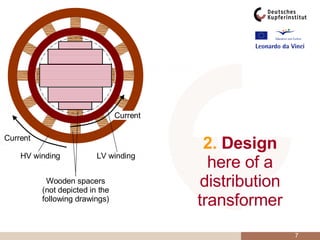
2.  Design here of a distribution transformer Wooden spacers (not depicted in the following drawings) HV winding LV winding Current Current
Yoke spanning bar Winding spanning bolts Yoke lamination spanning Wooden winding spacers HV winding Yoke lamination spanning bolts LV winding Off-load tap changer
 
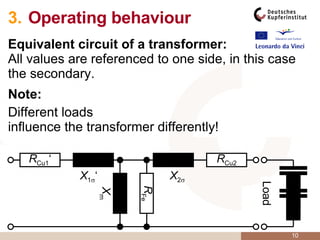
3. Operating behaviour Equivalent circuit of a transformer: All values are referenced to one side, in this case the secondary. Note: Different loads influence the transformer differently! Load R Fe X 1  ‘ X 2  X m R Cu1 ‘ R Cu2
By the way, what really is short-circuit voltage? You apply a voltage magnitude to the input side which is just enough to drive the short-circuit current in the output winding when shorted. U SC I N X m R Fe R Cu1 ‘ R Cu2 X 1  ‘ X 2  A V
By the way, what really is short-circuit power? It doesn't really exist. You multiply the no-load voltage by the short-circuit current. X m R Cu1 ‘ R Cu2 X 1  ‘ X 2  V A R Fe
R load (rated load) L load Tricky: C load Voltage across the load ( ≈ 107%!) Equivalent input voltage  U 1 ' (100%) Inductive drop  u X Ohmic drop  u R  in the trans-former Total drop  u SC  in the transformer Voltage across the load ( ≈ 94%) Equivalent input voltage  U 1 ' (100%) Inductive drop  u X Ohmic drop  u R  in the trans-former Total drop  u SC  in the transformer Voltage across the load ( ≈ 99%) Equivalent input voltage  U 1 ' (100%) Inductive drop  u X Ohmic drop  u R  in the trans-former Total drop  u SC  in the transformer Inductive drop ( u X  = 5.916%) Ohmic drop in the transformer (e. g.  u R  = 1%) Total drop inside the transformer (e. g.  u SC  = 6%)
Theoretical deduction of the load current Short circuit current  I SC =16.7* I N  16.7*rated load magnitude ( Z SC = Z load : “half a short-circuit”)  E. g. non-detuned static Var com-pensator 1670kvar on a 100kVA transformer  Rated load
Excerpt with the actually occurring values    Nennlast    Rated load
No-load current of a 16kV / 420V, 630kVA transformer, here excitated  from the low voltage side! R L ≈400m Ω R Fe  ≈400 Ω X 1  ‘ ≈12m Ω X 2  ≈12m Ω X m  >4k Ω R Cu1 ‘ ≈2m Ω R Cu2  ≈2m Ω
Vector groups Can the star point be loaded? 230V 400V
Vector groups Can the star point be loaded?    Yes Why? No   U   V W   U   V W u   v w   n   u v w n
Vector groups Can the star point be loaded? Approximate equivalent circuit of a Yyn vector group R L ≈400 m Ω R Fe  ≈400 Ω X 1  ‘ ≈12m Ω X 2  ≈12m Ω X m  >4k Ω R Cu1 ‘ ≈2m Ω R Cu2  ≈2m Ω R Fe  ≈400 Ω X 1  ‘ ≈12m Ω X 2  ≈12m Ω X m  >4k Ω R Cu1 ‘ ≈2m Ω R Cu2  ≈2m Ω L1 N L2 R L ≈ 400 Ω
Prerequisites for parallel operation: Equal voltages of windings to be paralleled, equal short-circuit voltage ratings, equal vector group figures, if input sides are not connected in parallel: Make sure the feeding grids are in phase with each other, if input sides are not connected in parallel: Make sure the feeding grids have approximately equal short-circuit powers, ratio of power ratings of units to be paralleled should be no greater than 3:1. u X  = 3.91% u R  = 0.9% u SC  = 4% u X  = 2.95% u R  = 2.7% u SC  = 4% 630 kVA transformer according to HD 428 list C 50 kVA transformer according to HD 428 list B
4. Efficiency Development of magnetic steel
Division into classes according to the present HD 428
Division into classes according to the future HD 428
 
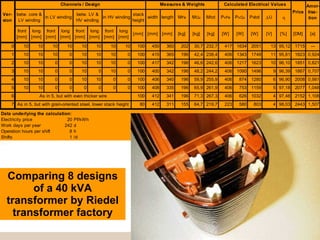
Comparing 8 designs of a 40 kVA transformer by Riedel transformer factory
 
Amorphous steel could cut the no-load losses down to a fraction However: bigger more expensive noisier
So the replacement of old transformers pays off for a variety of reasons 1958 1998 (Rauscher & Stoecklin) (ABB Sécheron SA)
No-load loss of a 400 kVA 16 kV / 400 V distribution transformer Improvement of efficiencies Load loss of a 400 kVA 16 kV / 400 V distribution transformer
5. Too hot from “hot” loads Apparent power, TRMS voltage and TRMS current within limits – and yet it ran too hot? Mutual influences between the trans-former and its load
The power loss in a transformer is: The  true  power loss in a transformer is:
“ supplementary” additional losses  in transformers can be calculated rapidly using the following two simple formulae: where: Oh well, perhaps a practical example is clearer: 1000 compact 11W (15VA) energy-saver lamps powered by a 15kVA transformer,  u SC =4%,  P ad =0.1 P Cu 81.4% etc. etc.
To some extent the transformer protects itself... Always remember: If the influence of the transformer upon the load did not exist, then the influence of the load upon the transformer would be nearly 9 times as high! 701.7% etc. etc.
A tool is available for this, too: The K Factor Calculator by www.cda.org.uk www.cda.org.uk/frontend/pubs.htm#ELECTRICAL/ENERGY%20EFFICIENCY
Deutsche Leonardo Schriften 1.1 Leitfaden Netzqualität – Einführung 1.2 Selbsthilfe-Leitfaden zur Beurteilung der Netzqualität 2.1 Kosten schlechter Netzqualität 3.1 Oberschwingungen – Ursachen und Auswirkungen 3.2.2 Echt effektiv – die einzig wahre Messung 3.3.1 Passive Filter 3.3.3 Aktive Filter 3.5.1 Auslegung des Neutralleiters in oberschwingungsreichen Anlagen 4.1 Ausfallsicherheit, Zuverlässigkeit und Redundanz 4.3.1 Verbesserung der Ausfallsicherheit durch Notstrom-Versorgung 4.5.1 Ausfallsichere und zuverlässige Stromversorgung eines modernen Bürogebäudes 5.1 Spannungseinbrüche – Einführung 5.1.3 Einführung in die Unsymmetrie 5.2.1 Vorbeugende Wartung – der Schlüssel zur Netzqualität 5.3.2 Maßnahmen gegen Spannungseinbrüche 5.5.1 Vom Umgang mit Spannungseinbrüchen – eine Fallstudie 6.1 Erdung mit System 6.3.1 »Erdungssysteme – Grundlagen der Berechnung und Auslegung
gave a total of 3 million Euros from within the framework of their LEONARDO programme to establish  the  European website dealing with  all  aspects of power quality with the help of adequate partners! Just go to www.lpqi.org from time to time and watch the  Leonardo Power Quality Initiative  growing! We want to develop and provide vocational training material on the mitigation of power quality problems in  11 languages! We address all electrical experts working in the field: Engineers, handicraftsmen, building maintenance technicians, architectural and planning consultants as well as trainers and trainees. So long, we are 86 partners from Europe, North and South America, among them commercial companies, institutes, universities and 5 national copper centres. Participation and contributions of further partners from industry and academics is possible at any time and even desired by the existing project partners. Accounting to this salient success, the project was extended by 3 ranges of topics. You can now also collect information in the areas of sustainability, decentrized energy generation and assisted living: www.leonardo-energy.org Just give us a click! The European Union 3 Projects out of about 4000 awarded – one of them was: www.lpqi.org www.leonardo-energy.org

Transformers

  • 1.
    Design, selection andoperation of distribution transformers Stefan Fassbinder Deutsches Kupferinstitut Am Bonneshof 5 D-40474 Düsseldorf Tel.: +49 211 4796-323 Fax: +49 211 4796-310 [email_address] www.kupferinstitut.de deutsch English
  • 2.
    The German CopperInstitute, DKI, is the central information and advisory service dealing with all uses of copper and copper alloys. We offer our services to: Commercial companies The skilled trades Industry R & D institutes Universities Artists and craftsmen Students Private individuals We can be contacted by: post phone fax e-mail internet online database, or personally
  • 3.
    1. Basics: “Gigantomania” or a necessity of economics? Why build power stations in such huge units that you need such big transformers?
  • 4.
    This one weighs300t and does 600MVA... ...and this one here weighs 300g and should therefore do 600VA! But in fact it only does 6VA!
  • 5.
    The coherence isgiven by an empirical formula It's a law of physics: Higher energy density in larger plant
  • 6.
    Structure of thepublic mains 0.4kV 20kV 10kV 380kV 220kV 110kV 50 Hz 3~ 27kV, nuclear 21kV, e. g. coal 10kV, e. g. hydro 0.5kV, e. g. wind
  • 7.
    2. Designhere of a distribution transformer Wooden spacers (not depicted in the following drawings) HV winding LV winding Current Current
  • 8.
    Yoke spanning barWinding spanning bolts Yoke lamination spanning Wooden winding spacers HV winding Yoke lamination spanning bolts LV winding Off-load tap changer
  • 9.
  • 10.
    3. Operating behaviourEquivalent circuit of a transformer: All values are referenced to one side, in this case the secondary. Note: Different loads influence the transformer differently! Load R Fe X 1  ‘ X 2  X m R Cu1 ‘ R Cu2
  • 11.
    By the way,what really is short-circuit voltage? You apply a voltage magnitude to the input side which is just enough to drive the short-circuit current in the output winding when shorted. U SC I N X m R Fe R Cu1 ‘ R Cu2 X 1  ‘ X 2  A V
  • 12.
    By the way,what really is short-circuit power? It doesn't really exist. You multiply the no-load voltage by the short-circuit current. X m R Cu1 ‘ R Cu2 X 1  ‘ X 2  V A R Fe
  • 13.
    R load (ratedload) L load Tricky: C load Voltage across the load ( ≈ 107%!) Equivalent input voltage U 1 ' (100%) Inductive drop u X Ohmic drop u R in the trans-former Total drop u SC in the transformer Voltage across the load ( ≈ 94%) Equivalent input voltage U 1 ' (100%) Inductive drop u X Ohmic drop u R in the trans-former Total drop u SC in the transformer Voltage across the load ( ≈ 99%) Equivalent input voltage U 1 ' (100%) Inductive drop u X Ohmic drop u R in the trans-former Total drop u SC in the transformer Inductive drop ( u X = 5.916%) Ohmic drop in the transformer (e. g. u R = 1%) Total drop inside the transformer (e. g. u SC = 6%)
  • 14.
    Theoretical deduction ofthe load current Short circuit current I SC =16.7* I N  16.7*rated load magnitude ( Z SC = Z load : “half a short-circuit”)  E. g. non-detuned static Var com-pensator 1670kvar on a 100kVA transformer  Rated load
  • 15.
    Excerpt with theactually occurring values  Nennlast  Rated load
  • 16.
    No-load current ofa 16kV / 420V, 630kVA transformer, here excitated from the low voltage side! R L ≈400m Ω R Fe ≈400 Ω X 1  ‘ ≈12m Ω X 2  ≈12m Ω X m >4k Ω R Cu1 ‘ ≈2m Ω R Cu2 ≈2m Ω
  • 17.
    Vector groups Canthe star point be loaded? 230V 400V
  • 18.
    Vector groups Canthe star point be loaded?  Yes Why? No  U V W U V W u v w n u v w n
  • 19.
    Vector groups Canthe star point be loaded? Approximate equivalent circuit of a Yyn vector group R L ≈400 m Ω R Fe ≈400 Ω X 1  ‘ ≈12m Ω X 2  ≈12m Ω X m >4k Ω R Cu1 ‘ ≈2m Ω R Cu2 ≈2m Ω R Fe ≈400 Ω X 1  ‘ ≈12m Ω X 2  ≈12m Ω X m >4k Ω R Cu1 ‘ ≈2m Ω R Cu2 ≈2m Ω L1 N L2 R L ≈ 400 Ω
  • 20.
    Prerequisites for paralleloperation: Equal voltages of windings to be paralleled, equal short-circuit voltage ratings, equal vector group figures, if input sides are not connected in parallel: Make sure the feeding grids are in phase with each other, if input sides are not connected in parallel: Make sure the feeding grids have approximately equal short-circuit powers, ratio of power ratings of units to be paralleled should be no greater than 3:1. u X = 3.91% u R = 0.9% u SC = 4% u X = 2.95% u R = 2.7% u SC = 4% 630 kVA transformer according to HD 428 list C 50 kVA transformer according to HD 428 list B
  • 21.
    4. Efficiency Developmentof magnetic steel
  • 22.
    Division into classesaccording to the present HD 428
  • 23.
    Division into classesaccording to the future HD 428
  • 24.
  • 25.
    Comparing 8 designsof a 40 kVA transformer by Riedel transformer factory
  • 26.
  • 27.
    Amorphous steel couldcut the no-load losses down to a fraction However: bigger more expensive noisier
  • 28.
    So the replacementof old transformers pays off for a variety of reasons 1958 1998 (Rauscher & Stoecklin) (ABB Sécheron SA)
  • 29.
    No-load loss ofa 400 kVA 16 kV / 400 V distribution transformer Improvement of efficiencies Load loss of a 400 kVA 16 kV / 400 V distribution transformer
  • 30.
    5. Too hotfrom “hot” loads Apparent power, TRMS voltage and TRMS current within limits – and yet it ran too hot? Mutual influences between the trans-former and its load
  • 31.
    The power lossin a transformer is: The true power loss in a transformer is:
  • 32.
    “ supplementary” additionallosses in transformers can be calculated rapidly using the following two simple formulae: where: Oh well, perhaps a practical example is clearer: 1000 compact 11W (15VA) energy-saver lamps powered by a 15kVA transformer, u SC =4%, P ad =0.1 P Cu 81.4% etc. etc.
  • 33.
    To some extentthe transformer protects itself... Always remember: If the influence of the transformer upon the load did not exist, then the influence of the load upon the transformer would be nearly 9 times as high! 701.7% etc. etc.
  • 34.
    A tool isavailable for this, too: The K Factor Calculator by www.cda.org.uk www.cda.org.uk/frontend/pubs.htm#ELECTRICAL/ENERGY%20EFFICIENCY
  • 35.
    Deutsche Leonardo Schriften1.1 Leitfaden Netzqualität – Einführung 1.2 Selbsthilfe-Leitfaden zur Beurteilung der Netzqualität 2.1 Kosten schlechter Netzqualität 3.1 Oberschwingungen – Ursachen und Auswirkungen 3.2.2 Echt effektiv – die einzig wahre Messung 3.3.1 Passive Filter 3.3.3 Aktive Filter 3.5.1 Auslegung des Neutralleiters in oberschwingungsreichen Anlagen 4.1 Ausfallsicherheit, Zuverlässigkeit und Redundanz 4.3.1 Verbesserung der Ausfallsicherheit durch Notstrom-Versorgung 4.5.1 Ausfallsichere und zuverlässige Stromversorgung eines modernen Bürogebäudes 5.1 Spannungseinbrüche – Einführung 5.1.3 Einführung in die Unsymmetrie 5.2.1 Vorbeugende Wartung – der Schlüssel zur Netzqualität 5.3.2 Maßnahmen gegen Spannungseinbrüche 5.5.1 Vom Umgang mit Spannungseinbrüchen – eine Fallstudie 6.1 Erdung mit System 6.3.1 »Erdungssysteme – Grundlagen der Berechnung und Auslegung
  • 36.
    gave a totalof 3 million Euros from within the framework of their LEONARDO programme to establish the European website dealing with all aspects of power quality with the help of adequate partners! Just go to www.lpqi.org from time to time and watch the Leonardo Power Quality Initiative growing! We want to develop and provide vocational training material on the mitigation of power quality problems in 11 languages! We address all electrical experts working in the field: Engineers, handicraftsmen, building maintenance technicians, architectural and planning consultants as well as trainers and trainees. So long, we are 86 partners from Europe, North and South America, among them commercial companies, institutes, universities and 5 national copper centres. Participation and contributions of further partners from industry and academics is possible at any time and even desired by the existing project partners. Accounting to this salient success, the project was extended by 3 ranges of topics. You can now also collect information in the areas of sustainability, decentrized energy generation and assisted living: www.leonardo-energy.org Just give us a click! The European Union 3 Projects out of about 4000 awarded – one of them was: www.lpqi.org www.leonardo-energy.org

Editor's Notes

  • #2 The German Copper Institute, DKI, welcomes you to this presentation “ Design, selection and operation of distribution transformers ”. It is written by Stefan Fassbinder, DKI’s Technical Director and is narrated by Jonathan Manson on behalf of the European Copper Institute. It is one of a series of Webcasts presented by the Leonardo Energy Academy that is dedicated to building a library of materials addressing contemporary electrical energy issues. Full details of this library and how to subscribe free to it are given at the end of this presentation.