Comparative Efficiency Measurements
on Permanent Magnet Synchronous Motors
and Cast Copper Cage Induction Motors
Stefan Fassbinder, Richard deFay
Just a moment, please!
What is it saying there again?
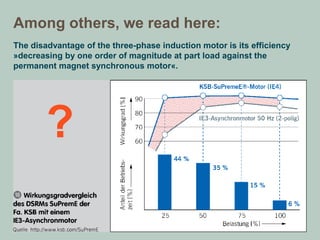
Among others, we read here:
The disadvantage of the three-phase induction motor is its efficiency
»decreasing by one order of magnitude at part load against the
permanent magnet synchronous motor«.
?
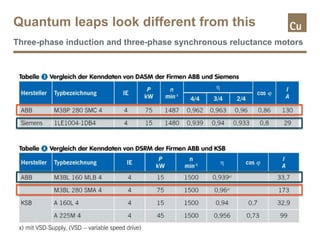
Quantum leaps look different from this
Isn‘t it miraculous? Motors of equal efficiency classes perform equally
Quantum leaps look different from this
Three-phase induction and three-phase synchronous reluctance motors
»The efficiencies of induction motors
drop at part load«
At half load, the efficiency of an induction motor from said publication
drops
from 96.2% to 96.0% (75 kW) or
from 93.9% to 93.3% (30 kW), respectively.
At half load, the efficiency of a synchronous reluctance motor from the
same publication drops
from 93.3% to 93.1% (30 kW).
It is always mentioned which type of inverter is used.
Not however whether it was included in the measurement.
The author is reluctant to send a statement »due to time issues«.
The editor feels embarrassed:
»This will peter out open-ended«.
Now what really is »part load«?
Argument:
»Permanent magnet synchronous motors do not require any additional
energy for excitation«.
However:
Permanent magnet synchronous motors are several times over-excited
at high speed and low torque and hence require active field weakening
in this operating mode.
Our US colleagues
wanted to know precisely what we are at
Copper Develompment Associacion USA Inc
www.copperalliance.us, Richard deFay
commissioned
Advanced Energy Inc.
to measure the efficiencies of some
Permanent magnet synchronous motors
compared to
induction motors with squirrel cages cast of copper.
What was measured?
Available samples were:
3 permanent magnet synchronous motors and
1 asynchronous motor with squirrel cage cast from copper at
5.0 Hp (3.7 kW),
7.5 Hp (5.5 kW),
10.0 Hp (7.5 kW),
20.0 Hp (15.0 kW),
respectively.
For each synchronous motor an inverter »as recommended by the
manufacturer« was procured.
The asynchronous motors were measured with 2 or 3 different
»adequate« inverters each.
The overall systems efficiencies of these circuits were measured.
The difficulties began right from the start
when purchasing the samples
Copper rotor motors
were available off the shelf.
Permanent magnet motors
were assembled on
commission only.
P 2N Motor No. Price Lead time
Copper rotor motor 399.85 $ few days
Sync. PM motor 3 1432.32 $ 10 days
Sync. PM motor 4 1029.23 $ 14 weeks
Sync. PM motor 5 1587.51 $ 18 weeks
Copper rotor motor 565.85 $
Sync. PM motor 12 –
Sync. PM motor 14 1097.95 $
Sync. PM motor 15 893.15 $
Copper rotor motor 866.71 $ few days
Sync. PM motor 21 4414.95 $ 10 days
Sync. PM motor 24 1415.02 $ 8 weeks
Sync. PM motor 23 1823.29 $ 14 weeks
Copper rotor motor 1372.48 $ few days
Sync. PM motor 31 5427.58 $
Sync. PM motor 34 2035.47 $
Sync. PM motor 35 –
5.0 hp
7.5 hp
10.0 hp
20.0 hp 1 week to
16 weeks
70%
75%
80%
85%
90%
95%
100%
900/min 1200/min 1500/min 1800/min
η→
n →
5 Hp motors; 25% torque
Copper rotor with inverter 2
Copper rotor with inverter 3
PM motor 3 with inverter 2
PM motor 4 with inverter 2
PM motor 5 with inverter 3
3.7 kW motors
70%
75%
80%
85%
90%
95%
100%
900/min 1200/min 1500/min 1800/min
η→
n →
5 Hp motors; 50% torque
Copper rotor with inverter 2
Copper rotor with inverter 3
PM motor 3 with inverter 2
PM motor 4 with inverter 2
PM motor 5 with inverter 3
3.7 kW motors
70%
75%
80%
85%
90%
95%
100%
900/min 1200/min 1500/min 1800/min
η→
n →
5 Hp motors; 75% torque
Copper rotor with inverter 2
Copper rotor with inverter 3
PM motor 3 with inverter 2
PM motor 4 with inverter 2
PM motor 5 with inverter 3
3.7 kW motors
70%
75%
80%
85%
90%
95%
100%
900/min 1200/min 1500/min 1800/min
η→
n →
5 Hp motors; 100% torque
Copper rotor with inverter 2
Copper rotor with inverter 3
PM motor 3 with inverter 2
PM motor 4 with inverter 2
PM motor 5 with inverter 3
3.7 kW motors
70%
75%
80%
85%
90%
95%
100%
900/min 1200/min 1500/min 1800/min
η→
n →
5 Hp motors; 110% torque
Copper rotor with inverter 2
Copper rotor with inverter 3
PM motor 3 with inverter 2
PM motor 4 with inverter 2
PM motor 5 with inverter 3
3.7 kW motors
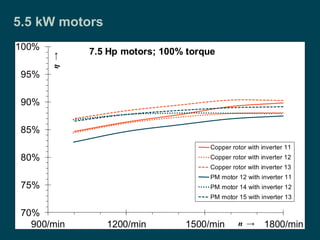
5.5 kW motors
70%
75%
80%
85%
90%
95%
100%
900/min 1200/min 1500/min 1800/min
η→
n →
7.5 Hp motors; 25% torque
Copper rotor with inverter 11
Copper rotor with inverter 12
Copper rotor with inverter 13
PM motor 12 with inverter 11
PM motor 23 with inverter 22
PM motor 15 with inverter 13
5.5 kW motors
70%
75%
80%
85%
90%
95%
100%
900/min 1200/min 1500/min 1800/min
η→
n →
7.5 Hp motors; 50% torque
Copper rotor with inverter 11
Copper rotor with inverter 12
Copper rotor with inverter 13
PM motor 12 with inverter 11
PM motor 14 with inverter 12
PM motor 15 with inverter 13
5.5 kW motors
70%
75%
80%
85%
90%
95%
100%
900/min 1200/min 1500/min 1800/min
η→
n →
7.5 Hp motors; 75% torque
Copper rotor with inverter 11
Copper rotor with inverter 12
Copper rotor with inverter 13
PM motor 12 with inverter 11
PM motor 14 with inverter 12
PM motor 15 with inverter 13
5.5 kW motors
70%
75%
80%
85%
90%
95%
100%
900/min 1200/min 1500/min 1800/min
η→
n →
7.5 Hp motors; 100% torque
Copper rotor with inverter 11
Copper rotor with inverter 12
Copper rotor with inverter 13
PM motor 12 with inverter 11
PM motor 14 with inverter 12
PM motor 15 with inverter 13
5.5 kW motors
70%
75%
80%
85%
90%
95%
100%
900/min 1200/min 1500/min 1800/min
η→
n →
7.5 Hp motors; 110% torque
Copper rotor with inverter 11
Copper rotor with inverter 12
Copper rotor with inverter 13
PM motor 12 with inverter 11
PM motor 14 with inverter 12
PM motor 15 with inverter 13
70%
75%
80%
85%
90%
95%
100%
900/min 1200/min 1500/min 1800/min
η→
n →
10 Hp motors; 25% torque
Copper rotor with inverter 24
Copper rotor with inverter 22
PM motor 21 with inverter 24
PM motor 24 with inverter 22
PM motor 23 with inverter 22
7.5 kW motors
70%
75%
80%
85%
90%
95%
100%
900/min 1200/min 1500/min 1800/min
η→
n →
10 Hp motors; 50% torque
Copper rotor with inverter 24
Copper rotor with inverter 22
PM motor 21 with inverter 24
PM motor 24 with inverter 22
PM motor 23 with inverter 22
7.5 kW motors
70%
75%
80%
85%
90%
95%
100%
900/min 1200/min 1500/min 1800/min
η→
n →
10 Hp motors; 75% torque
Copper rotor with inverter 24
Copper rotor with inverter 22
PM motor 21 with inverter 24
PM motor 24 with inverter 22
PM motor 23 with inverter 22
7.5 kW motors
70%
75%
80%
85%
90%
95%
100%
900/min 1200/min 1500/min 1800/min
η→
n →
10 Hp motors; 100% torque
Copper rotor with inverter 24
Copper rotor with inverter 22
PM motor 21 with inverter 24
PM motor 24 with inverter 22
PM motor 23 with inverter 22
7.5 kW motors
70%
75%
80%
85%
90%
95%
100%
900/min 1200/min 1500/min 1800/min
η→
n →
10 Hp motors; 110% torque
Copper rotor with inverter 24
Copper rotor with inverter 22
PM motor 21 with inverter 24
PM motor 24 with inverter 22
PM motor 23 with inverter 22
7.5 kW motors
70%
75%
80%
85%
90%
95%
100%
900/min 1200/min 1500/min 1800/min
η→
n →
20 Hp motors; 25% torque
Copper rotor with inverter 34
Copper rotor with inverter 32
Copper rotor with inverter 33
PM motor 31 with inverter 34
PM motor 34 with inverter 32
PM motor 35 with inverter 33
15 kW motors
70%
75%
80%
85%
90%
95%
100%
900/min 1200/min 1500/min 1800/min
η→
n →
20 Hp motors; 50% torque
Copper rotor with inverter 34
Copper rotor with inverter 32
Copper rotor with inverter 33
PM motor 31 with inverter 34
PM motor 34 with inverter 32
PM motor 35 with inverter 33
15 kW motors
70%
75%
80%
85%
90%
95%
100%
900/min 1200/min 1500/min 1800/min
η→
n →
20 Hp motors; 75% torque
Copper rotor with inverter 34
Copper rotor with inverter 32
Copper rotor with inverter 33
PM motor 31 with inverter 34
PM motor 34 with inverter 32
PM motor 35 with inverter 33
15 kW motors
70%
75%
80%
85%
90%
95%
100%
900/min 1200/min 1500/min 1800/min
η→
n →
20 Hp motors; 100% torque
Copper rotor with inverter 34
Copper rotor with inverter 32
Copper rotor with inverter 33
PM motor 31 with inverter 34
PM motor 34 with inverter 32
PM motor 35 with inverter 33
15 kW motors
70%
75%
80%
85%
90%
95%
100%
900/min 1200/min 1500/min 1800/min
η→
n →
20 Hp motors; 110% torque
Copper rotor with inverter 34
Copper rotor with inverter 32
Copper rotor with inverter 33
PM motor 31 with inverter 34
PM motor 34 with inverter 32
PM motor 35 with inverter 33
15 kW motors
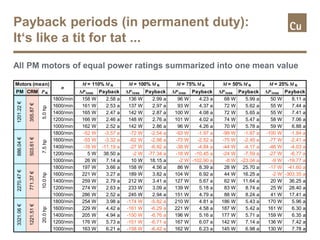
Payback periods (in permanent duty):
It‘s like a tit for tat ...
All PM motors of equal power ratings summarized into one mean value
Motors (mean) M = 110% M N M = 100% M N M = 75% M N M = 50% M N M = 25% M N
PM CRM P N ΔP loss Payback ΔP loss Payback ΔP loss Payback ΔP loss Payback ΔP loss Payback
1800/min 158 W 2.58 a 136 W 2.99 a 96 W 4.23 a 68 W 5.99 a 50 W 8.11 a
1600/min 161 W 2.53 a 137 W 2.97 a 93 W 4.37 a 72 W 5.62 a 55 W 7.44 a
1400/min 165 W 2.47 a 142 W 2.87 a 100 W 4.08 a 72 W 5.65 a 55 W 7.41 a
1200/min 166 W 2.46 a 148 W 2.76 a 101 W 4.02 a 74 W 5.47 a 58 W 7.06 a
1000/min 162 W 2.52 a 142 W 2.86 a 96 W 4.26 a 70 W 5.78 a 59 W 6.88 a
1800/min -52 W -3.57 a -72 W -2.54 a -93 W -1.97 a -99 W -1.87 a -100 W -1.84 a
1600/min -55 W -3.32 a -62 W -2.98 a -73 W -2.52 a -75 W -2.45 a -77 W -2.41 a
1400/min -16 W -11.19 a -27 W -6.92 a -38 W -4.84 a -44 W -4.17 a -46 W -4.03 a
1200/min 5 W 38.50 a -2 W -77.34 a -18 W -10.45 a -24 W -7.59 a -27 W -6.77 a
1000/min 26 W 7.14 a 10 W 18.15 a -2 W -102.90 a -8 W -23.04 a -9 W -19.77 a
1800/min 197 W 3.66 a 158 W 4.56 a 86 W 8.39 a 28 W 25.70 a -17 W -41.60 a
1600/min 221 W 3.27 a 189 W 3.82 a 104 W 6.92 a 44 W 16.25 a -2 W -303.35 a
1400/min 259 W 2.79 a 212 W 3.41 a 127 W 5.67 a 62 W 11.64 a 20 W 36.25 a
1200/min 274 W 2.63 a 233 W 3.09 a 139 W 5.18 a 83 W 8.74 a 25 W 28.40 a
1000/min 286 W 2.52 a 245 W 2.94 a 151 W 4.79 a 88 W 8.24 a 41 W 17.41 a
1800/min 254 W 3.98 a -174 W -5.82 a 210 W 4.81 a 186 W 5.43 a 170 W 5.96 a
1600/min 229 W 4.42 a -161 W -6.29 a 221 W 4.58 a 187 W 5.42 a 161 W 6.30 a
1400/min 205 W 4.94 a -150 W -6.76 a 196 W 5.16 a 177 W 5.71 a 159 W 6.35 a
1200/min 176 W 5.73 a -151 W -6.71 a 167 W 6.07 a 142 W 7.14 a 136 W 7.42 a
1000/min 163 W 6.21 a -158 W -6.42 a 162 W 6.23 a 145 W 6.98 a 130 W 7.78 a
n
1201.22€
355.87€
5.0hp
886.04€
503.61€
7.5hp
2270.47€
771.37€
10.0hp
3321.06€
1221.51€
20.0hp
Also the copper rotor facilitates
• efficieny class IE4
• smaller dimensions
and is
• just as robust
• and approximately as inexpensive
as asynchronous motors have ever been.
Comparing the cutting edge model of one technology to the average one
of another technology is a common means of PR when targeting at
higher sales figures.
But not a good one.

Electric Motors Efficiency Comparison

  • 1.
    Comparative Efficiency Measurements onPermanent Magnet Synchronous Motors and Cast Copper Cage Induction Motors Stefan Fassbinder, Richard deFay
  • 2.
    Just a moment,please! What is it saying there again?
  • 3.
    Among others, weread here: The disadvantage of the three-phase induction motor is its efficiency »decreasing by one order of magnitude at part load against the permanent magnet synchronous motor«. ?
  • 4.
    Quantum leaps lookdifferent from this Isn‘t it miraculous? Motors of equal efficiency classes perform equally
  • 5.
    Quantum leaps lookdifferent from this Three-phase induction and three-phase synchronous reluctance motors
  • 6.
    »The efficiencies ofinduction motors drop at part load« At half load, the efficiency of an induction motor from said publication drops from 96.2% to 96.0% (75 kW) or from 93.9% to 93.3% (30 kW), respectively. At half load, the efficiency of a synchronous reluctance motor from the same publication drops from 93.3% to 93.1% (30 kW). It is always mentioned which type of inverter is used. Not however whether it was included in the measurement. The author is reluctant to send a statement »due to time issues«. The editor feels embarrassed: »This will peter out open-ended«.
  • 7.
    Now what reallyis »part load«? Argument: »Permanent magnet synchronous motors do not require any additional energy for excitation«. However: Permanent magnet synchronous motors are several times over-excited at high speed and low torque and hence require active field weakening in this operating mode.
  • 8.
    Our US colleagues wantedto know precisely what we are at Copper Develompment Associacion USA Inc www.copperalliance.us, Richard deFay commissioned Advanced Energy Inc. to measure the efficiencies of some Permanent magnet synchronous motors compared to induction motors with squirrel cages cast of copper.
  • 9.
    What was measured? Availablesamples were: 3 permanent magnet synchronous motors and 1 asynchronous motor with squirrel cage cast from copper at 5.0 Hp (3.7 kW), 7.5 Hp (5.5 kW), 10.0 Hp (7.5 kW), 20.0 Hp (15.0 kW), respectively. For each synchronous motor an inverter »as recommended by the manufacturer« was procured. The asynchronous motors were measured with 2 or 3 different »adequate« inverters each. The overall systems efficiencies of these circuits were measured.
  • 10.
    The difficulties beganright from the start when purchasing the samples Copper rotor motors were available off the shelf. Permanent magnet motors were assembled on commission only. P 2N Motor No. Price Lead time Copper rotor motor 399.85 $ few days Sync. PM motor 3 1432.32 $ 10 days Sync. PM motor 4 1029.23 $ 14 weeks Sync. PM motor 5 1587.51 $ 18 weeks Copper rotor motor 565.85 $ Sync. PM motor 12 – Sync. PM motor 14 1097.95 $ Sync. PM motor 15 893.15 $ Copper rotor motor 866.71 $ few days Sync. PM motor 21 4414.95 $ 10 days Sync. PM motor 24 1415.02 $ 8 weeks Sync. PM motor 23 1823.29 $ 14 weeks Copper rotor motor 1372.48 $ few days Sync. PM motor 31 5427.58 $ Sync. PM motor 34 2035.47 $ Sync. PM motor 35 – 5.0 hp 7.5 hp 10.0 hp 20.0 hp 1 week to 16 weeks
  • 11.
    70% 75% 80% 85% 90% 95% 100% 900/min 1200/min 1500/min1800/min η→ n → 5 Hp motors; 25% torque Copper rotor with inverter 2 Copper rotor with inverter 3 PM motor 3 with inverter 2 PM motor 4 with inverter 2 PM motor 5 with inverter 3 3.7 kW motors
  • 12.
    70% 75% 80% 85% 90% 95% 100% 900/min 1200/min 1500/min1800/min η→ n → 5 Hp motors; 50% torque Copper rotor with inverter 2 Copper rotor with inverter 3 PM motor 3 with inverter 2 PM motor 4 with inverter 2 PM motor 5 with inverter 3 3.7 kW motors
  • 13.
    70% 75% 80% 85% 90% 95% 100% 900/min 1200/min 1500/min1800/min η→ n → 5 Hp motors; 75% torque Copper rotor with inverter 2 Copper rotor with inverter 3 PM motor 3 with inverter 2 PM motor 4 with inverter 2 PM motor 5 with inverter 3 3.7 kW motors
  • 14.
    70% 75% 80% 85% 90% 95% 100% 900/min 1200/min 1500/min1800/min η→ n → 5 Hp motors; 100% torque Copper rotor with inverter 2 Copper rotor with inverter 3 PM motor 3 with inverter 2 PM motor 4 with inverter 2 PM motor 5 with inverter 3 3.7 kW motors
  • 15.
    70% 75% 80% 85% 90% 95% 100% 900/min 1200/min 1500/min1800/min η→ n → 5 Hp motors; 110% torque Copper rotor with inverter 2 Copper rotor with inverter 3 PM motor 3 with inverter 2 PM motor 4 with inverter 2 PM motor 5 with inverter 3 3.7 kW motors
  • 16.
    5.5 kW motors 70% 75% 80% 85% 90% 95% 100% 900/min1200/min 1500/min 1800/min η→ n → 7.5 Hp motors; 25% torque Copper rotor with inverter 11 Copper rotor with inverter 12 Copper rotor with inverter 13 PM motor 12 with inverter 11 PM motor 23 with inverter 22 PM motor 15 with inverter 13
  • 17.
    5.5 kW motors 70% 75% 80% 85% 90% 95% 100% 900/min1200/min 1500/min 1800/min η→ n → 7.5 Hp motors; 50% torque Copper rotor with inverter 11 Copper rotor with inverter 12 Copper rotor with inverter 13 PM motor 12 with inverter 11 PM motor 14 with inverter 12 PM motor 15 with inverter 13
  • 18.
    5.5 kW motors 70% 75% 80% 85% 90% 95% 100% 900/min1200/min 1500/min 1800/min η→ n → 7.5 Hp motors; 75% torque Copper rotor with inverter 11 Copper rotor with inverter 12 Copper rotor with inverter 13 PM motor 12 with inverter 11 PM motor 14 with inverter 12 PM motor 15 with inverter 13
  • 19.
    5.5 kW motors 70% 75% 80% 85% 90% 95% 100% 900/min1200/min 1500/min 1800/min η→ n → 7.5 Hp motors; 100% torque Copper rotor with inverter 11 Copper rotor with inverter 12 Copper rotor with inverter 13 PM motor 12 with inverter 11 PM motor 14 with inverter 12 PM motor 15 with inverter 13
  • 20.
    5.5 kW motors 70% 75% 80% 85% 90% 95% 100% 900/min1200/min 1500/min 1800/min η→ n → 7.5 Hp motors; 110% torque Copper rotor with inverter 11 Copper rotor with inverter 12 Copper rotor with inverter 13 PM motor 12 with inverter 11 PM motor 14 with inverter 12 PM motor 15 with inverter 13
  • 21.
    70% 75% 80% 85% 90% 95% 100% 900/min 1200/min 1500/min1800/min η→ n → 10 Hp motors; 25% torque Copper rotor with inverter 24 Copper rotor with inverter 22 PM motor 21 with inverter 24 PM motor 24 with inverter 22 PM motor 23 with inverter 22 7.5 kW motors
  • 22.
    70% 75% 80% 85% 90% 95% 100% 900/min 1200/min 1500/min1800/min η→ n → 10 Hp motors; 50% torque Copper rotor with inverter 24 Copper rotor with inverter 22 PM motor 21 with inverter 24 PM motor 24 with inverter 22 PM motor 23 with inverter 22 7.5 kW motors
  • 23.
    70% 75% 80% 85% 90% 95% 100% 900/min 1200/min 1500/min1800/min η→ n → 10 Hp motors; 75% torque Copper rotor with inverter 24 Copper rotor with inverter 22 PM motor 21 with inverter 24 PM motor 24 with inverter 22 PM motor 23 with inverter 22 7.5 kW motors
  • 24.
    70% 75% 80% 85% 90% 95% 100% 900/min 1200/min 1500/min1800/min η→ n → 10 Hp motors; 100% torque Copper rotor with inverter 24 Copper rotor with inverter 22 PM motor 21 with inverter 24 PM motor 24 with inverter 22 PM motor 23 with inverter 22 7.5 kW motors
  • 25.
    70% 75% 80% 85% 90% 95% 100% 900/min 1200/min 1500/min1800/min η→ n → 10 Hp motors; 110% torque Copper rotor with inverter 24 Copper rotor with inverter 22 PM motor 21 with inverter 24 PM motor 24 with inverter 22 PM motor 23 with inverter 22 7.5 kW motors
  • 26.
    70% 75% 80% 85% 90% 95% 100% 900/min 1200/min 1500/min1800/min η→ n → 20 Hp motors; 25% torque Copper rotor with inverter 34 Copper rotor with inverter 32 Copper rotor with inverter 33 PM motor 31 with inverter 34 PM motor 34 with inverter 32 PM motor 35 with inverter 33 15 kW motors
  • 27.
    70% 75% 80% 85% 90% 95% 100% 900/min 1200/min 1500/min1800/min η→ n → 20 Hp motors; 50% torque Copper rotor with inverter 34 Copper rotor with inverter 32 Copper rotor with inverter 33 PM motor 31 with inverter 34 PM motor 34 with inverter 32 PM motor 35 with inverter 33 15 kW motors
  • 28.
    70% 75% 80% 85% 90% 95% 100% 900/min 1200/min 1500/min1800/min η→ n → 20 Hp motors; 75% torque Copper rotor with inverter 34 Copper rotor with inverter 32 Copper rotor with inverter 33 PM motor 31 with inverter 34 PM motor 34 with inverter 32 PM motor 35 with inverter 33 15 kW motors
  • 29.
    70% 75% 80% 85% 90% 95% 100% 900/min 1200/min 1500/min1800/min η→ n → 20 Hp motors; 100% torque Copper rotor with inverter 34 Copper rotor with inverter 32 Copper rotor with inverter 33 PM motor 31 with inverter 34 PM motor 34 with inverter 32 PM motor 35 with inverter 33 15 kW motors
  • 30.
    70% 75% 80% 85% 90% 95% 100% 900/min 1200/min 1500/min1800/min η→ n → 20 Hp motors; 110% torque Copper rotor with inverter 34 Copper rotor with inverter 32 Copper rotor with inverter 33 PM motor 31 with inverter 34 PM motor 34 with inverter 32 PM motor 35 with inverter 33 15 kW motors
  • 31.
    Payback periods (inpermanent duty): It‘s like a tit for tat ... All PM motors of equal power ratings summarized into one mean value Motors (mean) M = 110% M N M = 100% M N M = 75% M N M = 50% M N M = 25% M N PM CRM P N ΔP loss Payback ΔP loss Payback ΔP loss Payback ΔP loss Payback ΔP loss Payback 1800/min 158 W 2.58 a 136 W 2.99 a 96 W 4.23 a 68 W 5.99 a 50 W 8.11 a 1600/min 161 W 2.53 a 137 W 2.97 a 93 W 4.37 a 72 W 5.62 a 55 W 7.44 a 1400/min 165 W 2.47 a 142 W 2.87 a 100 W 4.08 a 72 W 5.65 a 55 W 7.41 a 1200/min 166 W 2.46 a 148 W 2.76 a 101 W 4.02 a 74 W 5.47 a 58 W 7.06 a 1000/min 162 W 2.52 a 142 W 2.86 a 96 W 4.26 a 70 W 5.78 a 59 W 6.88 a 1800/min -52 W -3.57 a -72 W -2.54 a -93 W -1.97 a -99 W -1.87 a -100 W -1.84 a 1600/min -55 W -3.32 a -62 W -2.98 a -73 W -2.52 a -75 W -2.45 a -77 W -2.41 a 1400/min -16 W -11.19 a -27 W -6.92 a -38 W -4.84 a -44 W -4.17 a -46 W -4.03 a 1200/min 5 W 38.50 a -2 W -77.34 a -18 W -10.45 a -24 W -7.59 a -27 W -6.77 a 1000/min 26 W 7.14 a 10 W 18.15 a -2 W -102.90 a -8 W -23.04 a -9 W -19.77 a 1800/min 197 W 3.66 a 158 W 4.56 a 86 W 8.39 a 28 W 25.70 a -17 W -41.60 a 1600/min 221 W 3.27 a 189 W 3.82 a 104 W 6.92 a 44 W 16.25 a -2 W -303.35 a 1400/min 259 W 2.79 a 212 W 3.41 a 127 W 5.67 a 62 W 11.64 a 20 W 36.25 a 1200/min 274 W 2.63 a 233 W 3.09 a 139 W 5.18 a 83 W 8.74 a 25 W 28.40 a 1000/min 286 W 2.52 a 245 W 2.94 a 151 W 4.79 a 88 W 8.24 a 41 W 17.41 a 1800/min 254 W 3.98 a -174 W -5.82 a 210 W 4.81 a 186 W 5.43 a 170 W 5.96 a 1600/min 229 W 4.42 a -161 W -6.29 a 221 W 4.58 a 187 W 5.42 a 161 W 6.30 a 1400/min 205 W 4.94 a -150 W -6.76 a 196 W 5.16 a 177 W 5.71 a 159 W 6.35 a 1200/min 176 W 5.73 a -151 W -6.71 a 167 W 6.07 a 142 W 7.14 a 136 W 7.42 a 1000/min 163 W 6.21 a -158 W -6.42 a 162 W 6.23 a 145 W 6.98 a 130 W 7.78 a n 1201.22€ 355.87€ 5.0hp 886.04€ 503.61€ 7.5hp 2270.47€ 771.37€ 10.0hp 3321.06€ 1221.51€ 20.0hp
  • 32.
    Also the copperrotor facilitates • efficieny class IE4 • smaller dimensions and is • just as robust • and approximately as inexpensive as asynchronous motors have ever been. Comparing the cutting edge model of one technology to the average one of another technology is a common means of PR when targeting at higher sales figures. But not a good one.