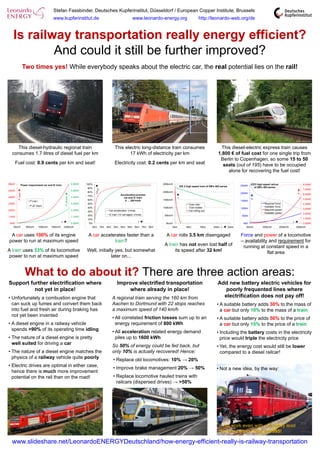
Stefan Fassbinder, Deutsches Kupferinstitut, Düsseldorf / European Copper Institute, Brusselswww.kupferinstitut.dewww.leonardo-energy.orghttp://leonardo-web.org/deIs railway transportation really energy efficient?And could it still be further improved?Two times yes!While everybody speaks about the electric car, the real potential lies on the rail!This diesel-hydraulic regional train consumes 1.7 litres of diesel fuel per kmFuel cost: 0.9 cents per km and seat!This electric long-distance train consumes17 kWh of electricity per kmElectricity cost: 0.2 cents per km and seatThis diesel-electric express train causes 1,800 € of fuel cost for one single trip from Berlin to Copenhagen, so some 15 to 50 seats (out of 195) have to be occupied alone for recovering the fuel cost!A car uses 100% of its engine power to run at maximum speedA train uses 33% of its locomotive power to run at maximum speedA car accelerates faster than a train?Well, initially yes, but somewhat later on...A car rolls 3.5 km disengagedA train has not even lost half of its speed after 32 km!Force and power of a locomotive – availability and requirement for running at constant speed in a flat areaWhat to do about it? There are three action areas:Add new battery electric vehicles for poorly frequented lines where electrification does not pay off!A suitable battery adds 30% to the mass of a car but only 10% to the mass of a train

Railway efficiency poster

  • 1.
    Stefan Fassbinder, DeutschesKupferinstitut, Düsseldorf / European Copper Institute, Brusselswww.kupferinstitut.dewww.leonardo-energy.orghttp://leonardo-web.org/deIs railway transportation really energy efficient?And could it still be further improved?Two times yes!While everybody speaks about the electric car, the real potential lies on the rail!This diesel-hydraulic regional train consumes 1.7 litres of diesel fuel per kmFuel cost: 0.9 cents per km and seat!This electric long-distance train consumes17 kWh of electricity per kmElectricity cost: 0.2 cents per km and seatThis diesel-electric express train causes 1,800 € of fuel cost for one single trip from Berlin to Copenhagen, so some 15 to 50 seats (out of 195) have to be occupied alone for recovering the fuel cost!A car uses 100% of its engine power to run at maximum speedA train uses 33% of its locomotive power to run at maximum speedA car accelerates faster than a train?Well, initially yes, but somewhat later on...A car rolls 3.5 km disengagedA train has not even lost half of its speed after 32 km!Force and power of a locomotive – availability and requirement for running at constant speed in a flat areaWhat to do about it? There are three action areas:Add new battery electric vehicles for poorly frequented lines where electrification does not pay off!A suitable battery adds 30% to the mass of a car but only 10% to the mass of a train