Presented by: Charizza M. Javier
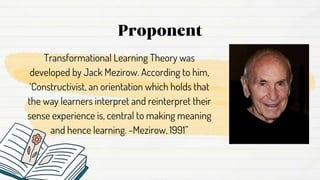
Transformational Learning Theory was
developed by Jack Mezirow. According to him,
‘Constructivist, an orientation which holds that
the way learners interpret and reinterpret their
sense experience is, central to making meaning
and hence learning. -Mezirow, 1991”
• According to Mezirow, 1996, transformative
learning is the process of constructing new
interpretation of meaning of an individual’s
experience to guide future action using a prior
interpretation.
• Example: Students learning world religions,
and the teacher intriduces literature and
articles that discuss different religions, that
helps them gain new idea and understanding.
• Instrumental Learning
• Communicative Learning
•
This learning focuses on task-oriented problems and
determination of cause and effect relationships.
In instrumental learning, a response is associated with a
stimulus that follows it—the instrumental response is
associated with the reward once they have been
matched repeatedly.
•
This is also a type of learning which behaviors are
strengthened or weakened by their consequences.
•
Example:
• Your parents gave you reward after getting perfect
score in exam which requires to study hard, as a
result, you study harder to get more rewards.
•
Example:
2. In an experiment known as the “Skinner box,” Skinner
placed a rat in a box with a lever that released food into the
box. After the rat accidentally hit the lever enough times, it
ultimately learned that its behavior (pulling the lever) led to
a specific consequence (receiving food).
(Operant Conditioning)
This learning focuses on achieving coherence rather than
exercising more effective control over cause and effect
relationship to improve performance.
It is more about understanding the meaning of what
others communicate, concerning values, ideals, feelings
moral decisions, and other concepts like freedom love,
and etc.
Examples:
Students participating in a role play where they have
specific roles that interact using real-life situations such as
shopkeeper and customer in order to achieve
communicative goal, like having complaints or shopkeeper’s
marketing strategy to pursue customer
to buy the item.
Examples:
Talk show interview that discusses, for example, their love
for mobile games, insights about specific idea or topic which
connotes real-life situations.
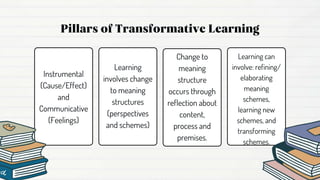
Instrumental
(Cause/Effect)
and
Communicative
(Feelings)
Learning
involves change
to meaning
structures
(perspectives
and schemes)
Change to
meaning
structure
occurs through
reflection about
content,
process and
premises.
Learning can
involve: refining/
elaborating
meaning
schemes,
learning new
schemes, and
transforming
schemes.
Transformative Learning - Charizza M. Javier.pptx

Transformative Learning - Charizza M. Javier.pptx

  • 1.
  • 2.
    Transformational Learning Theorywas developed by Jack Mezirow. According to him, ‘Constructivist, an orientation which holds that the way learners interpret and reinterpret their sense experience is, central to making meaning and hence learning. -Mezirow, 1991”
  • 3.
    • According toMezirow, 1996, transformative learning is the process of constructing new interpretation of meaning of an individual’s experience to guide future action using a prior interpretation.
  • 4.
    • Example: Studentslearning world religions, and the teacher intriduces literature and articles that discuss different religions, that helps them gain new idea and understanding.
  • 5.
    • Instrumental Learning •Communicative Learning
  • 6.
    • This learning focuseson task-oriented problems and determination of cause and effect relationships. In instrumental learning, a response is associated with a stimulus that follows it—the instrumental response is associated with the reward once they have been matched repeatedly.
  • 7.
    • This is alsoa type of learning which behaviors are strengthened or weakened by their consequences.
  • 8.
    • Example: • Your parentsgave you reward after getting perfect score in exam which requires to study hard, as a result, you study harder to get more rewards.
  • 9.
    • Example: 2. In anexperiment known as the “Skinner box,” Skinner placed a rat in a box with a lever that released food into the box. After the rat accidentally hit the lever enough times, it ultimately learned that its behavior (pulling the lever) led to a specific consequence (receiving food). (Operant Conditioning)
  • 10.
    This learning focuseson achieving coherence rather than exercising more effective control over cause and effect relationship to improve performance. It is more about understanding the meaning of what others communicate, concerning values, ideals, feelings moral decisions, and other concepts like freedom love, and etc.
  • 11.
    Examples: Students participating ina role play where they have specific roles that interact using real-life situations such as shopkeeper and customer in order to achieve communicative goal, like having complaints or shopkeeper’s marketing strategy to pursue customer to buy the item.
  • 12.
    Examples: Talk show interviewthat discusses, for example, their love for mobile games, insights about specific idea or topic which connotes real-life situations.
  • 13.
    Instrumental (Cause/Effect) and Communicative (Feelings) Learning involves change to meaning structures (perspectives andschemes) Change to meaning structure occurs through reflection about content, process and premises. Learning can involve: refining/ elaborating meaning schemes, learning new schemes, and transforming schemes.

Editor's Notes