Transferring learning from the
classroom to the workplace
Richard Fryer
Group Manager, Organisational Effectiveness
Focus of this session
•

Explore the relationship between learning investment
and business impact

•

Explore the merits of centring development around
mindset rather than skill

•

Look at a case study of mindset-based learning at
Energex
• Electricity distribution services to SEQ
• Government Owned Corporation
• Regulated by the Australian Energy Regulator (AER)
• c.3,800 employees
• Mixture of white and blue collar within workforce
• Approximately 550 leaders
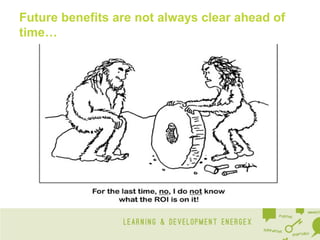
Future benefits are not always clear ahead of
time…
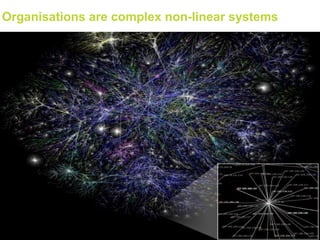
Organisations are complex non-linear systems
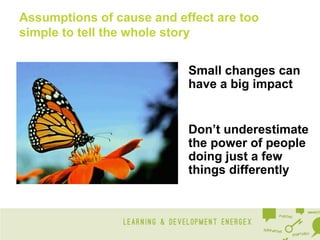
Assumptions of cause and effect are too
simple to tell the whole story
Small changes can
have a big impact

Don’t underestimate
the power of people
doing just a few
things differently
Learning is a social process
It occurs naturally and continually through collaborative
activities, rather than through discreet events (i.e. courses)

Learning in the workplace (or as close to it as possible) is
the most effective way of ensuring application of knowledge

People have to want to learn, therefore mindset is the key
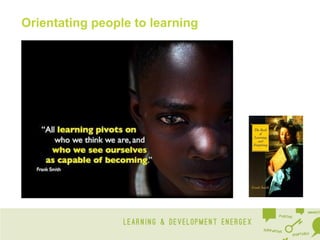
Orientating people to learning
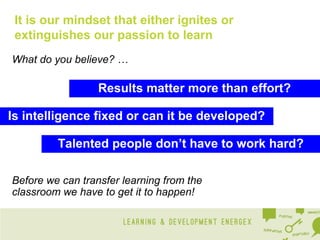
It is our mindset that either ignites or
extinguishes our passion to learn
What do you believe? …

Results matter more than effort?
Is intelligence fixed or can it be developed?
Talented people don’t have to work hard?
Before we can transfer learning from the
classroom we have to get it to happen!
A growth mindset is a learning orientation

[Source: Carol Dweck]
CASE STUDY:
Building Conscious Leaders at Energex
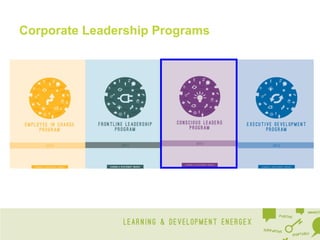
Corporate Leadership Programs
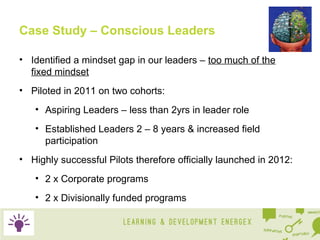
Case Study – Conscious Leaders
• Identified a mindset gap in our leaders – too much of the
fixed mindset
• Piloted in 2011 on two cohorts:
• Aspiring Leaders – less than 2yrs in leader role
• Established Leaders 2 – 8 years & increased field
participation
• Highly successful Pilots therefore officially launched in 2012:
• 2 x Corporate programs
• 2 x Divisionally funded programs
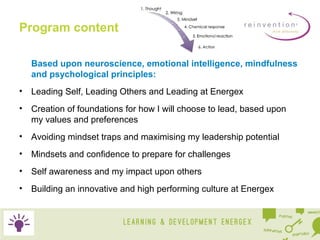
Program content
Based upon neuroscience, emotional intelligence, mindfulness
and psychological principles:
•

Leading Self, Leading Others and Leading at Energex

•

Creation of foundations for how I will choose to lead, based upon
my values and preferences

•

Avoiding mindset traps and maximising my leadership potential

•

Mindsets and confidence to prepare for challenges

•

Self awareness and my impact upon others

•

Building an innovative and high performing culture at Energex
Strategies for transferring the learning
• Short & Intensive delivery spread out over time – 5 days within 4
modules across 3 months.
• Regular 1:1 coaching between Modules provided by previous CL
‘Alumni’, L&D team members and program facilitators
• Weekly challenges sent to participants
• Formation of CL ‘Alumni’ networks across divisions and leadership
levels
• Involvement of direct manager in program presentation days
Embedding activities
•

1 day workshop per quarter on Leadership topics (e.g.
Engagement @ Work, Creativity in the Workplace,
Influence – How to Make a Difference)

•

Regularly distributed Leadersheets, articles and
resources

•

Intranet workspace site for virtual networking and
resource sharing (Sharepoint)

•

Use of ‘Alumni’ as coaches and mentors within current
programs

•

Leadership Development ‘consulting’ service to assist in
further reinforcement and tailored embedding to specific
leadership teams via direct service provision and/or
coaching of ‘Alumni’ in application of program learnings
to the workplace
Observed shifts in participants
• Pre-Post Surveys conducted to determine self-reported shifts in
mindsets and leadership development
• Overall improvements observed across areas of Emotional
Intelligence such as moderating behaviour, understanding hindering
mindsets, and impacts upon others
• Other additional shifts were observed re: building positive
relationships across the business, and effectively leading people
through change
• Participants’ managers identified that these areas of improvement
made an observable, helpful and direct business impact
• The demand for Conscious Leaders programs is ever growing
Transferring learning from the classroom to the workplace final

Transferring learning from the classroom to the workplace final

  • 1.
    Transferring learning fromthe classroom to the workplace Richard Fryer Group Manager, Organisational Effectiveness
  • 2.
    Focus of thissession • Explore the relationship between learning investment and business impact • Explore the merits of centring development around mindset rather than skill • Look at a case study of mindset-based learning at Energex
  • 3.
    • Electricity distributionservices to SEQ • Government Owned Corporation • Regulated by the Australian Energy Regulator (AER) • c.3,800 employees • Mixture of white and blue collar within workforce • Approximately 550 leaders
  • 4.
    Future benefits arenot always clear ahead of time…
  • 5.
    Organisations are complexnon-linear systems
  • 6.
    Assumptions of causeand effect are too simple to tell the whole story Small changes can have a big impact Don’t underestimate the power of people doing just a few things differently
  • 8.
    Learning is asocial process It occurs naturally and continually through collaborative activities, rather than through discreet events (i.e. courses) Learning in the workplace (or as close to it as possible) is the most effective way of ensuring application of knowledge People have to want to learn, therefore mindset is the key
  • 9.
  • 11.
    It is ourmindset that either ignites or extinguishes our passion to learn What do you believe? … Results matter more than effort? Is intelligence fixed or can it be developed? Talented people don’t have to work hard? Before we can transfer learning from the classroom we have to get it to happen!
  • 12.
    A growth mindsetis a learning orientation [Source: Carol Dweck]
  • 13.
  • 14.
  • 15.
    Case Study –Conscious Leaders • Identified a mindset gap in our leaders – too much of the fixed mindset • Piloted in 2011 on two cohorts: • Aspiring Leaders – less than 2yrs in leader role • Established Leaders 2 – 8 years & increased field participation • Highly successful Pilots therefore officially launched in 2012: • 2 x Corporate programs • 2 x Divisionally funded programs
  • 16.
    Program content Based uponneuroscience, emotional intelligence, mindfulness and psychological principles: • Leading Self, Leading Others and Leading at Energex • Creation of foundations for how I will choose to lead, based upon my values and preferences • Avoiding mindset traps and maximising my leadership potential • Mindsets and confidence to prepare for challenges • Self awareness and my impact upon others • Building an innovative and high performing culture at Energex
  • 17.
    Strategies for transferringthe learning • Short & Intensive delivery spread out over time – 5 days within 4 modules across 3 months. • Regular 1:1 coaching between Modules provided by previous CL ‘Alumni’, L&D team members and program facilitators • Weekly challenges sent to participants • Formation of CL ‘Alumni’ networks across divisions and leadership levels • Involvement of direct manager in program presentation days
  • 18.
    Embedding activities • 1 dayworkshop per quarter on Leadership topics (e.g. Engagement @ Work, Creativity in the Workplace, Influence – How to Make a Difference) • Regularly distributed Leadersheets, articles and resources • Intranet workspace site for virtual networking and resource sharing (Sharepoint) • Use of ‘Alumni’ as coaches and mentors within current programs • Leadership Development ‘consulting’ service to assist in further reinforcement and tailored embedding to specific leadership teams via direct service provision and/or coaching of ‘Alumni’ in application of program learnings to the workplace
  • 19.
    Observed shifts inparticipants • Pre-Post Surveys conducted to determine self-reported shifts in mindsets and leadership development • Overall improvements observed across areas of Emotional Intelligence such as moderating behaviour, understanding hindering mindsets, and impacts upon others • Other additional shifts were observed re: building positive relationships across the business, and effectively leading people through change • Participants’ managers identified that these areas of improvement made an observable, helpful and direct business impact • The demand for Conscious Leaders programs is ever growing

Editor's Notes

  • #5 History is full of ‘poor predictions’. Business cases predicated on ROI calculations give the impression of rigour but often the future value of the investment cannot be known. I’m interested more in how to transfer learning from the classroom to the workplace, rather than getting caught up in attempting to demonstrate return on investment. I think ROI significantly devalues the true value of learning. Conference on neuroscience in 2010 – mind and its potential. Some of the worlds’ best minds on neuroscience (Matt Lieberman, Rita Carter, Mike Merzenich, Judy Willis and Carol Dweck). I was staggered that the single most commonly recurring theme during the event was learning. Continuous learning seems to be what enhances and extends life. To try and wrap its benefits into an ROI calculation underplays its significance to human lives
  • #6 According to UC Berkeley, all words ever spoken by human beings could be stored electronically in 5 exabytes of text Monthly internet traffic in 2010 was 21 exabytes (1 EB = 1,000,000 TB)
  • #7 The butterfly effect Every interaction has a neurological impact – we are changing every day. Business cases often require substantial and clear benefits to be demonstrated. Most change happens on the inside.
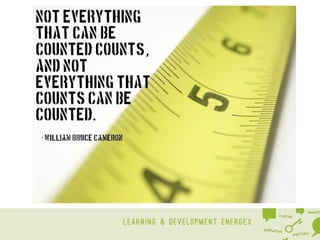
  • #8 We need to be released from the numbers and work on releasing people’s learning potential
  • #13 The Fixed Mindset is alive and well in our organisations.