




Richard Fryer
Oral Defence of Dissertation
MSc Sport & Exercise Psychology
Faculty of Health Sciences
Staffordshire University

1
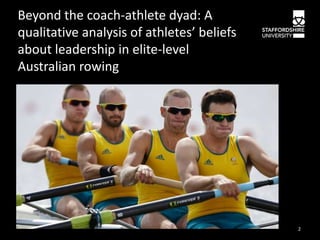
Beyond the coach-athlete dyad: A
qualitative analysis of athletes’ beliefs
about leadership in elite-level
Australian rowing

2
Introduction
• Leadership is an important factor in organisational
performance.
• Leadership is viewed as a key aspect of the future success of
sporting nations, including Australia
• Much of the sport research has assumed leader is
synonymous with coach
• The present study explored athlete views on leadership to
complement the significant body of leader views on
leadership that exist

3
Literature
• Assumed synonym of leader = coach sits most closely with
dyadic relationship described in the Leader-Member
Exchange theory of Leadership (LMX).
• Asssumes that leadership is a hierarchical and role-defined
concept.
• Contemporary models may offer different insights:
– Distributed model of leadership
– Social identity theory
– Authentic leadership

• A follower perspective on leadership has arguably been
overlooked in the literature
4
Research Aims
1. The applicability of Leader-Member Exchange theory versus
more contemporary models of leadership
2. Insight into athlete perspectives on leadership in sport
3. Inductive creation of a set of characteristics of leadership by
the followers
4. Provide insight into changing needs of leaders throughout an
athlete’s career
It was expected the research would help identify how leaders in
sport could better contribute to the creation of a positive and
successful performance environment.
5
Design
•
•
•
•

Qualitative design
Semi-structured interview format
Skype Interviews
Interpretative Phenomenological Analysis (IPA)

6
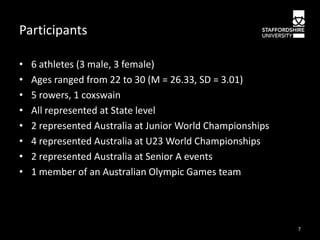
Participants
•
•
•
•
•
•
•
•

6 athletes (3 male, 3 female)
Ages ranged from 22 to 30 (M = 26.33, SD = 3.01)
5 rowers, 1 coxswain
All represented at State level
2 represented Australia at Junior World Championships
4 represented Australia at U23 World Championships
2 represented Australia at Senior A events
1 member of an Australian Olympic Games team

7
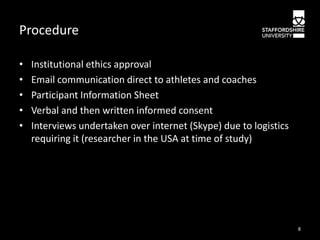
Procedure
•
•
•
•
•

Institutional ethics approval
Email communication direct to athletes and coaches
Participant Information Sheet
Verbal and then written informed consent
Interviews undertaken over internet (Skype) due to logistics
requiring it (researcher in the USA at time of study)

8
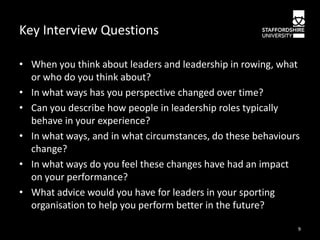
Key Interview Questions
• When you think about leaders and leadership in rowing, what
or who do you think about?
• In what ways has you perspective changed over time?
• Can you describe how people in leadership roles typically
behave in your experience?
• In what ways, and in what circumstances, do these behaviours
change?
• In what ways do you feel these changes have had an impact
on your performance?
• What advice would you have for leaders in your sporting
organisation to help you perform better in the future?
9
Results
• Interviews ranged in duration from 22 to 54 minutes ( M=37
mins, SD = 12.33)
• Verbatim transcripts yielded 15,000 words of data
• IPA produced 31 lower-order themes
• 9 higher-order themes
• 3 super-ordinate themes

10
Theme 1 – Procedural Justice
• Related to athletes’ beliefs about the fairness and
transparency of selection decisions made by leaders
• Consisted of 3 higher-order themes:
– Transparency
– Fairness
– Respect for decisions

11
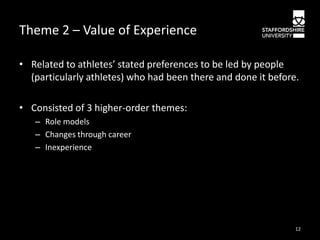
Theme 2 – Value of Experience
• Related to athletes’ stated preferences to be led by people
(particularly athletes) who had been there and done it before.
• Consisted of 3 higher-order themes:
– Role models
– Changes through career
– Inexperience

12
Theme 3 – Authentic Support
• Related to the need to be led by someone who genuinely
believed in them and in their abilities and would back them in
difficult situations.
• Consisted of 3 higher-order themes:
– Belief in the athlete
– Back me
– Positive environment

13
Discussion of Findings
• Athletes viewed leadership as being more complex than just a
synonym for the role of a coach.
• Whilst team coaches (not so those more remote from the
athlete) were viewed as having a leadership role, other
athletes were seen as the primary source of leadership for
most.
• Fairness, belief, trust, authenticity and support for the
athletes were seen by athletes as being the subject matter of
leadership
• Contemporary leadership theory can perhaps better explain
the dynamics that are present in sport when viewed from the
athlete’s perspective.
14
Limitations
• Single researcher qualitative methodology
• Perceptual distance – do performance directors provide
leadership?
• Generalisability of findings
– Participant numbers
– Qualitative method
– Single sport

• Data quality due to internet connection issues
• No real insight into changes throughout the career

15
Future Research
• Quantitative exploration of athlete views
• Broaden to different sports and different countries
• Look simultaneously at athlete and coach perspectives

16
Conclusion
• The present study adds a follower perspective on leadership
to the body of research of this subject in sport.
• Raises questions as to the applicability of the dyadic coachathlete leader-follower relationship proposed by LMX
• Discussed in the context of contemporary leadership theory
• Implications for leadership development activities in
sport, particularly the transition of successful athletes into
leadership positions.

17
Thank you
• Questions

18

Athletes' beliefs about leadership in elite sport

  • 1.
    Richard Fryer Oral Defenceof Dissertation MSc Sport & Exercise Psychology Faculty of Health Sciences Staffordshire University 1
  • 2.
    Beyond the coach-athletedyad: A qualitative analysis of athletes’ beliefs about leadership in elite-level Australian rowing 2
  • 3.
    Introduction • Leadership isan important factor in organisational performance. • Leadership is viewed as a key aspect of the future success of sporting nations, including Australia • Much of the sport research has assumed leader is synonymous with coach • The present study explored athlete views on leadership to complement the significant body of leader views on leadership that exist 3
  • 4.
    Literature • Assumed synonymof leader = coach sits most closely with dyadic relationship described in the Leader-Member Exchange theory of Leadership (LMX). • Asssumes that leadership is a hierarchical and role-defined concept. • Contemporary models may offer different insights: – Distributed model of leadership – Social identity theory – Authentic leadership • A follower perspective on leadership has arguably been overlooked in the literature 4
  • 5.
    Research Aims 1. Theapplicability of Leader-Member Exchange theory versus more contemporary models of leadership 2. Insight into athlete perspectives on leadership in sport 3. Inductive creation of a set of characteristics of leadership by the followers 4. Provide insight into changing needs of leaders throughout an athlete’s career It was expected the research would help identify how leaders in sport could better contribute to the creation of a positive and successful performance environment. 5
  • 6.
    Design • • • • Qualitative design Semi-structured interviewformat Skype Interviews Interpretative Phenomenological Analysis (IPA) 6
  • 7.
    Participants • • • • • • • • 6 athletes (3male, 3 female) Ages ranged from 22 to 30 (M = 26.33, SD = 3.01) 5 rowers, 1 coxswain All represented at State level 2 represented Australia at Junior World Championships 4 represented Australia at U23 World Championships 2 represented Australia at Senior A events 1 member of an Australian Olympic Games team 7
  • 8.
    Procedure • • • • • Institutional ethics approval Emailcommunication direct to athletes and coaches Participant Information Sheet Verbal and then written informed consent Interviews undertaken over internet (Skype) due to logistics requiring it (researcher in the USA at time of study) 8
  • 9.
    Key Interview Questions •When you think about leaders and leadership in rowing, what or who do you think about? • In what ways has you perspective changed over time? • Can you describe how people in leadership roles typically behave in your experience? • In what ways, and in what circumstances, do these behaviours change? • In what ways do you feel these changes have had an impact on your performance? • What advice would you have for leaders in your sporting organisation to help you perform better in the future? 9
  • 10.
    Results • Interviews rangedin duration from 22 to 54 minutes ( M=37 mins, SD = 12.33) • Verbatim transcripts yielded 15,000 words of data • IPA produced 31 lower-order themes • 9 higher-order themes • 3 super-ordinate themes 10
  • 11.
    Theme 1 –Procedural Justice • Related to athletes’ beliefs about the fairness and transparency of selection decisions made by leaders • Consisted of 3 higher-order themes: – Transparency – Fairness – Respect for decisions 11
  • 12.
    Theme 2 –Value of Experience • Related to athletes’ stated preferences to be led by people (particularly athletes) who had been there and done it before. • Consisted of 3 higher-order themes: – Role models – Changes through career – Inexperience 12
  • 13.
    Theme 3 –Authentic Support • Related to the need to be led by someone who genuinely believed in them and in their abilities and would back them in difficult situations. • Consisted of 3 higher-order themes: – Belief in the athlete – Back me – Positive environment 13
  • 14.
    Discussion of Findings •Athletes viewed leadership as being more complex than just a synonym for the role of a coach. • Whilst team coaches (not so those more remote from the athlete) were viewed as having a leadership role, other athletes were seen as the primary source of leadership for most. • Fairness, belief, trust, authenticity and support for the athletes were seen by athletes as being the subject matter of leadership • Contemporary leadership theory can perhaps better explain the dynamics that are present in sport when viewed from the athlete’s perspective. 14
  • 15.
    Limitations • Single researcherqualitative methodology • Perceptual distance – do performance directors provide leadership? • Generalisability of findings – Participant numbers – Qualitative method – Single sport • Data quality due to internet connection issues • No real insight into changes throughout the career 15
  • 16.
    Future Research • Quantitativeexploration of athlete views • Broaden to different sports and different countries • Look simultaneously at athlete and coach perspectives 16
  • 17.
    Conclusion • The presentstudy adds a follower perspective on leadership to the body of research of this subject in sport. • Raises questions as to the applicability of the dyadic coachathlete leader-follower relationship proposed by LMX • Discussed in the context of contemporary leadership theory • Implications for leadership development activities in sport, particularly the transition of successful athletes into leadership positions. 17
  • 18.