Transfer of Technology
Prepared by :
Bhargav Dharaiya
Agri Rock
JAU, Junagadh
2
Definition of Technology Transfer
Technology transfer [and commercialization] is defined
as the transfer of results of basic and applied research to
the design, development, production, and
commercialization of new and improved products,
services or processes. That which is transferred is often
not really technology but rather a particular kind of
knowledge that is a precursor of technology.
The transfer process emphasizes the value and
protection of the intellectual product of the researchers.
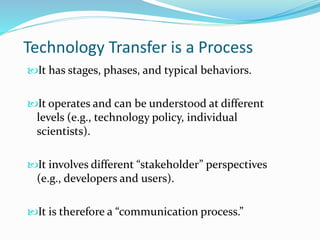
Technology Transfer is a Process
It has stages, phases, and typical behaviors.
It operates and can be understood at different
levels (e.g., technology policy, individual
scientists).
It involves different “stakeholder” perspectives
(e.g., developers and users).
It is therefore a “communication process.”
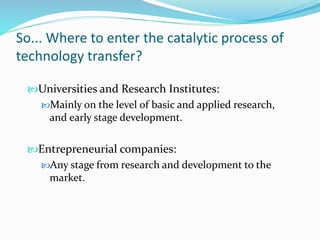
So... Where to enter the catalytic process of
technology transfer?
Universities and Research Institutes:
Mainly on the level of basic and applied research,
and early stage development.
Entrepreneurial companies:
Any stage from research and development to the
market.
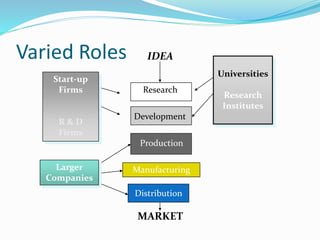
Varied Roles
Distribution
Research
Development
Production
IDEA
MARKET
Universities
Research
Institutes
Start-up
Firms
R & D
Firms
Larger
Companies
Manufacturing
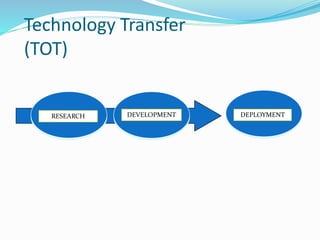
Technology Transfer
(TOT)
DEPLOYMENTDEVELOPMENTRESEARCH
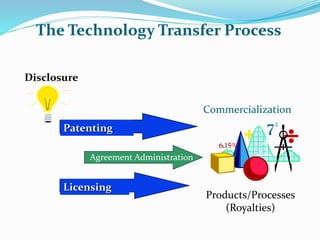
Patenting
Licensing
Disclosure
Commercialization
Products/Processes
(Royalties)
The Technology Transfer Process
Agreement Administration
Forms in Which Technology May Be
Transferred ......
Technology is primarily transferred in two forms
First, it can be transferred via machinery or other
intermediate goods. This is normally adequate for
manufacturing purposes where the nature of the
technology is not complex.
Technology can also be transferred through
individual experts. Transferring technology via a
competent expert has the advantage of cost-
savings to the recipient, but it is generally suitable
only for small and medium-sized projects where
the technology is simple and unpatented.
Intramural: Within the “walls” of an institution or
company. Transfer between different functions within
a company or institution.
Extramural: Outside the “walls” of an institution or
company. Transfer between a company or institution
and the rest of the world.
Public/Private: Transfer from publicly funded
research to the private sector.
Different Kinds of Technology Transfer
Vertical technology transfer : when information is
transmitted from basic research to applied research,
from applied research to development, and from
development to production. Such transfers occur in
both directions.
Horizontal transfer of technology : when technology
used in one place, organisation, or context is
transferred and used in another place, or
organisation.
Types of technology transfer
Necessary Conditions for Successful Technology
Transfer
1.Technology is transferred most effectively by direct
people-to-people actions.
2.Technology transfer agents must be well-qualified
and able to communicate effectively to people who
are capable of receiving applying the technology.
3. In addition to transfer agents and capable
recipients. “facilitators” or “middlemen” are needed.
4.Users and transfer agents should be involved in
choosing. Planning and implementing the
technology so it meets actual needs and is
appropriate for the situation.
5. All parties involved must feel that they are
“winners” and must, in fact be winners.
Transfer of technology in agriculture
Front-line demonstrations in farmer’s fields
Field days and interactive farmers-scientists meetings or
focus groups
National level/ State level training programmes for
development personnel, State officials and farmers & other
agencies
Farmers' Participation Action Research Programmes
(FPARP)
Kisan Melas and exhibitions
Publications including extension pamphlets and technical
bulletins
Programmes in public media like Radio Talks, TV
Programmes, News papers and other forums
Transfer of technology

Transfer of technology

  • 2.
    Transfer of Technology Preparedby : Bhargav Dharaiya Agri Rock JAU, Junagadh 2
  • 3.
    Definition of TechnologyTransfer Technology transfer [and commercialization] is defined as the transfer of results of basic and applied research to the design, development, production, and commercialization of new and improved products, services or processes. That which is transferred is often not really technology but rather a particular kind of knowledge that is a precursor of technology. The transfer process emphasizes the value and protection of the intellectual product of the researchers.
  • 4.
    Technology Transfer isa Process It has stages, phases, and typical behaviors. It operates and can be understood at different levels (e.g., technology policy, individual scientists). It involves different “stakeholder” perspectives (e.g., developers and users). It is therefore a “communication process.”
  • 5.
    So... Where toenter the catalytic process of technology transfer? Universities and Research Institutes: Mainly on the level of basic and applied research, and early stage development. Entrepreneurial companies: Any stage from research and development to the market.
  • 6.
  • 7.
  • 8.
  • 9.
    Forms in WhichTechnology May Be Transferred ...... Technology is primarily transferred in two forms First, it can be transferred via machinery or other intermediate goods. This is normally adequate for manufacturing purposes where the nature of the technology is not complex. Technology can also be transferred through individual experts. Transferring technology via a competent expert has the advantage of cost- savings to the recipient, but it is generally suitable only for small and medium-sized projects where the technology is simple and unpatented.
  • 10.
    Intramural: Within the“walls” of an institution or company. Transfer between different functions within a company or institution. Extramural: Outside the “walls” of an institution or company. Transfer between a company or institution and the rest of the world. Public/Private: Transfer from publicly funded research to the private sector. Different Kinds of Technology Transfer
  • 11.
    Vertical technology transfer: when information is transmitted from basic research to applied research, from applied research to development, and from development to production. Such transfers occur in both directions. Horizontal transfer of technology : when technology used in one place, organisation, or context is transferred and used in another place, or organisation. Types of technology transfer
  • 12.
    Necessary Conditions forSuccessful Technology Transfer 1.Technology is transferred most effectively by direct people-to-people actions. 2.Technology transfer agents must be well-qualified and able to communicate effectively to people who are capable of receiving applying the technology.
  • 13.
    3. In additionto transfer agents and capable recipients. “facilitators” or “middlemen” are needed. 4.Users and transfer agents should be involved in choosing. Planning and implementing the technology so it meets actual needs and is appropriate for the situation. 5. All parties involved must feel that they are “winners” and must, in fact be winners.
  • 14.
    Transfer of technologyin agriculture Front-line demonstrations in farmer’s fields Field days and interactive farmers-scientists meetings or focus groups National level/ State level training programmes for development personnel, State officials and farmers & other agencies Farmers' Participation Action Research Programmes (FPARP) Kisan Melas and exhibitions Publications including extension pamphlets and technical bulletins Programmes in public media like Radio Talks, TV Programmes, News papers and other forums