TOPIC: LICENSING OF TECHNOLOGY
Submitted By:
Adit Singla
Roll No. 21-M-AGRI-017
M.Sc. (Ag.) Agronomy
Submitted To:
Dr. Anand
Assistant Professor
Department of Agriculture
SAST, RIMT University
SUBJECT: AIPR-5221 INTELLECTUAL PROPERTY RIGHTS AND ITS
MANAGEMENT
Intellectual Property (IP)
• Intellectual property (IP) refers to creations of the mind, such as
inventions; literary and artistic works; designs and symbols, names and
images used in commerce.
• IP is protected in law by patents, copyright and trademarks,which enable
people to earn recognition or financial benefit from what they invent or
create.
• IP is a broad concept and includes many different intangibles like:
 Patents (inventions).
 Copyright (works of authorship including technical manuals, software,
specifications, formulae, schematics and documentation).
 Trade secrets (a protected formula or method, undisclosed customer or
technical information, algorithms,etc.).
 Trademarks (logos, distinctive names for products and technologies).
 Designs (the unique way a product looks such as a computer’s molding).
Technology Licensing
• Licensing implies an agreement between parties who receive and
exchange approximately equal benefits and value.
• Technology licensing only occurs when a party owns valuable
intangible assets (Intellectual Property), and has the legal right to
prevent the other party from using it.
• A license is a consent by the owner to the use of IP in exchange for
money or something else of value.
• Technology licensing doesn't occur without IP!
License
• Either we sell the patent/technology outright or license it, If licensed, the
licensor retains ownership and title and the power to reverse the license in
case the licensee breaches its duties.
• A license is less expensive for the licensee while more flexible in
providing significant shared upside if the technology succeeds.
• A recurring revenue stream could be established with multiple licensees,
that provides predictable income.
• Licensing could be a way to increase the chances of market success for a
new or nascent technology (multiple go to market licensees buying access
‘affordably’).
Three Broad Categories of IP Licenses
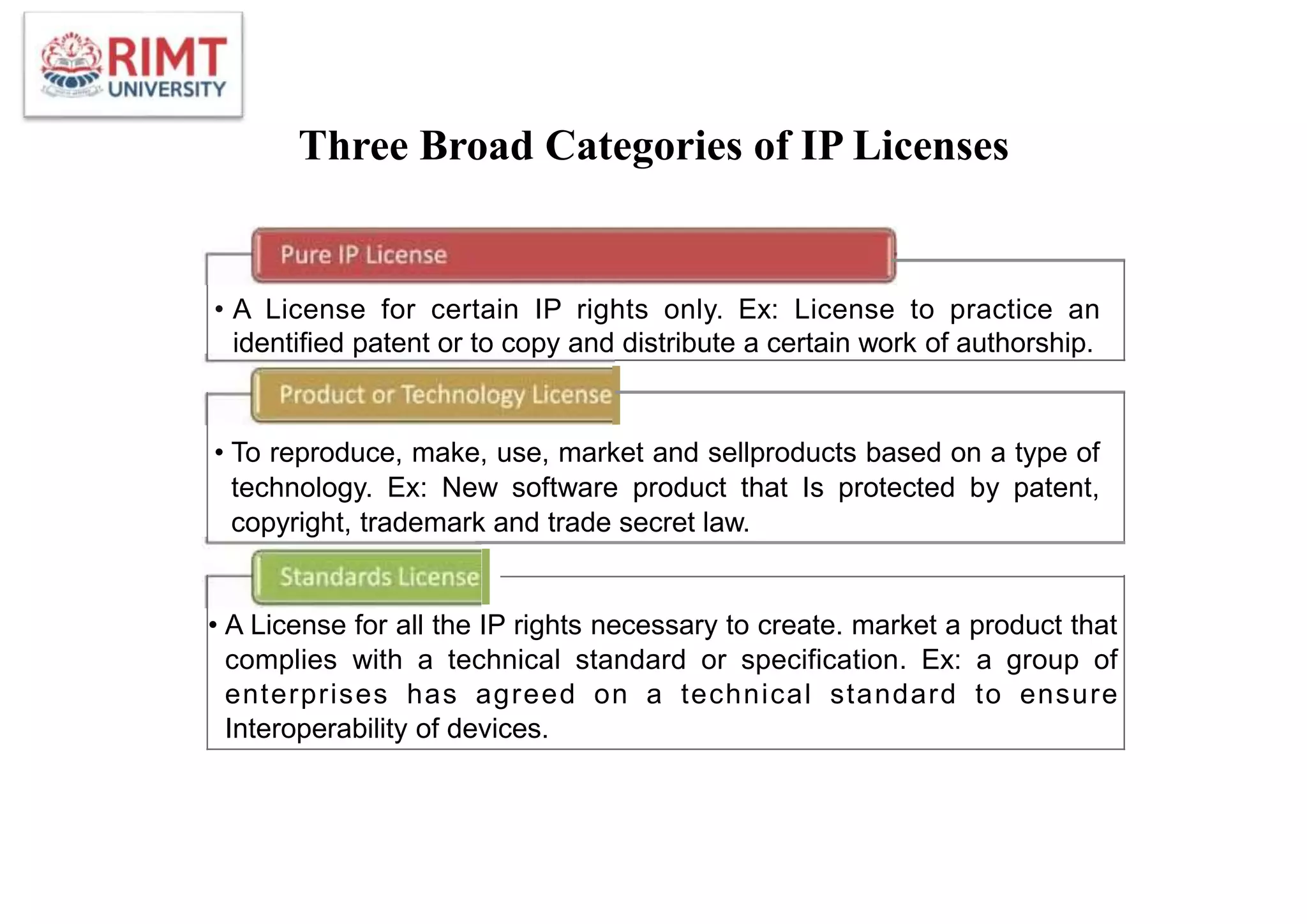
• A License for certain IP rights only. Ex: License to practice an
identified patent or to copy and distribute a certain work of authorship.
• To reproduce, make, use, market and sellproducts based on a type of
technology. Ex: New software product that Is protected by patent,
copyright, trademark and trade secret law.
• A License for all the IP rights necessary to create. market a product that
complies with a technical standard or specification. Ex: a group of
enterprises has agreed on a technical standard to ensure
Interoperability of devices.
Key Attributes of Licensing IP
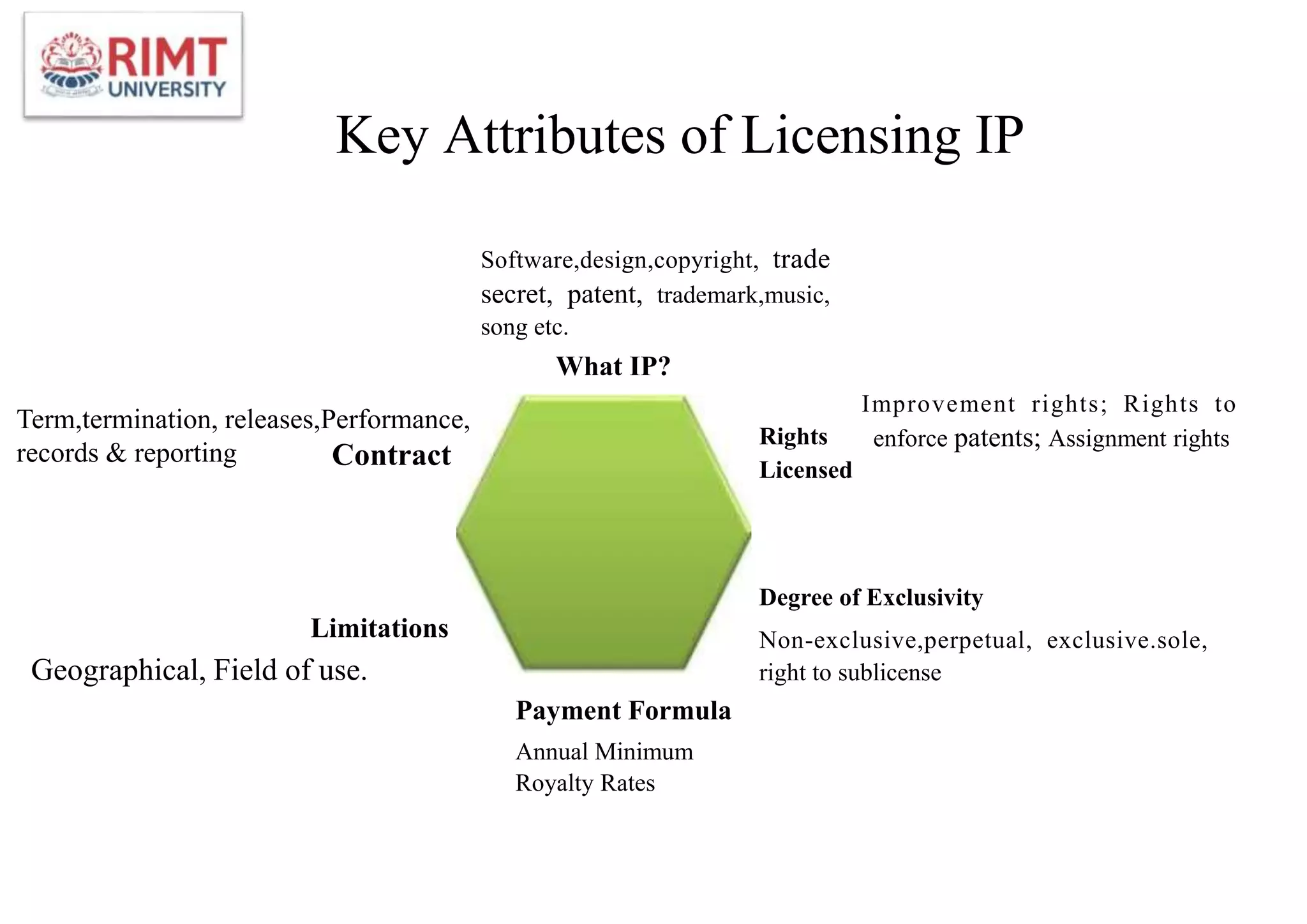
Term,termination, releases,Performance,
records & reporting Contract
Limitations
Geographical, Field of use.
Software,design,copyright, trade
secret, patent, trademark,music,
song etc.
What IP?
Payment Formula
Annual Minimum
Royalty Rates
Rights
Licensed
Improvement rights; Rights to
enforce patents; Assignment rights
Degree of Exclusivity
Non-exclusive,perpetual, exclusive.sole,
right to sublicense
Components of a License
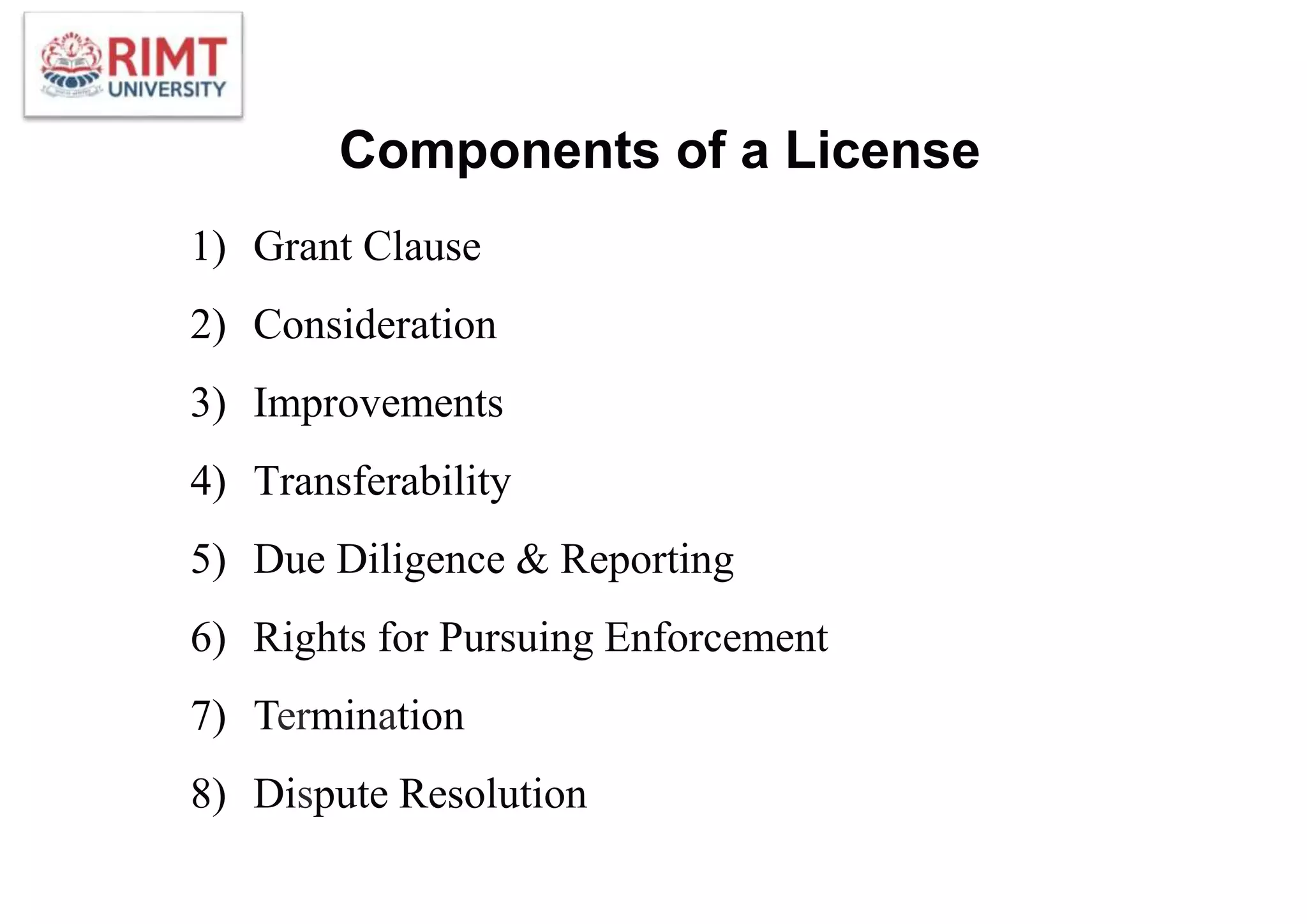
1) Grant Clause
2) Consideration
3) Improvements
4) Transferability
5) Due Diligence & Reporting
6) Rights for Pursuing Enforcement
7) Termination
8) Dispute Resolution
Grant Clause
• Sets forth what patent rights are being conveyed.
• The grant can be:
 Exclusive: Only the licensee has the right to exploit the patent
rights.
 Non-Exclusive: The licensor can grant similar rights to other
parties.
• The grant can be limited by geography (such as U.S.,Asia and
field of use (such as for tablets but not cameras).
Consideration
• The license agreement typically requires a licensee to pay an
upfront license fee as well as ongoing royalties based on a
percentage of sales or on a per-unit basis can require annual
minimum royalties (AMR) or minimum annual product sales to be
sure the licensee is diligently marketing the products or services
covered in the patent can also require that the licensee provide
reports to the licensor,e.g., of sales or revenue,to ensure accurate
royalty payments.
• A licensor may propose the licensee take over the cost of IP
maintenance in return for the rights of enforcement.
Improvements
• A patent license defines each party's rights to improvements of
the patented technology.
• Depending on the negotiation, Improvements might be solely
owned by the licensor, licensee or jointly owned by both.
• The party with more bargaining power often insists on
controlling the rights to improvements.
Transferability
• License agreements can provide the licensee a right
to sublicense or assign the IP.
• It is important for the licensee to have some ability
to assign the license without restriction or else it may
impact their business unduly.
Due Diligence & Reporting
• License agreements can require due diligence by the licensee to develop
and/or commercialize the IP.
• Such terms help ensure that the IP is used and not just put on the shelf. E.g.
the licensee can be required to use reasonable efforts to develop and
commercial ize products covered by the license.
• License agreements can include milestones that must be met for the
licensee to maintain the license.
• They can also require submission of periodic reports of the licensee's
activities related to the development and testing and the sales and
marketing progress of the products covered by the licensed IP.
Rights for Pursuing Enforcement
• A patent license can also control each party's responsibilities for
enforcing the patent rights along with apportioning liability if the
licensee issued for infringement.
• Depending on the terms, an exclusive licensee can have the right
to sue for infringement. The license agreement can determine
how the costs of litigation are apportioned between licensor and
licensee.
Termination
• License agreements can include negotiated provisions that
establish how and for what reasons the agreement can be
terminated.
• Clauses that provide for automatic termination of the license
agreement if one party seeks or is placed under bankruptcy
protection may not be enforceable.
• But clauses that provide for termination for failure to pay royalties
may be enforceable regardless of bankruptcy.
Dispute Resolution
• License agreements can require the parties to provide notice of any
breach of the agreement and can specify periods during which any
such breach can be cured.
• The license agreement can provide in advance for arbitration or
mediation of disputes. E.g. The agreement can require binding
arbitration vs. litigation.
• Binding arbitration weakens a powerful licensor's ability to pursue
critical breaches and hence will not be favored when they perceive
the need to carry a big stick.
Licensing of Technology in IPR

Licensing of Technology in IPR

  • 1.
    TOPIC: LICENSING OFTECHNOLOGY Submitted By: Adit Singla Roll No. 21-M-AGRI-017 M.Sc. (Ag.) Agronomy Submitted To: Dr. Anand Assistant Professor Department of Agriculture SAST, RIMT University SUBJECT: AIPR-5221 INTELLECTUAL PROPERTY RIGHTS AND ITS MANAGEMENT
  • 2.
    Intellectual Property (IP) •Intellectual property (IP) refers to creations of the mind, such as inventions; literary and artistic works; designs and symbols, names and images used in commerce. • IP is protected in law by patents, copyright and trademarks,which enable people to earn recognition or financial benefit from what they invent or create. • IP is a broad concept and includes many different intangibles like:  Patents (inventions).  Copyright (works of authorship including technical manuals, software, specifications, formulae, schematics and documentation).  Trade secrets (a protected formula or method, undisclosed customer or technical information, algorithms,etc.).  Trademarks (logos, distinctive names for products and technologies).  Designs (the unique way a product looks such as a computer’s molding).
  • 3.
    Technology Licensing • Licensingimplies an agreement between parties who receive and exchange approximately equal benefits and value. • Technology licensing only occurs when a party owns valuable intangible assets (Intellectual Property), and has the legal right to prevent the other party from using it. • A license is a consent by the owner to the use of IP in exchange for money or something else of value. • Technology licensing doesn't occur without IP!
  • 4.
    License • Either wesell the patent/technology outright or license it, If licensed, the licensor retains ownership and title and the power to reverse the license in case the licensee breaches its duties. • A license is less expensive for the licensee while more flexible in providing significant shared upside if the technology succeeds. • A recurring revenue stream could be established with multiple licensees, that provides predictable income. • Licensing could be a way to increase the chances of market success for a new or nascent technology (multiple go to market licensees buying access ‘affordably’).
  • 5.
    Three Broad Categoriesof IP Licenses • A License for certain IP rights only. Ex: License to practice an identified patent or to copy and distribute a certain work of authorship. • To reproduce, make, use, market and sellproducts based on a type of technology. Ex: New software product that Is protected by patent, copyright, trademark and trade secret law. • A License for all the IP rights necessary to create. market a product that complies with a technical standard or specification. Ex: a group of enterprises has agreed on a technical standard to ensure Interoperability of devices.
  • 6.
    Key Attributes ofLicensing IP Term,termination, releases,Performance, records & reporting Contract Limitations Geographical, Field of use. Software,design,copyright, trade secret, patent, trademark,music, song etc. What IP? Payment Formula Annual Minimum Royalty Rates Rights Licensed Improvement rights; Rights to enforce patents; Assignment rights Degree of Exclusivity Non-exclusive,perpetual, exclusive.sole, right to sublicense
  • 7.
    Components of aLicense 1) Grant Clause 2) Consideration 3) Improvements 4) Transferability 5) Due Diligence & Reporting 6) Rights for Pursuing Enforcement 7) Termination 8) Dispute Resolution
  • 8.
    Grant Clause • Setsforth what patent rights are being conveyed. • The grant can be:  Exclusive: Only the licensee has the right to exploit the patent rights.  Non-Exclusive: The licensor can grant similar rights to other parties. • The grant can be limited by geography (such as U.S.,Asia and field of use (such as for tablets but not cameras).
  • 9.
    Consideration • The licenseagreement typically requires a licensee to pay an upfront license fee as well as ongoing royalties based on a percentage of sales or on a per-unit basis can require annual minimum royalties (AMR) or minimum annual product sales to be sure the licensee is diligently marketing the products or services covered in the patent can also require that the licensee provide reports to the licensor,e.g., of sales or revenue,to ensure accurate royalty payments. • A licensor may propose the licensee take over the cost of IP maintenance in return for the rights of enforcement.
  • 10.
    Improvements • A patentlicense defines each party's rights to improvements of the patented technology. • Depending on the negotiation, Improvements might be solely owned by the licensor, licensee or jointly owned by both. • The party with more bargaining power often insists on controlling the rights to improvements.
  • 11.
    Transferability • License agreementscan provide the licensee a right to sublicense or assign the IP. • It is important for the licensee to have some ability to assign the license without restriction or else it may impact their business unduly.
  • 12.
    Due Diligence &Reporting • License agreements can require due diligence by the licensee to develop and/or commercialize the IP. • Such terms help ensure that the IP is used and not just put on the shelf. E.g. the licensee can be required to use reasonable efforts to develop and commercial ize products covered by the license. • License agreements can include milestones that must be met for the licensee to maintain the license. • They can also require submission of periodic reports of the licensee's activities related to the development and testing and the sales and marketing progress of the products covered by the licensed IP.
  • 13.
    Rights for PursuingEnforcement • A patent license can also control each party's responsibilities for enforcing the patent rights along with apportioning liability if the licensee issued for infringement. • Depending on the terms, an exclusive licensee can have the right to sue for infringement. The license agreement can determine how the costs of litigation are apportioned between licensor and licensee.
  • 14.
    Termination • License agreementscan include negotiated provisions that establish how and for what reasons the agreement can be terminated. • Clauses that provide for automatic termination of the license agreement if one party seeks or is placed under bankruptcy protection may not be enforceable. • But clauses that provide for termination for failure to pay royalties may be enforceable regardless of bankruptcy.
  • 15.
    Dispute Resolution • Licenseagreements can require the parties to provide notice of any breach of the agreement and can specify periods during which any such breach can be cured. • The license agreement can provide in advance for arbitration or mediation of disputes. E.g. The agreement can require binding arbitration vs. litigation. • Binding arbitration weakens a powerful licensor's ability to pursue critical breaches and hence will not be favored when they perceive the need to carry a big stick.