Marketing Information System
FOR
EFFICIENT AGRICULTURAL
MARKETING
An important marketing function which ensures the
smooth and efficient operation of the marketing
system.
Accurate, adequate and timely availability of market
information facilitates decision about when and where to
market the products.
It is essential at all stages of marketing, from the sale of
the produce at the farm until the goods reach the last
consumer.
At present AGMARKNET is the largest network in India to
provide real time information by connecting major
regulated markets across the country.
Market Information
Importance
• Farmer/Producers: Helps in improving the decision making
power of the farmer
• Market middlemen
• General economy
• Government
Market information and intelligence are crucial to
enable farmers and traders to make informed
decisions about
what to grow,
when to harvest,
to which markets produce should be sent,
and whether to store it or not.
Market Intelligence:
• includes information relating to such facts as the prices (price
intelligence) that prevailed in the past and market arrivals over time.
• An analysis of the past helps us to take decision about the future.
• It helps in building outlook for current and future decisions.
Market News:
• refers to current information about prices, arrivals and changes in
market conditions.
• Helps the farmers in taking decisions about when and where to sell
his produce.
• Its availability in time and with speed is of utmost value.
• It quickly becomes obsolete and requires frequent updating.
Market outlook:
refers to the market situation that is likely to prevail in the near
future.
Types of Market Information
Criteria for good Market Information
• Comprehensive
Must be complete and cover all the agricultural
Commodities.
• Accuracy
• Relevance
• Trustworthiness
Agency that collects it must create faith, and the users
must trust the organisation/agency.
• Equal and Easy accessibility
• Timeliness
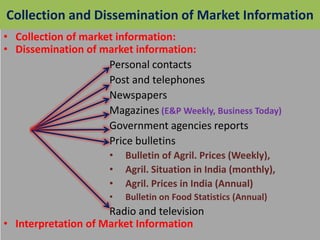
Collection and Dissemination of Market Information
• Collection of market information:
• Dissemination of market information:
Personal contacts
Post and telephones
Newspapers
Magazines (E&P Weekly, Business Today)
Government agencies reports
Price bulletins
• Bulletin of Agril. Prices (Weekly),
• Agril. Situation in India (monthly),
• Agril. Prices in India (Annual)
• Bulletin on Food Statistics (Annual)
Radio and television
• Interpretation of Market Information
Marketing Intelligence System
(MIS)
Consists of people, equipment, and
procedures to gather, sort, analyze,
evaluate and distribute timely and accurate
information to decision makers.
Components of Intelligence System
• Customer Intelligence: This provides useful
information on a customer’s business, preferences
or loyalties, personal demographic details.
• Competition Intelligence: This gives information on
strengths and weaknesses of each competitor in
the territory, the strategy and the tactics being used
by them.
Purposes of Marketing Intelligence
• Customer satisfaction
• Creative and effective marketing strategy
• Realities of the company and its competitors
– Strengths and weaknesses
• Realities of the marketplace
– Opportunities and threats
• Competitive advantage
• Anticipate the competitive move and develop
competitive strategies
Sources of Marketing Intelligence
• Company’s own personnel
– Executives
– Consultants and specialists
– Purchasing agents
– Salespersons
– Other employees
Issue:
 Always busy people
 Fail to pass on important information
Sources of Marketing Intelligence
Company’s supply chain
Suppliers
Business partners
Business allies
Other marketing intermediaries
Competitors
Annual reports
Speeches and press releases
Products and labels
Advertisements and other marketing
communications
Web sites
Sources of Marketing Intelligence
• Government sources
– Census of population
– Census of industries
– Other government agencies and publications
• Academic sources
– Theses and research reports
– Academic journals
– Academic forum
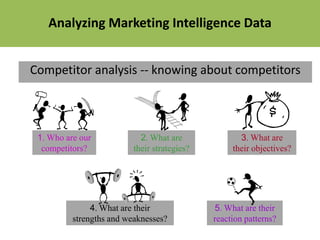
Analyzing Marketing Intelligence Data
Competitor analysis -- knowing about competitors
1. Who are our
competitors?
2. What are
their strategies?
3. What are
their objectives?
4. What are their
strengths and weaknesses?
5. What are their
reaction patterns?
Marketing Intelligence Scheme in India
• It provides for the collection of data on prices, arrivals,
dispatches and stocks of important agricultural commodities.
• These data are reported by market intelligence inspectors,
market reporters, agriculture assistants, price inspectors,
statistical investigators, marketing inspectors etc.
• The scheme covered 137 agricultural commodities and 1300
markets of the country.
• Market intelligence centres set up under the scheme work
under the supervision of Directorate of Agricultural Marketing
or Directorate of Economics and Statistics of the states.
• The importance of flow of market information has
considerably increased in recent years particularly in case of
fruits & Vegetables.
Market Information vs Market Intelligence
• Market Intelligence is a process of giving you insights into
what might happen in the near future.
• This process requires that we go from market data to
information and then to market intelligence. For example
• Data – Arrivals and Prices of fruits and vegetables in Narwal
mandi.
• Information – Month wise arrivals and prices of
commodities for 20 years
• Intelligence – Forecasting the arrivals and prices of the
commodities on the basis of available data for next say 5
years or 10 years.
The Ideal Agricultural Marketing Information System (AMIS)
should be Responsible for
• sourcing all the market data/information being collected by
various agencies;
• processing and analyzing such data/information to turn it
into useable knowledge; and
• developing mechanisms/systems for information/
knowledge dissemination through various media such as
radio, TV, newsletters, bulletins, and websites.
Factors responsible for poor market
intelligence
i) Limited availability of market intelligence.
ii) Poor access to relevant market information.
iii) Limited dissemination of existing information to farmers
and entrepreneurs.
iv) Lack of price forecasting system.
v) Limited capacity to understand and use market
intelligence.
Marketing intelligence system

Marketing intelligence system

  • 1.
  • 2.
    An important marketingfunction which ensures the smooth and efficient operation of the marketing system. Accurate, adequate and timely availability of market information facilitates decision about when and where to market the products. It is essential at all stages of marketing, from the sale of the produce at the farm until the goods reach the last consumer. At present AGMARKNET is the largest network in India to provide real time information by connecting major regulated markets across the country. Market Information
  • 3.
    Importance • Farmer/Producers: Helpsin improving the decision making power of the farmer • Market middlemen • General economy • Government Market information and intelligence are crucial to enable farmers and traders to make informed decisions about what to grow, when to harvest, to which markets produce should be sent, and whether to store it or not.
  • 4.
    Market Intelligence: • includesinformation relating to such facts as the prices (price intelligence) that prevailed in the past and market arrivals over time. • An analysis of the past helps us to take decision about the future. • It helps in building outlook for current and future decisions. Market News: • refers to current information about prices, arrivals and changes in market conditions. • Helps the farmers in taking decisions about when and where to sell his produce. • Its availability in time and with speed is of utmost value. • It quickly becomes obsolete and requires frequent updating. Market outlook: refers to the market situation that is likely to prevail in the near future. Types of Market Information
  • 5.
    Criteria for goodMarket Information • Comprehensive Must be complete and cover all the agricultural Commodities. • Accuracy • Relevance • Trustworthiness Agency that collects it must create faith, and the users must trust the organisation/agency. • Equal and Easy accessibility • Timeliness
  • 6.
    Collection and Disseminationof Market Information • Collection of market information: • Dissemination of market information: Personal contacts Post and telephones Newspapers Magazines (E&P Weekly, Business Today) Government agencies reports Price bulletins • Bulletin of Agril. Prices (Weekly), • Agril. Situation in India (monthly), • Agril. Prices in India (Annual) • Bulletin on Food Statistics (Annual) Radio and television • Interpretation of Market Information
  • 7.
    Marketing Intelligence System (MIS) Consistsof people, equipment, and procedures to gather, sort, analyze, evaluate and distribute timely and accurate information to decision makers.
  • 8.
    Components of IntelligenceSystem • Customer Intelligence: This provides useful information on a customer’s business, preferences or loyalties, personal demographic details. • Competition Intelligence: This gives information on strengths and weaknesses of each competitor in the territory, the strategy and the tactics being used by them.
  • 9.
    Purposes of MarketingIntelligence • Customer satisfaction • Creative and effective marketing strategy • Realities of the company and its competitors – Strengths and weaknesses • Realities of the marketplace – Opportunities and threats • Competitive advantage • Anticipate the competitive move and develop competitive strategies
  • 10.
    Sources of MarketingIntelligence • Company’s own personnel – Executives – Consultants and specialists – Purchasing agents – Salespersons – Other employees Issue:  Always busy people  Fail to pass on important information
  • 11.
    Sources of MarketingIntelligence Company’s supply chain Suppliers Business partners Business allies Other marketing intermediaries
  • 12.
    Competitors Annual reports Speeches andpress releases Products and labels Advertisements and other marketing communications Web sites Sources of Marketing Intelligence
  • 13.
    Sources of MarketingIntelligence • Government sources – Census of population – Census of industries – Other government agencies and publications • Academic sources – Theses and research reports – Academic journals – Academic forum
  • 14.
    Analyzing Marketing IntelligenceData Competitor analysis -- knowing about competitors 1. Who are our competitors? 2. What are their strategies? 3. What are their objectives? 4. What are their strengths and weaknesses? 5. What are their reaction patterns?
  • 15.
    Marketing Intelligence Schemein India • It provides for the collection of data on prices, arrivals, dispatches and stocks of important agricultural commodities. • These data are reported by market intelligence inspectors, market reporters, agriculture assistants, price inspectors, statistical investigators, marketing inspectors etc. • The scheme covered 137 agricultural commodities and 1300 markets of the country. • Market intelligence centres set up under the scheme work under the supervision of Directorate of Agricultural Marketing or Directorate of Economics and Statistics of the states. • The importance of flow of market information has considerably increased in recent years particularly in case of fruits & Vegetables.
  • 16.
    Market Information vsMarket Intelligence • Market Intelligence is a process of giving you insights into what might happen in the near future. • This process requires that we go from market data to information and then to market intelligence. For example • Data – Arrivals and Prices of fruits and vegetables in Narwal mandi. • Information – Month wise arrivals and prices of commodities for 20 years • Intelligence – Forecasting the arrivals and prices of the commodities on the basis of available data for next say 5 years or 10 years.
  • 17.
    The Ideal AgriculturalMarketing Information System (AMIS) should be Responsible for • sourcing all the market data/information being collected by various agencies; • processing and analyzing such data/information to turn it into useable knowledge; and • developing mechanisms/systems for information/ knowledge dissemination through various media such as radio, TV, newsletters, bulletins, and websites.
  • 18.
    Factors responsible forpoor market intelligence i) Limited availability of market intelligence. ii) Poor access to relevant market information. iii) Limited dissemination of existing information to farmers and entrepreneurs. iv) Lack of price forecasting system. v) Limited capacity to understand and use market intelligence.