IPR and Economic
   Development

                   Ashutosh Sharma
Meaning of both the terms

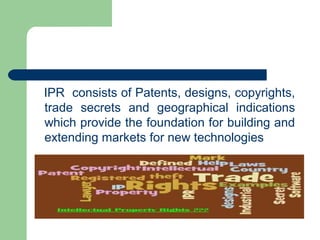
IPR (Intellectual Property Rights)
IPR consists of Patents, designs, copyrights,
trade secrets and geographical indications
which provide the foundation for building and
extending markets for new technologies
What comes under IPR

   Patent : is a monopoly right to the exclusive use of
    invention, granted to inventor or his assignee. This
    right is granted only for a limited period i.e. called the
    term of patent.
   Trademarks : is a visual symbol in the form of word,
    device, character attached to the goods for indicating
    their trade origin.
    Geographical indications: Qualities & characteristics
    of certain goods attributable to some geographical
    locations and reputable to as producer of certain
    items come under GI. (Oranges & Tea)
Legislations on IPR in INDIA

 The Patents Act, 1970 (2005)
 The Designs Act, 2000
 The Trade Marks Act, 1999
 The Geographical Indications of Goods Act,
  1999
 The Copyright Act, 1957 (2000)
Economic Development
    Economic development is the increase in the
 standard of living in a nation's population with
 sustained growth from a simple, low-income
 economy to a modern, high-income economy.
Link Between the two terms
IPR could well increase economic growth and foster
beneficial technical change, thereby improving
development prospects, if they are structured in a
manner that promotes effective and dynamic
competition .
How IPR helps in Economic
Development

   Intellectual property rights could play a significant
 role in encouraging innovation, product development,
 and technical change to help in development of the
 economy through low-cost imitation of foreign
 products and technologies. However, inadequate
 IPR could stifle technical change even at low levels
 of economic development because much invention
 and product innovation are aimed at local markets
 and could benefit from domestic protection of
 patents, utility models, and trade secrets.
Example

   Japanese patent system (JPS) affected postwar
 Japanese technical progress, as measured by
 increases in total factor productivity (TFP). The JPS
 in place over the estimation period 1960-1993
 evidently was designed to encourage incremental
 and adaptive innovation and diffusion of technical
 knowledge into the economy. That is they created
 new technology (in the form of IPR) that helped the
 Japanese economy to cover the post war losses.
Scenario for Poor Nations

  Recent studies suggest that innovation through
product development and entry of new firms is
motivated in part by trademark protection, even in
poor nations that helps their economy to grow. As
poor nations does not have the required resources
and infrastructure to support and do innovations
which are treated as IPR.
It is widely recognized by economists that imports of goods and
services could transfer and diffuse technology. Imports of
capital goods and technical inputs could directly reduce
production costs and raise productivity for the developed
countries by outsourcing the required services from low income
countries. this benefit would depend on the technological
content of imports, suggesting that close trade linkages with
innovative developed economies could engender considerable
productivity gains through trade flows.
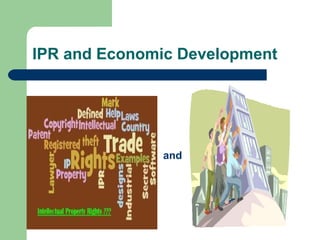
IPR and Economic Development


              and
There are two types of countries:
 a developed, innovating" North” and a developing, imitating
“South”, then the impact of stronger IPR protection benefits
the innovating North, but its impact in the South where
innovation is limited or non-existent is ambiguous, depending
on the channels through which technology is transferred.
Research indicates that stronger IPR protection is only found
to benefit the South when R&D is highly productive, thus
resulting in significant cost reductions, and when the South
comprises a large share of the overall market of the product.
Ways through which IPR helps in
Economic Development

Trade channel
 When technology is transferred through trade, then successful
 southern imitation results in shifting the competitive advantage
 for the production of imitated products from the North to the
 South.
Foreign direct investment channel
  When foreign direct investment (FDI) is considered as a source
  of technology transfer, northern innovators may shift production
  to the South, reducing competition for resources in the North .
Licensing channel
   If technology is transferred through licensing, stronger IPR
  protection in the South results in greater innovation in the
  North, and increased licensing to the South. Licensing has the
  advantage to northern firms of higher profits due to lower
  production costs in the South, but involves other costs in terms
  of contract negotiations, transferring the necessary technology
  and in the rents that the innovator must give to the licensee to
  discourage imitation.
Conclusion

Strong IPR protection will hinder rather than facilitate
technology transfer and indigenous learning activities in the
early stages of industrialization, when learning takes place
through reverse engineering and duplicative imitation of
mature foreign products. It is only after countries have
accumulated sufficient indigenous capabilities and an
extensive science and technology infrastructure capable of
undertaking creative imitation that IPR protection becomes an
important element in technology transfer and industrial
activities. Similarly, the development experience of India
indicates the importance of weak IPR protection in building up
local capabilities, even when countries are at very low levels
of development.

IPR and Economic Development

  • 1.
    IPR and Economic Development Ashutosh Sharma
  • 2.
    Meaning of boththe terms IPR (Intellectual Property Rights)
  • 3.
    IPR consists ofPatents, designs, copyrights, trade secrets and geographical indications which provide the foundation for building and extending markets for new technologies
  • 4.
    What comes underIPR  Patent : is a monopoly right to the exclusive use of invention, granted to inventor or his assignee. This right is granted only for a limited period i.e. called the term of patent.  Trademarks : is a visual symbol in the form of word, device, character attached to the goods for indicating their trade origin.  Geographical indications: Qualities & characteristics of certain goods attributable to some geographical locations and reputable to as producer of certain items come under GI. (Oranges & Tea)
  • 5.
    Legislations on IPRin INDIA  The Patents Act, 1970 (2005)  The Designs Act, 2000  The Trade Marks Act, 1999  The Geographical Indications of Goods Act, 1999  The Copyright Act, 1957 (2000)
  • 6.
    Economic Development Economic development is the increase in the standard of living in a nation's population with sustained growth from a simple, low-income economy to a modern, high-income economy.
  • 7.
  • 8.
    IPR could wellincrease economic growth and foster beneficial technical change, thereby improving development prospects, if they are structured in a manner that promotes effective and dynamic competition .
  • 9.
    How IPR helpsin Economic Development Intellectual property rights could play a significant role in encouraging innovation, product development, and technical change to help in development of the economy through low-cost imitation of foreign products and technologies. However, inadequate IPR could stifle technical change even at low levels of economic development because much invention and product innovation are aimed at local markets and could benefit from domestic protection of patents, utility models, and trade secrets.
  • 10.
    Example Japanese patent system (JPS) affected postwar Japanese technical progress, as measured by increases in total factor productivity (TFP). The JPS in place over the estimation period 1960-1993 evidently was designed to encourage incremental and adaptive innovation and diffusion of technical knowledge into the economy. That is they created new technology (in the form of IPR) that helped the Japanese economy to cover the post war losses.
  • 11.
    Scenario for PoorNations Recent studies suggest that innovation through product development and entry of new firms is motivated in part by trademark protection, even in poor nations that helps their economy to grow. As poor nations does not have the required resources and infrastructure to support and do innovations which are treated as IPR.
  • 12.
    It is widelyrecognized by economists that imports of goods and services could transfer and diffuse technology. Imports of capital goods and technical inputs could directly reduce production costs and raise productivity for the developed countries by outsourcing the required services from low income countries. this benefit would depend on the technological content of imports, suggesting that close trade linkages with innovative developed economies could engender considerable productivity gains through trade flows.
  • 13.
    IPR and EconomicDevelopment and
  • 14.
    There are twotypes of countries: a developed, innovating" North” and a developing, imitating “South”, then the impact of stronger IPR protection benefits the innovating North, but its impact in the South where innovation is limited or non-existent is ambiguous, depending on the channels through which technology is transferred. Research indicates that stronger IPR protection is only found to benefit the South when R&D is highly productive, thus resulting in significant cost reductions, and when the South comprises a large share of the overall market of the product.
  • 15.
    Ways through whichIPR helps in Economic Development Trade channel When technology is transferred through trade, then successful southern imitation results in shifting the competitive advantage for the production of imitated products from the North to the South.
  • 16.
    Foreign direct investmentchannel When foreign direct investment (FDI) is considered as a source of technology transfer, northern innovators may shift production to the South, reducing competition for resources in the North . Licensing channel If technology is transferred through licensing, stronger IPR protection in the South results in greater innovation in the North, and increased licensing to the South. Licensing has the advantage to northern firms of higher profits due to lower production costs in the South, but involves other costs in terms of contract negotiations, transferring the necessary technology and in the rents that the innovator must give to the licensee to discourage imitation.
  • 17.
    Conclusion Strong IPR protectionwill hinder rather than facilitate technology transfer and indigenous learning activities in the early stages of industrialization, when learning takes place through reverse engineering and duplicative imitation of mature foreign products. It is only after countries have accumulated sufficient indigenous capabilities and an extensive science and technology infrastructure capable of undertaking creative imitation that IPR protection becomes an important element in technology transfer and industrial activities. Similarly, the development experience of India indicates the importance of weak IPR protection in building up local capabilities, even when countries are at very low levels of development.