Transfection
-Protoplast fusion,
-Electroporation
Dr. R. S. Jadhav
Dept. of Microbiology
VNBN college, Shirala, (MS)
Introduction

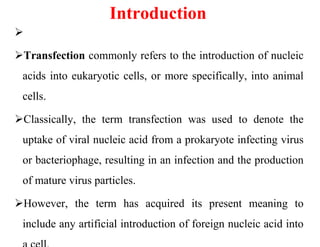
Transfection commonly refers to the introduction of nucleic
acids into eukaryotic cells, or more specifically, into animal
cells.
Classically, the term transfection was used to denote the
uptake of viral nucleic acid from a prokaryote infecting virus
or bacteriophage, resulting in an infection and the production
of mature virus particles.
However, the term has acquired its present meaning to
include any artificial introduction of foreign nucleic acid into
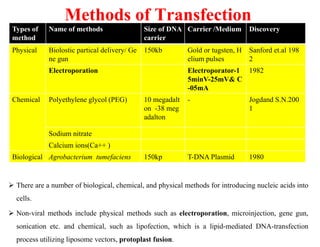
 There are a number of biological, chemical, and physical methods for introducing nucleic acids into
cells.
 Non-viral methods include physical methods such as electroporation, microinjection, gene gun,
sonication etc. and chemical, such as lipofection, which is a lipid-mediated DNA-transfection
process utilizing liposome vectors, protoplast fusion.
Methods of Transfection
Types of
method
Name of methods Size of DNA
carrier
Carrier /Medium Discovery
Physical Biolostic partical delivery/ Ge
ne gun
150kb Gold or tugsten, H
elium pulses
Sanford et.al 198
2
Electroporation Electroporator-1
5minV-25mV& C
-05mA
1982
Chemical Polyethylene glycol (PEG) 10 megadalt
on -38 meg
adalton
- Jogdand S.N.200
1
Sodium nitrate
Calcium ions(Ca++ )
Biological Agrobacterium tumefaciens 150kp T-DNA Plasmid 1980
Protoplasts are the cells of which cell walls are removed and
cytoplasmic membrane is the outermost layer in such cells.
During fusion two or more protoplasts come in contact and
adhere with one another either spontaneously or in presence of
fusion inducing agents.
Why to do Protoplast Fusion?
By protoplast fusion it is possible to transfer some useful genes
from one species to another.
Protoplast fusion is an important tools in strain improvement.
These are the powerful techniques for engineering of microbial
strains for desirable industrial properties.
Protoplast Fusion
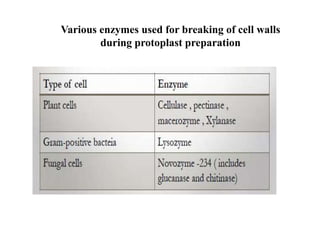
Various enzymes used for breaking of cell walls
during protoplast preparation
Methods of Protoplast fusion
Protoplast fusion can be broadly classified into two
categories:
1. Spontaneous fusion
2. Induced fusion (needs a fusion inducing chemicals):
a) Mechanical fusion
b) Chemofusion
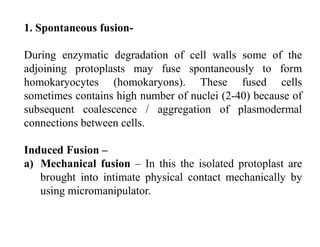
1. Spontaneous fusion-
During enzymatic degradation of cell walls some of the
adjoining protoplasts may fuse spontaneously to form
homokaryocytes (homokaryons). These fused cells
sometimes contains high number of nuclei (2-40) because of
subsequent coalescence / aggregation of plasmodermal
connections between cells.
Induced Fusion –
a) Mechanical fusion – In this the isolated protoplast are
brought into intimate physical contact mechanically by
using micromanipulator.
b) Chemofusion -
Several chemicals has been used to induced protoplast fusion
such as NaNo3, polyethylene glycol and Calcium ions.
Chemofusion is a non specific.
It is inexpensive.
Can cause massive fusion product.
Disadvantages: It can be cytotoxic and non selective and
having less fusion frequency.
Polyethylene glycol (PEG) treatment- Isolated protoplast in
culture medium (1ml) are mixed with equal volume (1ml) of
28-56% PEG in a tube. Tube is shaken and then allowed to
settle and settled protoplasts are washed several times with
culture medium during which fusion occurs.
NaNO3 treatment – Isolated protoplasts exposed to a mixture
of 5.5% NaNo3 in 10% sucrose solution. Incubation carried out
for 5 mins at 350C followed by centrifugation. Protoplast pellet
kept in water bath at 300C for 30 min. during which fusion
occurs.
Treatment with calcium ions (Ca++) –
The method consists of incubating protoplasts in a solution of
0.4 M mannitol containing 0.05 M CaCl2 at pH 10.5 (glycine-
NaOH buffer) at 370C for 30-40 min. Fusion occurs within 10
Minutes.
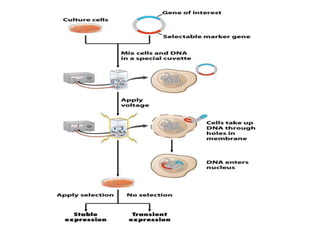
Electroporation, or electropermeabilization, is
a microbiology technique in which an electrical field is applied
to cells in order to increase the permeability of the cell
membrane, allowing chemicals, drugs, or DNA to be introduced
into the cell (also called electrotransfer).
The pore created are called as eletropores.
In microbiology, the process of electroporation is often used
to transform bacteria, yeast, or plant protoplasts by introducing
new coding DNA.
The cells are placed in a solution containing DNA and
subjected to electrical pulse to cause holes in the membrane.
The foreign DNA fragments enter through holes into the
cytoplasm and then to nucleus.
Electrofusion
Advantages of Electroporation
1. Method is fast.
2. Less costly.
3. Applied for a number of cell types.
4. Simultaneously a large number of cell can be treated.
5. High percentage of stable transformants can be produced.
Application
1. Improve the genetic properties of these strains using protoplast fusion
are attempt to develop methods for preparation and regeneration of
protoplasts.
2. Intraspecific protoplast fusion with polyethylene glycol 1000 in
Streptomyces griseoflavus to increase the production of
desferrioxamine B chelator that absorbs additional iron from the blood
of thalasemia patients.
3. Improve the quality of beer.
4. Improve an inducible cholesterol oxidase producing bacterium
Arthrobacter simplex.
Transfection

Transfection

  • 1.
    Transfection -Protoplast fusion, -Electroporation Dr. R.S. Jadhav Dept. of Microbiology VNBN college, Shirala, (MS)
  • 2.
    Introduction  Transfection commonly refersto the introduction of nucleic acids into eukaryotic cells, or more specifically, into animal cells. Classically, the term transfection was used to denote the uptake of viral nucleic acid from a prokaryote infecting virus or bacteriophage, resulting in an infection and the production of mature virus particles. However, the term has acquired its present meaning to include any artificial introduction of foreign nucleic acid into
  • 3.
     There area number of biological, chemical, and physical methods for introducing nucleic acids into cells.  Non-viral methods include physical methods such as electroporation, microinjection, gene gun, sonication etc. and chemical, such as lipofection, which is a lipid-mediated DNA-transfection process utilizing liposome vectors, protoplast fusion. Methods of Transfection Types of method Name of methods Size of DNA carrier Carrier /Medium Discovery Physical Biolostic partical delivery/ Ge ne gun 150kb Gold or tugsten, H elium pulses Sanford et.al 198 2 Electroporation Electroporator-1 5minV-25mV& C -05mA 1982 Chemical Polyethylene glycol (PEG) 10 megadalt on -38 meg adalton - Jogdand S.N.200 1 Sodium nitrate Calcium ions(Ca++ ) Biological Agrobacterium tumefaciens 150kp T-DNA Plasmid 1980
  • 4.
    Protoplasts are thecells of which cell walls are removed and cytoplasmic membrane is the outermost layer in such cells. During fusion two or more protoplasts come in contact and adhere with one another either spontaneously or in presence of fusion inducing agents. Why to do Protoplast Fusion? By protoplast fusion it is possible to transfer some useful genes from one species to another. Protoplast fusion is an important tools in strain improvement. These are the powerful techniques for engineering of microbial strains for desirable industrial properties. Protoplast Fusion
  • 5.
    Various enzymes usedfor breaking of cell walls during protoplast preparation
  • 6.
    Methods of Protoplastfusion Protoplast fusion can be broadly classified into two categories: 1. Spontaneous fusion 2. Induced fusion (needs a fusion inducing chemicals): a) Mechanical fusion b) Chemofusion
  • 7.
    1. Spontaneous fusion- Duringenzymatic degradation of cell walls some of the adjoining protoplasts may fuse spontaneously to form homokaryocytes (homokaryons). These fused cells sometimes contains high number of nuclei (2-40) because of subsequent coalescence / aggregation of plasmodermal connections between cells. Induced Fusion – a) Mechanical fusion – In this the isolated protoplast are brought into intimate physical contact mechanically by using micromanipulator.
  • 8.
    b) Chemofusion - Severalchemicals has been used to induced protoplast fusion such as NaNo3, polyethylene glycol and Calcium ions. Chemofusion is a non specific. It is inexpensive. Can cause massive fusion product. Disadvantages: It can be cytotoxic and non selective and having less fusion frequency.
  • 9.
    Polyethylene glycol (PEG)treatment- Isolated protoplast in culture medium (1ml) are mixed with equal volume (1ml) of 28-56% PEG in a tube. Tube is shaken and then allowed to settle and settled protoplasts are washed several times with culture medium during which fusion occurs. NaNO3 treatment – Isolated protoplasts exposed to a mixture of 5.5% NaNo3 in 10% sucrose solution. Incubation carried out for 5 mins at 350C followed by centrifugation. Protoplast pellet kept in water bath at 300C for 30 min. during which fusion occurs. Treatment with calcium ions (Ca++) – The method consists of incubating protoplasts in a solution of 0.4 M mannitol containing 0.05 M CaCl2 at pH 10.5 (glycine- NaOH buffer) at 370C for 30-40 min. Fusion occurs within 10 Minutes.
  • 10.
    Electroporation, or electropermeabilization,is a microbiology technique in which an electrical field is applied to cells in order to increase the permeability of the cell membrane, allowing chemicals, drugs, or DNA to be introduced into the cell (also called electrotransfer). The pore created are called as eletropores. In microbiology, the process of electroporation is often used to transform bacteria, yeast, or plant protoplasts by introducing new coding DNA. The cells are placed in a solution containing DNA and subjected to electrical pulse to cause holes in the membrane. The foreign DNA fragments enter through holes into the cytoplasm and then to nucleus. Electrofusion
  • 12.
    Advantages of Electroporation 1.Method is fast. 2. Less costly. 3. Applied for a number of cell types. 4. Simultaneously a large number of cell can be treated. 5. High percentage of stable transformants can be produced. Application 1. Improve the genetic properties of these strains using protoplast fusion are attempt to develop methods for preparation and regeneration of protoplasts. 2. Intraspecific protoplast fusion with polyethylene glycol 1000 in Streptomyces griseoflavus to increase the production of desferrioxamine B chelator that absorbs additional iron from the blood of thalasemia patients. 3. Improve the quality of beer. 4. Improve an inducible cholesterol oxidase producing bacterium Arthrobacter simplex.