DEPARTMENT OF ELECTROTHERAPY
AND ELECTRODIAGNOSIS
DATTA MEGHE COLLEGE OF
PHYSIOTHERAPY
LECTURE 1
DR. NEHA INGALE-
CHAUDHARY
MPT NEURO
PROFESSOR (HOD)
ND
T.E.N.S.
DEFINITION AND TYPES
PURPOSE OF LECTURE
 At the end of lecture students should understand
the definition and types of tens.
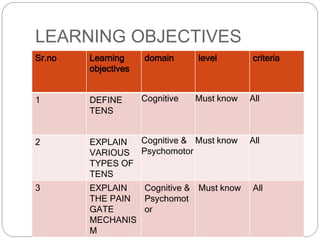
LEARNING OBJECTIVES
Sr.no Learning
objectives
domain level criteria
1 DEFINE
TENS
Cognitive Must know All
2 EXPLAIN
VARIOUS
TYPES OF
TENS
Cognitive &
Psychomotor
Must know All
3 EXPLAIN
THE PAIN
GATE
MECHANIS
M
Cognitive &
Psychomot
or
Must know All
WHAT IS TENS?
TENS
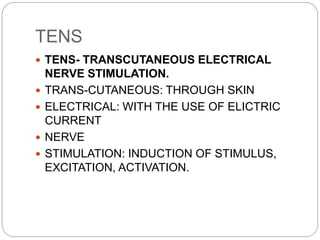
 TENS- TRANSCUTANEOUS ELECTRICAL
NERVE STIMULATION.
 TRANS-CUTANEOUS: THROUGH SKIN
 ELECTRICAL: WITH THE USE OF ELICTRIC
CURRENT
 NERVE
 STIMULATION: INDUCTION OF STIMULUS,
EXCITATION, ACTIVATION.
DEFINITION
It is the application of a pulsed
rectangular wave current via surface
electrode on the patient’s skin -
Clayton’s electrotherapy.
It is a simple noninvasive analgesic
technique used for the symptomatic
management of acute and
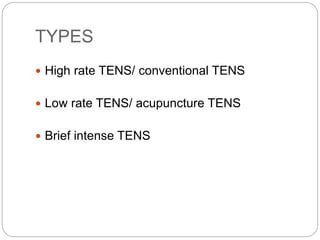
TYPES
 High rate TENS/ conventional TENS
 Low rate TENS/ acupuncture TENS
 Brief intense TENS
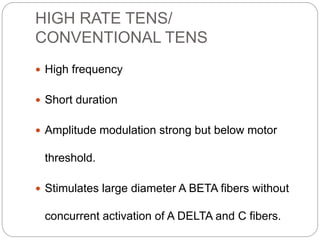
HIGH RATE TENS/
CONVENTIONAL TENS
 High frequency
 Short duration
 Amplitude modulation strong but below motor
threshold.
 Stimulates large diameter A BETA fibers without
concurrent activation of A DELTA and C fibers.
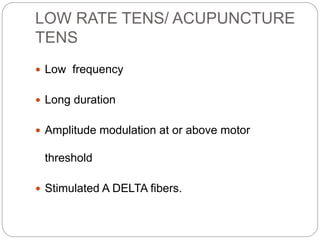
LOW RATE TENS/ ACUPUNCTURE
TENS
 Low frequency
 Long duration
 Amplitude modulation at or above motor
threshold
 Stimulated A DELTA fibers.
BRIEF / INTENSE TENS
 High frequency
 Long duration
 Amplitude modulation highest tolerable
 Stimulates small diameter noxious afferents
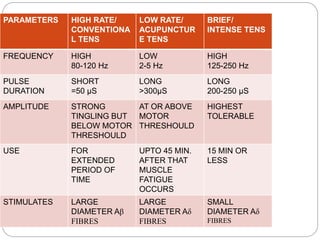
PARAMETERS HIGH RATE/
CONVENTIONA
L TENS
LOW RATE/
ACUPUNCTUR
E TENS
BRIEF/
INTENSE TENS
FREQUENCY HIGH
80-120 Hz
LOW
2-5 Hz
HIGH
125-250 Hz
PULSE
DURATION
SHORT
=50 µS
LONG
>300µS
LONG
200-250 µS
AMPLITUDE STRONG
TINGLING BUT
BELOW MOTOR
THRESHOULD
AT OR ABOVE
MOTOR
THRESHOULD
HIGHEST
TOLERABLE
USE FOR
EXTENDED
PERIOD OF
TIME
UPTO 45 MIN.
AFTER THAT
MUSCLE
FATIGUE
OCCURS
15 MIN OR
LESS
STIMULATES LARGE
DIAMETER Aβ
FIBRES
LARGE
DIAMETER Aδ
FIBRES
SMALL
DIAMETER Aδ
FIBRES
PAIN GATE MECHANISM
WHAT IS PAIN GATE
MECHANISM?
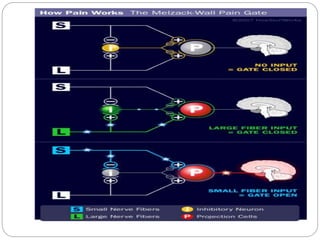
 Proposed by Melzack and Wall in 1965.
 The pain gate is supposed to be at substantia gelatinosa
and nucleus proprius of posterior horn of spinal cord.
 Pain gate closes at 3 levels:-
1. By traffic signal phenomenon
2. At the presynaptic level by –presynaptic inhibition.
3. Descending pain suppression systems -by release of
endorphins and enkaphelins by descending neurones of
PAG and Raphe nucleus.
REFERENCES
 Claytons electrotherapy edition 9
 Low and reed : edition 4
 Electrotherapy evidence based practice: 12th
edition.
THANK YOU…

TRANSCUTANEOUS ELECTRICAL NERVE STIMULATION 1.pptx

  • 1.
    DEPARTMENT OF ELECTROTHERAPY ANDELECTRODIAGNOSIS DATTA MEGHE COLLEGE OF PHYSIOTHERAPY
  • 2.
  • 3.
    DR. NEHA INGALE- CHAUDHARY MPTNEURO PROFESSOR (HOD) ND T.E.N.S. DEFINITION AND TYPES
  • 4.
    PURPOSE OF LECTURE At the end of lecture students should understand the definition and types of tens.
  • 5.
    LEARNING OBJECTIVES Sr.no Learning objectives domainlevel criteria 1 DEFINE TENS Cognitive Must know All 2 EXPLAIN VARIOUS TYPES OF TENS Cognitive & Psychomotor Must know All 3 EXPLAIN THE PAIN GATE MECHANIS M Cognitive & Psychomot or Must know All
  • 6.
  • 7.
    TENS  TENS- TRANSCUTANEOUSELECTRICAL NERVE STIMULATION.  TRANS-CUTANEOUS: THROUGH SKIN  ELECTRICAL: WITH THE USE OF ELICTRIC CURRENT  NERVE  STIMULATION: INDUCTION OF STIMULUS, EXCITATION, ACTIVATION.
  • 8.
    DEFINITION It is theapplication of a pulsed rectangular wave current via surface electrode on the patient’s skin - Clayton’s electrotherapy. It is a simple noninvasive analgesic technique used for the symptomatic management of acute and
  • 9.
    TYPES  High rateTENS/ conventional TENS  Low rate TENS/ acupuncture TENS  Brief intense TENS
  • 10.
    HIGH RATE TENS/ CONVENTIONALTENS  High frequency  Short duration  Amplitude modulation strong but below motor threshold.  Stimulates large diameter A BETA fibers without concurrent activation of A DELTA and C fibers.
  • 11.
    LOW RATE TENS/ACUPUNCTURE TENS  Low frequency  Long duration  Amplitude modulation at or above motor threshold  Stimulated A DELTA fibers.
  • 12.
    BRIEF / INTENSETENS  High frequency  Long duration  Amplitude modulation highest tolerable  Stimulates small diameter noxious afferents
  • 13.
    PARAMETERS HIGH RATE/ CONVENTIONA LTENS LOW RATE/ ACUPUNCTUR E TENS BRIEF/ INTENSE TENS FREQUENCY HIGH 80-120 Hz LOW 2-5 Hz HIGH 125-250 Hz PULSE DURATION SHORT =50 µS LONG >300µS LONG 200-250 µS AMPLITUDE STRONG TINGLING BUT BELOW MOTOR THRESHOULD AT OR ABOVE MOTOR THRESHOULD HIGHEST TOLERABLE USE FOR EXTENDED PERIOD OF TIME UPTO 45 MIN. AFTER THAT MUSCLE FATIGUE OCCURS 15 MIN OR LESS STIMULATES LARGE DIAMETER Aβ FIBRES LARGE DIAMETER Aδ FIBRES SMALL DIAMETER Aδ FIBRES
  • 14.
    PAIN GATE MECHANISM WHATIS PAIN GATE MECHANISM?
  • 15.
     Proposed byMelzack and Wall in 1965.  The pain gate is supposed to be at substantia gelatinosa and nucleus proprius of posterior horn of spinal cord.  Pain gate closes at 3 levels:- 1. By traffic signal phenomenon 2. At the presynaptic level by –presynaptic inhibition. 3. Descending pain suppression systems -by release of endorphins and enkaphelins by descending neurones of PAG and Raphe nucleus.
  • 17.
    REFERENCES  Claytons electrotherapyedition 9  Low and reed : edition 4  Electrotherapy evidence based practice: 12th edition.
  • 18.