2020
MOHAMMED ABDULLATEEF
MOHAMMED ALI
DOCTOR
mohammedchina@gmail.com
Saad Salih Mahdi
‫مهدي‬ ‫صالح‬ ‫سعد‬
Second stage
Group : A
saadiylep@ced.nahrainuniv.edu.iq
Activation of gene expression
by transcription factors
Supervisors:
Transcription factor glossary
 gene expression – the process bywhich information from a gene is used in the synthesis of a
functional gene productsuch as a protein
 transcription – the process ofmaking messenger RNA (mRNA) from a DNA template by RNA
polymerase
 transcription factor – a protein that binds to DNA and regulates gene expression by promoting
or suppressing transcription
 transcriptional regulation – controlling the rate of gene transcription for example by helping or
hindering RNA polymerase binding to DNA
 upregulation, activation, or promotion – increase the rate of gene transcription
 downregulation, repression, or suppression – decrease the rate of gene transcription
 coactivator – a protein that works with transcription factors to increase the rate of gene
transcription
 corepressor – a protein that works with transcription factors to decrease the rate of gene
transcription
 responseelement – a specific sequence of DNA that a transcription factor binds to
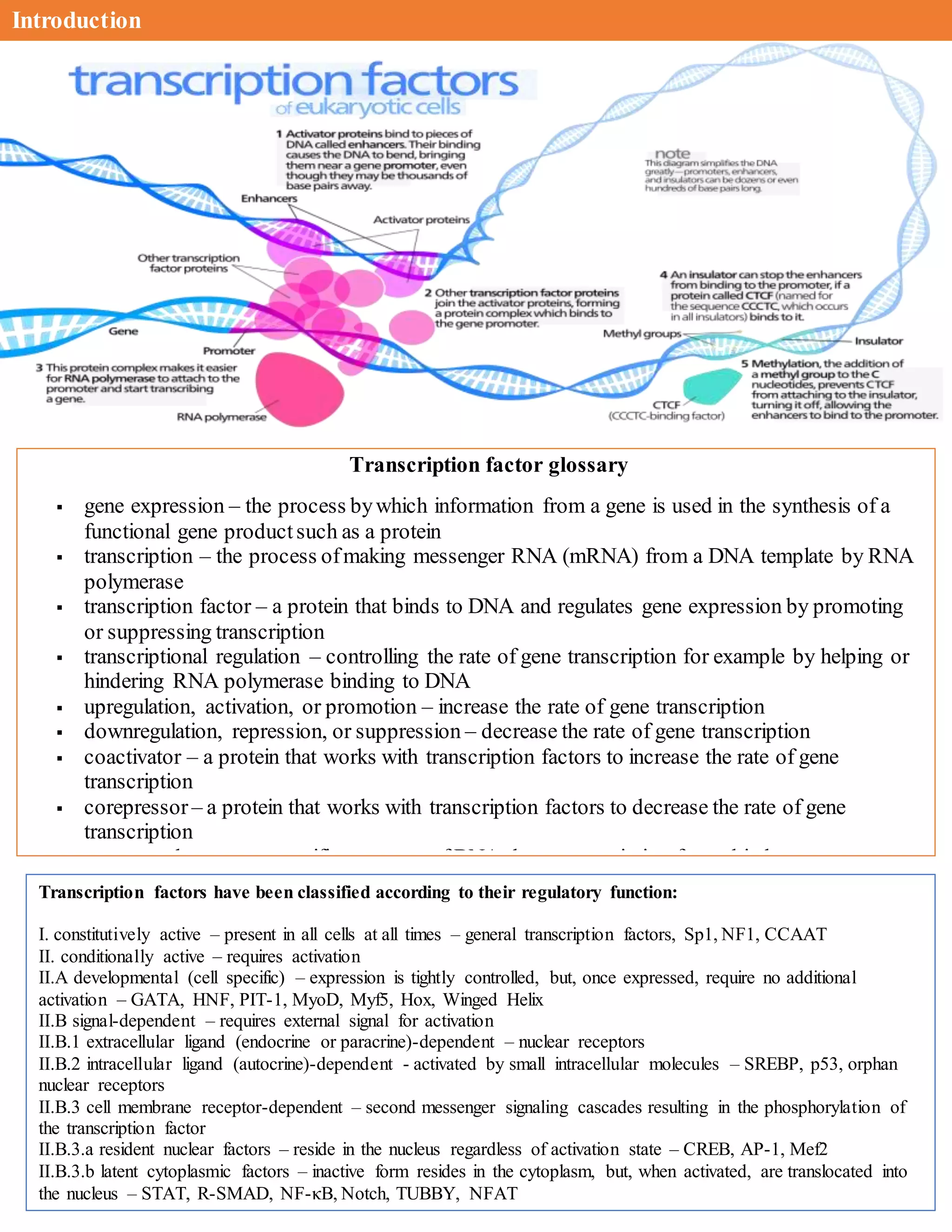
Introduction
Transcription factors have been classified according to their regulatory function:
I. constitutively active – present in all cells at all times – general transcription factors, Sp1, NF1, CCAAT
II. conditionally active – requires activation
II.A developmental (cell specific) – expression is tightly controlled, but, once expressed, require no additional
activation – GATA, HNF, PIT-1, MyoD, Myf5, Hox, Winged Helix
II.B signal-dependent – requires external signal for activation
II.B.1 extracellular ligand (endocrine or paracrine)-dependent – nuclear receptors
II.B.2 intracellular ligand (autocrine)-dependent - activated by small intracellular molecules – SREBP, p53, orphan
nuclear receptors
II.B.3 cell membrane receptor-dependent – second messenger signaling cascades resulting in the phosphorylation of
the transcription factor
II.B.3.a resident nuclear factors – reside in the nucleus regardless of activation state – CREB, AP-1, Mef2
II.B.3.b latent cytoplasmic factors – inactive form resides in the cytoplasm, but, when activated, are translocated into
the nucleus – STAT, R-SMAD, NF-κB, Notch, TUBBY, NFAT
Transcription
Key Points
 The purpose of the promoter is to bind transcription factors that control the initiation of transcription.
 The promoter region can be short or quite long; the longer the promoter is, the more available space for proteins to bind.
 To initiate transcription, a transcription factor (TFIID) binds to the TATA box, which causes other transcription factors
to subsequently bind to the TATA box.
 Once the transcription initiation complex is assembled, RNA polymerase can bind to its upstream sequence and is then
phosphorylated.
 Phosphorylation of RNA polymerase releases part of the protein from the DNA to activate the transcription initiation
complex and places RNA polymerase in the correct orientation to begin transcription.
 Transcription factors respond to environmental stimuli that cause the proteins to find their binding sites and initiate
transcription of the gene that is needed.
Key Terms
 TATA box: a DNA sequence (cis-regulatory element) found in the promoter region of genes in archaea and eukaryotes
 transcription factor: a protein that binds to specific DNA sequences,thereby controlling the flow (or transcription) of
genetic information from DNA to mRNA
 promoter: the section of DNA that controls the initiation of RNA transcription
The Promoterand the TranscriptionMachinery
 Genes are organized to make the control of gene expression easier. The promoter region is immediately upstream of the
coding sequence. This region can be short (only a few nucleotides in length) or quite long (hundreds of nucleotides
long). The longer the promoter, the more available space for proteins to bind. This also adds more control to the
transcription process. The length of the promoter is gene-specific and can differ dramatically between genes.
Consequently, the level of control of gene expression can also differ quite dramatically between genes. The purpose of
the promoter is to bind transcription factors that control the initiation of transcription.
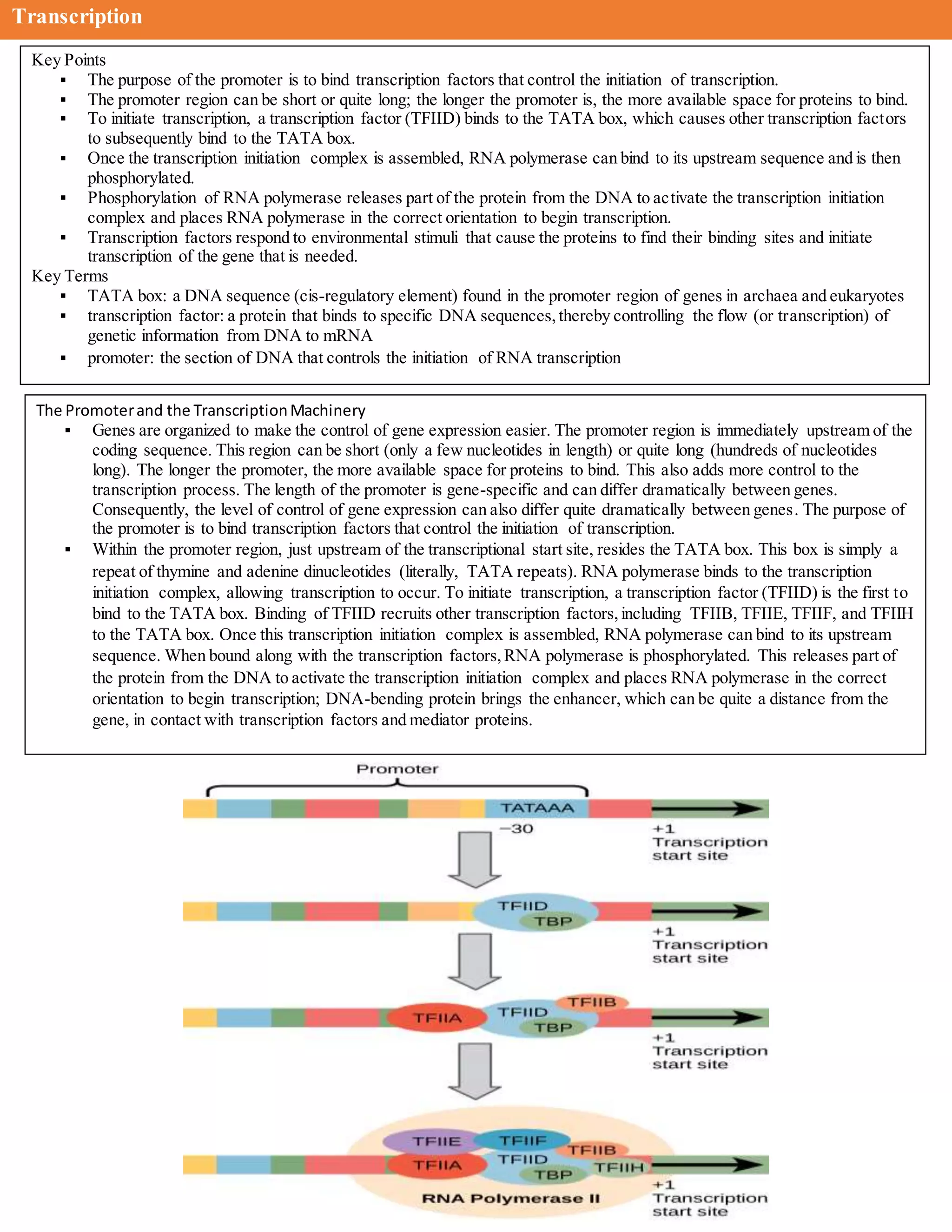
 Within the promoter region, just upstream of the transcriptional start site, resides the TATA box. This box is simply a
repeat of thymine and adenine dinucleotides (literally, TATA repeats). RNA polymerase binds to the transcription
initiation complex, allowing transcription to occur. To initiate transcription, a transcription factor (TFIID) is the first to
bind to the TATA box. Binding of TFIID recruits other transcription factors,including TFIIB, TFIIE, TFIIF, and TFIIH
to the TATA box. Once this transcription initiation complex is assembled, RNA polymerase can bind to its upstream
sequence. When bound along with the transcription factors,RNA polymerase is phosphorylated. This releases part of
the protein from the DNA to activate the transcription initiation complex and places RNA polymerase in the correct
orientation to begin transcription; DNA-bending protein brings the enhancer, which can be quite a distance from the
gene, in contact with transcription factors and mediator proteins.
TranscriptionalEnhancers and Repressors
Key Points
 Enhancers can be located upstream of a gene, within the coding region of the gene, downstream of a gene, or
thousands of nucleotides away.
 When a DNA -bending protein binds to the enhancer, the shape of the DNA changes, which allows interactions
between the activators and transcription factors to occur.
 Repressors respond to external stimuli to prevent the binding of activating transcription factors.
 Corepressors can repress transcriptional initiation by recruiting histone deacetylase.
 Histone deacetylation increases the positive charge on histones, which strengthens the interaction between the
histones and DNA, making the DNA less accessible to transcription.
Key Terms
 enhancer: a short region of DNA that can increase transcription of genes
 repressor: any protein that binds to DNA and thus regulates the expression of genes by decreasing the rate of
transcription
 activator: any chemical or agent which regulates one or more genes by increasing the rate of transcription
Enhancers and Transcription
 In some eukaryotic genes, there are regions that help increase or enhance transcription. These regions, called
enhancers, are not necessarily close to the genes they enhance. They can be located upstream of a gene,
within the coding region of the gene, downstream of a gene, or may be thousands of nucleotides away.
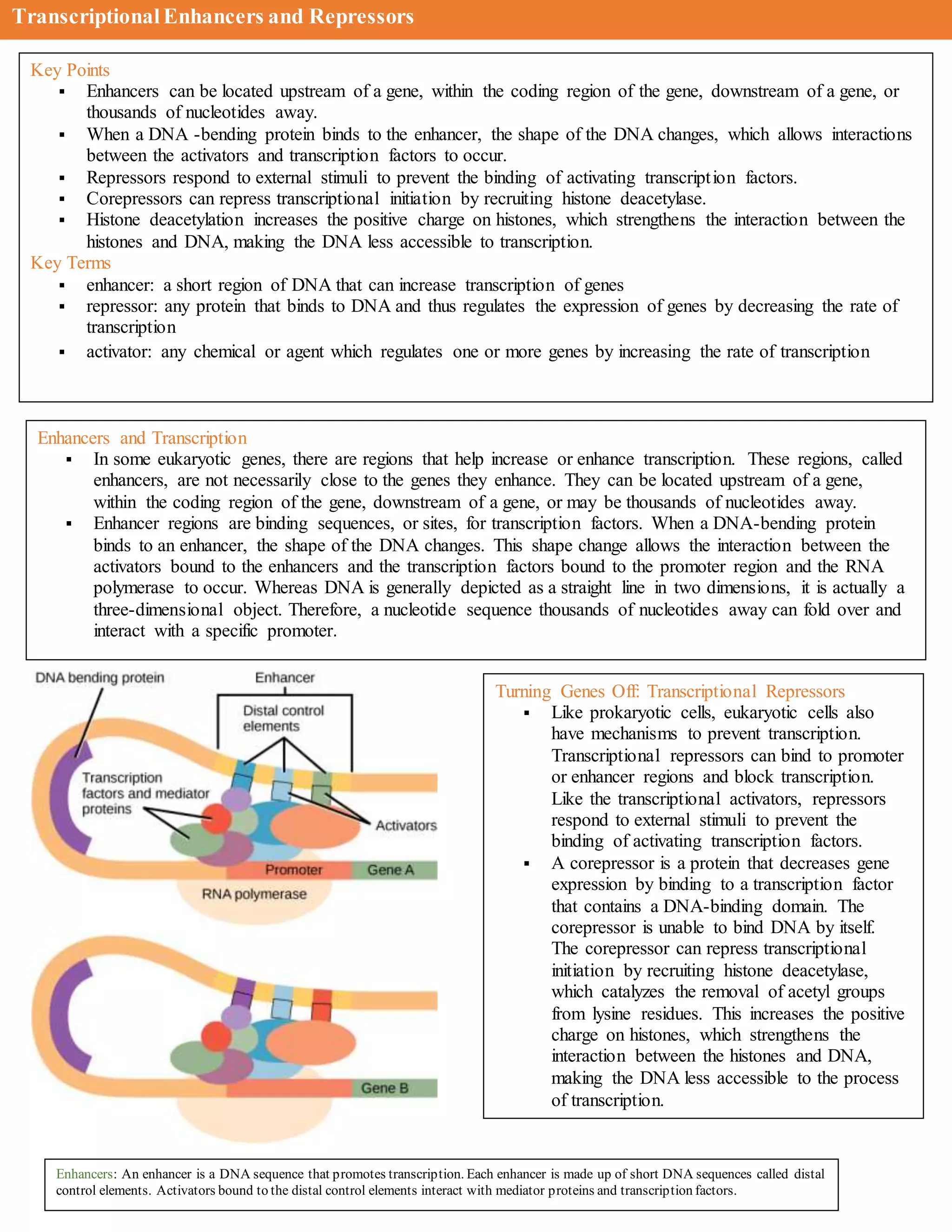
 Enhancer regions are binding sequences, or sites, for transcription factors. When a DNA-bending protein
binds to an enhancer, the shape of the DNA changes. This shape change allows the interaction between the
activators bound to the enhancers and the transcription factors bound to the promoter region and the RNA
polymerase to occur. Whereas DNA is generally depicted as a straight line in two dimensions, it is actually a
three-dimensional object. Therefore, a nucleotide sequence thousands of nucleotides away can fold over and
interact with a specific promoter.
Enhancers: An enhancer is a DNA sequence that promotes transcription. Each enhancer is made up of short DNA sequences called distal
control elements. Activators bound to the distal control elements interact with mediator proteins and transcription factors.
Turning Genes Off: Transcriptional Repressors
 Like prokaryotic cells, eukaryotic cells also
have mechanisms to prevent transcription.
Transcriptional repressors can bind to promoter
or enhancer regions and block transcription.
Like the transcriptional activators, repressors
respond to external stimuli to prevent the
binding of activating transcription factors.
 A corepressor is a protein that decreases gene
expression by binding to a transcription factor
that contains a DNA-binding domain. The
corepressor is unable to bind DNA by itself.
The corepressor can repress transcriptional
initiation by recruiting histone deacetylase,
which catalyzes the removal of acetyl groups
from lysine residues. This increases the positive
charge on histones, which strengthens the
interaction between the histones and DNA,
making the DNA less accessible to the process
of transcription.
So, what is activator?
Activator (genetics)
 A transcriptional activator is a protein (transcription factor) that increases gene
transcription of a gene or set of genes. Most activators are DNA-binding proteins that bind
to enhancers or promoter-proximal elements.
 Most activators function by binding sequence-specifically to a DNA site located in or near
a promoter and making protein–protein interactions with the general transcription
machinery (RNA polymerase and general transcription factors), thereby facilitating the
binding of the general transcription machinery to the promoter. The DNA site bound by
the activator is referred to as an "activator site". The part of the activator that makes
protein–protein interactions with the general transcription machinery is referred to as an
"activating region". The part of the general transcription machinery that makes protein–
protein interactions with the activator is referred to as an "activation target".
The catabolite activator protein (CAP; also known as cAMP receptor protein, CRP)activates
transcription at the lac operon of the bacterium Escherichia coli.[1] Cyclic adenosine monophosphate
(cAMP) is produced during glucose starvation, binds to CAP, causes a conformational change that
allows CAP to bind to a DNA site located adjacent to the lac promoter. CAP then makes a direct
protein–protein interaction with RNA polymerase that recruits RNA polymerase to the lac promoter.
Gene Expression
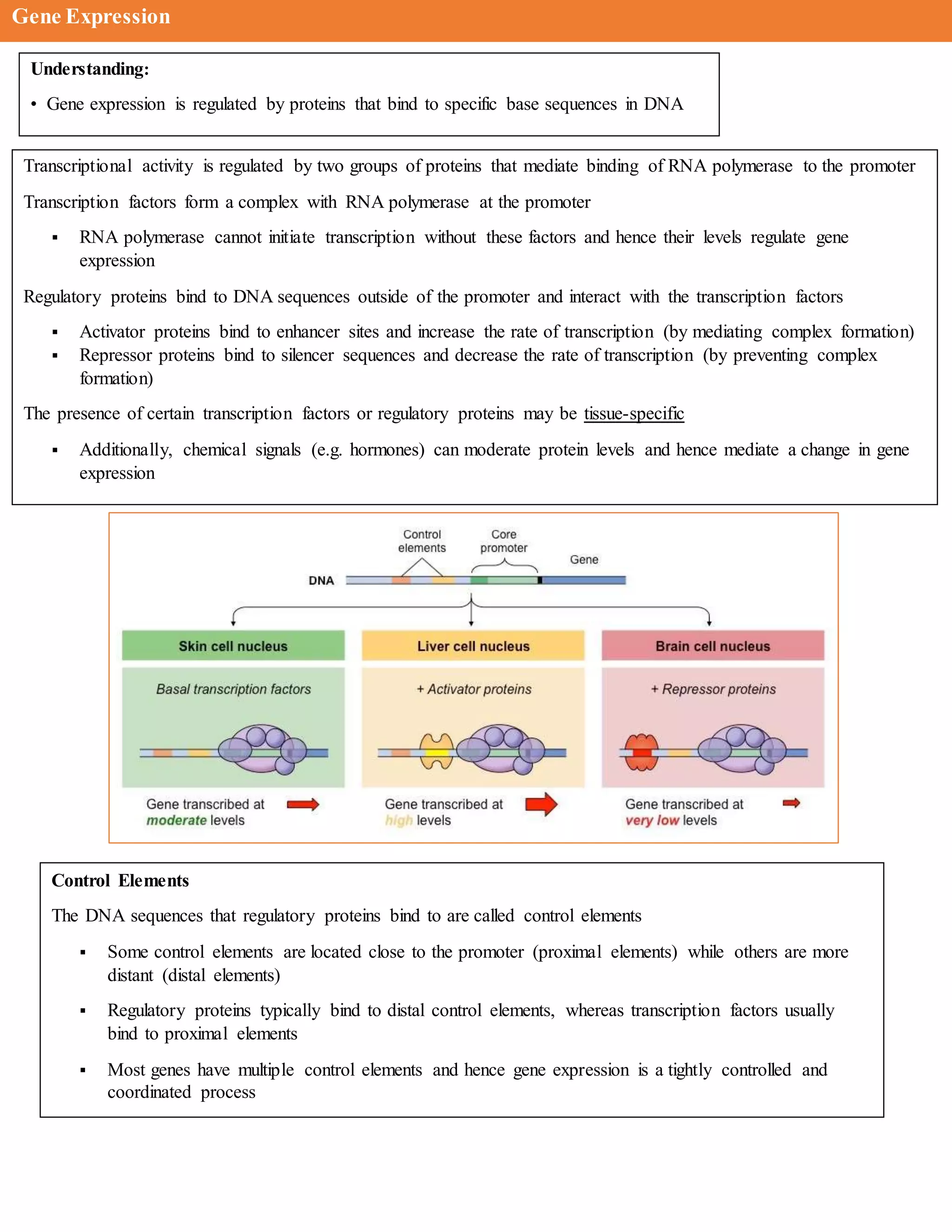
Understanding:
• Gene expression is regulated by proteins that bind to specific base sequences in DNA
Transcriptional activity is regulated by two groups of proteins that mediate binding of RNA polymerase to the promoter
Transcription factors form a complex with RNA polymerase at the promoter
 RNA polymerase cannot initiate transcription without these factors and hence their levels regulate gene
expression
Regulatory proteins bind to DNA sequences outside of the promoter and interact with the transcription factors
 Activator proteins bind to enhancer sites and increase the rate of transcription (by mediating complex formation)
 Repressor proteins bind to silencer sequences and decrease the rate of transcription (by preventing complex
formation)
The presence of certain transcription factors or regulatory proteins may be tissue-specific
 Additionally, chemical signals (e.g. hormones) can moderate protein levels and hence mediate a change in gene
expression
Control Elements
The DNA sequences that regulatory proteins bind to are called control elements
 Some control elements are located close to the promoter (proximal elements) while others are more
distant (distal elements)
 Regulatory proteins typically bind to distal control elements, whereas transcription factors usually
bind to proximal elements
 Most genes have multiple control elements and hence gene expression is a tightly controlled and
coordinated process
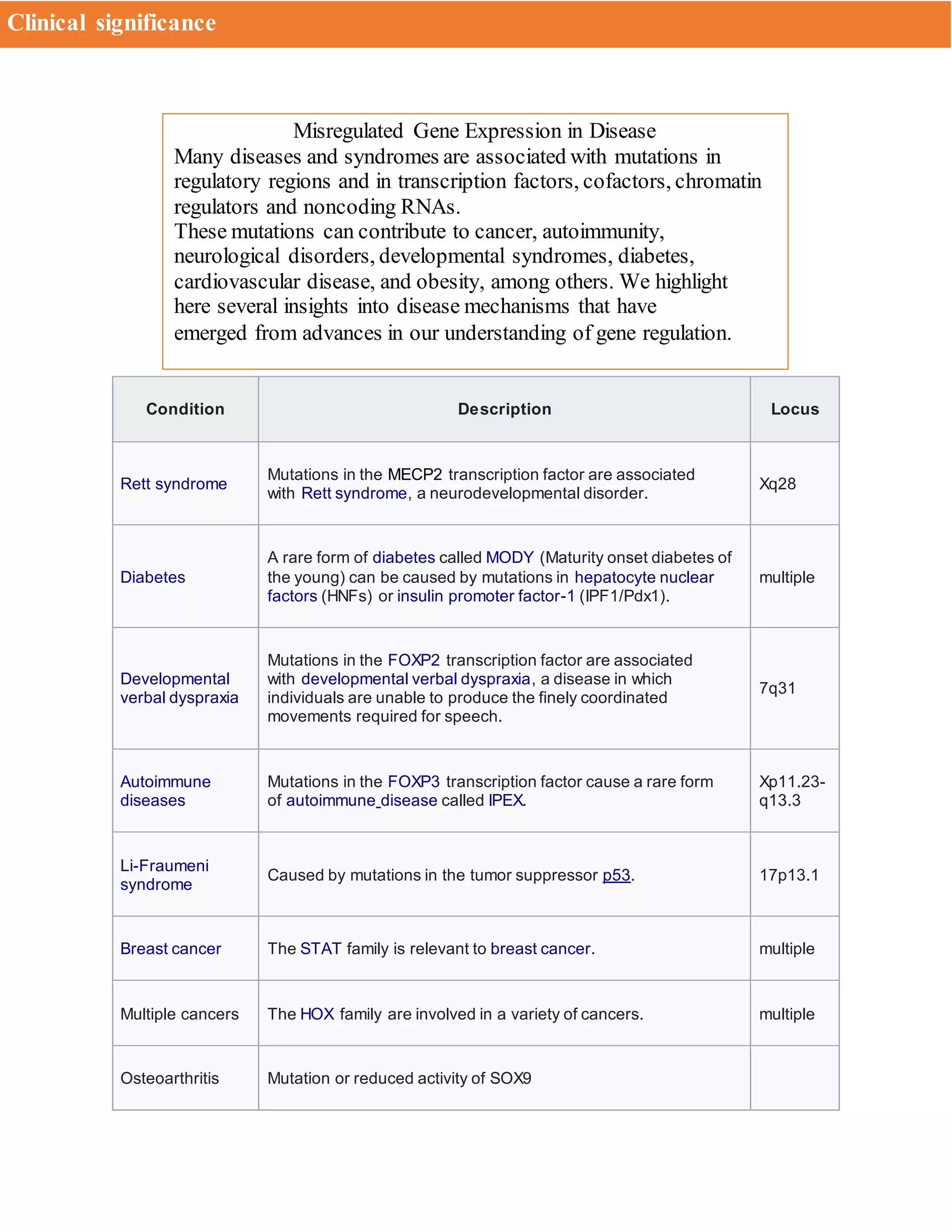
Condition Description Locus
Rett syndrome
Mutations in the MECP2 transcription factor are associated
with Rett syndrome, a neurodevelopmental disorder.
Xq28
Diabetes
A rare form of diabetes called MODY (Maturity onset diabetes of
the young) can be caused by mutations in hepatocyte nuclear
factors (HNFs) or insulin promoter factor-1 (IPF1/Pdx1).
multiple
Developmental
verbal dyspraxia
Mutations in the FOXP2 transcription factor are associated
with developmental verbal dyspraxia, a disease in which
individuals are unable to produce the finely coordinated
movements required for speech.
7q31
Autoimmune
diseases
Mutations in the FOXP3 transcription factor cause a rare form
of autoimmune disease called IPEX.
Xp11.23-
q13.3
Li-Fraumeni
syndrome
Caused by mutations in the tumor suppressor p53. 17p13.1
Breast cancer The STAT family is relevant to breast cancer. multiple
Multiple cancers The HOX family are involved in a variety of cancers. multiple
Osteoarthritis Mutation or reduced activity of SOX9
Misregulated Gene Expression in Disease
Many diseases and syndromes are associated with mutations in
regulatory regions and in transcription factors, cofactors, chromatin
regulators and noncoding RNAs.
These mutations can contribute to cancer, autoimmunity,
neurological disorders, developmental syndromes, diabetes,
cardiovascular disease, and obesity, among others. We highlight
here several insights into disease mechanisms that have
emerged from advances in our understanding of gene regulation.
Clinical significance
01 02
03 04
05 06
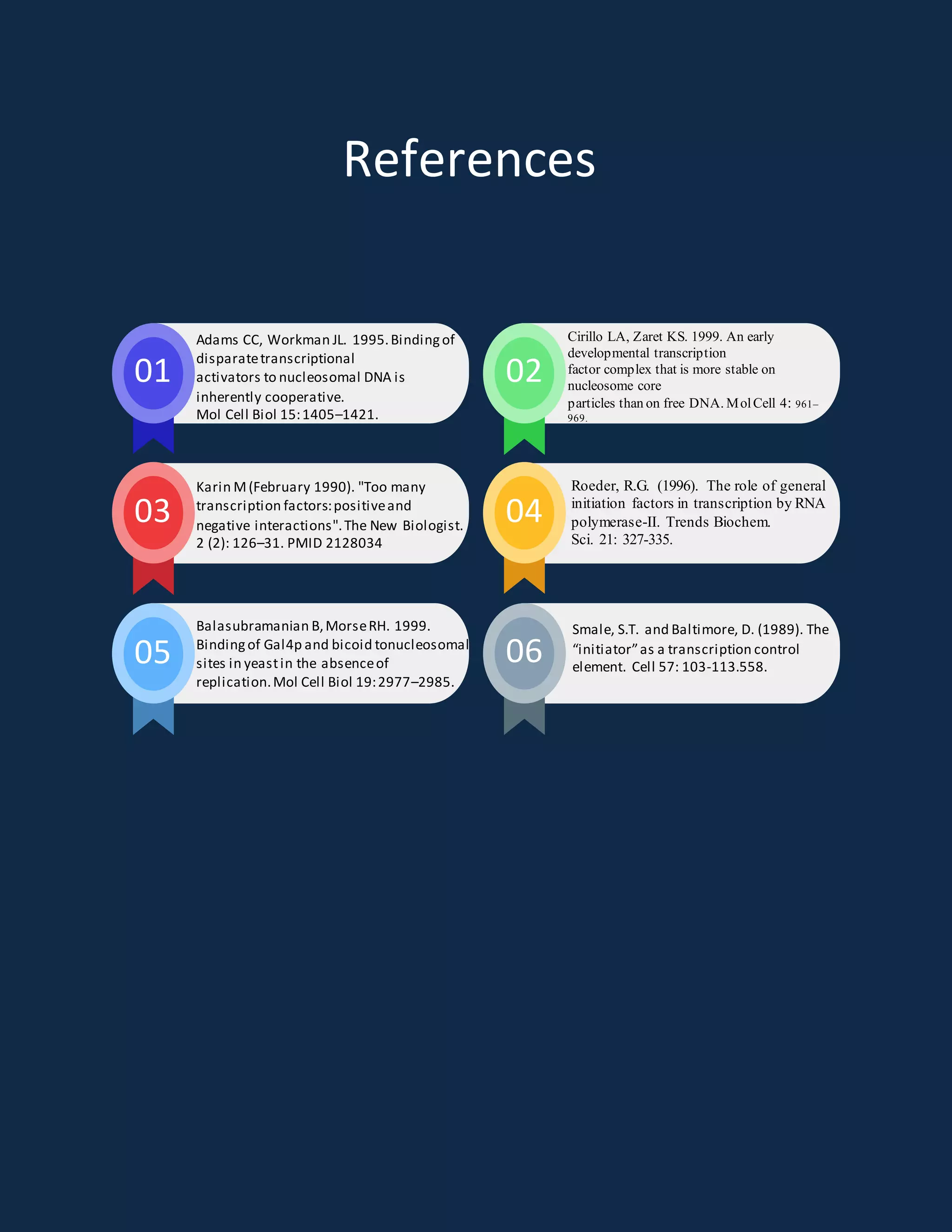
References
Adams CC, Workman JL. 1995.Bindingof
disparatetranscriptional
activators to nucleosomal DNA is
inherently cooperative.
Mol Cell Biol 15:1405–1421.
Karin M(February 1990). "Too many
transcription factors:positiveand
negative interactions".The New Biologist.
2 (2): 126–31. PMID 2128034
Balasubramanian B,MorseRH. 1999.
Bindingof Gal4p and bicoid tonucleosomal
sites in yeastin the absenceof
replication.Mol Cell Biol 19:2977–2985.
Smale, S.T. and Baltimore, D. (1989). The
“initiator”as a transcription control
element. Cell 57: 103-113.558.
Roeder, R.G. (1996). The role of general
initiation factors in transcription by RNA
polymerase-II. Trends Biochem.
Sci. 21: 327-335.
Cirillo LA, Zaret KS. 1999. An early
developmental transcription
factor complex that is more stable on
nucleosome core
particles than on free DNA. MolCell 4: 961–
969.

Activation of gene expression by transcription factors

  • 1.
    2020 MOHAMMED ABDULLATEEF MOHAMMED ALI DOCTOR mohammedchina@gmail.com SaadSalih Mahdi ‫مهدي‬ ‫صالح‬ ‫سعد‬ Second stage Group : A saadiylep@ced.nahrainuniv.edu.iq Activation of gene expression by transcription factors Supervisors:
  • 2.
    Transcription factor glossary gene expression – the process bywhich information from a gene is used in the synthesis of a functional gene productsuch as a protein  transcription – the process ofmaking messenger RNA (mRNA) from a DNA template by RNA polymerase  transcription factor – a protein that binds to DNA and regulates gene expression by promoting or suppressing transcription  transcriptional regulation – controlling the rate of gene transcription for example by helping or hindering RNA polymerase binding to DNA  upregulation, activation, or promotion – increase the rate of gene transcription  downregulation, repression, or suppression – decrease the rate of gene transcription  coactivator – a protein that works with transcription factors to increase the rate of gene transcription  corepressor – a protein that works with transcription factors to decrease the rate of gene transcription  responseelement – a specific sequence of DNA that a transcription factor binds to Introduction Transcription factors have been classified according to their regulatory function: I. constitutively active – present in all cells at all times – general transcription factors, Sp1, NF1, CCAAT II. conditionally active – requires activation II.A developmental (cell specific) – expression is tightly controlled, but, once expressed, require no additional activation – GATA, HNF, PIT-1, MyoD, Myf5, Hox, Winged Helix II.B signal-dependent – requires external signal for activation II.B.1 extracellular ligand (endocrine or paracrine)-dependent – nuclear receptors II.B.2 intracellular ligand (autocrine)-dependent - activated by small intracellular molecules – SREBP, p53, orphan nuclear receptors II.B.3 cell membrane receptor-dependent – second messenger signaling cascades resulting in the phosphorylation of the transcription factor II.B.3.a resident nuclear factors – reside in the nucleus regardless of activation state – CREB, AP-1, Mef2 II.B.3.b latent cytoplasmic factors – inactive form resides in the cytoplasm, but, when activated, are translocated into the nucleus – STAT, R-SMAD, NF-κB, Notch, TUBBY, NFAT
  • 3.
    Transcription Key Points  Thepurpose of the promoter is to bind transcription factors that control the initiation of transcription.  The promoter region can be short or quite long; the longer the promoter is, the more available space for proteins to bind.  To initiate transcription, a transcription factor (TFIID) binds to the TATA box, which causes other transcription factors to subsequently bind to the TATA box.  Once the transcription initiation complex is assembled, RNA polymerase can bind to its upstream sequence and is then phosphorylated.  Phosphorylation of RNA polymerase releases part of the protein from the DNA to activate the transcription initiation complex and places RNA polymerase in the correct orientation to begin transcription.  Transcription factors respond to environmental stimuli that cause the proteins to find their binding sites and initiate transcription of the gene that is needed. Key Terms  TATA box: a DNA sequence (cis-regulatory element) found in the promoter region of genes in archaea and eukaryotes  transcription factor: a protein that binds to specific DNA sequences,thereby controlling the flow (or transcription) of genetic information from DNA to mRNA  promoter: the section of DNA that controls the initiation of RNA transcription The Promoterand the TranscriptionMachinery  Genes are organized to make the control of gene expression easier. The promoter region is immediately upstream of the coding sequence. This region can be short (only a few nucleotides in length) or quite long (hundreds of nucleotides long). The longer the promoter, the more available space for proteins to bind. This also adds more control to the transcription process. The length of the promoter is gene-specific and can differ dramatically between genes. Consequently, the level of control of gene expression can also differ quite dramatically between genes. The purpose of the promoter is to bind transcription factors that control the initiation of transcription.  Within the promoter region, just upstream of the transcriptional start site, resides the TATA box. This box is simply a repeat of thymine and adenine dinucleotides (literally, TATA repeats). RNA polymerase binds to the transcription initiation complex, allowing transcription to occur. To initiate transcription, a transcription factor (TFIID) is the first to bind to the TATA box. Binding of TFIID recruits other transcription factors,including TFIIB, TFIIE, TFIIF, and TFIIH to the TATA box. Once this transcription initiation complex is assembled, RNA polymerase can bind to its upstream sequence. When bound along with the transcription factors,RNA polymerase is phosphorylated. This releases part of the protein from the DNA to activate the transcription initiation complex and places RNA polymerase in the correct orientation to begin transcription; DNA-bending protein brings the enhancer, which can be quite a distance from the gene, in contact with transcription factors and mediator proteins.
  • 4.
    TranscriptionalEnhancers and Repressors KeyPoints  Enhancers can be located upstream of a gene, within the coding region of the gene, downstream of a gene, or thousands of nucleotides away.  When a DNA -bending protein binds to the enhancer, the shape of the DNA changes, which allows interactions between the activators and transcription factors to occur.  Repressors respond to external stimuli to prevent the binding of activating transcription factors.  Corepressors can repress transcriptional initiation by recruiting histone deacetylase.  Histone deacetylation increases the positive charge on histones, which strengthens the interaction between the histones and DNA, making the DNA less accessible to transcription. Key Terms  enhancer: a short region of DNA that can increase transcription of genes  repressor: any protein that binds to DNA and thus regulates the expression of genes by decreasing the rate of transcription  activator: any chemical or agent which regulates one or more genes by increasing the rate of transcription Enhancers and Transcription  In some eukaryotic genes, there are regions that help increase or enhance transcription. These regions, called enhancers, are not necessarily close to the genes they enhance. They can be located upstream of a gene, within the coding region of the gene, downstream of a gene, or may be thousands of nucleotides away.  Enhancer regions are binding sequences, or sites, for transcription factors. When a DNA-bending protein binds to an enhancer, the shape of the DNA changes. This shape change allows the interaction between the activators bound to the enhancers and the transcription factors bound to the promoter region and the RNA polymerase to occur. Whereas DNA is generally depicted as a straight line in two dimensions, it is actually a three-dimensional object. Therefore, a nucleotide sequence thousands of nucleotides away can fold over and interact with a specific promoter. Enhancers: An enhancer is a DNA sequence that promotes transcription. Each enhancer is made up of short DNA sequences called distal control elements. Activators bound to the distal control elements interact with mediator proteins and transcription factors. Turning Genes Off: Transcriptional Repressors  Like prokaryotic cells, eukaryotic cells also have mechanisms to prevent transcription. Transcriptional repressors can bind to promoter or enhancer regions and block transcription. Like the transcriptional activators, repressors respond to external stimuli to prevent the binding of activating transcription factors.  A corepressor is a protein that decreases gene expression by binding to a transcription factor that contains a DNA-binding domain. The corepressor is unable to bind DNA by itself. The corepressor can repress transcriptional initiation by recruiting histone deacetylase, which catalyzes the removal of acetyl groups from lysine residues. This increases the positive charge on histones, which strengthens the interaction between the histones and DNA, making the DNA less accessible to the process of transcription.
  • 5.
    So, what isactivator? Activator (genetics)  A transcriptional activator is a protein (transcription factor) that increases gene transcription of a gene or set of genes. Most activators are DNA-binding proteins that bind to enhancers or promoter-proximal elements.  Most activators function by binding sequence-specifically to a DNA site located in or near a promoter and making protein–protein interactions with the general transcription machinery (RNA polymerase and general transcription factors), thereby facilitating the binding of the general transcription machinery to the promoter. The DNA site bound by the activator is referred to as an "activator site". The part of the activator that makes protein–protein interactions with the general transcription machinery is referred to as an "activating region". The part of the general transcription machinery that makes protein– protein interactions with the activator is referred to as an "activation target". The catabolite activator protein (CAP; also known as cAMP receptor protein, CRP)activates transcription at the lac operon of the bacterium Escherichia coli.[1] Cyclic adenosine monophosphate (cAMP) is produced during glucose starvation, binds to CAP, causes a conformational change that allows CAP to bind to a DNA site located adjacent to the lac promoter. CAP then makes a direct protein–protein interaction with RNA polymerase that recruits RNA polymerase to the lac promoter.
  • 6.
    Gene Expression Understanding: • Geneexpression is regulated by proteins that bind to specific base sequences in DNA Transcriptional activity is regulated by two groups of proteins that mediate binding of RNA polymerase to the promoter Transcription factors form a complex with RNA polymerase at the promoter  RNA polymerase cannot initiate transcription without these factors and hence their levels regulate gene expression Regulatory proteins bind to DNA sequences outside of the promoter and interact with the transcription factors  Activator proteins bind to enhancer sites and increase the rate of transcription (by mediating complex formation)  Repressor proteins bind to silencer sequences and decrease the rate of transcription (by preventing complex formation) The presence of certain transcription factors or regulatory proteins may be tissue-specific  Additionally, chemical signals (e.g. hormones) can moderate protein levels and hence mediate a change in gene expression Control Elements The DNA sequences that regulatory proteins bind to are called control elements  Some control elements are located close to the promoter (proximal elements) while others are more distant (distal elements)  Regulatory proteins typically bind to distal control elements, whereas transcription factors usually bind to proximal elements  Most genes have multiple control elements and hence gene expression is a tightly controlled and coordinated process
  • 7.
    Condition Description Locus Rettsyndrome Mutations in the MECP2 transcription factor are associated with Rett syndrome, a neurodevelopmental disorder. Xq28 Diabetes A rare form of diabetes called MODY (Maturity onset diabetes of the young) can be caused by mutations in hepatocyte nuclear factors (HNFs) or insulin promoter factor-1 (IPF1/Pdx1). multiple Developmental verbal dyspraxia Mutations in the FOXP2 transcription factor are associated with developmental verbal dyspraxia, a disease in which individuals are unable to produce the finely coordinated movements required for speech. 7q31 Autoimmune diseases Mutations in the FOXP3 transcription factor cause a rare form of autoimmune disease called IPEX. Xp11.23- q13.3 Li-Fraumeni syndrome Caused by mutations in the tumor suppressor p53. 17p13.1 Breast cancer The STAT family is relevant to breast cancer. multiple Multiple cancers The HOX family are involved in a variety of cancers. multiple Osteoarthritis Mutation or reduced activity of SOX9 Misregulated Gene Expression in Disease Many diseases and syndromes are associated with mutations in regulatory regions and in transcription factors, cofactors, chromatin regulators and noncoding RNAs. These mutations can contribute to cancer, autoimmunity, neurological disorders, developmental syndromes, diabetes, cardiovascular disease, and obesity, among others. We highlight here several insights into disease mechanisms that have emerged from advances in our understanding of gene regulation. Clinical significance
  • 8.
    01 02 03 04 0506 References Adams CC, Workman JL. 1995.Bindingof disparatetranscriptional activators to nucleosomal DNA is inherently cooperative. Mol Cell Biol 15:1405–1421. Karin M(February 1990). "Too many transcription factors:positiveand negative interactions".The New Biologist. 2 (2): 126–31. PMID 2128034 Balasubramanian B,MorseRH. 1999. Bindingof Gal4p and bicoid tonucleosomal sites in yeastin the absenceof replication.Mol Cell Biol 19:2977–2985. Smale, S.T. and Baltimore, D. (1989). The “initiator”as a transcription control element. Cell 57: 103-113.558. Roeder, R.G. (1996). The role of general initiation factors in transcription by RNA polymerase-II. Trends Biochem. Sci. 21: 327-335. Cirillo LA, Zaret KS. 1999. An early developmental transcription factor complex that is more stable on nucleosome core particles than on free DNA. MolCell 4: 961– 969.