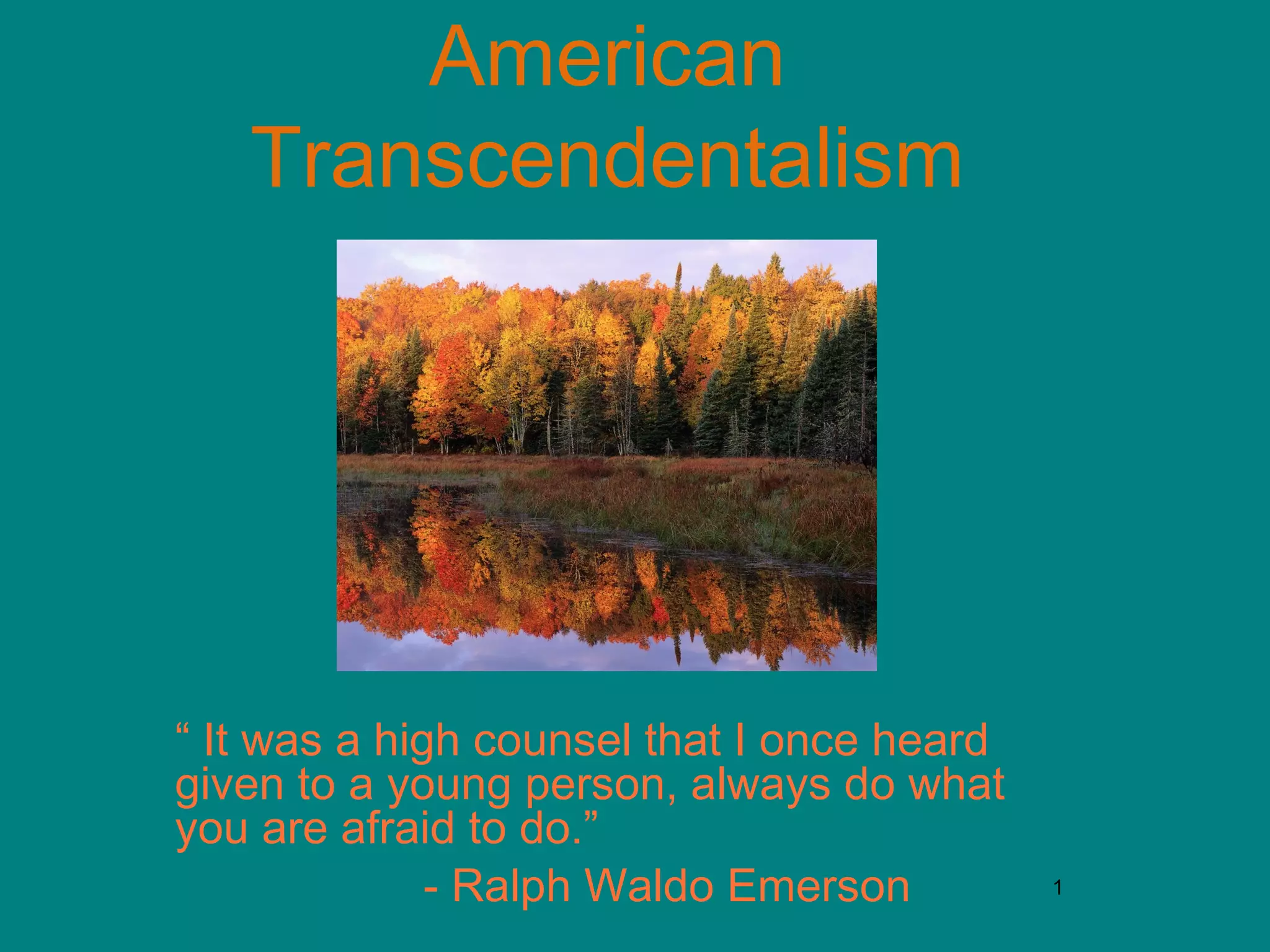
American
Transcendentalism

“ It was a high counsel that I once heard
given to a young person, always do what
you are afraid to do.”
- Ralph Waldo Emerson

1
What does
“transcendentalism” mean?
• There is an ideal spiritual state which
“transcends” the physical and empirical.
• A loose collection of eclectic ideas about
literature, philosophy, religion, social
reform, and the general state of American
culture.
• Transcendentalism had different meanings
for each person involved in the movement.
Transcendentalism
• Relationship between man
and nature. Heightened
awareness of this
relationship would cause a
“reformation” of society
away from materialism and
corruption.
3
3
Transcendentalism
• A literary movement that established a
clear “American voice”.
• Emerson first expressed his philosophy in
his essay “Nature”.
• A belief in a higher reality than that
achieved by human reasoning.
• Suggests that every individual is capable
of discovering this higher truth through
intuition.
4
5
6
Where did it come from?
• Ralph Waldo Emerson gave German
philosopher Immanuel Kant credit for
popularizing the term
“transcendentalism.”
• It began as a reform movement in the
Unitarian church.
• It is not a religion—more accurately, it
is a philosophy or form of spirituality.
• It centered around Boston and
Concord, MA. in the mid-1800’s.
What did Transcendentalists
believe?
The intuitive faculty, instead of the
rational or sensical, became the
means for a conscious union of the
individual psyche (known in Sanskrit
as Atman) with the world psyche also
known as the Oversoul, life-force,
prime mover and God (known in
Sanskrit as Brahma).
Basic Premise #1
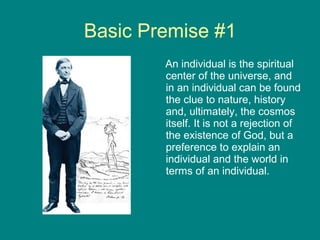
An individual is the spiritual
center of the universe, and
in an individual can be found
the clue to nature, history
and, ultimately, the cosmos
itself. It is not a rejection of
the existence of God, but a
preference to explain an
individual and the world in
terms of an individual.
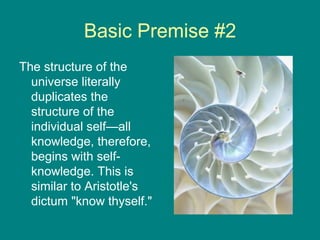
Basic Premise #2
The structure of the
universe literally
duplicates the
structure of the
individual self—all
knowledge, therefore,
begins with selfknowledge. This is
similar to Aristotle's
dictum "know thyself."
Basic Premise #3
Transcendentalists
accepted the
concept of nature as
a living mystery, full
of signs; nature is
symbolic.
Basic Premise #4
The belief that individual virtue and
happiness depend upon self-realization
—this depends upon the reconciliation of
two universal psychological tendencies:
1. The desire to embrace the whole world—
to know and become one with the world.
2. The desire to withdraw, remain unique
and separate—an egotistical existence.
Transcendentalism
• Believed in living close to
nature/importance of nature. Nature is
the source of truth and inspiration.
• Taught the dignity of manual labor
• Advocated self-trust/ confidence
• Valued individuality/non-conformity/free
thought
• Advocated self-reliance/ simplicity
13
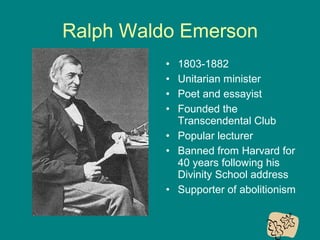
Ralph Waldo Emerson
•
•
•
•

1803-1882
Unitarian minister
Poet and essayist
Founded the
Transcendental Club
• Popular lecturer
• Banned from Harvard for
40 years following his
Divinity School address
• Supporter of abolitionism
“Self-reliance” -Emerson
• “What I must do is all that concerns me,
not what people think…”
• “…to be great is to be misunderstood”

15
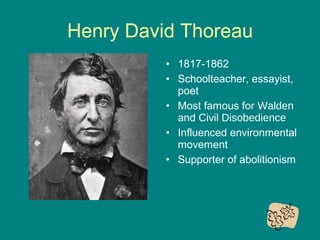
Henry David Thoreau
• 1817-1862
• Schoolteacher, essayist,
poet
• Most famous for Walden
and Civil Disobedience
• Influenced environmental
movement
• Supporter of abolitionism
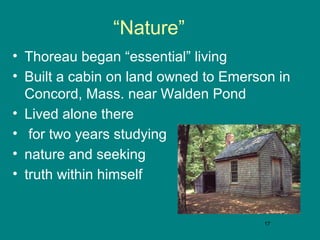
“Nature”
• Thoreau began “essential” living
• Built a cabin on land owned to Emerson in
Concord, Mass. near Walden Pond
• Lived alone there
• for two years studying
• nature and seeking
• truth within himself

17
“I went into the woods
because I wished to live
deliberately, to front only
the essential facts of life
and see if I could not learn
what it has to teach, and
not, when I came to die,
discover that I had not
lived.”
18
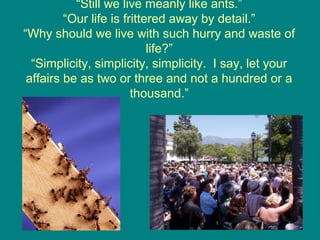
“Still we live meanly like ants.”
“Our life is frittered away by detail.”
“Why should we live with such hurry and waste of
life?”
“Simplicity, simplicity, simplicity. I say, let your
affairs be as two or three and not a hundred or a
thousand.”

19
Walden
Individuality
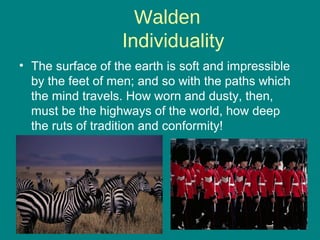
• The surface of the earth is soft and impressible
by the feet of men; and so with the paths which
the mind travels. How worn and dusty, then,
must be the highways of the world, how deep
the ruts of tradition and conformity!

20
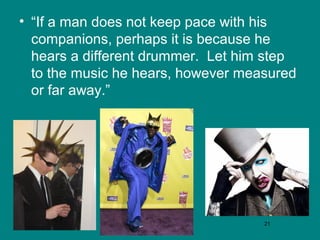
• “If a man does not keep pace with his
companions, perhaps it is because he
hears a different drummer. Let him step
to the music he hears, however measured
or far away.”

21
“Civil Disobedience”

• Thoreau’s essay urging passive, nonviolent resistance to governmental policies
to which an individual is morally opposed.
• Influenced individuals such a Ghandi, Dr.
Martin Luther King Jr., and Cesar Chavez

22
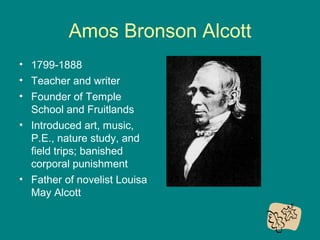
Amos Bronson Alcott
• 1799-1888
• Teacher and writer
• Founder of Temple
School and Fruitlands
• Introduced art, music,
P.E., nature study, and
field trips; banished
corporal punishment
• Father of novelist Louisa
May Alcott
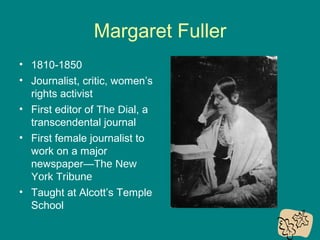
Margaret Fuller
• 1810-1850
• Journalist, critic, women’s
rights activist
• First editor of The Dial, a
transcendental journal
• First female journalist to
work on a major
newspaper—The New
York Tribune
• Taught at Alcott’s Temple
School
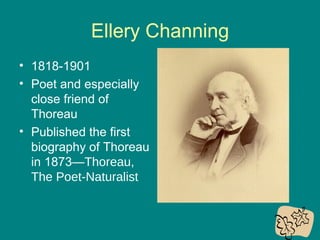
Ellery Channing
• 1818-1901
• Poet and especially
close friend of
Thoreau
• Published the first
biography of Thoreau
in 1873—Thoreau,
The Poet-Naturalist
Resources
• American Transcendental Web:
http://www.vcu.edu/engweb/transcendentalism/index.html

• American Transcendentalism:
http://www.wsu.edu/~campbelld/amlit/amtrans.htm

• PAL: Chapter Four
http://www.csustan.edu/english/reuben/pal/chap4/4intro.html

Transcendentalism

  • 1.
    American Transcendentalism “ It wasa high counsel that I once heard given to a young person, always do what you are afraid to do.” - Ralph Waldo Emerson 1
  • 2.
    What does “transcendentalism” mean? •There is an ideal spiritual state which “transcends” the physical and empirical. • A loose collection of eclectic ideas about literature, philosophy, religion, social reform, and the general state of American culture. • Transcendentalism had different meanings for each person involved in the movement.
  • 3.
    Transcendentalism • Relationship betweenman and nature. Heightened awareness of this relationship would cause a “reformation” of society away from materialism and corruption. 3 3
  • 4.
    Transcendentalism • A literarymovement that established a clear “American voice”. • Emerson first expressed his philosophy in his essay “Nature”. • A belief in a higher reality than that achieved by human reasoning. • Suggests that every individual is capable of discovering this higher truth through intuition. 4
  • 5.
  • 6.
  • 7.
    Where did itcome from? • Ralph Waldo Emerson gave German philosopher Immanuel Kant credit for popularizing the term “transcendentalism.” • It began as a reform movement in the Unitarian church. • It is not a religion—more accurately, it is a philosophy or form of spirituality. • It centered around Boston and Concord, MA. in the mid-1800’s.
  • 8.
    What did Transcendentalists believe? Theintuitive faculty, instead of the rational or sensical, became the means for a conscious union of the individual psyche (known in Sanskrit as Atman) with the world psyche also known as the Oversoul, life-force, prime mover and God (known in Sanskrit as Brahma).
  • 9.
    Basic Premise #1 Anindividual is the spiritual center of the universe, and in an individual can be found the clue to nature, history and, ultimately, the cosmos itself. It is not a rejection of the existence of God, but a preference to explain an individual and the world in terms of an individual.
  • 10.
    Basic Premise #2 Thestructure of the universe literally duplicates the structure of the individual self—all knowledge, therefore, begins with selfknowledge. This is similar to Aristotle's dictum "know thyself."
  • 11.
    Basic Premise #3 Transcendentalists acceptedthe concept of nature as a living mystery, full of signs; nature is symbolic.
  • 12.
    Basic Premise #4 Thebelief that individual virtue and happiness depend upon self-realization —this depends upon the reconciliation of two universal psychological tendencies: 1. The desire to embrace the whole world— to know and become one with the world. 2. The desire to withdraw, remain unique and separate—an egotistical existence.
  • 13.
    Transcendentalism • Believed inliving close to nature/importance of nature. Nature is the source of truth and inspiration. • Taught the dignity of manual labor • Advocated self-trust/ confidence • Valued individuality/non-conformity/free thought • Advocated self-reliance/ simplicity 13
  • 14.
    Ralph Waldo Emerson • • • • 1803-1882 Unitarianminister Poet and essayist Founded the Transcendental Club • Popular lecturer • Banned from Harvard for 40 years following his Divinity School address • Supporter of abolitionism
  • 15.
    “Self-reliance” -Emerson • “WhatI must do is all that concerns me, not what people think…” • “…to be great is to be misunderstood” 15
  • 16.
    Henry David Thoreau •1817-1862 • Schoolteacher, essayist, poet • Most famous for Walden and Civil Disobedience • Influenced environmental movement • Supporter of abolitionism
  • 17.
    “Nature” • Thoreau began“essential” living • Built a cabin on land owned to Emerson in Concord, Mass. near Walden Pond • Lived alone there • for two years studying • nature and seeking • truth within himself 17
  • 18.
    “I went intothe woods because I wished to live deliberately, to front only the essential facts of life and see if I could not learn what it has to teach, and not, when I came to die, discover that I had not lived.” 18
  • 19.
    “Still we livemeanly like ants.” “Our life is frittered away by detail.” “Why should we live with such hurry and waste of life?” “Simplicity, simplicity, simplicity. I say, let your affairs be as two or three and not a hundred or a thousand.” 19
  • 20.
    Walden Individuality • The surfaceof the earth is soft and impressible by the feet of men; and so with the paths which the mind travels. How worn and dusty, then, must be the highways of the world, how deep the ruts of tradition and conformity! 20
  • 21.
    • “If aman does not keep pace with his companions, perhaps it is because he hears a different drummer. Let him step to the music he hears, however measured or far away.” 21
  • 22.
    “Civil Disobedience” • Thoreau’sessay urging passive, nonviolent resistance to governmental policies to which an individual is morally opposed. • Influenced individuals such a Ghandi, Dr. Martin Luther King Jr., and Cesar Chavez 22
  • 23.
    Amos Bronson Alcott •1799-1888 • Teacher and writer • Founder of Temple School and Fruitlands • Introduced art, music, P.E., nature study, and field trips; banished corporal punishment • Father of novelist Louisa May Alcott
  • 24.
    Margaret Fuller • 1810-1850 •Journalist, critic, women’s rights activist • First editor of The Dial, a transcendental journal • First female journalist to work on a major newspaper—The New York Tribune • Taught at Alcott’s Temple School
  • 25.
    Ellery Channing • 1818-1901 •Poet and especially close friend of Thoreau • Published the first biography of Thoreau in 1873—Thoreau, The Poet-Naturalist
  • 26.
    Resources • American TranscendentalWeb: http://www.vcu.edu/engweb/transcendentalism/index.html • American Transcendentalism: http://www.wsu.edu/~campbelld/amlit/amtrans.htm • PAL: Chapter Four http://www.csustan.edu/english/reuben/pal/chap4/4intro.html