Civil DisobedienceHenry David Thoreau ( 1848)
OutlineBiography.Historical context of the Text “ Civil Disobedience”.Major key statements( Section 1).
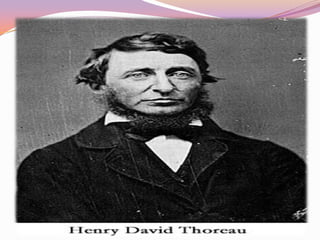
Henry David ThoreauHenry David Thoreau was born in Concord, on July 12, 1817. After graduating from Harvard University in 1837, he taught school but quit after a few weeks, then worked for a short while for his father, a pencil-maker.By the early 1840's  Thoreau had decided to pursue writing as a career . ( poetry and essays)He was not successful as a writer and lived in poverty all his life.
His most famous work is Walden; or Life in the Woods , which recounts his experiences living alone in a cabin he built at Walden Pond near Concord.Thoreau was active in social life and had a strong sense of justice.“ Civil Disobedience” is his most canonical work which embodies his own beliefs of social and political creed.
An overviewIn his essay “ Civil Disobedience” , Thoreau persuades individuals to oppose unjust governments. According to him, citizens of a good conscious should actively oppose unjust government policies  through non-violent resistance, such as : refusal to pay taxes.Good individuals should be willing to go to jail, rather than give away their ethics and subdue to immoral government's laws and activities.
The Historical ContextWhat fired up Thoreau’s thought?Many historical facts influenced and provoked Thoreau and resulted his essay “ Civil Disobedience”.The continuation of the institution of slavery . The prosecution of the Mexican War (April 1846-February 1848).Thoreau refused to pay a poll-tax of 2 dollars because he felt the tax was unfair, and thus he was jailed. He believed Slavery was an evil institution that must be abolished, and  that the Mexican war is unjust, because it was being fought to grab a new territory, in which to establish slavery.
Major Key PointsThoreau prefers a flexible government, but he doesn’t call for abolishing government, rather he wants a better government with severely limited powers and that it should use its powers only to carry out moral and ethical activities on behalf of the citizens .“That government is best which governs least”
“…I ask for, not at once no government, but at once a better government.”He claims that most people serve the state mechanically and do not freely exercise moral judgment about their service.“The mass of men serve the state thus, not as men mainly, but as machines, with their bodies.  They are the standing army, and the militia, jailers … etc.  In most cases there is no free exercise whatever of the judgment or of the moral sense; but they put themselves on a level with wood and earth and stones”Most people conform to their governments blindly and unconsciously.
Thoreau believes that it is man’s duty to wash his hands of wrong. It is the duty of all citizens to disobey unjust government policies. They should express their opposition through acts of civil disobedience.“It is not man’s duty, as a matter of course, to devote himself to the eradication of any…wrong; he may still properly have other concerns to engage him; but it is his duty, at least, to wash his hands of it”
Because unjust governments oppress  and suppress the voice of truth and justice, sometimes it requires one honest man  to change the state by standing up against it , because if government, "is of such a nature that it requires you to be the agent of injustice to another, then I say, break the law. Let your life be a counter friction to stop the machine”.
A man can change an unjust system by refusing to be unjust, and by being entirely willing to make a sacrifice. Thoreau believes that resistance should not be only with words but rather with actions, even if these action would impose some hardships. “Under a government which imprisons any unjustly, the true place for a just man is also a prison….” For him a prison is the only place where an honorable man in a slave state can live with honor.
Conclusion  Thoreau calls for a Liberal government that offers the right for its citizen to do whatever they find it “right/just” to be done.
One should not bow to the government’s dictations without considering the “ moral truth”.

Civil disobedience

  • 1.
  • 2.
    OutlineBiography.Historical context ofthe Text “ Civil Disobedience”.Major key statements( Section 1).
  • 3.
    Henry David ThoreauHenryDavid Thoreau was born in Concord, on July 12, 1817. After graduating from Harvard University in 1837, he taught school but quit after a few weeks, then worked for a short while for his father, a pencil-maker.By the early 1840's Thoreau had decided to pursue writing as a career . ( poetry and essays)He was not successful as a writer and lived in poverty all his life.
  • 4.
    His most famouswork is Walden; or Life in the Woods , which recounts his experiences living alone in a cabin he built at Walden Pond near Concord.Thoreau was active in social life and had a strong sense of justice.“ Civil Disobedience” is his most canonical work which embodies his own beliefs of social and political creed.
  • 6.
    An overviewIn hisessay “ Civil Disobedience” , Thoreau persuades individuals to oppose unjust governments. According to him, citizens of a good conscious should actively oppose unjust government policies through non-violent resistance, such as : refusal to pay taxes.Good individuals should be willing to go to jail, rather than give away their ethics and subdue to immoral government's laws and activities.
  • 7.
    The Historical ContextWhatfired up Thoreau’s thought?Many historical facts influenced and provoked Thoreau and resulted his essay “ Civil Disobedience”.The continuation of the institution of slavery . The prosecution of the Mexican War (April 1846-February 1848).Thoreau refused to pay a poll-tax of 2 dollars because he felt the tax was unfair, and thus he was jailed. He believed Slavery was an evil institution that must be abolished, and that the Mexican war is unjust, because it was being fought to grab a new territory, in which to establish slavery.
  • 8.
    Major Key PointsThoreauprefers a flexible government, but he doesn’t call for abolishing government, rather he wants a better government with severely limited powers and that it should use its powers only to carry out moral and ethical activities on behalf of the citizens .“That government is best which governs least”
  • 9.
    “…I ask for,not at once no government, but at once a better government.”He claims that most people serve the state mechanically and do not freely exercise moral judgment about their service.“The mass of men serve the state thus, not as men mainly, but as machines, with their bodies. They are the standing army, and the militia, jailers … etc. In most cases there is no free exercise whatever of the judgment or of the moral sense; but they put themselves on a level with wood and earth and stones”Most people conform to their governments blindly and unconsciously.
  • 10.
    Thoreau believes thatit is man’s duty to wash his hands of wrong. It is the duty of all citizens to disobey unjust government policies. They should express their opposition through acts of civil disobedience.“It is not man’s duty, as a matter of course, to devote himself to the eradication of any…wrong; he may still properly have other concerns to engage him; but it is his duty, at least, to wash his hands of it”
  • 11.
    Because unjust governmentsoppress and suppress the voice of truth and justice, sometimes it requires one honest man to change the state by standing up against it , because if government, "is of such a nature that it requires you to be the agent of injustice to another, then I say, break the law. Let your life be a counter friction to stop the machine”.
  • 12.
    A man canchange an unjust system by refusing to be unjust, and by being entirely willing to make a sacrifice. Thoreau believes that resistance should not be only with words but rather with actions, even if these action would impose some hardships. “Under a government which imprisons any unjustly, the true place for a just man is also a prison….” For him a prison is the only place where an honorable man in a slave state can live with honor.
  • 13.
    Conclusion  Thoreau callsfor a Liberal government that offers the right for its citizen to do whatever they find it “right/just” to be done.
  • 14.
    One should notbow to the government’s dictations without considering the “ moral truth”.