Transcendentalism
What does “transcendentalism” mean? There is an ideal spiritual state which “transcends” the physical and empirical. A loose collection of eclectic ideas about literature, philosophy, religion, social reform, and the general state of American culture. Transcendentalism had different meanings for each person involved in the movement.
Where did it come from? Ralph Waldo Emerson gave German philosopher Immanuel Kant credit for popularizing the term “transcendentalism.” It began as a reform movement in the Unitarian church. It is not a religion—more accurately, it is a philosophy or form of spirituality. It centered around Boston and Concord, MA. in the mid-1800’s. Emerson first expressed his philosophy of transcendentalism in his essay  Nature.
What did Transcendentalists believe? The intuitive faculty, instead of the rational or sensical, became the means for a conscious union of the individual psyche (known in Sanskrit as  Atman ) with the world psyche also known as the Oversoul, life-force, prime mover and G-d (known in Sanskrit as  Brahma ).
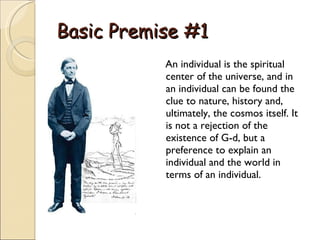
Basic Premise #1 An individual is the spiritual center of the universe, and in an individual can be found the clue to nature, history and, ultimately, the cosmos itself. It is not a rejection of the existence of G-d, but a preference to explain an individual and the world in terms of an individual.
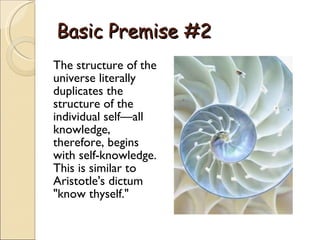
Basic Premise #2 The structure of the universe literally duplicates the structure of the individual self—all knowledge, therefore, begins with self-knowledge. This is similar to Aristotle's dictum "know thyself."
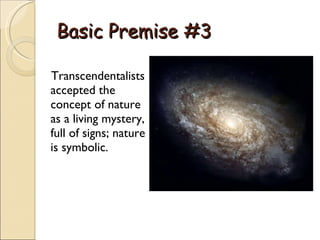
Basic Premise #3 Transcendentalists accepted the concept of nature as a living mystery, full of signs; nature is symbolic.
Basic Premise #4 The belief that individual virtue and happiness depend upon self-realization—this depends upon the reconciliation of two universal psychological tendencies:  The desire to embrace the whole world—to know and become one with the world.  The desire to withdraw, remain unique and separate—an egotistical existence.

C:\fakepath\transcendentalism

  • 1.
  • 2.
    What does “transcendentalism”mean? There is an ideal spiritual state which “transcends” the physical and empirical. A loose collection of eclectic ideas about literature, philosophy, religion, social reform, and the general state of American culture. Transcendentalism had different meanings for each person involved in the movement.
  • 3.
    Where did itcome from? Ralph Waldo Emerson gave German philosopher Immanuel Kant credit for popularizing the term “transcendentalism.” It began as a reform movement in the Unitarian church. It is not a religion—more accurately, it is a philosophy or form of spirituality. It centered around Boston and Concord, MA. in the mid-1800’s. Emerson first expressed his philosophy of transcendentalism in his essay Nature.
  • 4.
    What did Transcendentalistsbelieve? The intuitive faculty, instead of the rational or sensical, became the means for a conscious union of the individual psyche (known in Sanskrit as Atman ) with the world psyche also known as the Oversoul, life-force, prime mover and G-d (known in Sanskrit as Brahma ).
  • 5.
    Basic Premise #1An individual is the spiritual center of the universe, and in an individual can be found the clue to nature, history and, ultimately, the cosmos itself. It is not a rejection of the existence of G-d, but a preference to explain an individual and the world in terms of an individual.
  • 6.
    Basic Premise #2The structure of the universe literally duplicates the structure of the individual self—all knowledge, therefore, begins with self-knowledge. This is similar to Aristotle's dictum "know thyself."
  • 7.
    Basic Premise #3Transcendentalists accepted the concept of nature as a living mystery, full of signs; nature is symbolic.
  • 8.
    Basic Premise #4The belief that individual virtue and happiness depend upon self-realization—this depends upon the reconciliation of two universal psychological tendencies: The desire to embrace the whole world—to know and become one with the world. The desire to withdraw, remain unique and separate—an egotistical existence.