Personal Information
● Presented: Baraiya Krisha L.
● STD : M.A., Semester 2
● Paper : The American Literature
● Topic : Transcendentalists & Its Key Thinkers
● Roll no. : 11
● Enrollment no.: 5108240003
● Department: Department of English (MKBU)
● Email ID : krishnageerbaraiya@gmail.com
3.
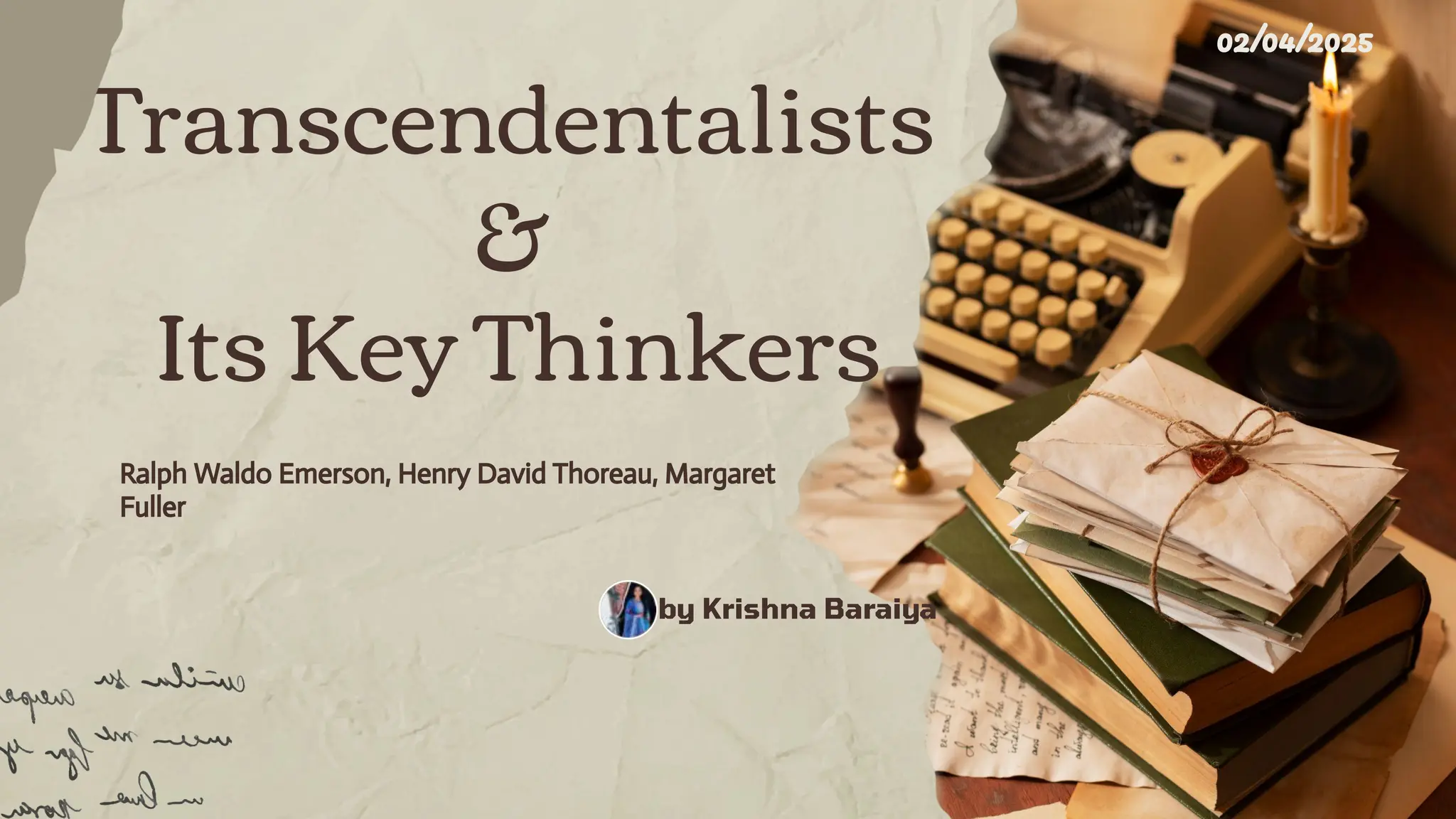
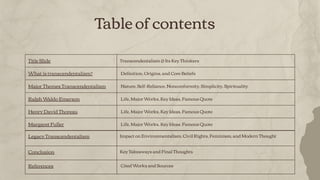
Title Slide Transcendentalism& Its Key Thinkers
What is transcendentalism? Definition, Origins, and Core Beliefs
Major Themes Transcendentalism Nature, Self-Reliance, Nonconformity, Simplicity, Spirituality
Ralph Waldo Emerson Life, Major Works, Key Ideas, Famous Quote
Henry David Thoreau Life, Major Works, Key Ideas, Famous Quote
Margaret Fuller Life, Major Works, Key Ideas, Famous Quote
Legacy Transcendentalism Impact on Environmentalism, Civil Rights, Feminism, and Modern Thought
Conclusion Key Takeaways and Final Thoughts
References Cited Works and Sources
Table of contents
4.
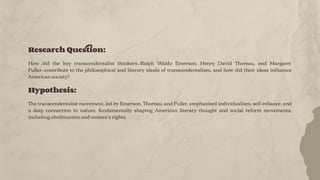
Research Question:
How didthe key transcendentalist thinkers—Ralph Waldo Emerson, Henry David Thoreau, and Margaret
Fuller—contribute to the philosophical and literary ideals of transcendentalism, and how did their ideas influence
American society?
Hypothesis:
The transcendentalist movement, led by Emerson, Thoreau, and Fuller, emphasized individualism, self-reliance, and
a deep connection to nature, fundamentally shaping American literary thought and social reform movements,
including abolitionism and women's rights.
5.
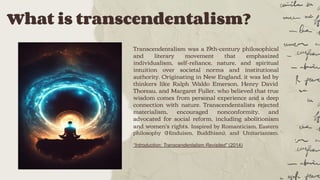
What is transcendentalism?
Transcendentalismwas a 19th-century philosophical
and literary movement that emphasized
individualism, self-reliance, nature, and spiritual
intuition over societal norms and institutional
authority. Originating in New England, it was led by
thinkers like Ralph Waldo Emerson, Henry David
Thoreau, and Margaret Fuller, who believed that true
wisdom comes from personal experience and a deep
connection with nature. Transcendentalists rejected
materialism, encouraged nonconformity, and
advocated for social reform, including abolitionism
and women's rights. Inspired by Romanticism, Eastern
philosophy (Hinduism, Buddhism), and Unitarianism.
“Introduction: Transcendentalism Revisited” (2014)
6.
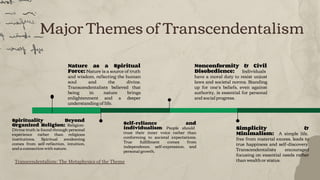
Major Themes ofTranscendentalism
Nonconformity & Civil
Disobedience: Individuals
have a moral duty to resist unjust
laws and societal norms. Standing
up for one’s beliefs, even against
authority, is essential for personal
and social progress.
Simplicity &
Minimalism: A simple life,
free from material excess, leads to
true happiness and self-discovery.
Transcendentalists encouraged
focusing on essential needs rather
than wealth or status.
Nature as a Spiritual
Force: Nature is a source of truth
and wisdom, reflecting the human
soul and the divine.
Transcendentalists believed that
being in nature brings
enlightenment and a deeper
understanding of life.
Self-reliance and
individualism: People should
trust their inner voice rather than
conforming to societal expectations.
True fulfillment comes from
independence, self-expression, and
personal growth.
Spirituality Beyond
Organized Religion: Religion:
Divine truth is found through personal
experience rather than religious
institutions. Spiritual awakening
comes from self-reflection, intuition,
and a connection with nature.
Transcendentalism: The Metaphysics of the Theme
7.
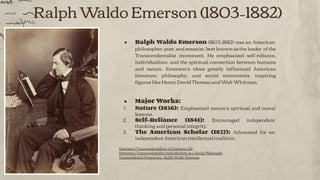
Ralph Waldo Emerson(1803–1882)
● Ralph Waldo Emerson (1803–1882) was an American
philosopher, poet, and essayist, best known as the leader of the
Transcendentalist movement. He emphasized self-reliance,
individualism, and the spiritual connection between humans
and nature. Emerson’s ideas greatly influenced American
literature, philosophy, and social movements, inspiring
figures like Henry David Thoreau and Walt Whitman.
● Major Works:
1. Nature (1836): Emphasized nature’s spiritual and moral
lessons.
2. Self-Reliance (1841): Encouraged independent
thinking and personal integrity.
3. The American Scholar (1837): Advocated for an
independent American intellectual tradition.
Emerson's Transcendentalism of Common Life,,,
Emerson's Transcendentalist Individualism as a Social Philosophy
Transcendental Democracy: Ralph Waldo Emerson
8.
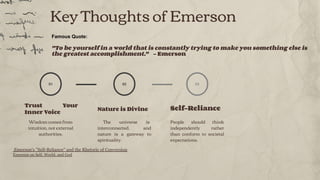
Key Thoughts ofEmerson
01
Trust Your
Inner Voice
Wisdom comes from
intuition, not external
authorities.
Nature is Divine
The universe is
interconnected, and
nature is a gateway to
spirituality.
02
Self-Reliance
People should think
independently rather
than conform to societal
expectations.
03
Famous Quote:
"To be yourself in a world that is constantly trying to make you something else is
the greatest accomplishment." - Emerson
Emerson's "Self-Reliance" and the Rhetoric of Conversion
Emerson on Self, World, and God
9.
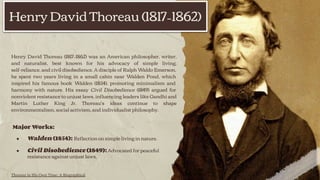
Henry David Thoreau(1817–1862) was an American philosopher, writer,
and naturalist, best known for his advocacy of simple living,
self-reliance, and civil disobedience. A disciple of Ralph Waldo Emerson,
he spent two years living in a small cabin near Walden Pond, which
inspired his famous book Walden (1854), promoting minimalism and
harmony with nature. His essay Civil Disobedience (1849) argued for
nonviolent resistance to unjust laws, influencing leaders like Gandhi and
Martin Luther King Jr. Thoreau’s ideas continue to shape
environmentalism, social activism, and individualist philosophy.
Major Works:
● Walden (1854): Reflection on simple living in nature.
● Civil Disobedience (1849): Advocated for peaceful
resistance against unjust laws.
Henry David Thoreau (1817–1862)
Thoreau in His Own Time: A Biographical
10.
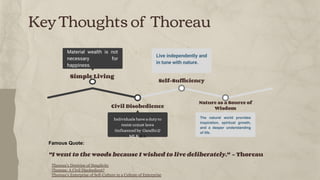
Key Thoughts ofThoreau
Nature as a Source of
Wisdom
The natural world provides
inspiration, spiritual growth,
and a deeper understanding
of life.
Self-Sufficiency
Live independently and
in tune with nature.
Civil Disobedience
Individuals have a duty to
resist unjust laws
(influenced by Gandhi &
MLK Jr.).
Simple Living
Material wealth is not
necessary for
happiness.
Famous Quote:
"I went to the woods because I wished to live deliberately." – Thoreau
Thoreau's Doctrine of Simplicity
Thoreau: A Civil Disobedient?
Thoreau's Enterprise of Self-Culture in a Culture of Enterprise
11.
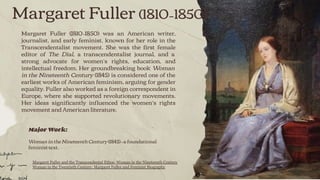
Margaret Fuller (1810–1850)
MargaretFuller (1810–1850) was an American writer,
journalist, and early feminist, known for her role in the
Transcendentalist movement. She was the first female
editor of The Dial, a transcendentalist journal, and a
strong advocate for women’s rights, education, and
intellectual freedom. Her groundbreaking book Woman
in the Nineteenth Century (1845) is considered one of the
earliest works of American feminism, arguing for gender
equality. Fuller also worked as a foreign correspondent in
Europe, where she supported revolutionary movements.
Her ideas significantly influenced the women’s rights
movement and American literature.
Major Work:
Woman in the Nineteenth Century (1845)—a foundational
feminist text.
Margaret Fuller and the Transcendental Ethos: Woman in the Nineteenth Century
Woman in the Twentieth Century: Margaret Fuller and Feminist Biography
12.
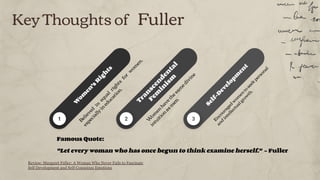
Key Thoughts ofFuller
1
W
o
m
e
n
’
s
R
i
g
h
t
s
B
e
l
i
e
v
e
d
i
n
e
q
u
a
l
r
i
g
h
t
s
f
o
r
w
o
m
e
n
,
e
s
p
e
c
i
a
l
l
y
i
n
e
d
u
c
a
t
i
o
n
.2
T
r
a
n
s
c
e
n
d
e
n
t
a
l
F
e
m
i
n
i
s
m
W
o
m
e
n
h
a
v
e
t
h
e
s
a
m
e
d
i
v
i
n
e
i
n
t
u
i
t
i
o
n
a
s
m
e
n
.
3
S
e
l
f
-
D
e
v
e
l
o
p
m
e
n
t
E
n
c
o
u
r
a
g
e
d
w
o
m
e
n
t
o
s
e
e
k
p
e
r
s
o
n
a
l
a
n
d
i
n
t
e
l
l
e
c
t
u
a
l
g
r
o
w
t
h
.
Famous Quote:
"Let every woman who has once begun to think examine herself." – Fuller
Review: Margaret Fuller: A Woman Who Never Fails to Fascinate
Self Development and Self-Conscious Emotions
13.
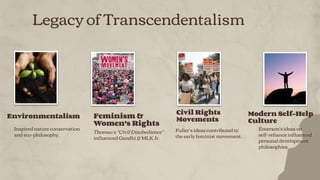
Legacy of Transcendentalism
Inspirednature conservation
and eco-philosophy.
Thoreau’s "Civil Disobedience"
influenced Gandhi & MLK Jr.
Fuller’s ideas contributed to
the early feminist movement.
Environmentalism Feminism &
Women’s Rights
Civil Rights
Movements
Modern Self-Help
Culture
Emerson'sideas on
self-reliance influenced
personal development
philosophies.
14.
Conclusion:
Transcendentalists believed inthe power of
individualism and self-reliance, emphasising that
true wisdom comes from within rather than
societal expectations. They saw nature as a source
of spiritual and moral lessons, teaching people to
live in harmony with the world around them.
Additionally, they encouraged questioning
authority and resisting unjust systems, advocating
for personal freedom and social change. Their ideas
continue to shape philosophy, literature, and
activism, inspiring movements for civil rights,
environmentalism, and self-discovery. As Emerson
beautifully put it, "Live in the sunshine, swim in the
sea, drink the wild air."
15.
References:
There was anerror loading the content. (n.d.). www.jstor.org.
https://www.jstor.org/stable/2940664?seq=1
Civil Disobedience" and other essays (n.d.). Google Books.
https://books.google.co.in/books?id=wlaMCgAAQBAJ&lpg=PA1&ots=4nVCwPXhOG&dq=%22H
enry%20David%20Thoreau%20and%20Civil%20Disobedience%22&lr&pg=PA4#v=onepage&q
=%22Henry%20David%20Thoreau%20and%20Civil%20Disobedience%22&f=false
Review: [Untitled]. (2018). Early American Literature, 53(1), 220–222.
https://www.jstor.org/stable/90019143
Davinroy, L. (1998). A rhetoric of reconciled differences: Margaret Fuller’s “Woman in the
Nineteenth Century.” CEA Critic, 60(2), 27–41. https://www.jstor.org/stable/44377229
Robinson, David M. “Margaret Fuller and the Transcendental Ethos: Woman in the Nineteenth
Century.” PMLA, vol. 97, no. 1, 1982, pp. 83–98. JSTOR,
doi.org/10.2307/462242https://www.jstor.org/stable/462242.
“Review: [Untitled].” Journal of the Early Republic, vol. 30, no. 3, 2010, pp. 488–91. JSTOR,
www.jstor.org/stable/40925942.
“There Was an Error Loading the Content," www.jstor.org/stable/1413661.
Dillman, Richard. H. “Resources for the Study of Transcendentalist Rhetoric: Emerson and
Thoreau.” Rhetoric Society Quarterly, vol. 8, no. 4, 1978, pp. 165–75. JSTOR,
www.jstor.org/stable/3885667.


![References:
There was an error loading the content. (n.d.). www.jstor.org.
https://www.jstor.org/stable/2940664?seq=1
Civil Disobedience" and other essays (n.d.). Google Books.
https://books.google.co.in/books?id=wlaMCgAAQBAJ&lpg=PA1&ots=4nVCwPXhOG&dq=%22H
enry%20David%20Thoreau%20and%20Civil%20Disobedience%22&lr&pg=PA4#v=onepage&q
=%22Henry%20David%20Thoreau%20and%20Civil%20Disobedience%22&f=false
Review: [Untitled]. (2018). Early American Literature, 53(1), 220–222.
https://www.jstor.org/stable/90019143
Davinroy, L. (1998). A rhetoric of reconciled differences: Margaret Fuller’s “Woman in the
Nineteenth Century.” CEA Critic, 60(2), 27–41. https://www.jstor.org/stable/44377229
Robinson, David M. “Margaret Fuller and the Transcendental Ethos: Woman in the Nineteenth
Century.” PMLA, vol. 97, no. 1, 1982, pp. 83–98. JSTOR,
doi.org/10.2307/462242https://www.jstor.org/stable/462242.
“Review: [Untitled].” Journal of the Early Republic, vol. 30, no. 3, 2010, pp. 488–91. JSTOR,
www.jstor.org/stable/40925942.
“There Was an Error Loading the Content," www.jstor.org/stable/1413661.
Dillman, Richard. H. “Resources for the Study of Transcendentalist Rhetoric: Emerson and
Thoreau.” Rhetoric Society Quarterly, vol. 8, no. 4, 1978, pp. 165–75. JSTOR,
www.jstor.org/stable/3885667.](https://image.slidesharecdn.com/transcendentalistitskeythinkers-250619053651-f7ef6e47/85/Transcendentalist-Its-Key-Thinkers-pdf-15-320.jpg)



![American Transcendentalism Good Copy[1]](https://cdn.slidesharecdn.com/ss_thumbnails/americantranscendentalismgoodcopy1-100331113533-phpapp02-thumbnail.jpg?width=640&height=640&fit=bounds)


