By- Hijrat ullah Tahir
Master Trainer
Organization for Health Promotion and Management
Paktika Provincial Office
hijrat.hrm@gmail.com
+93 777 07 65 85
Professionalism – a definition
 Knowledge that an individual possesses
about a certain field
 Constant and consistent behavior
 An attitude devoid of politics, mind games, bias,
discrimination and blaming
 A professional person – an individual doing their job
with sincerity who maintains accepted etiquette and
ethics while performing quality work
Professionalism – behavior expected
 Avoid discussion of personal issues so that the
environment is free of empathy related bias about
productivity.
 Avoid gossip, colleague bashing, listening to and
relaying rumors to co workers that come through the
grapevine.
 Rules, policies and procedures should be the same for
everyone – preferential treatment lowers morale and
perpetuates poor productivity while lowering self
esteem.
Professionalism – behavior expected
 Accountability – take responsibility for your
actions/mistakes.
 Be a team player who can also work
independently.
 Support and encourage colleagues and co-workers
and avoid constant complaining.
 Speak with courtesy to all internal and external
customers and co-workers.
 Respect people and their position.
Professionalism – behavior expected
 Follow through on deadlines.
 Keep your word; fulfill agreements and
obligations both legally and morally.
 Strive for recognition on the basis of your work
performance.
 Give credit to others.
 Be proud of your work and let others know how
much satisfaction it gives you.
 Show enthusiasm – it is contagious.
 Be flexible and patient; learn to collaborate.
Grievances, Personal and Business
Problems
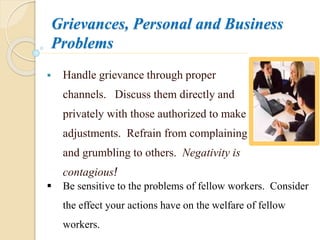
 Handle grievance through proper
channels. Discuss them directly and
privately with those authorized to make
adjustments. Refrain from complaining
and grumbling to others. Negativity is
contagious!
 Be sensitive to the problems of fellow workers. Consider
the effect your actions have on the welfare of fellow
workers.
Employer’s Policies
Discrimination, sexual harassment, and other policies
implemented at your workplace can usually be found
on the company’s Human Resources website.
Learn what the expectations are and what to do if you
feel that any violations have taken place against you
or anyone in your office.
What is Professional Dress?
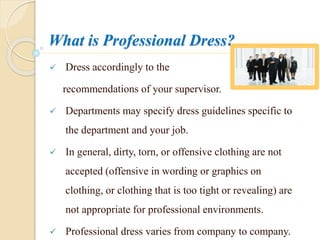
 Dress accordingly to the
recommendations of your supervisor.
 Departments may specify dress guidelines specific to
the department and your job.
 In general, dirty, torn, or offensive clothing are not
accepted (offensive in wording or graphics on
clothing, or clothing that is too tight or revealing) are
not appropriate for professional environments.
 Professional dress varies from company to company.
Professional Communication
 Practice active listening.
 Use proper language – slang, profanity and vulgarity are not
acceptable.
 Don’t yell information across the room.
 Speak clearly; confirm that you are being understood and that you
understand what is being said to you.
 Maintain a pleasant, courteous tone of voice.
 Avoid emotional or angry outbursts.
 Acknowledge the needs of internal and external customers and co-
workers.
 Create a friendly environment but respect boundaries.
Why is Professionalism Critical in the
Workplace?
 Ensures positive performance
 Builds and maintains team spirit
 Encourages motivation
 Creates happy, satisfied employees that are positive
organization ambassadors
 Quality of work improves – employees feel that their work is
important
 Fosters clear and collaborative communication
 Promotes and confirms fairness for every employee – everyone
treated equally – eliminates favoritism
Strong Ethics = large part of Professionalism
 Ethics is a code of morality – a system of principles governing the
appropriate conduct for a person or group.
 Integrity, honesty, diligence, loyalty, respect and commitment are
all part of an ethical character which in turn exemplifies
professionalism.
 Maintaining confidentiality – certain information cannot be
discussed or shown to others. The welfare of others is important
and the professional maintains this confidence.
Remember…..
A professional learns how to balance confidence,
assertiveness and humility, never allowing anyone to
persuade them to change their code of ethic's or lower
their standards.
Questions & Answers
Thanks to all of you!!!

Training on professionalism in the workplace

  • 1.
    By- Hijrat ullahTahir Master Trainer Organization for Health Promotion and Management Paktika Provincial Office hijrat.hrm@gmail.com +93 777 07 65 85
  • 2.
    Professionalism – adefinition  Knowledge that an individual possesses about a certain field  Constant and consistent behavior  An attitude devoid of politics, mind games, bias, discrimination and blaming  A professional person – an individual doing their job with sincerity who maintains accepted etiquette and ethics while performing quality work
  • 3.
    Professionalism – behaviorexpected  Avoid discussion of personal issues so that the environment is free of empathy related bias about productivity.  Avoid gossip, colleague bashing, listening to and relaying rumors to co workers that come through the grapevine.  Rules, policies and procedures should be the same for everyone – preferential treatment lowers morale and perpetuates poor productivity while lowering self esteem.
  • 4.
    Professionalism – behaviorexpected  Accountability – take responsibility for your actions/mistakes.  Be a team player who can also work independently.  Support and encourage colleagues and co-workers and avoid constant complaining.  Speak with courtesy to all internal and external customers and co-workers.  Respect people and their position.
  • 5.
    Professionalism – behaviorexpected  Follow through on deadlines.  Keep your word; fulfill agreements and obligations both legally and morally.  Strive for recognition on the basis of your work performance.  Give credit to others.  Be proud of your work and let others know how much satisfaction it gives you.  Show enthusiasm – it is contagious.  Be flexible and patient; learn to collaborate.
  • 6.
    Grievances, Personal andBusiness Problems  Handle grievance through proper channels. Discuss them directly and privately with those authorized to make adjustments. Refrain from complaining and grumbling to others. Negativity is contagious!  Be sensitive to the problems of fellow workers. Consider the effect your actions have on the welfare of fellow workers.
  • 7.
    Employer’s Policies Discrimination, sexualharassment, and other policies implemented at your workplace can usually be found on the company’s Human Resources website. Learn what the expectations are and what to do if you feel that any violations have taken place against you or anyone in your office.
  • 8.
    What is ProfessionalDress?  Dress accordingly to the recommendations of your supervisor.  Departments may specify dress guidelines specific to the department and your job.  In general, dirty, torn, or offensive clothing are not accepted (offensive in wording or graphics on clothing, or clothing that is too tight or revealing) are not appropriate for professional environments.  Professional dress varies from company to company.
  • 9.
    Professional Communication  Practiceactive listening.  Use proper language – slang, profanity and vulgarity are not acceptable.  Don’t yell information across the room.  Speak clearly; confirm that you are being understood and that you understand what is being said to you.  Maintain a pleasant, courteous tone of voice.  Avoid emotional or angry outbursts.  Acknowledge the needs of internal and external customers and co- workers.  Create a friendly environment but respect boundaries.
  • 10.
    Why is ProfessionalismCritical in the Workplace?  Ensures positive performance  Builds and maintains team spirit  Encourages motivation  Creates happy, satisfied employees that are positive organization ambassadors  Quality of work improves – employees feel that their work is important  Fosters clear and collaborative communication  Promotes and confirms fairness for every employee – everyone treated equally – eliminates favoritism
  • 11.
    Strong Ethics =large part of Professionalism  Ethics is a code of morality – a system of principles governing the appropriate conduct for a person or group.  Integrity, honesty, diligence, loyalty, respect and commitment are all part of an ethical character which in turn exemplifies professionalism.  Maintaining confidentiality – certain information cannot be discussed or shown to others. The welfare of others is important and the professional maintains this confidence.
  • 12.
    Remember….. A professional learnshow to balance confidence, assertiveness and humility, never allowing anyone to persuade them to change their code of ethic's or lower their standards.
  • 13.
  • 14.
    Thanks to allof you!!!