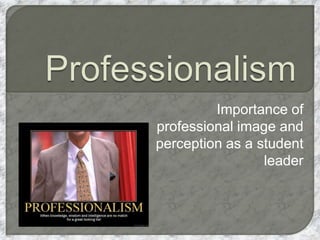
Importance of
professional image and
perception as a student
leader
Introductions and Icebreakers
Defining professionalism
Attire
Professionalism on Campus
Break
Social Media Presence
Goal Setting
Conclusion w/ Q&A
Evaluations
PRESENTERS:
 Gissel Lopez
 Kelly DeSisto
 Jennifer Smolinski
PURPOSE OF PRESENTATION:
 To educate student leaders on how to
enhance their understanding and
identification with the notion of
professionalism and its importance both on
and off campus.
Take what you need
M&Ms Game
 Encompasses an individual’s behavior,
appearance, and workplace ethics
 Focus on the workplace before their personal
problems and agendas
 Able to focus on their work and avoid unnecessary
distractions
 Often perceived to be more competent and
valuable
 Usually referred to as leaders
Interviews
Work environment
Conferences
Classroom
Organization meetings/events
On campus
 Formal Business: Just one step down from tuxedos, such as dark
tailored suits for men and women.
• Men: white shirts (French cuff styles), cuff links, silk ties, and pocket squares (silk
or linen).
• Women: Skirted suits, hosiery, and closed-toe/closed heel pumps.
• Often requested for Award dinners, political events, and a variety of dressy
evening business occasions.
 Traditional Business: Always includes a jacket
• Men: Slacks, long sleeve dress shirt with sport jacket or blazer; tie can be
optional. Sport jacket/blazer.
• Women: Pantsuits are acceptable, skirts or slacks with blouse and jacket
 Business Casual- Usually has a collar for both men and women. A
twin set is acceptable for women at this level. An appropriate fit is
essential.
• Men: Slacks and long sleeve shirts, slacks with company issued polo shirt. No tee
shirts allowed.
• Women: Skirts or slacks with sweaters sets or blouses that have sleeves.
Sleeveless tops can lower your credibility.
T-shirts
Sneakers
Flip Flops
Wrinkled and/or unkempt shirt
Active Attire
Leggings
Short Skirts
Tight fitting clothes
Showing cleavage
Too much makeup
Heavy perfumes
Untraditional hair styles
Scuffed shoes
Un-tidy facial hair
Baggy clothing
Heavy Colognes
Untraditional Hair Styles
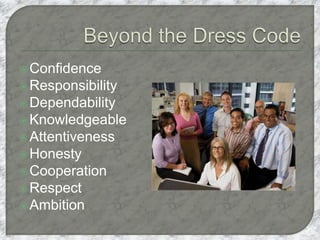
Confidence
Responsibility
Dependability
Knowledgeable
Attentiveness
Honesty
Cooperation
Respect
Ambition
Tips on how to translate professionalism into your leadership role
on-campus
Which roles you are affiliated with on-
campus?
What skills and qualities are necessary in
your position?
• What qualities are similar between these
leadership roles?
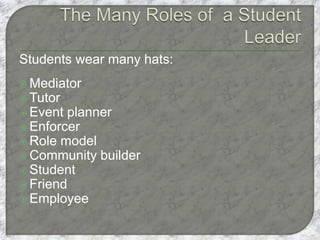
Students wear many hats:
 Mediator
 Tutor
 Event planner
 Enforcer
 Role model
 Community builder
 Student
 Friend
 Employee
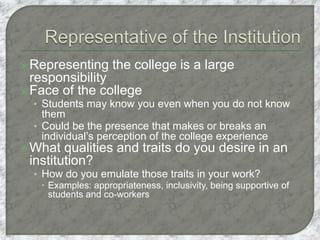
 Representing the college is a large
responsibility
 Face of the college
• Students may know you even when you do not know
them
• Could be the presence that makes or breaks an
individual’s perception of the college experience
 What qualities and traits do you desire in an
institution?
• How do you emulate those traits in your work?
 Examples: appropriateness, inclusivity, being supportive of
students and co-workers
Who is your student body?
A student leader represents:
• LGBTQA
• Race
• Gender
• Ethnicity
• Religion
• Socioeconomic status
• Ability/Barriers
Should still maintain a sense of
professionalism on campus
 Be prepared for any new encounters that may lead to
beneficial opportunities
 Important for those who are interested in being involved
on campus and/or creating strong connections in or
outside of campus
 EMAIL ETIQUETTE
• Create a meaningful and relevant message for the subject
line
• Always start your email with a greeting such as Dear Mr.
Smith or Mr. Smith. Addressing an individual by first name
is only encouraged if you have already know the individual
well or he/she has addressed his/her emails with their first
name.
• Use appropriate and standard spelling and punctuation
 Ex. Unwarranted use of CAPS Lock
• Be clear, concise, direct, and straight to the point with your
e-mail message
• Be friendly and amiable, but refrain from informal and joking
language unless your relationship with the recipient deems
it appropriate
 PHONE ETIQUETTE
• Try to answer the phone on the second ring
 Too soon – can catch the caller off-guard
 Too late – inconveniences the caller and shows that they are not your
priority to help
• Don’t answer the phone by only saying ―hello‖
 Answer in a friendly manner that introduces your designated office and
your name
 Example: ―Thank you for calling the Office of Residence Life, this is <insert
your name>, how may I help you?‖
• Smile — it shows over the phone
• Make sure to ask for the caller’s name and write down any
information that is imperative
• Speak clearly, slowly, and at a medium volume
 Never talk with anything in your mouth (such as gum)
• Ask the caller if there is anything else you can help him/her with
• Thank them for their phone call
How does your tone differ with:
• Faculty
• Staff
• Outside contacts
• Students
• Prospective students
 Should there be a difference in tone between
these groups of people?
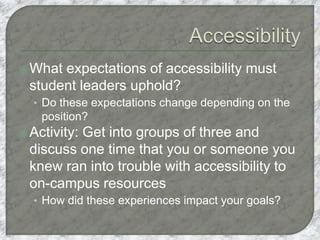
What expectations of accessibility must
student leaders uphold?
• Do these expectations change depending on the
position?
Activity: Get into groups of three and
discuss one time that you or someone you
knew ran into trouble with accessibility to
on-campus resources
• How did these experiences impact your goals?
Expectations should be indicated at the
beginning of a position
• If not already established, connect with your
supervisor and see if this can be done during a
staff meeting
Means of access
• Email
• Phone
• Office Hours
Where else are you required to be accessible in
your positions?
How your presence on social mediums can enhance or hinder your
professional image
What is Social Media?
What social mediums do you use?
http://www.youtube.com/watch?v=sIFYPQj
Yhv8
• What did you think of the video?
• What surprised you?
• How could social media’s influence on the world
be relevant to your image as a student leader?
Do you know how to use privacy settings
on your favorite social mediums?
Facebook Privacy Settings Tutorial
• Facebook Privacy Setting updates
 Can interfere with original settings
Identity crisis
• How does the pressure of the student leader
image impact your college experience?
How can you best balance being a student
and a representative of the institution?
• Do you have examples in which this has been
difficult to balance?
• How have YOU balanced these roles effectively?
#1 Rule of Professionalism – DO YOUR JOB.
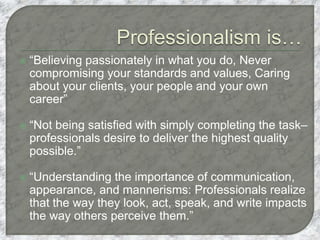
 ―Believing passionately in what you do, Never
compromising your standards and values, Caring
about your clients, your people and your own
career‖
 ―Not being satisfied with simply completing the task–
professionals desire to deliver the highest quality
possible.‖
 ―Understanding the importance of communication,
appearance, and mannerisms: Professionals realize
that the way they look, act, speak, and write impacts
the way others perceive them.‖
Professionalism is…
http://www.youtube.com/watch?v=K3L-
_Nbki0Q
What stood out to you?
What did you agree with?
What did you disagree with?
Do you think that this institution’s idea of
professionalism is different from ours?
Recap of major points
Professionalism – a dynamic definition
What areas of professionalism could be
debated?
How can enhancing professionalism help
you in your leadership roles?
Are there any QUESTIONS?

Student Training Workshop: Professionalism

  • 1.
    Importance of professional imageand perception as a student leader
  • 2.
    Introductions and Icebreakers Definingprofessionalism Attire Professionalism on Campus Break Social Media Presence Goal Setting Conclusion w/ Q&A Evaluations
  • 3.
    PRESENTERS:  Gissel Lopez Kelly DeSisto  Jennifer Smolinski PURPOSE OF PRESENTATION:  To educate student leaders on how to enhance their understanding and identification with the notion of professionalism and its importance both on and off campus.
  • 4.
    Take what youneed M&Ms Game
  • 5.
     Encompasses anindividual’s behavior, appearance, and workplace ethics  Focus on the workplace before their personal problems and agendas  Able to focus on their work and avoid unnecessary distractions  Often perceived to be more competent and valuable  Usually referred to as leaders
  • 6.
  • 7.
     Formal Business:Just one step down from tuxedos, such as dark tailored suits for men and women. • Men: white shirts (French cuff styles), cuff links, silk ties, and pocket squares (silk or linen). • Women: Skirted suits, hosiery, and closed-toe/closed heel pumps. • Often requested for Award dinners, political events, and a variety of dressy evening business occasions.  Traditional Business: Always includes a jacket • Men: Slacks, long sleeve dress shirt with sport jacket or blazer; tie can be optional. Sport jacket/blazer. • Women: Pantsuits are acceptable, skirts or slacks with blouse and jacket  Business Casual- Usually has a collar for both men and women. A twin set is acceptable for women at this level. An appropriate fit is essential. • Men: Slacks and long sleeve shirts, slacks with company issued polo shirt. No tee shirts allowed. • Women: Skirts or slacks with sweaters sets or blouses that have sleeves. Sleeveless tops can lower your credibility.
  • 8.
    T-shirts Sneakers Flip Flops Wrinkled and/orunkempt shirt Active Attire Leggings
  • 9.
    Short Skirts Tight fittingclothes Showing cleavage Too much makeup Heavy perfumes Untraditional hair styles
  • 10.
    Scuffed shoes Un-tidy facialhair Baggy clothing Heavy Colognes Untraditional Hair Styles
  • 11.
  • 12.
    Tips on howto translate professionalism into your leadership role on-campus
  • 13.
    Which roles youare affiliated with on- campus? What skills and qualities are necessary in your position? • What qualities are similar between these leadership roles?
  • 14.
    Students wear manyhats:  Mediator  Tutor  Event planner  Enforcer  Role model  Community builder  Student  Friend  Employee
  • 15.
     Representing thecollege is a large responsibility  Face of the college • Students may know you even when you do not know them • Could be the presence that makes or breaks an individual’s perception of the college experience  What qualities and traits do you desire in an institution? • How do you emulate those traits in your work?  Examples: appropriateness, inclusivity, being supportive of students and co-workers
  • 16.
    Who is yourstudent body? A student leader represents: • LGBTQA • Race • Gender • Ethnicity • Religion • Socioeconomic status • Ability/Barriers
  • 17.
    Should still maintaina sense of professionalism on campus  Be prepared for any new encounters that may lead to beneficial opportunities  Important for those who are interested in being involved on campus and/or creating strong connections in or outside of campus
  • 18.
     EMAIL ETIQUETTE •Create a meaningful and relevant message for the subject line • Always start your email with a greeting such as Dear Mr. Smith or Mr. Smith. Addressing an individual by first name is only encouraged if you have already know the individual well or he/she has addressed his/her emails with their first name. • Use appropriate and standard spelling and punctuation  Ex. Unwarranted use of CAPS Lock • Be clear, concise, direct, and straight to the point with your e-mail message • Be friendly and amiable, but refrain from informal and joking language unless your relationship with the recipient deems it appropriate
  • 19.
     PHONE ETIQUETTE •Try to answer the phone on the second ring  Too soon – can catch the caller off-guard  Too late – inconveniences the caller and shows that they are not your priority to help • Don’t answer the phone by only saying ―hello‖  Answer in a friendly manner that introduces your designated office and your name  Example: ―Thank you for calling the Office of Residence Life, this is <insert your name>, how may I help you?‖ • Smile — it shows over the phone • Make sure to ask for the caller’s name and write down any information that is imperative • Speak clearly, slowly, and at a medium volume  Never talk with anything in your mouth (such as gum) • Ask the caller if there is anything else you can help him/her with • Thank them for their phone call
  • 20.
    How does yourtone differ with: • Faculty • Staff • Outside contacts • Students • Prospective students  Should there be a difference in tone between these groups of people?
  • 21.
    What expectations ofaccessibility must student leaders uphold? • Do these expectations change depending on the position? Activity: Get into groups of three and discuss one time that you or someone you knew ran into trouble with accessibility to on-campus resources • How did these experiences impact your goals?
  • 22.
    Expectations should beindicated at the beginning of a position • If not already established, connect with your supervisor and see if this can be done during a staff meeting Means of access • Email • Phone • Office Hours Where else are you required to be accessible in your positions?
  • 23.
    How your presenceon social mediums can enhance or hinder your professional image
  • 24.
    What is SocialMedia? What social mediums do you use? http://www.youtube.com/watch?v=sIFYPQj Yhv8 • What did you think of the video? • What surprised you? • How could social media’s influence on the world be relevant to your image as a student leader?
  • 25.
    Do you knowhow to use privacy settings on your favorite social mediums? Facebook Privacy Settings Tutorial • Facebook Privacy Setting updates  Can interfere with original settings
  • 26.
    Identity crisis • Howdoes the pressure of the student leader image impact your college experience? How can you best balance being a student and a representative of the institution? • Do you have examples in which this has been difficult to balance? • How have YOU balanced these roles effectively?
  • 27.
    #1 Rule ofProfessionalism – DO YOUR JOB.
  • 28.
     ―Believing passionatelyin what you do, Never compromising your standards and values, Caring about your clients, your people and your own career‖  ―Not being satisfied with simply completing the task– professionals desire to deliver the highest quality possible.‖  ―Understanding the importance of communication, appearance, and mannerisms: Professionals realize that the way they look, act, speak, and write impacts the way others perceive them.‖ Professionalism is…
  • 29.
  • 30.
    What stood outto you? What did you agree with? What did you disagree with? Do you think that this institution’s idea of professionalism is different from ours?
  • 31.
    Recap of majorpoints Professionalism – a dynamic definition What areas of professionalism could be debated? How can enhancing professionalism help you in your leadership roles? Are there any QUESTIONS?