
Potential of Underutilized Vegetable Crops
Resource Person:
Dr.Sunil Prajapati
Assistant Professor
Department of Agriculture
Mangalayatan University, Jabalpur
Mob. No. +91-94078-04830
email: sunil@mangalayatan.ac.in
DoP: 30/07/2021
Content
 Global Biodiversity Hot Spot
 Nutrients and major constituents of foods
 Most common nutrient deficiencies
 Global Hunger Index
 Challenges
 Concept of UUVC
 Potential of UUVC
 Significant Role of UUVC
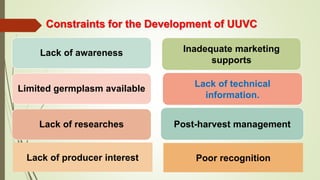
 Constraints for the Development of UUVC
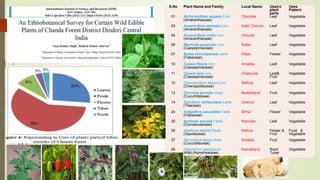
 Wild edible plant spp of Chanda Forest, Mandla
 List of underutilized vegetable crops
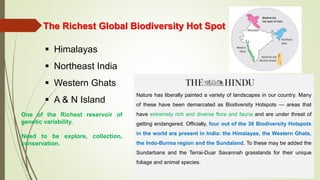
The Richest Global Biodiversity Hot Spot
 Himalayas
 Northeast India
 Western Ghats
 A & N Island
Nature has liberally painted a variety of landscapes in our country. Many
of these have been demarcated as Biodiversity Hotspots — areas that
have extremely rich and diverse flora and fauna and are under threat of
getting endangered. Officially, four out of the 36 Biodiversity Hotspots
in the world are present in India: the Himalayas, the Western Ghats,
the Indo-Burma region and the Sundaland. To these may be added the
Sundarbans and the Terrai-Duar Savannah grasslands for their unique
foliage and animal species.
•
One of the Richest reservoir of
genetic variability.
Need to be explore, collection,
conservation.
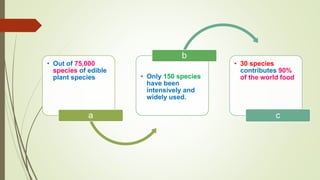
• Out of 75,000
species of edible
plant species
a
• Only 150 species
have been
intensively and
widely used.
b
• 30 species
contributes 90%
of the world food
c
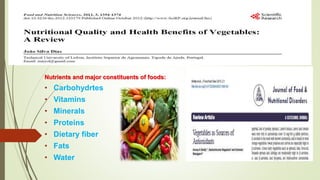
Nutrients and major constituents of foods:
• Carbohydrtes
• Vitamins
• Minerals
• Proteins
• Dietary fiber
• Fats
• Water
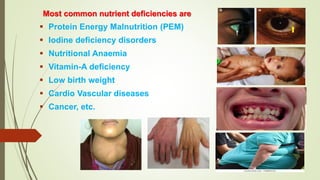
Most common nutrient deficiencies are
 Protein Energy Malnutrition (PEM)
 Iodine deficiency disorders
 Nutritional Anaemia
 Vitamin-A deficiency
 Low birth weight
 Cardio Vascular diseases
 Cancer, etc.
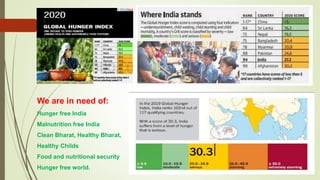
We are in need of:
Hunger free India
Malnutrition free India
Clean Bharat, Healthy Bharat,
Healthy Childs
Food and nutritional security
Hunger free world.

Environmental sustainability
Food Security
Nutritional security
Malnutrition
Global Hunger Index
Poverty elimination
Global Warming
Climate change
Soil Health, etc.
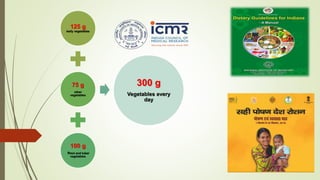
125 g
leafy vegetables
75 g
other
vegetables
100 g
Root and tuber
vegetables
300 g
Vegetables every
day
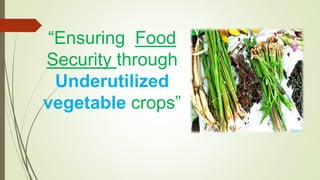
“Ensuring Food
Security through
Underutilized
vegetable crops”
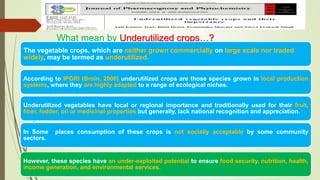
What mean by Underutilized crops…?
The vegetable crops, which are neither grown commercially on large scale nor traded
widely, may be termed as underutilized.
According to IPGRI (Broin, 2006) underutilized crops are those species grown in local production
systems, where they are highly adapted to a range of ecological niches.
Underutilized vegetables have local or regional importance and traditionally used for their fruit,
fiber, fodder, oil or medicinal properties but generally, lack national recognition and appreciation.
However, these species have an under-exploited potential to ensure food security, nutrition, health,
income generation, and environmental services.
In Some places consumption of these crops is not socially acceptable by some community
sectors.
Major Concerns Which Make A Crop So Called Underutilized
• Crop must have a scientific or ethno-botanical proof
of food value.
• Local people are aware about their nutritional and
medicinal properties.
• Crop even under adverse soil and climatic
conditions.
• Easier to grow and hardy in nature.
• Have a long history of consumption.
• These are cheap and readily available.
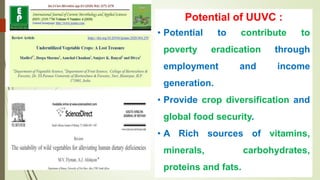
Potential of UUVC :
• Potential to contribute to
poverty eradication through
employment and income
generation.
• Provide crop diversification and
global food security.
• A Rich sources of vitamins,
minerals, carbohydrates,
proteins and fats.
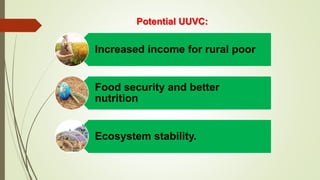
Potential UUVC:
Increased income for rural poor
Food security and better
nutrition
Ecosystem stability.
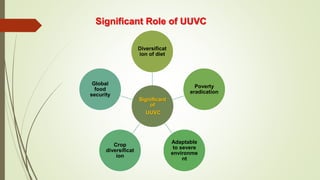
Significant
of
UUVC
Diversificat
ion of diet
Poverty
eradication
Adaptable
to severe
environme
nt
Crop
diversificat
ion
Global
food
security
Significant Role of UUVC
Constraints for the Development of UUVC
Lack of awareness
Limited germplasm available
Lack of researches
Inadequate marketing
supports
Lack of technical
information.
Post-harvest management
Lack of producer interest Poor recognition
S.No Plant Name and Family Local Name Usedo
plant
parts
Uses
Pattern
01 Achyranthes aspera Linn.
(Amaranthaceae)
Chirchita Leaf Vegetable
03 Amaranthus spinosa Linn.
(Amaranthaceae)
Katili Chourai Leaf Vegetable
04 Amaranthus virdis Linn.
(Amaranthaceae)
Chourai Leaf Vegetable
06 Bauhinia perpurea Linn.
(Caesalpiniaceae)
Koilar Leaf Vegetable
07 Butea monosperma Lamk.
(Fabaceae)
Palas Flower Vegetable
10 Cassia fistula Linn.
(Caesalpiniaceae)
Amaltas Leaf Vegetable
11 Cassia tora Linn.
(Caesalpiniaceae)
Chakauda Leaf&
Fruit
Vegetable
12 Chenopodium album Linn.
(Chenopodiaceae)
Bathua Leaf Vegetable
13 Coccinia grandis Voigt.
(Cucurbitaceae)
Bedarikand Fruit Vegetable
14 Corchoru strilocularis Lamk.
(Tiliaceae)
Chench Leaf Vegetable
24 Indigofera cassoides Farsk.
(Fabaceae)
Birhul Flower Vegetable
25 Ipomoea aquetia Farsk.
(Convalvulaceae)
Karmata Leaf Vegetable
26 Madhuca latifolia Roxb.
(Sapotaceae)
Mahua Flower &
Fruit
Food &
Vegetable
27 Momordica dioica Roxb.
(Cucurbitaceae)
Kheksa Fruit Vegetable
28 Nelumbium speciosum
Willd.(Nympheaceae)
Kamalkand Root/
Tuber
Vegetable
Common Name Scientific Name
Amarnathus Amarnathus spp.
Asparagus Asparagus officinalis
Lettuce Lactuca sativa
Celery Apium graveolens
Leek Allium porrum
Globe Artichoke Cynara scolymus
Elephant Foot Yam Amorphophallus campanulatus
Brussels sprout Brassica oleracea var. gemmifera
Kale Brassica oleracea var. acephala
Chinese cabbage Brassica compestris spp.
Winged bean Psophocarpus tetragonolobus
Jack bean Canavalia ensiformis
Pointed gourd Trichosanthes dioica
Parsnip Pastinaca sativa
Rhubarb Rheum rhabarbarrum
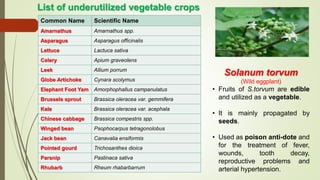
List of underutilized vegetable crops
Solanum torvum
(Wild eggplant)
• Fruits of S.torvum are edible
and utilized as a vegetable.
• It is mainly propagated by
seeds.
• Used as poison anti-dote and
for the treatment of fever,
wounds, tooth decay,
reproductive problems and
arterial hypertension.
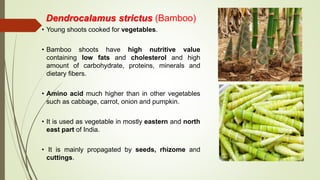
Dendrocalamus strictus (Bamboo)
• Young shoots cooked for vegetables.
• Bamboo shoots have high nutritive value
containing low fats and cholesterol and high
amount of carbohydrate, proteins, minerals and
dietary fibers.
• Amino acid much higher than in other vegetables
such as cabbage, carrot, onion and pumpkin.
• It is used as vegetable in mostly eastern and north
east part of India.
• It is mainly propagated by seeds, rhizome and
cuttings.
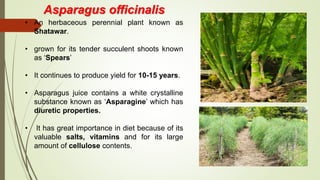
Asparagus officinalis
• An herbaceous perennial plant known as
Shatawar.
• grown for its tender succulent shoots known
as ‘Spears’
• It continues to produce yield for 10-15 years.
• Asparagus juice contains a white crystalline
substance known as ‘Asparagine’ which has
diuretic properties.
• It has great importance in diet because of its
valuable salts, vitamins and for its large
amount of cellulose contents.
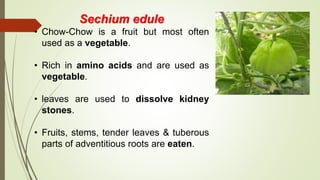
Sechium edule
• Chow-Chow is a fruit but most often
used as a vegetable.
• Rich in amino acids and are used as
vegetable.
• leaves are used to dissolve kidney
stones.
• Fruits, stems, tender leaves & tuberous
parts of adventitious roots are eaten.
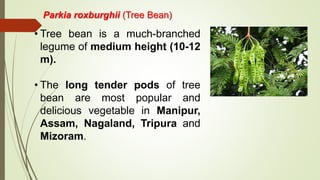
Parkia roxburghii (Tree Bean)
• Tree bean is a much-branched
legume of medium height (10-12
m).
• The long tender pods of tree
bean are most popular and
delicious vegetable in Manipur,
Assam, Nagaland, Tripura and
Mizoram.
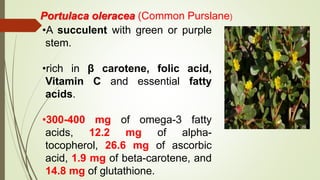
Portulaca oleracea (Common Purslane)
•A succulent with green or purple
stem.
•rich in β carotene, folic acid,
Vitamin C and essential fatty
acids.
•300-400 mg of omega-3 fatty
acids, 12.2 mg of alpha-
tocopherol, 26.6 mg of ascorbic
acid, 1.9 mg of beta-carotene, and
14.8 mg of glutathione.
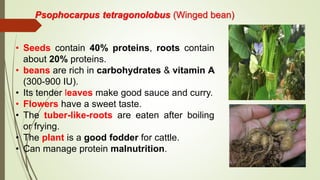
Psophocarpus tetragonolobus (Winged bean)
• Seeds contain 40% proteins, roots contain
about 20% proteins.
• beans are rich in carbohydrates & vitamin A
(300-900 IU).
• Its tender leaves make good sauce and curry.
• Flowers have a sweet taste.
• The tuber-like-roots are eaten after boiling
or frying.
• The plant is a good fodder for cattle.
• Can manage protein malnutrition.
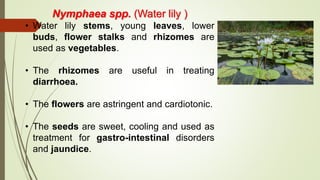
Nymphaea spp. (Water lily )
• Water lily stems, young leaves, lower
buds, flower stalks and rhizomes are
used as vegetables.
• The rhizomes are useful in treating
diarrhoea.
• The flowers are astringent and cardiotonic.
• The seeds are sweet, cooling and used as
treatment for gastro-intestinal disorders
and jaundice.
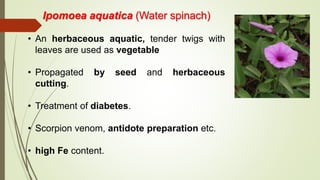
Ipomoea aquatica (Water spinach)
• An herbaceous aquatic, tender twigs with
leaves are used as vegetable
• Propagated by seed and herbaceous
cutting.
• Treatment of diabetes.
• Scorpion venom, antidote preparation etc.
• high Fe content.
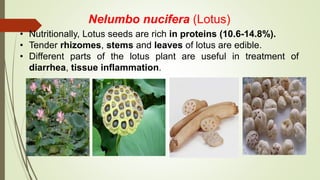
Nelumbo nucifera (Lotus)
• Nutritionally, Lotus seeds are rich in proteins (10.6-14.8%).
• Tender rhizomes, stems and leaves of lotus are edible.
• Different parts of the lotus plant are useful in treatment of
diarrhea, tissue inflammation.
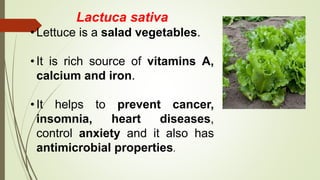
Lactuca sativa
• Lettuce is a salad vegetables.
• It is rich source of vitamins A,
calcium and iron.
• It helps to prevent cancer,
insomnia, heart diseases,
control anxiety and it also has
antimicrobial properties.
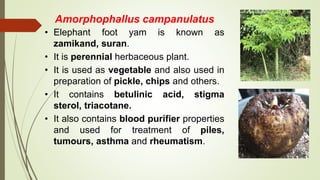
Amorphophallus campanulatus
• Elephant foot yam is known as
zamikand, suran.
• It is perennial herbaceous plant.
• It is used as vegetable and also used in
preparation of pickle, chips and others.
• It contains betulinic acid, stigma
sterol, triacotane.
• It also contains blood purifier properties
and used for treatment of piles,
tumours, asthma and rheumatism.
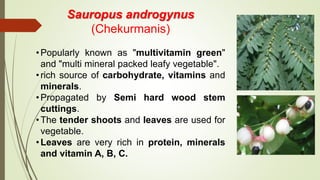
Sauropus androgynus
(Chekurmanis)
•Popularly known as "multivitamin green"
and "multi mineral packed leafy vegetable".
•rich source of carbohydrate, vitamins and
minerals.
•Propagated by Semi hard wood stem
cuttings.
•The tender shoots and leaves are used for
vegetable.
•Leaves are very rich in protein, minerals
and vitamin A, B, C.
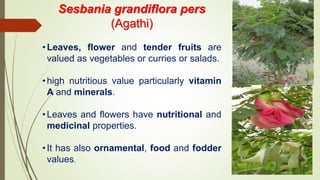
Sesbania grandiflora pers
(Agathi)
•Leaves, flower and tender fruits are
valued as vegetables or curries or salads.
•high nutritious value particularly vitamin
A and minerals.
•Leaves and flowers have nutritional and
medicinal properties.
•It has also ornamental, food and fodder
values.
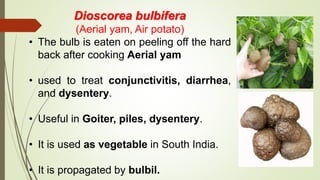
Dioscorea bulbifera
(Aerial yam, Air potato)
• The bulb is eaten on peeling off the hard
back after cooking Aerial yam
• used to treat conjunctivitis, diarrhea,
and dysentery.
• Useful in Goiter, piles, dysentery.
• It is used as vegetable in South India.
• It is propagated by bulbil.
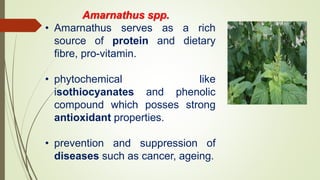
Amarnathus spp.
• Amarnathus serves as a rich
source of protein and dietary
fibre, pro-vitamin.
• phytochemical like
isothiocyanates and phenolic
compound which posses strong
antioxidant properties.
• prevention and suppression of
diseases such as cancer, ageing.
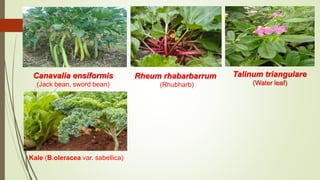
Canavalia ensiformis
(Jack bean, sword bean)
Rheum rhabarbarrum
(Rhubharb)
Talinum triangulare
(Water leaf)
Kale (B.oleracea var. sabellica)
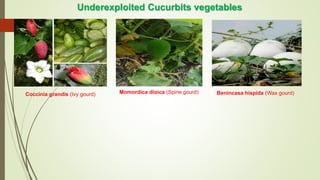
Underexploited Cucurbits vegetables
Coccinia grandis (Ivy gourd) Momordica dioica (Spine gourd) Benincasa hispida (Wax gourd)
International Research Organization For UUVC
• International Plant Genetic Research Institute (IPGRI)
• International Centre For Underutilized Crops (ICUC)
• International Atomic Energy Agency (IAEA)
• Global Facilitation Unit (GFU)
• Need to broaden the range of economical importance plant species.
• Global awareness must be among the peoples regarding potential role of
UUVC.
• Specific exploration programmes should be carried out for collection,
conservation for crop improvements.
• Global public awareness programmes should be carried out in remote
areas to educate the peoples about nutritional values of UUVC.
• Characterization and documentation of germplasm.
• Value addition facilities and market values of UUVC.
Inference
Underutilized Vegetable Crops

Underutilized Vegetable Crops

  • 1.
    Potential of UnderutilizedVegetable Crops Resource Person: Dr.Sunil Prajapati Assistant Professor Department of Agriculture Mangalayatan University, Jabalpur Mob. No. +91-94078-04830 email: sunil@mangalayatan.ac.in DoP: 30/07/2021
  • 2.
    Content  Global BiodiversityHot Spot  Nutrients and major constituents of foods  Most common nutrient deficiencies  Global Hunger Index  Challenges  Concept of UUVC  Potential of UUVC  Significant Role of UUVC  Constraints for the Development of UUVC  Wild edible plant spp of Chanda Forest, Mandla  List of underutilized vegetable crops
  • 3.
    The Richest GlobalBiodiversity Hot Spot  Himalayas  Northeast India  Western Ghats  A & N Island Nature has liberally painted a variety of landscapes in our country. Many of these have been demarcated as Biodiversity Hotspots — areas that have extremely rich and diverse flora and fauna and are under threat of getting endangered. Officially, four out of the 36 Biodiversity Hotspots in the world are present in India: the Himalayas, the Western Ghats, the Indo-Burma region and the Sundaland. To these may be added the Sundarbans and the Terrai-Duar Savannah grasslands for their unique foliage and animal species. • One of the Richest reservoir of genetic variability. Need to be explore, collection, conservation.
  • 4.
    • Out of75,000 species of edible plant species a • Only 150 species have been intensively and widely used. b • 30 species contributes 90% of the world food c
  • 5.
    Nutrients and majorconstituents of foods: • Carbohydrtes • Vitamins • Minerals • Proteins • Dietary fiber • Fats • Water
  • 6.
    Most common nutrientdeficiencies are  Protein Energy Malnutrition (PEM)  Iodine deficiency disorders  Nutritional Anaemia  Vitamin-A deficiency  Low birth weight  Cardio Vascular diseases  Cancer, etc.
  • 7.
    We are inneed of: Hunger free India Malnutrition free India Clean Bharat, Healthy Bharat, Healthy Childs Food and nutritional security Hunger free world.
  • 8.
     Environmental sustainability Food Security Nutritionalsecurity Malnutrition Global Hunger Index Poverty elimination Global Warming Climate change Soil Health, etc.
  • 9.
    125 g leafy vegetables 75g other vegetables 100 g Root and tuber vegetables 300 g Vegetables every day
  • 10.
  • 11.
    What mean byUnderutilized crops…? The vegetable crops, which are neither grown commercially on large scale nor traded widely, may be termed as underutilized. According to IPGRI (Broin, 2006) underutilized crops are those species grown in local production systems, where they are highly adapted to a range of ecological niches. Underutilized vegetables have local or regional importance and traditionally used for their fruit, fiber, fodder, oil or medicinal properties but generally, lack national recognition and appreciation. However, these species have an under-exploited potential to ensure food security, nutrition, health, income generation, and environmental services. In Some places consumption of these crops is not socially acceptable by some community sectors.
  • 12.
    Major Concerns WhichMake A Crop So Called Underutilized • Crop must have a scientific or ethno-botanical proof of food value. • Local people are aware about their nutritional and medicinal properties. • Crop even under adverse soil and climatic conditions. • Easier to grow and hardy in nature. • Have a long history of consumption. • These are cheap and readily available.
  • 13.
    Potential of UUVC: • Potential to contribute to poverty eradication through employment and income generation. • Provide crop diversification and global food security. • A Rich sources of vitamins, minerals, carbohydrates, proteins and fats.
  • 14.
    Potential UUVC: Increased incomefor rural poor Food security and better nutrition Ecosystem stability.
  • 15.
    Significant of UUVC Diversificat ion of diet Poverty eradication Adaptable tosevere environme nt Crop diversificat ion Global food security Significant Role of UUVC
  • 16.
    Constraints for theDevelopment of UUVC Lack of awareness Limited germplasm available Lack of researches Inadequate marketing supports Lack of technical information. Post-harvest management Lack of producer interest Poor recognition
  • 17.
    S.No Plant Nameand Family Local Name Usedo plant parts Uses Pattern 01 Achyranthes aspera Linn. (Amaranthaceae) Chirchita Leaf Vegetable 03 Amaranthus spinosa Linn. (Amaranthaceae) Katili Chourai Leaf Vegetable 04 Amaranthus virdis Linn. (Amaranthaceae) Chourai Leaf Vegetable 06 Bauhinia perpurea Linn. (Caesalpiniaceae) Koilar Leaf Vegetable 07 Butea monosperma Lamk. (Fabaceae) Palas Flower Vegetable 10 Cassia fistula Linn. (Caesalpiniaceae) Amaltas Leaf Vegetable 11 Cassia tora Linn. (Caesalpiniaceae) Chakauda Leaf& Fruit Vegetable 12 Chenopodium album Linn. (Chenopodiaceae) Bathua Leaf Vegetable 13 Coccinia grandis Voigt. (Cucurbitaceae) Bedarikand Fruit Vegetable 14 Corchoru strilocularis Lamk. (Tiliaceae) Chench Leaf Vegetable 24 Indigofera cassoides Farsk. (Fabaceae) Birhul Flower Vegetable 25 Ipomoea aquetia Farsk. (Convalvulaceae) Karmata Leaf Vegetable 26 Madhuca latifolia Roxb. (Sapotaceae) Mahua Flower & Fruit Food & Vegetable 27 Momordica dioica Roxb. (Cucurbitaceae) Kheksa Fruit Vegetable 28 Nelumbium speciosum Willd.(Nympheaceae) Kamalkand Root/ Tuber Vegetable
  • 18.
    Common Name ScientificName Amarnathus Amarnathus spp. Asparagus Asparagus officinalis Lettuce Lactuca sativa Celery Apium graveolens Leek Allium porrum Globe Artichoke Cynara scolymus Elephant Foot Yam Amorphophallus campanulatus Brussels sprout Brassica oleracea var. gemmifera Kale Brassica oleracea var. acephala Chinese cabbage Brassica compestris spp. Winged bean Psophocarpus tetragonolobus Jack bean Canavalia ensiformis Pointed gourd Trichosanthes dioica Parsnip Pastinaca sativa Rhubarb Rheum rhabarbarrum List of underutilized vegetable crops Solanum torvum (Wild eggplant) • Fruits of S.torvum are edible and utilized as a vegetable. • It is mainly propagated by seeds. • Used as poison anti-dote and for the treatment of fever, wounds, tooth decay, reproductive problems and arterial hypertension.
  • 19.
    Dendrocalamus strictus (Bamboo) •Young shoots cooked for vegetables. • Bamboo shoots have high nutritive value containing low fats and cholesterol and high amount of carbohydrate, proteins, minerals and dietary fibers. • Amino acid much higher than in other vegetables such as cabbage, carrot, onion and pumpkin. • It is used as vegetable in mostly eastern and north east part of India. • It is mainly propagated by seeds, rhizome and cuttings.
  • 20.
    Asparagus officinalis • Anherbaceous perennial plant known as Shatawar. • grown for its tender succulent shoots known as ‘Spears’ • It continues to produce yield for 10-15 years. • Asparagus juice contains a white crystalline substance known as ‘Asparagine’ which has diuretic properties. • It has great importance in diet because of its valuable salts, vitamins and for its large amount of cellulose contents.
  • 21.
    Sechium edule • Chow-Chowis a fruit but most often used as a vegetable. • Rich in amino acids and are used as vegetable. • leaves are used to dissolve kidney stones. • Fruits, stems, tender leaves & tuberous parts of adventitious roots are eaten.
  • 22.
    Parkia roxburghii (TreeBean) • Tree bean is a much-branched legume of medium height (10-12 m). • The long tender pods of tree bean are most popular and delicious vegetable in Manipur, Assam, Nagaland, Tripura and Mizoram.
  • 23.
    Portulaca oleracea (CommonPurslane) •A succulent with green or purple stem. •rich in β carotene, folic acid, Vitamin C and essential fatty acids. •300-400 mg of omega-3 fatty acids, 12.2 mg of alpha- tocopherol, 26.6 mg of ascorbic acid, 1.9 mg of beta-carotene, and 14.8 mg of glutathione.
  • 24.
    Psophocarpus tetragonolobus (Wingedbean) • Seeds contain 40% proteins, roots contain about 20% proteins. • beans are rich in carbohydrates & vitamin A (300-900 IU). • Its tender leaves make good sauce and curry. • Flowers have a sweet taste. • The tuber-like-roots are eaten after boiling or frying. • The plant is a good fodder for cattle. • Can manage protein malnutrition.
  • 25.
    Nymphaea spp. (Waterlily ) • Water lily stems, young leaves, lower buds, flower stalks and rhizomes are used as vegetables. • The rhizomes are useful in treating diarrhoea. • The flowers are astringent and cardiotonic. • The seeds are sweet, cooling and used as treatment for gastro-intestinal disorders and jaundice.
  • 26.
    Ipomoea aquatica (Waterspinach) • An herbaceous aquatic, tender twigs with leaves are used as vegetable • Propagated by seed and herbaceous cutting. • Treatment of diabetes. • Scorpion venom, antidote preparation etc. • high Fe content.
  • 27.
    Nelumbo nucifera (Lotus) •Nutritionally, Lotus seeds are rich in proteins (10.6-14.8%). • Tender rhizomes, stems and leaves of lotus are edible. • Different parts of the lotus plant are useful in treatment of diarrhea, tissue inflammation.
  • 28.
    Lactuca sativa • Lettuceis a salad vegetables. • It is rich source of vitamins A, calcium and iron. • It helps to prevent cancer, insomnia, heart diseases, control anxiety and it also has antimicrobial properties.
  • 29.
    Amorphophallus campanulatus • Elephantfoot yam is known as zamikand, suran. • It is perennial herbaceous plant. • It is used as vegetable and also used in preparation of pickle, chips and others. • It contains betulinic acid, stigma sterol, triacotane. • It also contains blood purifier properties and used for treatment of piles, tumours, asthma and rheumatism.
  • 30.
    Sauropus androgynus (Chekurmanis) •Popularly knownas "multivitamin green" and "multi mineral packed leafy vegetable". •rich source of carbohydrate, vitamins and minerals. •Propagated by Semi hard wood stem cuttings. •The tender shoots and leaves are used for vegetable. •Leaves are very rich in protein, minerals and vitamin A, B, C.
  • 31.
    Sesbania grandiflora pers (Agathi) •Leaves,flower and tender fruits are valued as vegetables or curries or salads. •high nutritious value particularly vitamin A and minerals. •Leaves and flowers have nutritional and medicinal properties. •It has also ornamental, food and fodder values.
  • 32.
    Dioscorea bulbifera (Aerial yam,Air potato) • The bulb is eaten on peeling off the hard back after cooking Aerial yam • used to treat conjunctivitis, diarrhea, and dysentery. • Useful in Goiter, piles, dysentery. • It is used as vegetable in South India. • It is propagated by bulbil.
  • 33.
    Amarnathus spp. • Amarnathusserves as a rich source of protein and dietary fibre, pro-vitamin. • phytochemical like isothiocyanates and phenolic compound which posses strong antioxidant properties. • prevention and suppression of diseases such as cancer, ageing.
  • 34.
    Canavalia ensiformis (Jack bean,sword bean) Rheum rhabarbarrum (Rhubharb) Talinum triangulare (Water leaf) Kale (B.oleracea var. sabellica)
  • 35.
    Underexploited Cucurbits vegetables Cocciniagrandis (Ivy gourd) Momordica dioica (Spine gourd) Benincasa hispida (Wax gourd)
  • 36.
    International Research OrganizationFor UUVC • International Plant Genetic Research Institute (IPGRI) • International Centre For Underutilized Crops (ICUC) • International Atomic Energy Agency (IAEA) • Global Facilitation Unit (GFU)
  • 37.
    • Need tobroaden the range of economical importance plant species. • Global awareness must be among the peoples regarding potential role of UUVC. • Specific exploration programmes should be carried out for collection, conservation for crop improvements. • Global public awareness programmes should be carried out in remote areas to educate the peoples about nutritional values of UUVC. • Characterization and documentation of germplasm. • Value addition facilities and market values of UUVC. Inference