Rijan Upadhyay
BCD
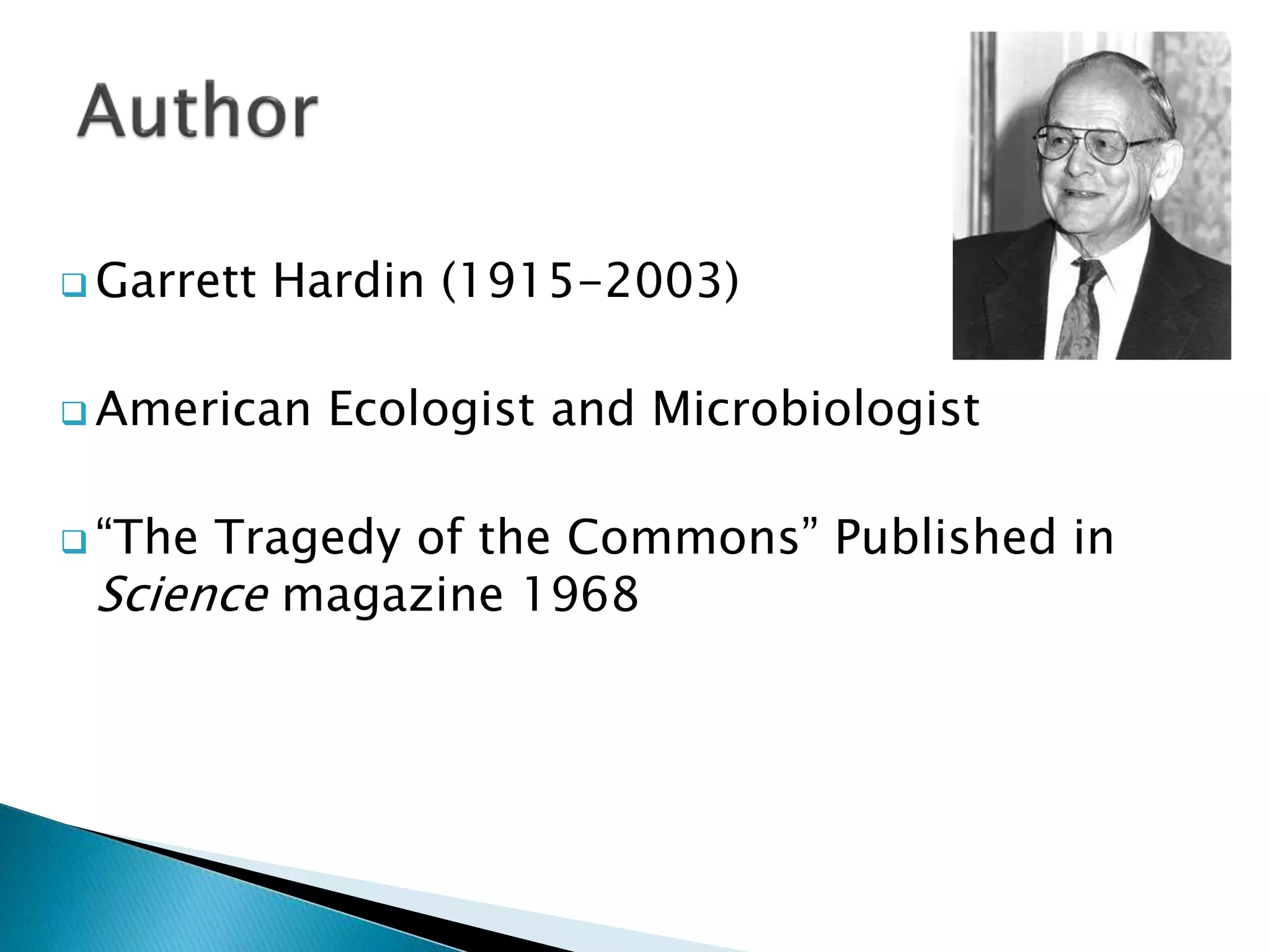
 Garrett Hardin (1915-2003)
 American Ecologist and Microbiologist
 “The Tragedy of the Commons” Published in
Science magazine 1968
 Concept: A shared resource in which any
given user reaps the full benefit of his/her
personal use, while the losses are distributed
amongst all users.
 Result: Tragedy all around.
Hardin: appeals to individual conscience are bad because:
1) It discriminates against people of good conscience, and tends
to eliminate them from the population.
2) It won’t work in the long run. Nature’s revenge. People
without conscience with outbreed the others, and population
will increase again eventually.
3) It is not psychologically healthy to force people to act against
their own interests on the basis of conscience.
 Mutual coercion to solve population problem (government
regulation on number of offspring allowed) and other problems of
the commons:
 Enclose the commons as private property, Or limit usage of the
commons (e.g. limits on people’s right to pollute, to fish on the high
seas, to increase public noise levels, etc.)
 Rights and freedoms must be restricted for the good of everyone.
 The right to breed in excess is like the right to steal from banks – it
must be controlled.
 http://www.econlib.org/library/Enc/Tragedyo
ftheCommons.html
THANK YOU

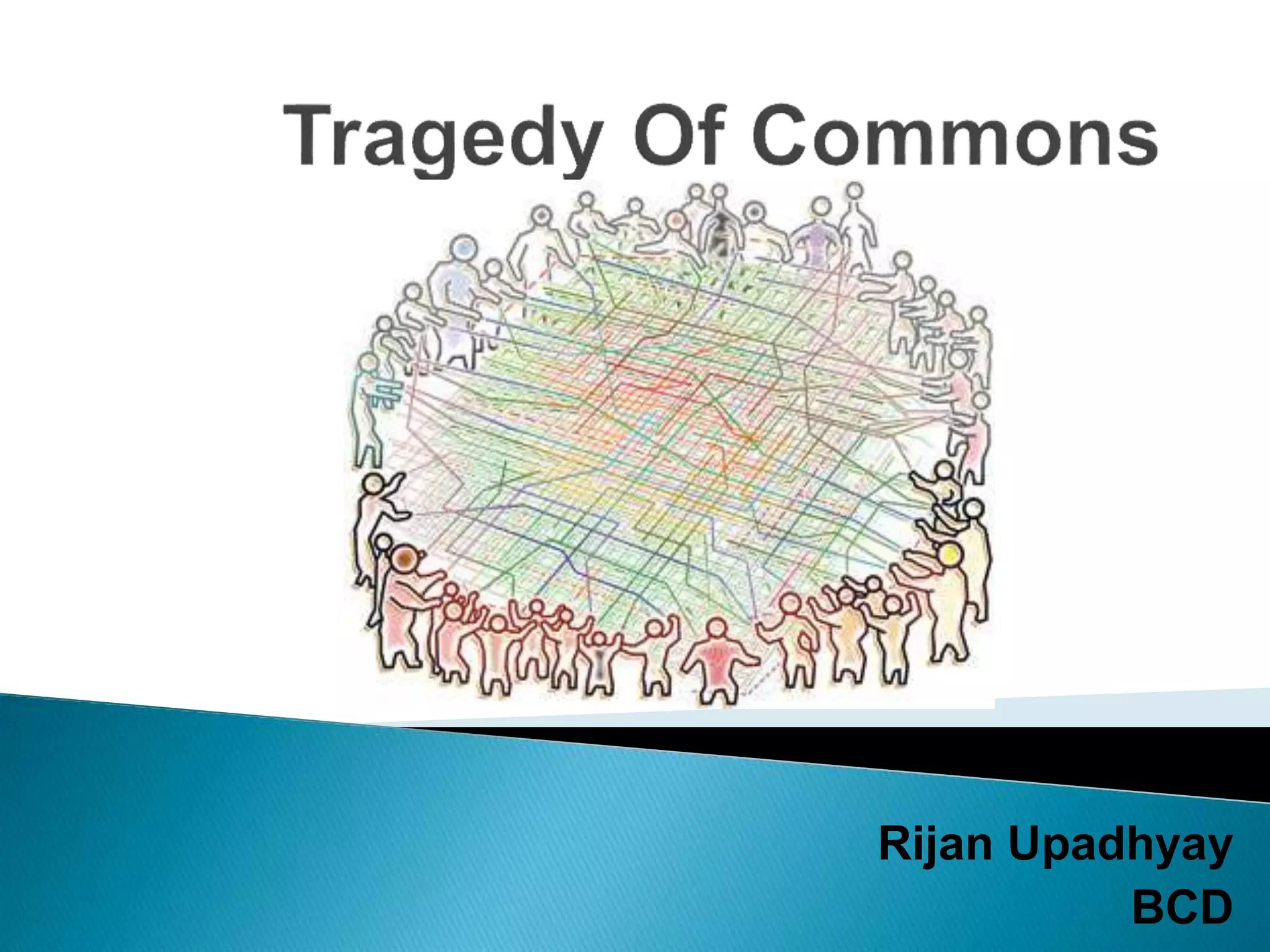
Tragedy of commons

  • 1.
  • 2.
     Garrett Hardin(1915-2003)  American Ecologist and Microbiologist  “The Tragedy of the Commons” Published in Science magazine 1968
  • 3.
     Concept: Ashared resource in which any given user reaps the full benefit of his/her personal use, while the losses are distributed amongst all users.  Result: Tragedy all around.
  • 4.
    Hardin: appeals toindividual conscience are bad because: 1) It discriminates against people of good conscience, and tends to eliminate them from the population. 2) It won’t work in the long run. Nature’s revenge. People without conscience with outbreed the others, and population will increase again eventually. 3) It is not psychologically healthy to force people to act against their own interests on the basis of conscience.
  • 5.
     Mutual coercionto solve population problem (government regulation on number of offspring allowed) and other problems of the commons:  Enclose the commons as private property, Or limit usage of the commons (e.g. limits on people’s right to pollute, to fish on the high seas, to increase public noise levels, etc.)  Rights and freedoms must be restricted for the good of everyone.  The right to breed in excess is like the right to steal from banks – it must be controlled.
  • 6.