World Report on Disability
(Rehabilitation)
Rijan Upadhyay
BCD
This Chapter Includes
Understanding Rehabilitation
Types of Rehabilitation
Unmet Needs
Barriers to accessing rehabilitation
Some Strategies to overcome the barriers
Casey Says:
“Coming from a country where there is not much awareness and resources for
dealing with post-spinal cord injured victims, my return home was indeed an
enormous challenge. Living in a house that was inaccessible, members of my
family have had to persevere with daily lifting me up and down the house.
Physiotherapy had become a crucial necessity and as a result of the continuous
costs suffered, my mother took up the task to administer physiotherapy as well
as stand in as my caretaker. During my rehabilitation process, getting admitted
for treatment during times of illness or to use physiotherapy facilities was close
to impossible as a result of the overwhelming numbers on the waiting list. My
rehabilitation period despite challenging was a humbling moment of my life and
a continuous process that I face until today. I have learned disability is not
inability and a strong mentality and great attitude have been very important!”
Rehabilitation
Rehabilitation assists individuals with disability to achieve and maintain optimal
functioning in interaction with their environment by reducing the impact of a
broad range of health conditions.
Rehabilitation is meant the preparation of people with disabilities to adapt to
and positively interact with the society, through a host of social programs and
activities, as well as offering them jobs; work is no less important for them than
all other people. (Ministry of Health)
Typically rehabilitation occurs for a specific period of time, but can involve single
or multiple interventions delivered by an individual or a team of rehabilitation
workers, and can be needed from the acute or initial phase immediately
following recognition of a health condition through to post-acute and
maintenance phases.
Measures and Outcomes
Rehabilitation measures target body functions and structures, activities and participation,
environmental factors, and personal factors. They contribute to a person achieving and
maintaining optimal functioning in interaction with their environment, using the following
broad outcomes:
■ prevention of the loss of function
■ slowing the rate of loss of function
■ improvement or restoration of function
■ compensation for lost function
■ maintenance of current function.
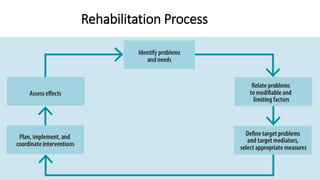
Rehabilitation Process
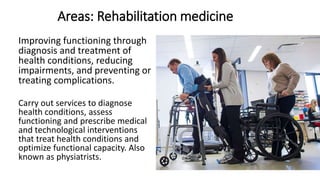
Areas: Rehabilitation medicine
Improving functioning through
diagnosis and treatment of
health conditions, reducing
impairments, and preventing or
treating complications.
Carry out services to diagnose
health conditions, assess
functioning and prescribe medical
and technological interventions
that treat health conditions and
optimize functional capacity. Also
known as physiatrists.
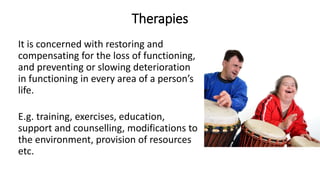
Therapies
It is concerned with restoring and
compensating for the loss of functioning,
and preventing or slowing deterioration
in functioning in every area of a person’s
life.
E.g. training, exercises, education,
support and counselling, modifications to
the environment, provision of resources
etc.
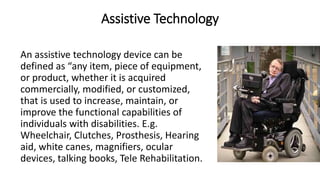
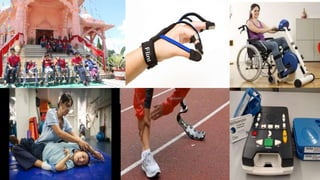
Assistive Technology
An assistive technology device can be
defined as “any item, piece of equipment,
or product, whether it is acquired
commercially, modified, or customized,
that is used to increase, maintain, or
improve the functional capabilities of
individuals with disabilities. E.g.
Wheelchair, Clutches, Prosthesis, Hearing
aid, white canes, magnifiers, ocular
devices, talking books, Tele Rehabilitation.
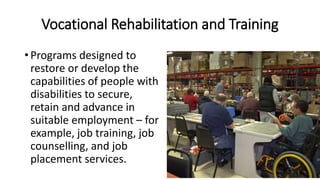
Vocational Rehabilitation and Training
• Programs designed to
restore or develop the
capabilities of people with
disabilities to secure,
retain and advance in
suitable employment – for
example, job training, job
counselling, and job
placement services.
Estimating Needs
• Rehabilitation is a good investment because it builds human capacity
and promotes participation.
• Limited global data on met and unmet needs.
• Increase in disabling conditions and global aging.
• Waiting time for services- Global survey on vision services:
• Urban: less than 1 month
• Rural: 6-12 months
Addressing Human Resources
• 3 Levels: University, Mid-Level, Community Based Rehabilitation (CBR).
• Increase training at the mid-level.
• Generic multi-purpose training (Physical and Occupational Therapy, & Speech), or
profession-specific assistants.
• Limited ability to migrate to developed countries.
• CBR: minimal training, Geographic access, Referral.
• Regional Training centers.
• Primary Health care workers need more training when there are insufficient
specialists.
• Rehabilitation should be integrated into primary and secondary health care.
• Holding of rehabilitation professionals
Challenges
• Clear policies often lacking for rehabilitation.
• Unmet need for services.
• Difficult access to services, e.g. services overly centralized in major cities.
• Inadequate financing.
Rehabilitation: issues and challenges
• Global data is limited on met and unmet needs, but country surveys reveal
large gaps in the provision of rehabilitation and assistive devices.
• Limited access results in deterioration in health, activity limitations and
participation restrictions, increased dependency, and reduced quality of life.
• Few rehabilitation personnel: limited capacity, particularly in Africa.
• Systemic problems: rehabilitation overly centralized, lack of effective referral.
• Need for more investment in rehabilitation services.
Addressing systematic barriers
• Reforming policies, laws and systems.
• Development or revision of national rehabilitation plans.
• Increase and decentralization of services.
Rehabilitation: Solutions
• Policy, legislation and regulatory mechanisms.
• Financing: address cost and coverage through international cooperation,
partnerships, targeted funding.
• Human resources: increase capacity and supply of personnel through education
and training, mechanisms for recruiting and retaining. Mid-level workers as first
step.
• Service delivery: integration into health system, coordination, community-
based, early intervention.
• Assistive technology: appropriate for user needs, good follow-up, local
manufacturing, reducing taxes.
• Research and evidence-based practice.
THANK YOU

World report on disability

  • 1.
    World Report onDisability (Rehabilitation) Rijan Upadhyay BCD
  • 2.
    This Chapter Includes UnderstandingRehabilitation Types of Rehabilitation Unmet Needs Barriers to accessing rehabilitation Some Strategies to overcome the barriers
  • 3.
    Casey Says: “Coming froma country where there is not much awareness and resources for dealing with post-spinal cord injured victims, my return home was indeed an enormous challenge. Living in a house that was inaccessible, members of my family have had to persevere with daily lifting me up and down the house. Physiotherapy had become a crucial necessity and as a result of the continuous costs suffered, my mother took up the task to administer physiotherapy as well as stand in as my caretaker. During my rehabilitation process, getting admitted for treatment during times of illness or to use physiotherapy facilities was close to impossible as a result of the overwhelming numbers on the waiting list. My rehabilitation period despite challenging was a humbling moment of my life and a continuous process that I face until today. I have learned disability is not inability and a strong mentality and great attitude have been very important!”
  • 4.
    Rehabilitation Rehabilitation assists individualswith disability to achieve and maintain optimal functioning in interaction with their environment by reducing the impact of a broad range of health conditions. Rehabilitation is meant the preparation of people with disabilities to adapt to and positively interact with the society, through a host of social programs and activities, as well as offering them jobs; work is no less important for them than all other people. (Ministry of Health) Typically rehabilitation occurs for a specific period of time, but can involve single or multiple interventions delivered by an individual or a team of rehabilitation workers, and can be needed from the acute or initial phase immediately following recognition of a health condition through to post-acute and maintenance phases.
  • 5.
    Measures and Outcomes Rehabilitationmeasures target body functions and structures, activities and participation, environmental factors, and personal factors. They contribute to a person achieving and maintaining optimal functioning in interaction with their environment, using the following broad outcomes: ■ prevention of the loss of function ■ slowing the rate of loss of function ■ improvement or restoration of function ■ compensation for lost function ■ maintenance of current function.
  • 6.
  • 7.
    Areas: Rehabilitation medicine Improvingfunctioning through diagnosis and treatment of health conditions, reducing impairments, and preventing or treating complications. Carry out services to diagnose health conditions, assess functioning and prescribe medical and technological interventions that treat health conditions and optimize functional capacity. Also known as physiatrists.
  • 8.
    Therapies It is concernedwith restoring and compensating for the loss of functioning, and preventing or slowing deterioration in functioning in every area of a person’s life. E.g. training, exercises, education, support and counselling, modifications to the environment, provision of resources etc.
  • 9.
    Assistive Technology An assistivetechnology device can be defined as “any item, piece of equipment, or product, whether it is acquired commercially, modified, or customized, that is used to increase, maintain, or improve the functional capabilities of individuals with disabilities. E.g. Wheelchair, Clutches, Prosthesis, Hearing aid, white canes, magnifiers, ocular devices, talking books, Tele Rehabilitation.
  • 10.
    Vocational Rehabilitation andTraining • Programs designed to restore or develop the capabilities of people with disabilities to secure, retain and advance in suitable employment – for example, job training, job counselling, and job placement services.
  • 12.
    Estimating Needs • Rehabilitationis a good investment because it builds human capacity and promotes participation. • Limited global data on met and unmet needs. • Increase in disabling conditions and global aging. • Waiting time for services- Global survey on vision services: • Urban: less than 1 month • Rural: 6-12 months
  • 13.
    Addressing Human Resources •3 Levels: University, Mid-Level, Community Based Rehabilitation (CBR). • Increase training at the mid-level. • Generic multi-purpose training (Physical and Occupational Therapy, & Speech), or profession-specific assistants. • Limited ability to migrate to developed countries. • CBR: minimal training, Geographic access, Referral. • Regional Training centers. • Primary Health care workers need more training when there are insufficient specialists. • Rehabilitation should be integrated into primary and secondary health care. • Holding of rehabilitation professionals
  • 14.
    Challenges • Clear policiesoften lacking for rehabilitation. • Unmet need for services. • Difficult access to services, e.g. services overly centralized in major cities. • Inadequate financing.
  • 15.
    Rehabilitation: issues andchallenges • Global data is limited on met and unmet needs, but country surveys reveal large gaps in the provision of rehabilitation and assistive devices. • Limited access results in deterioration in health, activity limitations and participation restrictions, increased dependency, and reduced quality of life. • Few rehabilitation personnel: limited capacity, particularly in Africa. • Systemic problems: rehabilitation overly centralized, lack of effective referral. • Need for more investment in rehabilitation services.
  • 16.
    Addressing systematic barriers •Reforming policies, laws and systems. • Development or revision of national rehabilitation plans. • Increase and decentralization of services.
  • 17.
    Rehabilitation: Solutions • Policy,legislation and regulatory mechanisms. • Financing: address cost and coverage through international cooperation, partnerships, targeted funding. • Human resources: increase capacity and supply of personnel through education and training, mechanisms for recruiting and retaining. Mid-level workers as first step. • Service delivery: integration into health system, coordination, community- based, early intervention. • Assistive technology: appropriate for user needs, good follow-up, local manufacturing, reducing taxes. • Research and evidence-based practice.
  • 18.

Editor's Notes