Garrett Hardin  (1968) Professor of  Biology University of California, Santa Barbara   The Tragedy of the Commons
Definition and Conceptual Root The  tragedy of the commons   (also  Common Pool Theory- CPT)  is a class of phenomena that involve a conflict for resources between individual interests and the  common good . The term derives originally from a parable published by  William Forster Lloyd  in his 1833 book on population
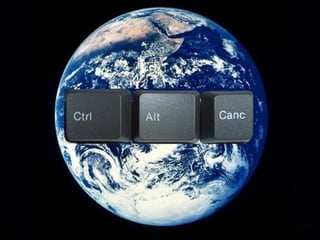
Core Argument of CPT The parable demonstrates how free access and unrestricted demand for a finite resource ultimately dooms the resource through over-exploitation. This occurs because the  benefits of exploitation accrue to individuals , each of which is motivated to maximise his or her own use of the resource, while the  costs of exploitation are distributed between all those to whom the resource is available  (which may be more individuals than the exploiters).
Points to Note About CPT The Tragedy is a metaphor for what Alfred N. Whitehead called "the remorseless working of things.” Hardin’s aim was to draw attention to problems that cannot be solved by technical means, (need change in human values or ideas of morality. He focused on population growth vs. life-support systems (a critical issue today)
Paradigm Example of CPT   Imagine the use by individuals of  communally  owned land for the grazing of cows owned  privately  by those individuals.  The utility to each individual of adding a single cow to his own herd is, more or less, the value of that cow; the cost to the individual is the consumption of the resources of that cow  divided by the number of communal owners of the common . That is, the benefit to an individual of "hogging" a resource inevitably outweighs the cost where communal resources are concerned.
Paradigm Example (cont’d) 3. All  economically rational herdsman in the community will add as many cows as they can to their own herds and as quickly as they can (before other herdsmen do), meaning that the finite resources of the communal land will quickly become exhausted. "Therein is the tragedy. Each man is locked into a system that compels him to increase his herd without limit—in a world that is limited. Ruin is the destination toward which all men rush, each pursuing his own best interest in a society that believes in the freedom of the commons. Freedom in a commons brings ruin to all.
Modern Commons and Tragedies Planet Earth - Uncontrolled human population growth, leading to overpopulation 2. Air - Air pollution 3.  Water – Water pollution and water wastage due to over-use 4. Soil – Soil contamination 5. Public spaces and lands – Littering, crime, graffiti  6. Roads – Traffic congestion, accidents and medical/insurance
Modern Commons and Tragedies 6. Energy resources and  climate  - Burning of  fossil fuels  and consequential  global warming   7.  Fauna Species – Poaching, extinction 8. Forests  - Frontier  logging  of  old growth forest  and  slash and burn   9.  Public lands – Overgrazing, overbuilding  10. Oceans – Overfishing, reclamation, pollution   11. Flora Life  - Reduced  biodiversity
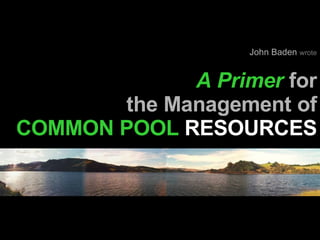
A Primer   for the Management of COMMON POOL   RESOURCES John Baden   wrote
introduction What is “Common Pool Resources” a natural or human-made resource system, whose size or characteristics of which makes it costly, but not impossible, to exclude potential beneficiaries from obtaining benefits from its use  typically consists of a core resource, which defines the stock variable, while providing a limited quantity of extractable fringe units, which defines the flow variable  To keep the resource available for future generations the core resources are preserved A Primer   for the Management of   COMMON POOL   RESOURCES
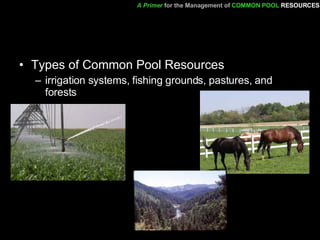
Common Pool Resources- Public Goods Types of Common Pool Resources irrigation systems, fishing grounds, pastures, and forests  A Primer   for the Management of   COMMON POOL   RESOURCES
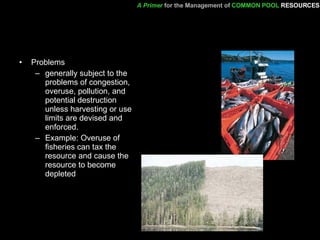
Problems  generally subject to the problems of congestion, overuse, pollution, and potential destruction unless harvesting or use limits are devised and enforced.  Example: Overuse of fisheries can tax the resource and cause the resource to become depleted A Primer   for the Management of   COMMON POOL   RESOURCES
Who are the actors and what are their roles/responsibilities? Government actors Corporate sector actors Non-governmental/non-profit actors Grassroots/citizen actors (Examples of roles: Regulation, advocacy, enlightenment, mobilization, coordination, enforcement, arbitration, collaboration, etc.)
Global Common-Pool Regime  The Kyoto Protocol  An amendment to the United Nations Opened for signature December 11, 1997 in Kyoto, Japan Aims to reduce the emissions of greenhouse gases, gases which are perceived by environmentalists to disrupt the perceived common-pool resource of a moderate global climate without climate change.  A Primer   for the Management of   COMMON POOL   RESOURCES
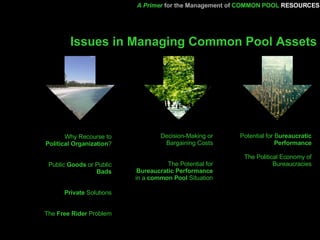
Issues in Managing Common Pool Assets Why Recourse to  Political Organization ? Public  Goods  or Public  Bads Private  Solutions The  Free Rider  Problem Potential for B ureaucratic Performance The Political Economy of Bureaucracies Decision-Making or Bargaining Costs The Potential for  Bureaucratic Performance  in a  common Pool  Situation A Primer   for the Management of   COMMON POOL   RESOURCES
Political Recourse Why Recourse to  Political Organization ? Public  Goods  or Public  Bads Private  Solutions The  Free Rider  Problem A Primer   for the Management of   COMMON POOL   RESOURCES
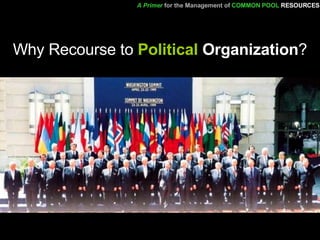
Why Recourse to  Political  Organization ? A Primer   for the Management of   COMMON POOL   RESOURCES
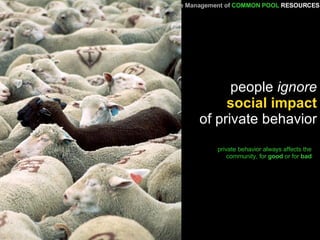
people  ignore social impact of private behavior private behavior always affects the community, for  good  or for  bad A Primer   for the Management of   COMMON POOL   RESOURCES
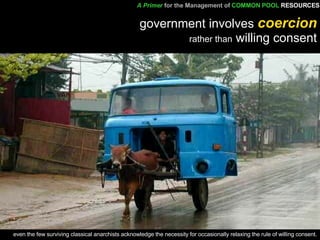
government involves  coercion rather than  willing consent even the few surviving classical anarchists acknowledge the necessity for occasionally relaxing the rule of willing consent. A Primer   for the Management of   COMMON POOL   RESOURCES
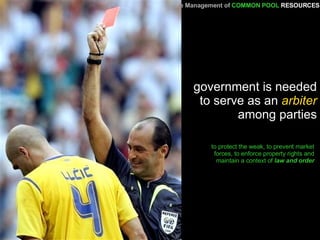
government is needed to serve as an  arbiter  among parties to protect the weak, to prevent market forces, to enforce property rights and maintain a context of  law and order A Primer   for the Management of   COMMON POOL   RESOURCES
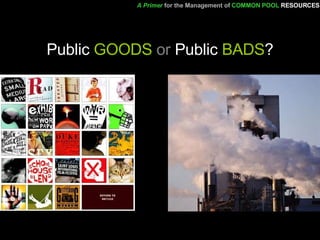
Public  GOODS  or  Public  BADS ? A Primer   for the Management of   COMMON POOL   RESOURCES
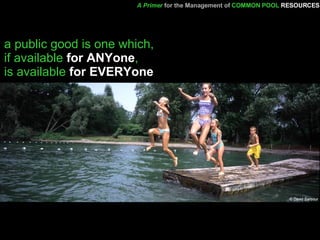
a public good is one which,  if available  for ANYone ,  is available  for EVERYone A Primer   for the Management of   COMMON POOL   RESOURCES
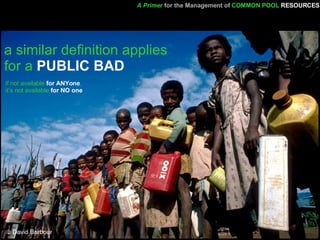
a similar definition applies for a  PUBLIC BAD A Primer   for the Management of   COMMON POOL   RESOURCES if not available  for ANYone ,  it’s not available  for NO one
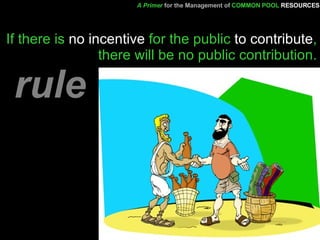
If there is  no incentive  for the public  to contribute , there will be no public contribution. A Primer   for the Management of   COMMON POOL   RESOURCES rule
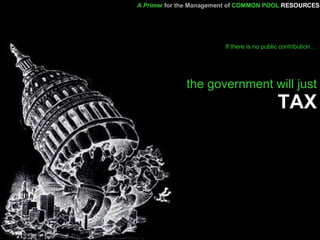
A Primer   for the Management of   COMMON POOL   RESOURCES the government will just  TAX If there is no public contribution…
exception #1   social pressure   can induce contribution for public goods   the  grass is always greener on the other side A Primer   for the Management of   COMMON POOL   RESOURCES
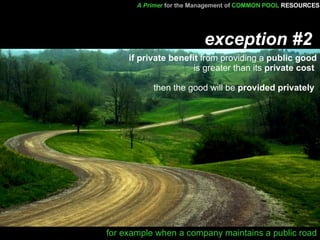
exception #2     if private benefit  from providing a  public good  is greater than its  private cost   then the good will be  provided privately   for example when a company maintains a public road A Primer   for the Management of   COMMON POOL   RESOURCES
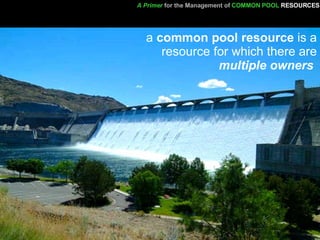
a  common pool resource  is a resource for which there are  multiple owners   A Primer   for the Management of   COMMON POOL   RESOURCES
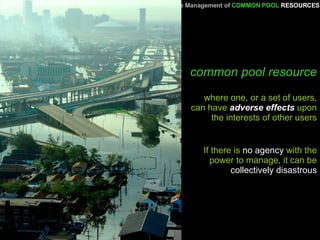
common pool resource where one, or a set of users, can have  adverse effects  upon the interests of other users A Primer   for the Management of   COMMON POOL   RESOURCES If there is  no agency  with the power to manage, it can be  collectively disastrous
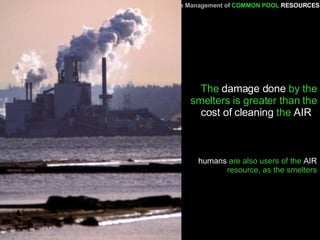
The  damage done  by the smelters is greater than the  cost of cleaning  the  AIR   A Primer   for the Management of   COMMON POOL   RESOURCES humans  are also users of the  AIR  resource, as the smelters
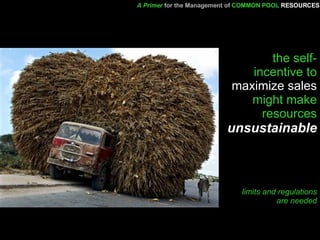
the self- incentive to  maximize sales  might make resources  unsustainable limits and regulations are needed A Primer   for the Management of   COMMON POOL   RESOURCES
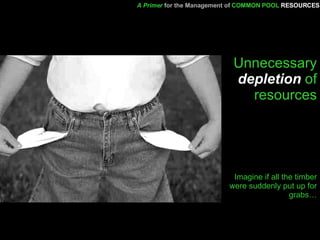
Unnecessary  depletion  of resources Imagine if all the timber were suddenly put up for grabs… A Primer   for the Management of   COMMON POOL   RESOURCES
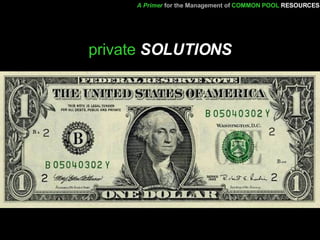
private  SOLUTIONS A Primer   for the Management of   COMMON POOL   RESOURCES
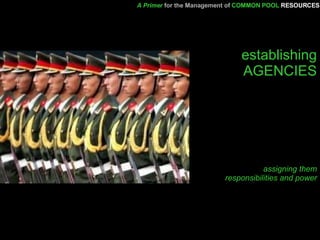
establishing AGENCIES assigning them responsibilities and power A Primer   for the Management of   COMMON POOL   RESOURCES
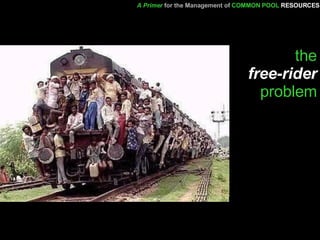
the   free-rider   problem A Primer   for the Management of   COMMON POOL   RESOURCES
in general,  the world is  taking on an ever-greater resemblance to a  common pool A Primer   for the Management of   COMMON POOL   RESOURCES oma
 
What do we do? Decision-Making or Bargaining Costs The Potential for  Bureaucratic Performance  in a  common Pool  Situation A Primer   for the Management of   COMMON POOL   RESOURCES
Decision making or bargaining costs Necessary to come to mutual voluntary agreements for use of common pool resources Incentive to reach agreements because marginal costs are low Two main sets of costs involved Actual cost Cost of construction or extraction of resources Opportunity costs Costs associated with time spent on finance issues A Primer   for the Management of   COMMON POOL   RESOURCES
Potential for Bureaucratic Performance in a Common Pool Situation Cost Benefit Analysis of Wildlife management With no common pool management the result will be a loss of the core resources If resource is managed then less net loss will accrue Possibility for management by bureaucracy to retain resources  MSB: (Marginal Social Benefit) MSC (Marginal Social Cost) A Primer   for the Management of   COMMON POOL   RESOURCES
Action Potential for B ureaucratic Performance The Political Economy of Bureaucracies A Primer   for the Management of   COMMON POOL   RESOURCES
conclusion Common Pool Resources and Sustainability Need to manage common pool resources to help achieve sustainability E.g., Overgrazing, Over-fishing, Deforestation, etc. Bureaucratic (Government) management  Dependent on the city (political will) and funding  Capabilities of citizens to take action Public (Community) Management Dependent on the knowledge, skills and experience of community activists. Q. Which method is best for the management of Common Pool Resources? A Primer   for the Management of   COMMON POOL   RESOURCES

Common Pool Theory

  • 1.
    Garrett Hardin (1968) Professor of Biology University of California, Santa Barbara The Tragedy of the Commons
  • 2.
    Definition and ConceptualRoot The tragedy of the commons (also Common Pool Theory- CPT) is a class of phenomena that involve a conflict for resources between individual interests and the common good . The term derives originally from a parable published by William Forster Lloyd in his 1833 book on population
  • 3.
    Core Argument ofCPT The parable demonstrates how free access and unrestricted demand for a finite resource ultimately dooms the resource through over-exploitation. This occurs because the benefits of exploitation accrue to individuals , each of which is motivated to maximise his or her own use of the resource, while the costs of exploitation are distributed between all those to whom the resource is available (which may be more individuals than the exploiters).
  • 4.
    Points to NoteAbout CPT The Tragedy is a metaphor for what Alfred N. Whitehead called "the remorseless working of things.” Hardin’s aim was to draw attention to problems that cannot be solved by technical means, (need change in human values or ideas of morality. He focused on population growth vs. life-support systems (a critical issue today)
  • 5.
    Paradigm Example ofCPT Imagine the use by individuals of communally owned land for the grazing of cows owned privately by those individuals. The utility to each individual of adding a single cow to his own herd is, more or less, the value of that cow; the cost to the individual is the consumption of the resources of that cow divided by the number of communal owners of the common . That is, the benefit to an individual of "hogging" a resource inevitably outweighs the cost where communal resources are concerned.
  • 6.
    Paradigm Example (cont’d)3. All economically rational herdsman in the community will add as many cows as they can to their own herds and as quickly as they can (before other herdsmen do), meaning that the finite resources of the communal land will quickly become exhausted. "Therein is the tragedy. Each man is locked into a system that compels him to increase his herd without limit—in a world that is limited. Ruin is the destination toward which all men rush, each pursuing his own best interest in a society that believes in the freedom of the commons. Freedom in a commons brings ruin to all.
  • 7.
    Modern Commons andTragedies Planet Earth - Uncontrolled human population growth, leading to overpopulation 2. Air - Air pollution 3. Water – Water pollution and water wastage due to over-use 4. Soil – Soil contamination 5. Public spaces and lands – Littering, crime, graffiti 6. Roads – Traffic congestion, accidents and medical/insurance
  • 8.
    Modern Commons andTragedies 6. Energy resources and climate - Burning of fossil fuels and consequential global warming 7. Fauna Species – Poaching, extinction 8. Forests - Frontier logging of old growth forest and slash and burn 9. Public lands – Overgrazing, overbuilding 10. Oceans – Overfishing, reclamation, pollution 11. Flora Life - Reduced biodiversity
  • 9.
    A Primer for the Management of COMMON POOL RESOURCES John Baden wrote
  • 10.
    introduction What is“Common Pool Resources” a natural or human-made resource system, whose size or characteristics of which makes it costly, but not impossible, to exclude potential beneficiaries from obtaining benefits from its use typically consists of a core resource, which defines the stock variable, while providing a limited quantity of extractable fringe units, which defines the flow variable To keep the resource available for future generations the core resources are preserved A Primer for the Management of COMMON POOL RESOURCES
  • 11.
    Common Pool Resources-Public Goods Types of Common Pool Resources irrigation systems, fishing grounds, pastures, and forests A Primer for the Management of COMMON POOL RESOURCES
  • 12.
    Problems generallysubject to the problems of congestion, overuse, pollution, and potential destruction unless harvesting or use limits are devised and enforced. Example: Overuse of fisheries can tax the resource and cause the resource to become depleted A Primer for the Management of COMMON POOL RESOURCES
  • 13.
    Who are theactors and what are their roles/responsibilities? Government actors Corporate sector actors Non-governmental/non-profit actors Grassroots/citizen actors (Examples of roles: Regulation, advocacy, enlightenment, mobilization, coordination, enforcement, arbitration, collaboration, etc.)
  • 14.
    Global Common-Pool Regime The Kyoto Protocol An amendment to the United Nations Opened for signature December 11, 1997 in Kyoto, Japan Aims to reduce the emissions of greenhouse gases, gases which are perceived by environmentalists to disrupt the perceived common-pool resource of a moderate global climate without climate change. A Primer for the Management of COMMON POOL RESOURCES
  • 15.
    Issues in ManagingCommon Pool Assets Why Recourse to Political Organization ? Public Goods or Public Bads Private Solutions The Free Rider Problem Potential for B ureaucratic Performance The Political Economy of Bureaucracies Decision-Making or Bargaining Costs The Potential for Bureaucratic Performance in a common Pool Situation A Primer for the Management of COMMON POOL RESOURCES
  • 16.
    Political Recourse WhyRecourse to Political Organization ? Public Goods or Public Bads Private Solutions The Free Rider Problem A Primer for the Management of COMMON POOL RESOURCES
  • 17.
    Why Recourse to Political Organization ? A Primer for the Management of COMMON POOL RESOURCES
  • 18.
    people ignoresocial impact of private behavior private behavior always affects the community, for good or for bad A Primer for the Management of COMMON POOL RESOURCES
  • 19.
    government involves coercion rather than willing consent even the few surviving classical anarchists acknowledge the necessity for occasionally relaxing the rule of willing consent. A Primer for the Management of COMMON POOL RESOURCES
  • 20.
    government is neededto serve as an arbiter among parties to protect the weak, to prevent market forces, to enforce property rights and maintain a context of law and order A Primer for the Management of COMMON POOL RESOURCES
  • 21.
    Public GOODS or Public BADS ? A Primer for the Management of COMMON POOL RESOURCES
  • 22.
    a public goodis one which, if available for ANYone , is available for EVERYone A Primer for the Management of COMMON POOL RESOURCES
  • 23.
    a similar definitionapplies for a PUBLIC BAD A Primer for the Management of COMMON POOL RESOURCES if not available for ANYone , it’s not available for NO one
  • 24.
    If there is no incentive for the public to contribute , there will be no public contribution. A Primer for the Management of COMMON POOL RESOURCES rule
  • 25.
    A Primer for the Management of COMMON POOL RESOURCES the government will just TAX If there is no public contribution…
  • 26.
    exception #1 social pressure can induce contribution for public goods the grass is always greener on the other side A Primer for the Management of COMMON POOL RESOURCES
  • 27.
    exception #2 if private benefit from providing a public good is greater than its private cost then the good will be provided privately for example when a company maintains a public road A Primer for the Management of COMMON POOL RESOURCES
  • 28.
    a commonpool resource is a resource for which there are multiple owners A Primer for the Management of COMMON POOL RESOURCES
  • 29.
    common pool resourcewhere one, or a set of users, can have adverse effects upon the interests of other users A Primer for the Management of COMMON POOL RESOURCES If there is no agency with the power to manage, it can be collectively disastrous
  • 30.
    The damagedone by the smelters is greater than the cost of cleaning the AIR A Primer for the Management of COMMON POOL RESOURCES humans are also users of the AIR resource, as the smelters
  • 31.
    the self- incentiveto maximize sales might make resources unsustainable limits and regulations are needed A Primer for the Management of COMMON POOL RESOURCES
  • 32.
    Unnecessary depletion of resources Imagine if all the timber were suddenly put up for grabs… A Primer for the Management of COMMON POOL RESOURCES
  • 33.
    private SOLUTIONSA Primer for the Management of COMMON POOL RESOURCES
  • 34.
    establishing AGENCIES assigningthem responsibilities and power A Primer for the Management of COMMON POOL RESOURCES
  • 35.
    the free-rider problem A Primer for the Management of COMMON POOL RESOURCES
  • 36.
    in general, the world is taking on an ever-greater resemblance to a common pool A Primer for the Management of COMMON POOL RESOURCES oma
  • 37.
  • 38.
    What do wedo? Decision-Making or Bargaining Costs The Potential for Bureaucratic Performance in a common Pool Situation A Primer for the Management of COMMON POOL RESOURCES
  • 39.
    Decision making orbargaining costs Necessary to come to mutual voluntary agreements for use of common pool resources Incentive to reach agreements because marginal costs are low Two main sets of costs involved Actual cost Cost of construction or extraction of resources Opportunity costs Costs associated with time spent on finance issues A Primer for the Management of COMMON POOL RESOURCES
  • 40.
    Potential for BureaucraticPerformance in a Common Pool Situation Cost Benefit Analysis of Wildlife management With no common pool management the result will be a loss of the core resources If resource is managed then less net loss will accrue Possibility for management by bureaucracy to retain resources MSB: (Marginal Social Benefit) MSC (Marginal Social Cost) A Primer for the Management of COMMON POOL RESOURCES
  • 41.
    Action Potential forB ureaucratic Performance The Political Economy of Bureaucracies A Primer for the Management of COMMON POOL RESOURCES
  • 42.
    conclusion Common PoolResources and Sustainability Need to manage common pool resources to help achieve sustainability E.g., Overgrazing, Over-fishing, Deforestation, etc. Bureaucratic (Government) management Dependent on the city (political will) and funding Capabilities of citizens to take action Public (Community) Management Dependent on the knowledge, skills and experience of community activists. Q. Which method is best for the management of Common Pool Resources? A Primer for the Management of COMMON POOL RESOURCES