Traffic Light Project
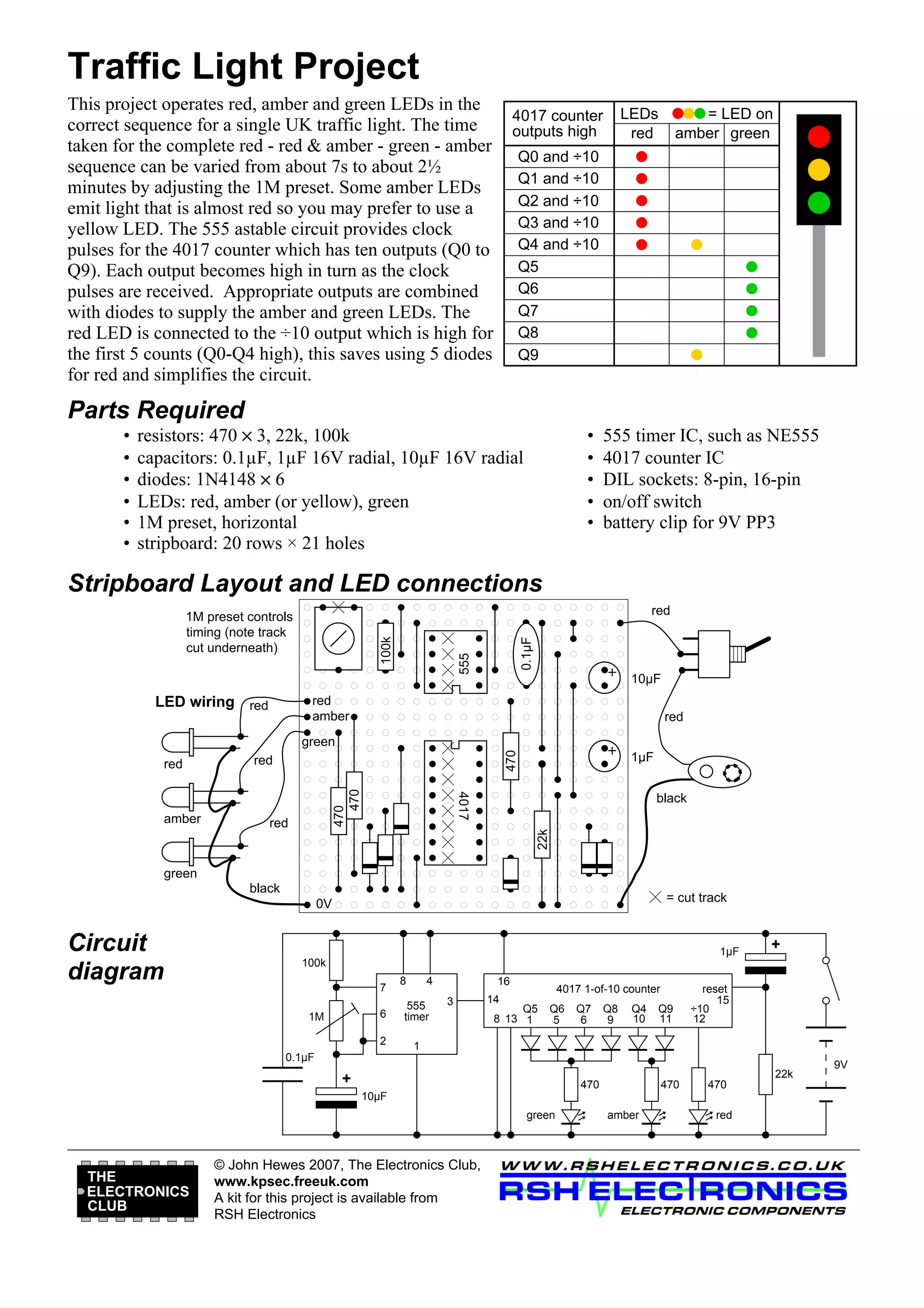
This project operates red, amber and green LEDs in the
correct sequence for a single UK traffic light. The time
taken for the complete red - red & amber - green - amber
sequence can be varied from about 7s to about 2½
minutes by adjusting the 1M preset. Some amber LEDs
emit light that is almost red so you may prefer to use a
yellow LED. The 555 astable circuit provides clock
pulses for the 4017 counter which has ten outputs (Q0 to
Q9). Each output becomes high in turn as the clock
pulses are received. Appropriate outputs are combined
with diodes to supply the amber and green LEDs. The
red LED is connected to the ÷10 output which is high for
the first 5 counts (Q0-Q4 high), this saves using 5 diodes
for red and simplifies the circuit.

LEDs
red

4017 counter
outputs high

= LED on
amber green

Q0 and ÷10
Q1 and ÷10
Q2 and ÷10
Q3 and ÷10
Q4 and ÷10
Q5
Q6
Q7
Q8
Q9

Parts Required
•
•
•
•
•
•

resistors: 470 × 3, 22k, 100k
capacitors: 0.1µF, 1µF 16V radial, 10µF 16V radial
diodes: 1N4148 × 6
LEDs: red, amber (or yellow), green
1M preset, horizontal
stripboard: 20 rows × 21 holes

•
•
•
•
•

555 timer IC, such as NE555
4017 counter IC
DIL sockets: 8-pin, 16-pin
on/off switch
battery clip for 9V PP3

Stripboard Layout and LED connections
555

100k

0.1µF

red

1M preset controls
timing (note track
cut underneath)

10µF

red
amber

LED wiring red

red

470
470

red

black
22k

red

1µF

4017

amber

470

green
red

green
black

= cut track

0V

Circuit
diagram

1µF

+

100k
7

8

4

6
2

1M

555
timer

16
3

14

4017 1-of-10 counter

reset
15

1

Q5
8 13 1

Q6
5

Q7
6

Q8
9

Q4
10

Q9
11

÷10
12

0.1µF
22k

+

470

470

470

10µF
green

THE
ELECTRONICS
CLUB

© John Hewes 2007, The Electronics Club,
www.kpsec.freeuk.com
A kit for this project is available from
RSH Electronics

amber

red

9V

Trafficlight Circuit

  • 1.
    Traffic Light Project Thisproject operates red, amber and green LEDs in the correct sequence for a single UK traffic light. The time taken for the complete red - red & amber - green - amber sequence can be varied from about 7s to about 2½ minutes by adjusting the 1M preset. Some amber LEDs emit light that is almost red so you may prefer to use a yellow LED. The 555 astable circuit provides clock pulses for the 4017 counter which has ten outputs (Q0 to Q9). Each output becomes high in turn as the clock pulses are received. Appropriate outputs are combined with diodes to supply the amber and green LEDs. The red LED is connected to the ÷10 output which is high for the first 5 counts (Q0-Q4 high), this saves using 5 diodes for red and simplifies the circuit. LEDs red 4017 counter outputs high = LED on amber green Q0 and ÷10 Q1 and ÷10 Q2 and ÷10 Q3 and ÷10 Q4 and ÷10 Q5 Q6 Q7 Q8 Q9 Parts Required • • • • • • resistors: 470 × 3, 22k, 100k capacitors: 0.1µF, 1µF 16V radial, 10µF 16V radial diodes: 1N4148 × 6 LEDs: red, amber (or yellow), green 1M preset, horizontal stripboard: 20 rows × 21 holes • • • • • 555 timer IC, such as NE555 4017 counter IC DIL sockets: 8-pin, 16-pin on/off switch battery clip for 9V PP3 Stripboard Layout and LED connections 555 100k 0.1µF red 1M preset controls timing (note track cut underneath) 10µF red amber LED wiring red red 470 470 red black 22k red 1µF 4017 amber 470 green red green black = cut track 0V Circuit diagram 1µF + 100k 7 8 4 6 2 1M 555 timer 16 3 14 4017 1-of-10 counter reset 15 1 Q5 8 13 1 Q6 5 Q7 6 Q8 9 Q4 10 Q9 11 ÷10 12 0.1µF 22k + 470 470 470 10µF green THE ELECTRONICS CLUB © John Hewes 2007, The Electronics Club, www.kpsec.freeuk.com A kit for this project is available from RSH Electronics amber red 9V