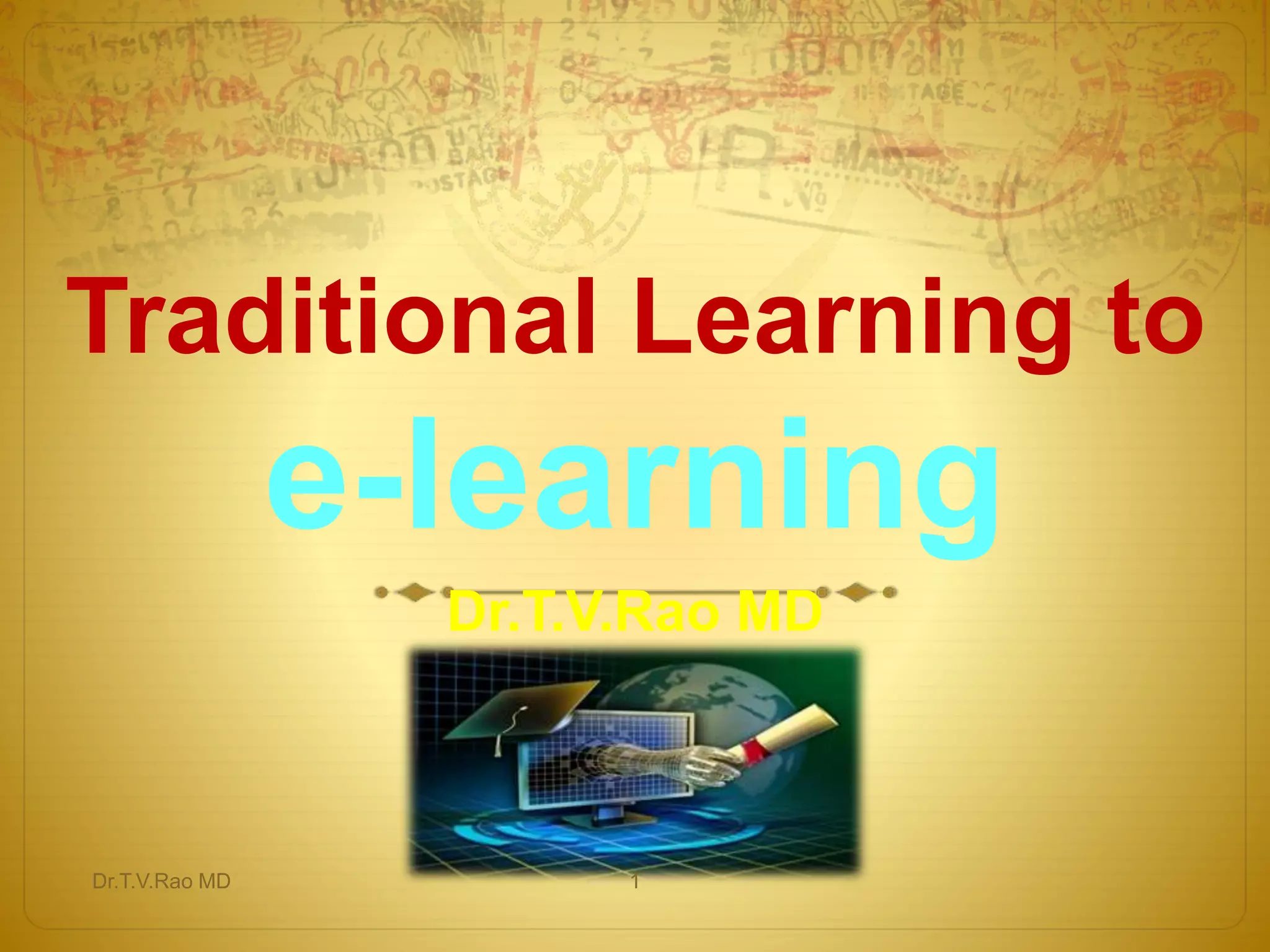
Traditional Learning to
e-learning
Dr.T.V.Rao MD
Dr.T.V.Rao MD 1
We Still Follow Socratic
Method
 Socratic method , is
named after the classical
Greek philosopher
Socrates. It is a form of
inquiry and discussion
between individuals, based
on asking and answering
questions to stimulate
critical thinking and to
illuminate ideas. It is a
dialectical method,
often involving a discussion
in which the defence of one
point of view is questioned;
Dr.T.V.Rao MD 2
Traditional Education
 Traditional education, is also known as
back-to-basics, conventional education
or customary education, refers to long-
established customs found in schools
that society traditionally used. Some
forms of education reform promote the
adoption of progressive education
practices, a more holistic approach
which focuses on individual students'
needs and self-expression
Dr.T.V.Rao MD 3
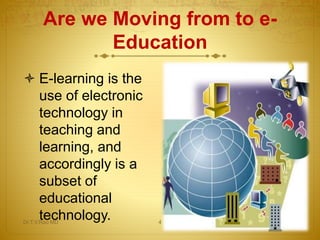
Are we Moving from to e-
Education
 E-learning is the
use of electronic
technology in
teaching and
learning, and
accordingly is a
subset of
educational
technology.Dr.T.V.Rao MD 4
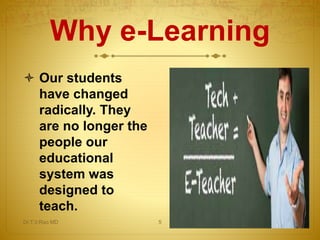
Why e-Learning
 Our students
have changed
radically. They
are no longer the
people our
educational
system was
designed to
teach.
Dr.T.V.Rao MD 5
E-learning Includes
 E-learning includes information and communication
technology (ICT) in education, EdTech, learning
technology, multimedia learning, technology-enhanced
learning (TEL), computer-based instruction (CBI),
computer managed instruction, computer-based training
(CBT), computer-assisted instruction or computer-aided
instruction (CAI), internet-based training (IBT), flexible
learning, web-based training (WBT), online education,
online learning, virtual education, virtual learning
environments (VLE; which are also called learning
platforms), m-learning, and digital education. All of these
terms appear in articles and reviews; the term "e-learning"
is used frequently, but is variously and imprecisely
defined and appliedDr.T.V.Rao MD 6
The Basis of E-learning remain with
Creating Interactive Class Rooms
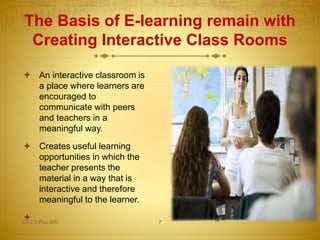
 An interactive classroom is
a place where learners are
encouraged to
communicate with peers
and teachers in a
meaningful way.
 Creates useful learning
opportunities in which the
teacher presents the
material in a way that is
interactive and therefore
meaningful to the learner.
Dr.T.V.Rao MD 7
What is E-Classroom
 E-classrooms provide a unique opportunity to
use technology to implement prompt feedback
and thereby augment the current classroom
experience. Coordinating various instructional
streams with student assessment and
feedback will provide the means for instructors
to know when and if their intended message
was communicated to their students,
permitting instructors and students to react
quickly when there is a gap between intent
and understanding.Dr.T.V.Rao MD 8
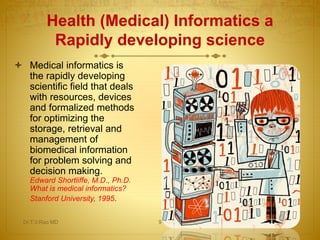
 Medical informatics is
the rapidly developing
scientific field that deals
with resources, devices
and formalized methods
for optimizing the
storage, retrieval and
management of
biomedical information
for problem solving and
decision making.
Edward Shortliffe, M.D., Ph.D.
What is medical informatics?
Stanford University, 1995.
Health (Medical) Informatics a
Rapidly developing science
Dr.T.V.Rao MD 9
 include not only
computers but also
clinical guidelines,
formal medical
terminologies, and
information and
communication
systems. It is applied
to the areas of
nursing, clinical care,
dentistry, pharmacy,
public health and
(bio)medical research.
Health Informatics
Tools
Dr.T.V.Rao MD 10
What is E-Classroom
 Further, developing a flexible
instructional infrastructure will create a
bridge between course objectives and
course assessment, classroom
instruction and student feedback, and
seat-time and study-time. By developing
this framework within an e-classroom,
information can be gathered to measure
student, instructor and organizational
achievement and to assist in
Dr.T.V.Rao MD 11
Computer-aided
instruction
Dr.T.V.Rao MD 12
 These include computer-aided instruction,
learning about computers and their
applications, use of computer-based
information resources, use of computers as a
tool and as a mechanism for information
management, decision support and
communication.) While medical informatics
includes computer applications, it is not
limited only to the use of computers, but
includes the knowledge, skills and attitudes
involved in seeking, manipulating and using
biomedical information.
Why Interactive
Classroom
 Cognitive psychologists:
 learning is more productive when the acquired knowledge
occurs in an interactive environment.
 Experimentally, it was found that students attending
interactive lectures learn more than students attending a
traditional one.
 This is because students in an interactive environment
do not spend the time in writing and copying the material
from the board as the case in traditional classrooms;
instead, they spend the time in thinking, understanding
and asking questions .
Dr.T.V.Rao MD 13
Why Interactive
Classroom
 Efficient learning techniques became mandatory to
keep up with the demand of productive learning:
 Significant improvements in computational power,
 networking bandwidth,
 storage capacity and graphical user interfaces
 New teaching methods, such as long-distance and virtual
learning, where students are separated in space and/or
time, become increasingly common in many universities
and educational institutes
Dr.T.V.Rao MD 14
Interactive Classroom
 Electronic classroom or simply “E-classroom” is
equipped with technologies that
 capture classroom activities,
 allow for audio and video recordings of lectures,
 slides presentation,
 capture the notes written by the lecturer, and
 make class material available all the time.
 can be accessed and reviewed by students for missing
parts, studying difficult concepts or to prepare for exams.
Dr.T.V.Rao MD 15
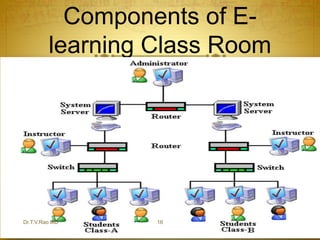
Components of E-
learning Class Room
Dr.T.V.Rao MD 16
Features of Interactive
Classroom
 For students, the new system encourages them to participate
and complete the coursework with more variety in learning
experiences, such as:
 answering questions directly,
 taking quizzes,
 downloading audio and video files,
 reviewing past lectures,
 uploading due assignments and many other interesting
tasks.
 Our system comes at low cost
 It has the advantages of being flexible, easy to use, and
has the ability to run at any place within the campus where
a networking connection is available.
Dr.T.V.Rao MD 17
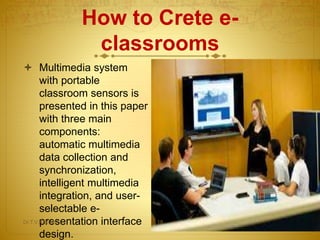
How to Crete e-
classrooms
 Multimedia system
with portable
classroom sensors is
presented in this paper
with three main
components:
automatic multimedia
data collection and
synchronization,
intelligent multimedia
integration, and user-
selectable e-
presentation interface
design.
Dr.T.V.Rao MD 18
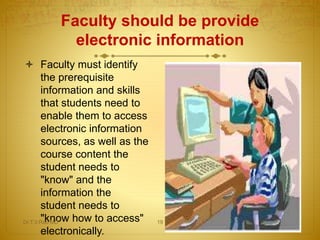
 Faculty must identify
the prerequisite
information and skills
that students need to
enable them to access
electronic information
sources, as well as the
course content the
student needs to
"know" and the
information the
student needs to
"know how to access"
electronically.
Faculty should be provide
electronic information
Dr.T.V.Rao MD 19
We still continue to do with
traditional didactic methods
Dr.T.V.Rao MD 20
 Till recently, teachers and their pupils have been
content with, and able to rely on, the traditional
resources that have always been available in
medical education.
 This involves teaching and learning centred on
the patient, and backed up by lectures and
tutorials. Other information can be obtained from
and journals. For a number of reasons these
resources are no longer sufficient
What is future of
e-learning
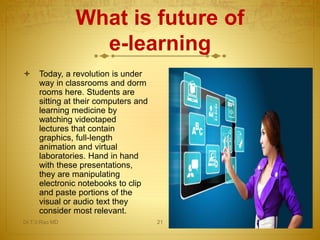
 Today, a revolution is under
way in classrooms and dorm
rooms here. Students are
sitting at their computers and
learning medicine by
watching videotaped
lectures that contain
graphics, full-length
animation and virtual
laboratories. Hand in hand
with these presentations,
they are manipulating
electronic notebooks to clip
and paste portions of the
visual or audio text they
consider most relevant.
Dr.T.V.Rao MD 21
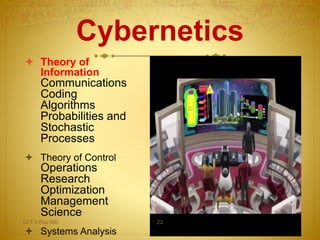
 Theory of
Information
Communications
Coding
Algorithms
Probabilities and
Stochastic
Processes
 Theory of Control
Operations
Research
Optimization
Management
Science
 Systems Analysis
Cybernetics
Dr.T.V.Rao MD 22
 Students' attitudes
toward their education
may also have to
change. Students need
to learn that they must
be information seekers
as well as information
managers. They also
need to acquire
knowledge about
relevant sources of
information, and the
skills to access
electronic information.
Students should develop interest in
electronic information
Dr.T.V.Rao MD 23
Our Medical Teachers to
Adopt faster
 Our teachers have to
adapt to newer methods
of training and teaching
the students or else it is
difficult to cope up with
the speed of changes
taking place in every
branch of Medicine.
Medical informatics
certainly helps to fill the
gaps in teaching
methods Training our
Medicos in ICT will
change the perceptions
of Health care and
Delivery system.
Dr.T.V.Rao MD 24
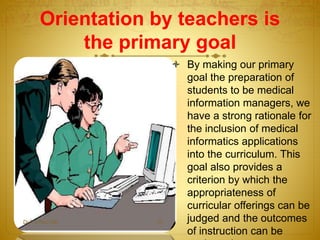
 By making our primary
goal the preparation of
students to be medical
information managers, we
have a strong rationale for
the inclusion of medical
informatics applications
into the curriculum. This
goal also provides a
criterion by which the
appropriateness of
curricular offerings can be
judged and the outcomes
of instruction can be
Orientation by teachers is
the primary goal
Dr.T.V.Rao MD 25
 Continued efforts must be
made to teach them the
skills necessary so that
they can benefit from
available and evolving
technology. In addition, we
recommend that students
be introduced to
computer-based testing
early in their medical
school careers to improve
their comfort levels with
this medium
Continued efforts by Faculty
will create interest
Dr.T.V.Rao MD 26
 The computer is here to
stay in one form or
another. It is unlikely that
any amount to scientific
data on its reliability or
validity will influence use
of the medium. However,
used appropriately
computers can be of
considerable educational
benefit and will serve
medical students and
practitioners throughout
their careers
Computer are staying with
us..
Dr.T.V.Rao MD 27
 Didactic vs problem
solving
 Competencies
 Word processing
 Information retrieval
 Information
management
 Data analysis
 Presentation
 Communication skills
 E-mail, file transfer,
web
Students and Teachers
should be familiar with
Dr.T.V.Rao MD 28
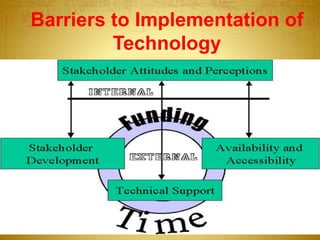
Barriers to Implementation of
Technology
Dr.T.V.Rao MD 29
 Indian Journal of
Medical Informatics
(IJMI) is an Open
Access, peer-
reviewed, online
journal adopting a
broad definition of
"medical informatics"
and focusing on the
applied aspects of
computers to
healthcare delivery.
Indian Journal of Medical
Informatics (IJMI)
Dr.T.V.Rao MD 30
 Information
technology must
not be viewed as
a potential cure to
the current
ailments of
medical
education. It may
be part of the
solution and
should be treated
as such
Information technology is not a remedy
for all ills in Medical Education ?
Dr.T.V.Rao MD 31
What Medical Council of
India Proposes
 There are also plans
to set up
eClassrooms to
reduce the
requirement of faculty
and increase the
number of students
each professor can
take at postgraduate
level.
 Indian Medical Times
Sat 23 May 2015
Dr.T.V.Rao MD 32
References
 Google search freelance information,
 Google images
 Bassam Hammo (Ph.D)
Department of Computer Information Systems
King Abdullah II School for Information Technology
Jordan UniversityAmman Jordan
Dr.T.V.Rao MD 33
Dr.T.V.Rao MD 34
Created by Dr.T.V.Rao MD for
‘e’ learning resources for
Medical Professionals.
Email
doctortvrao@gmail.com

Traditional Learning to e-learning

  • 1.
  • 2.
    We Still FollowSocratic Method  Socratic method , is named after the classical Greek philosopher Socrates. It is a form of inquiry and discussion between individuals, based on asking and answering questions to stimulate critical thinking and to illuminate ideas. It is a dialectical method, often involving a discussion in which the defence of one point of view is questioned; Dr.T.V.Rao MD 2
  • 3.
    Traditional Education  Traditionaleducation, is also known as back-to-basics, conventional education or customary education, refers to long- established customs found in schools that society traditionally used. Some forms of education reform promote the adoption of progressive education practices, a more holistic approach which focuses on individual students' needs and self-expression Dr.T.V.Rao MD 3
  • 4.
    Are we Movingfrom to e- Education  E-learning is the use of electronic technology in teaching and learning, and accordingly is a subset of educational technology.Dr.T.V.Rao MD 4
  • 5.
    Why e-Learning  Ourstudents have changed radically. They are no longer the people our educational system was designed to teach. Dr.T.V.Rao MD 5
  • 6.
    E-learning Includes  E-learningincludes information and communication technology (ICT) in education, EdTech, learning technology, multimedia learning, technology-enhanced learning (TEL), computer-based instruction (CBI), computer managed instruction, computer-based training (CBT), computer-assisted instruction or computer-aided instruction (CAI), internet-based training (IBT), flexible learning, web-based training (WBT), online education, online learning, virtual education, virtual learning environments (VLE; which are also called learning platforms), m-learning, and digital education. All of these terms appear in articles and reviews; the term "e-learning" is used frequently, but is variously and imprecisely defined and appliedDr.T.V.Rao MD 6
  • 7.
    The Basis ofE-learning remain with Creating Interactive Class Rooms  An interactive classroom is a place where learners are encouraged to communicate with peers and teachers in a meaningful way.  Creates useful learning opportunities in which the teacher presents the material in a way that is interactive and therefore meaningful to the learner. Dr.T.V.Rao MD 7
  • 8.
    What is E-Classroom E-classrooms provide a unique opportunity to use technology to implement prompt feedback and thereby augment the current classroom experience. Coordinating various instructional streams with student assessment and feedback will provide the means for instructors to know when and if their intended message was communicated to their students, permitting instructors and students to react quickly when there is a gap between intent and understanding.Dr.T.V.Rao MD 8
  • 9.
     Medical informaticsis the rapidly developing scientific field that deals with resources, devices and formalized methods for optimizing the storage, retrieval and management of biomedical information for problem solving and decision making. Edward Shortliffe, M.D., Ph.D. What is medical informatics? Stanford University, 1995. Health (Medical) Informatics a Rapidly developing science Dr.T.V.Rao MD 9
  • 10.
     include notonly computers but also clinical guidelines, formal medical terminologies, and information and communication systems. It is applied to the areas of nursing, clinical care, dentistry, pharmacy, public health and (bio)medical research. Health Informatics Tools Dr.T.V.Rao MD 10
  • 11.
    What is E-Classroom Further, developing a flexible instructional infrastructure will create a bridge between course objectives and course assessment, classroom instruction and student feedback, and seat-time and study-time. By developing this framework within an e-classroom, information can be gathered to measure student, instructor and organizational achievement and to assist in Dr.T.V.Rao MD 11
  • 12.
    Computer-aided instruction Dr.T.V.Rao MD 12 These include computer-aided instruction, learning about computers and their applications, use of computer-based information resources, use of computers as a tool and as a mechanism for information management, decision support and communication.) While medical informatics includes computer applications, it is not limited only to the use of computers, but includes the knowledge, skills and attitudes involved in seeking, manipulating and using biomedical information.
  • 13.
    Why Interactive Classroom  Cognitivepsychologists:  learning is more productive when the acquired knowledge occurs in an interactive environment.  Experimentally, it was found that students attending interactive lectures learn more than students attending a traditional one.  This is because students in an interactive environment do not spend the time in writing and copying the material from the board as the case in traditional classrooms; instead, they spend the time in thinking, understanding and asking questions . Dr.T.V.Rao MD 13
  • 14.
    Why Interactive Classroom  Efficientlearning techniques became mandatory to keep up with the demand of productive learning:  Significant improvements in computational power,  networking bandwidth,  storage capacity and graphical user interfaces  New teaching methods, such as long-distance and virtual learning, where students are separated in space and/or time, become increasingly common in many universities and educational institutes Dr.T.V.Rao MD 14
  • 15.
    Interactive Classroom  Electronicclassroom or simply “E-classroom” is equipped with technologies that  capture classroom activities,  allow for audio and video recordings of lectures,  slides presentation,  capture the notes written by the lecturer, and  make class material available all the time.  can be accessed and reviewed by students for missing parts, studying difficult concepts or to prepare for exams. Dr.T.V.Rao MD 15
  • 16.
    Components of E- learningClass Room Dr.T.V.Rao MD 16
  • 17.
    Features of Interactive Classroom For students, the new system encourages them to participate and complete the coursework with more variety in learning experiences, such as:  answering questions directly,  taking quizzes,  downloading audio and video files,  reviewing past lectures,  uploading due assignments and many other interesting tasks.  Our system comes at low cost  It has the advantages of being flexible, easy to use, and has the ability to run at any place within the campus where a networking connection is available. Dr.T.V.Rao MD 17
  • 18.
    How to Cretee- classrooms  Multimedia system with portable classroom sensors is presented in this paper with three main components: automatic multimedia data collection and synchronization, intelligent multimedia integration, and user- selectable e- presentation interface design. Dr.T.V.Rao MD 18
  • 19.
     Faculty mustidentify the prerequisite information and skills that students need to enable them to access electronic information sources, as well as the course content the student needs to "know" and the information the student needs to "know how to access" electronically. Faculty should be provide electronic information Dr.T.V.Rao MD 19
  • 20.
    We still continueto do with traditional didactic methods Dr.T.V.Rao MD 20  Till recently, teachers and their pupils have been content with, and able to rely on, the traditional resources that have always been available in medical education.  This involves teaching and learning centred on the patient, and backed up by lectures and tutorials. Other information can be obtained from and journals. For a number of reasons these resources are no longer sufficient
  • 21.
    What is futureof e-learning  Today, a revolution is under way in classrooms and dorm rooms here. Students are sitting at their computers and learning medicine by watching videotaped lectures that contain graphics, full-length animation and virtual laboratories. Hand in hand with these presentations, they are manipulating electronic notebooks to clip and paste portions of the visual or audio text they consider most relevant. Dr.T.V.Rao MD 21
  • 22.
     Theory of Information Communications Coding Algorithms Probabilitiesand Stochastic Processes  Theory of Control Operations Research Optimization Management Science  Systems Analysis Cybernetics Dr.T.V.Rao MD 22
  • 23.
     Students' attitudes towardtheir education may also have to change. Students need to learn that they must be information seekers as well as information managers. They also need to acquire knowledge about relevant sources of information, and the skills to access electronic information. Students should develop interest in electronic information Dr.T.V.Rao MD 23
  • 24.
    Our Medical Teachersto Adopt faster  Our teachers have to adapt to newer methods of training and teaching the students or else it is difficult to cope up with the speed of changes taking place in every branch of Medicine. Medical informatics certainly helps to fill the gaps in teaching methods Training our Medicos in ICT will change the perceptions of Health care and Delivery system. Dr.T.V.Rao MD 24
  • 25.
     By makingour primary goal the preparation of students to be medical information managers, we have a strong rationale for the inclusion of medical informatics applications into the curriculum. This goal also provides a criterion by which the appropriateness of curricular offerings can be judged and the outcomes of instruction can be Orientation by teachers is the primary goal Dr.T.V.Rao MD 25
  • 26.
     Continued effortsmust be made to teach them the skills necessary so that they can benefit from available and evolving technology. In addition, we recommend that students be introduced to computer-based testing early in their medical school careers to improve their comfort levels with this medium Continued efforts by Faculty will create interest Dr.T.V.Rao MD 26
  • 27.
     The computeris here to stay in one form or another. It is unlikely that any amount to scientific data on its reliability or validity will influence use of the medium. However, used appropriately computers can be of considerable educational benefit and will serve medical students and practitioners throughout their careers Computer are staying with us.. Dr.T.V.Rao MD 27
  • 28.
     Didactic vsproblem solving  Competencies  Word processing  Information retrieval  Information management  Data analysis  Presentation  Communication skills  E-mail, file transfer, web Students and Teachers should be familiar with Dr.T.V.Rao MD 28
  • 29.
    Barriers to Implementationof Technology Dr.T.V.Rao MD 29
  • 30.
     Indian Journalof Medical Informatics (IJMI) is an Open Access, peer- reviewed, online journal adopting a broad definition of "medical informatics" and focusing on the applied aspects of computers to healthcare delivery. Indian Journal of Medical Informatics (IJMI) Dr.T.V.Rao MD 30
  • 31.
     Information technology must notbe viewed as a potential cure to the current ailments of medical education. It may be part of the solution and should be treated as such Information technology is not a remedy for all ills in Medical Education ? Dr.T.V.Rao MD 31
  • 32.
    What Medical Councilof India Proposes  There are also plans to set up eClassrooms to reduce the requirement of faculty and increase the number of students each professor can take at postgraduate level.  Indian Medical Times Sat 23 May 2015 Dr.T.V.Rao MD 32
  • 33.
    References  Google searchfreelance information,  Google images  Bassam Hammo (Ph.D) Department of Computer Information Systems King Abdullah II School for Information Technology Jordan UniversityAmman Jordan Dr.T.V.Rao MD 33
  • 34.
    Dr.T.V.Rao MD 34 Createdby Dr.T.V.Rao MD for ‘e’ learning resources for Medical Professionals. Email doctortvrao@gmail.com