TRADING AREA EVALUATING METHODS-LOCATION SELECTION
MMS (17-19)
Welingkar Institute Of Management
TRADING-AREA ANALYSIS
A trading area is a geographic area containing
the customers of a particular firm or group
of firms for specific goods or services.
• Demonstrate the importance of store location for a retailer and outline the process
for choosing a store location.
• To examine three major factors in trading-area analysis
• Population characteristics
• Economic base characteristics
• Competition and level of saturation
Why?
LOCATION, LOCATION, LOCATION!
 Location decisions are complex, costly and little flexibility once selected.
 Location attributes have a large affect in retailer’s success
Other Factors to consider:
• population size and traits
• competition
• transportation access
• parking availability
• nature of nearby stores
• property costs
• length of agreement
• legal restrictions
STEPS IN CHOOSING A STORE LOCATION
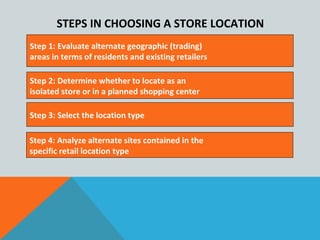
Step 1: Evaluate alternate geographic (trading)
areas in terms of residents and existing retailers
Step 3: Select the location type
Step 2: Determine whether to locate as an
isolated store or in a planned shopping center
Step 4: Analyze alternate sites contained in the
specific retail location type
BENEFITS OF TRADING AREA ANALYSIS
 Discovery of consumer demographics and socioeconomic characteristics
 Opportunity to determine focus of promotional activities
 Opportunity to view media coverage patterns
 Assessment of effects of trading area overlap
 Ascertain whether chain’s competitors will open nearby
 Discovery of ideal number of outlets, geographic weaknesses
 Review of other issues, such as transportation
Destination stores have a better
assortment, better promotion,
and/or better image
It generates a trading area much
larger than that of its competitors
Dunkin’ Donuts: “It’s worth the
trip!”
•Parasite stores do not create their
own traffic and have no real trading
area of their own
•These stores depend on people who
are drawn to area for other reasons.
DESTINATIONS VERSUS PARASITES
TRADITIONAL MEANS OF DELINEATING TRADING
AREAS
Reilly’s law of retail gravitation – establishes a point of indifference
between 2 cities so the trading areas of each can be determined
Point of difference – geographic breaking point between 2 cities
where consumers are indifferent to shopping at either trading area
Huff’s law of shopper attraction – delineates trading areas on the
basis of the product assortment (of the items desired most by
consumers) carried at various shopping locations, travel times from
the shoppers’ home and etc.
Total size and density
Age distribution
Average educational level
Percentage of residents owning
homes
Total disposable income
Per capita disposable income
Occupation distribution
Trends
FACTORS TO CONSIDER IN EVALUATING
RETAIL TRADING AREAS
Population Size and Characteristics
FACTORS TO CONSIDER IN EVALUATING
RETAIL TRADING AREAS
 Availability of labour
 Closeness to sources of supply(delivery cost, timeliness ,
reliability)
 Economic base
 Competitive situation
 Availability of store locations(access to transportation ,
costs, owning versus leasing)
 Regulations

Trading area evaluation methods and location selection

  • 1.
    TRADING AREA EVALUATINGMETHODS-LOCATION SELECTION MMS (17-19) Welingkar Institute Of Management
  • 2.
    TRADING-AREA ANALYSIS A tradingarea is a geographic area containing the customers of a particular firm or group of firms for specific goods or services.
  • 3.
    • Demonstrate theimportance of store location for a retailer and outline the process for choosing a store location. • To examine three major factors in trading-area analysis • Population characteristics • Economic base characteristics • Competition and level of saturation Why?
  • 4.
    LOCATION, LOCATION, LOCATION! Location decisions are complex, costly and little flexibility once selected.  Location attributes have a large affect in retailer’s success
  • 5.
    Other Factors toconsider: • population size and traits • competition • transportation access • parking availability • nature of nearby stores • property costs • length of agreement • legal restrictions
  • 6.
    STEPS IN CHOOSINGA STORE LOCATION Step 1: Evaluate alternate geographic (trading) areas in terms of residents and existing retailers Step 3: Select the location type Step 2: Determine whether to locate as an isolated store or in a planned shopping center Step 4: Analyze alternate sites contained in the specific retail location type
  • 7.
    BENEFITS OF TRADINGAREA ANALYSIS  Discovery of consumer demographics and socioeconomic characteristics  Opportunity to determine focus of promotional activities  Opportunity to view media coverage patterns  Assessment of effects of trading area overlap  Ascertain whether chain’s competitors will open nearby  Discovery of ideal number of outlets, geographic weaknesses  Review of other issues, such as transportation
  • 8.
    Destination stores havea better assortment, better promotion, and/or better image It generates a trading area much larger than that of its competitors Dunkin’ Donuts: “It’s worth the trip!” •Parasite stores do not create their own traffic and have no real trading area of their own •These stores depend on people who are drawn to area for other reasons. DESTINATIONS VERSUS PARASITES
  • 9.
    TRADITIONAL MEANS OFDELINEATING TRADING AREAS Reilly’s law of retail gravitation – establishes a point of indifference between 2 cities so the trading areas of each can be determined Point of difference – geographic breaking point between 2 cities where consumers are indifferent to shopping at either trading area Huff’s law of shopper attraction – delineates trading areas on the basis of the product assortment (of the items desired most by consumers) carried at various shopping locations, travel times from the shoppers’ home and etc.
  • 10.
    Total size anddensity Age distribution Average educational level Percentage of residents owning homes Total disposable income Per capita disposable income Occupation distribution Trends FACTORS TO CONSIDER IN EVALUATING RETAIL TRADING AREAS Population Size and Characteristics
  • 11.
    FACTORS TO CONSIDERIN EVALUATING RETAIL TRADING AREAS  Availability of labour  Closeness to sources of supply(delivery cost, timeliness , reliability)  Economic base  Competitive situation  Availability of store locations(access to transportation , costs, owning versus leasing)  Regulations