
TARIFF & NON-TARIFF
BARRIER
By Vijyata
Assistant Professor , Dept. of MBA
Ranchi Women’s College, Ranchi University
Introduction
In order to curb free trade and to promote
the well – being of domestic markets,
Government intervenes in trade policy by
means of barriers. These Barriers can be :
Tariff Barriers
Non- Tariff Barriers
TARIFF BARRIERS
Tariff barriers refer to the tax imposed by the
government on goods that are imported into
the country.
Tariff barrier increases the price of imported goods
in comparison to domestic goods which makes the
imported goods costlier giving the domestic goods a
relative advantage over foreign goods
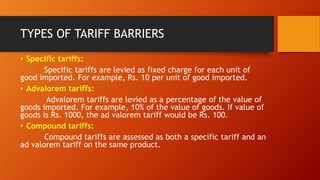
TYPES OF TARIFF BARRIERS
• Specific tariffs:
Specific tariffs are levied as fixed charge for each unit of
good imported. For example, Rs. 10 per unit of good imported.
• Advalorem tariffs:
Advalorem tariffs are levied as a percentage of the value of
goods imported. For example, 10% of the value of goods. If value of
goods is Rs. 1000, the ad valorem tariff would be Rs. 100.
• Compound tariffs:
Compound tariffs are assessed as both a specific tariff and an
ad valorem tariff on the same product.
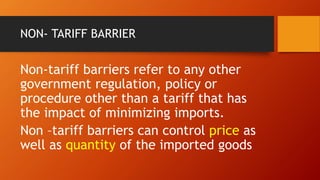
NON- TARIFF BARRIER
Non-tariff barriers refer to any other
government regulation, policy or
procedure other than a tariff that has
the impact of minimizing imports.
Non –tariff barriers can control price as
well as quantity of the imported goods
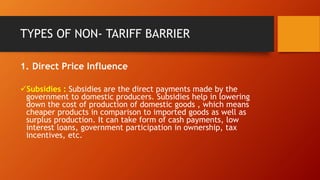
TYPES OF NON- TARIFF BARRIER
1. Direct Price Influence
Subsidies : Subsidies are the direct payments made by the
government to domestic producers. Subsidies help in lowering
down the cost of production of domestic goods , which means
cheaper products in comparison to imported goods as well as
surplus production. It can take form of cash payments, low
interest loans, government participation in ownership, tax
incentives, etc.
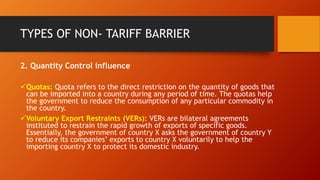
TYPES OF NON- TARIFF BARRIER
2. Quantity Control influence
Quotas: Quota refers to the direct restriction on the quantity of goods that
can be imported into a country during any period of time. The quotas help
the government to reduce the consumption of any particular commodity in
the country.
Voluntary Export Restraints (VERs): VERs are bilateral agreements
instituted to restrain the rapid growth of exports of specific goods.
Essentially, the government of country X asks the government of country Y
to reduce its companies’ exports to country X voluntarily to help the
importing country X to protect its domestic industry.
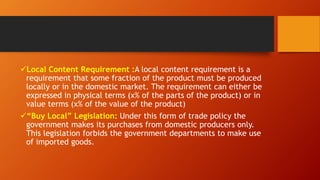
Local Content Requirement :A local content requirement is a
requirement that some fraction of the product must be produced
locally or in the domestic market. The requirement can either be
expressed in physical terms (x% of the parts of the product) or in
value terms (x% of the value of the product)
“Buy Local” Legislation: Under this form of trade policy the
government makes its purchases from domestic producers only.
This legislation forbids the government departments to make use
of imported goods.
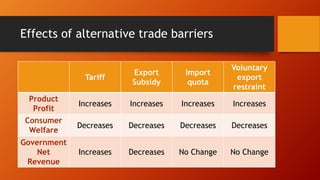
Effects of alternative trade barriers
Tariff
Export
Subsidy
Import
quota
Voluntary
export
restraint
Product
Profit
Increases Increases Increases Increases
Consumer
Welfare
Decreases Decreases Decreases Decreases
Government
Net
Revenue
Increases Decreases No Change No Change
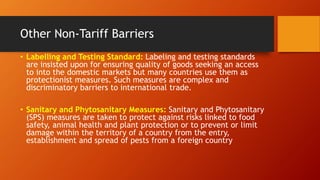
Other Non-Tariff Barriers
• Labelling and Testing Standard: Labeling and testing standards
are insisted upon for ensuring quality of goods seeking an access
to into the domestic markets but many countries use them as
protectionist measures. Such measures are complex and
discriminatory barriers to international trade.
• Sanitary and Phytosanitary Measures: Sanitary and Phytosanitary
(SPS) measures are taken to protect against risks linked to food
safety, animal health and plant protection or to prevent or limit
damage within the territory of a country from the entry,
establishment and spread of pests from a foreign country
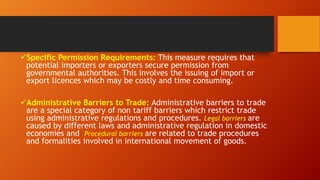
Specific Permission Requirements: This measure requires that
potential importers or exporters secure permission from
governmental authorities. This involves the issuing of import or
export licences which may be costly and time consuming.
Administrative Barriers to Trade: Administrative barriers to trade
are a special category of non tariff barriers which restrict trade
using administrative regulations and procedures. Legal barriers are
caused by different laws and administrative regulation in domestic
economies and Procedural barriers are related to trade procedures
and formalities involved in international movement of goods.
Rationale behind Trade Barriers
Tariffs help in raising revenues for the domestic
government especially in case of developing
countries.
They protect domestic producers from foreign
competition.
They promote local Research and development
in domestic market.
Thank You!!!
For feedback/Suggestions/query mail me at Vijyata.rwc@gmail.com or comment in “comment box”

Tariff and Non-tariff barrier

  • 1.
    TARIFF & NON-TARIFF BARRIER ByVijyata Assistant Professor , Dept. of MBA Ranchi Women’s College, Ranchi University
  • 2.
    Introduction In order tocurb free trade and to promote the well – being of domestic markets, Government intervenes in trade policy by means of barriers. These Barriers can be : Tariff Barriers Non- Tariff Barriers
  • 3.
    TARIFF BARRIERS Tariff barriersrefer to the tax imposed by the government on goods that are imported into the country. Tariff barrier increases the price of imported goods in comparison to domestic goods which makes the imported goods costlier giving the domestic goods a relative advantage over foreign goods
  • 4.
    TYPES OF TARIFFBARRIERS • Specific tariffs: Specific tariffs are levied as fixed charge for each unit of good imported. For example, Rs. 10 per unit of good imported. • Advalorem tariffs: Advalorem tariffs are levied as a percentage of the value of goods imported. For example, 10% of the value of goods. If value of goods is Rs. 1000, the ad valorem tariff would be Rs. 100. • Compound tariffs: Compound tariffs are assessed as both a specific tariff and an ad valorem tariff on the same product.
  • 5.
    NON- TARIFF BARRIER Non-tariffbarriers refer to any other government regulation, policy or procedure other than a tariff that has the impact of minimizing imports. Non –tariff barriers can control price as well as quantity of the imported goods
  • 6.
    TYPES OF NON-TARIFF BARRIER 1. Direct Price Influence Subsidies : Subsidies are the direct payments made by the government to domestic producers. Subsidies help in lowering down the cost of production of domestic goods , which means cheaper products in comparison to imported goods as well as surplus production. It can take form of cash payments, low interest loans, government participation in ownership, tax incentives, etc.
  • 7.
    TYPES OF NON-TARIFF BARRIER 2. Quantity Control influence Quotas: Quota refers to the direct restriction on the quantity of goods that can be imported into a country during any period of time. The quotas help the government to reduce the consumption of any particular commodity in the country. Voluntary Export Restraints (VERs): VERs are bilateral agreements instituted to restrain the rapid growth of exports of specific goods. Essentially, the government of country X asks the government of country Y to reduce its companies’ exports to country X voluntarily to help the importing country X to protect its domestic industry.
  • 8.
    Local Content Requirement:A local content requirement is a requirement that some fraction of the product must be produced locally or in the domestic market. The requirement can either be expressed in physical terms (x% of the parts of the product) or in value terms (x% of the value of the product) “Buy Local” Legislation: Under this form of trade policy the government makes its purchases from domestic producers only. This legislation forbids the government departments to make use of imported goods.
  • 9.
    Effects of alternativetrade barriers Tariff Export Subsidy Import quota Voluntary export restraint Product Profit Increases Increases Increases Increases Consumer Welfare Decreases Decreases Decreases Decreases Government Net Revenue Increases Decreases No Change No Change
  • 10.
    Other Non-Tariff Barriers •Labelling and Testing Standard: Labeling and testing standards are insisted upon for ensuring quality of goods seeking an access to into the domestic markets but many countries use them as protectionist measures. Such measures are complex and discriminatory barriers to international trade. • Sanitary and Phytosanitary Measures: Sanitary and Phytosanitary (SPS) measures are taken to protect against risks linked to food safety, animal health and plant protection or to prevent or limit damage within the territory of a country from the entry, establishment and spread of pests from a foreign country
  • 11.
    Specific Permission Requirements:This measure requires that potential importers or exporters secure permission from governmental authorities. This involves the issuing of import or export licences which may be costly and time consuming. Administrative Barriers to Trade: Administrative barriers to trade are a special category of non tariff barriers which restrict trade using administrative regulations and procedures. Legal barriers are caused by different laws and administrative regulation in domestic economies and Procedural barriers are related to trade procedures and formalities involved in international movement of goods.
  • 12.
    Rationale behind TradeBarriers Tariffs help in raising revenues for the domestic government especially in case of developing countries. They protect domestic producers from foreign competition. They promote local Research and development in domestic market.
  • 13.
    Thank You!!! For feedback/Suggestions/querymail me at Vijyata.rwc@gmail.com or comment in “comment box”