Paul Gibbs
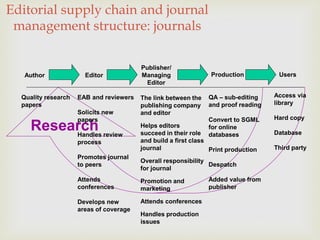
Research
Editorial supply chain and journal
management structure: journals
Author Editor
Publisher/
Managing
Editor
Production Users
Quality research
papers
EAB and reviewers
Solicits new
papers
Handles review
process
Promotes journal
to peers
Attends
conferences
Develops new
areas of coverage
The link between the
publishing company
and editor
Helps editors
succeed in their role
and build a first class
journal
Overall responsibility
for journal
Promotion and
marketing
Attends conferences
Handles production
issues
QA – sub-editing
and proof reading
Convert to SGML
for online
databases
Print production
Despatch
Added value from
publisher
Access via
library
Hard copy
Database
Third party

Ideas now!

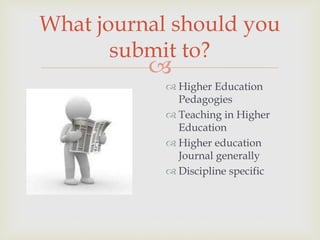
What journal should you
submit to?
 Higher Education
Pedagogies
 Teaching in Higher
Education
 Higher education
Journal generally
 Discipline specific

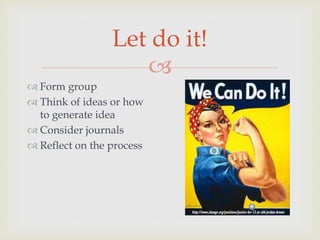
Let do it!
 Form group
 Think of ideas or how
to generate idea
 Consider journals
 Reflect on the process

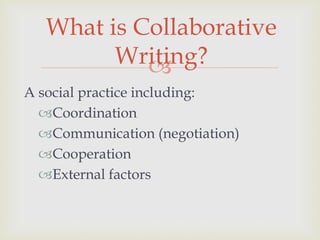
A social practice including:
Coordination
Communication (negotiation)
Cooperation
External factors
What is Collaborative
Writing?
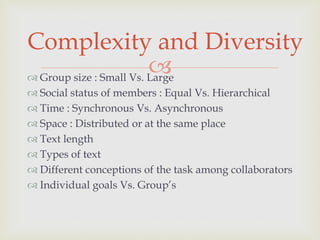
 Group size : Small Vs. Large
 Social status of members : Equal Vs. Hierarchical
 Time : Synchronous Vs. Asynchronous
 Space : Distributed or at the same place
 Text length
 Types of text
 Different conceptions of the task among collaborators
 Individual goals Vs. Group’s
Complexity and Diversity

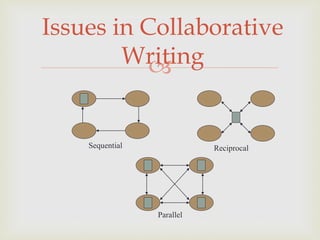
Issues in Collaborative
Writing
Sequential Reciprocal
Parallel

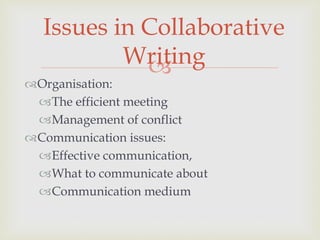
Organisation:
The efficient meeting
Management of conflict
Communication issues:
Effective communication,
What to communicate about
Communication medium
Issues in Collaborative
Writing

Routing procedures
the material between the members
Version control
Commenting Strategies
E-mail
Inserting the comments in the original
document
Annotation features in your word processor.
Issues in Collaborative
Writing

"A Review of the use of
Action Research in
Higher Education",
Case Study

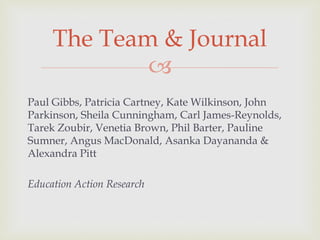
Paul Gibbs, Patricia Cartney, Kate Wilkinson, John
Parkinson, Sheila Cunningham, Carl James-Reynolds,
Tarek Zoubir, Venetia Brown, Phil Barter, Pauline
Sumner, Angus MacDonald, Asanka Dayananda &
Alexandra Pitt
Education Action Research
The Team & Journal

This literature review considers the use of action
research in higher education. The review specifically
looks at two areas of higher education activity. The first
concerns academic teaching practice and includes a
discussion of research and pedagogy practice, and staff
development. The second considers student
engagement. In both of these core features of higher
education, action research has proven to be a central
approach to the investigation, reflection and
improvement of practice. Each of these main foci
includes a discussion of the limitations of the literature.
The review illustrates the extent and range of uses to
have benefited from an action research approach.
Outcome

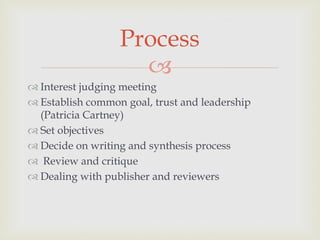
 Interest judging meeting
 Establish common goal, trust and leadership
(Patricia Cartney)
 Set objectives
 Decide on writing and synthesis process
 Review and critique
 Dealing with publisher and reviewers
Process

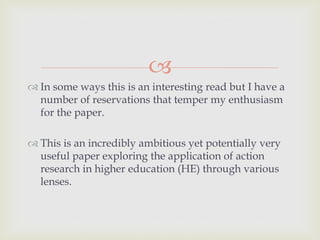
 In some ways this is an interesting read but I have a
number of reservations that temper my enthusiasm
for the paper.
 This is an incredibly ambitious yet potentially very
useful paper exploring the application of action
research in higher education (HE) through various
lenses.

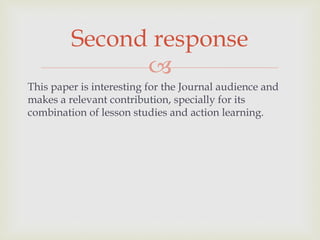
This paper is interesting for the Journal audience and
makes a relevant contribution, specially for its
combination of lesson studies and action learning.
Second response

Workshop 1: 'Collaborative writing' by Professor Paul Gibbs

  • 1.
  • 2.
    Research Editorial supply chainand journal management structure: journals Author Editor Publisher/ Managing Editor Production Users Quality research papers EAB and reviewers Solicits new papers Handles review process Promotes journal to peers Attends conferences Develops new areas of coverage The link between the publishing company and editor Helps editors succeed in their role and build a first class journal Overall responsibility for journal Promotion and marketing Attends conferences Handles production issues QA – sub-editing and proof reading Convert to SGML for online databases Print production Despatch Added value from publisher Access via library Hard copy Database Third party
  • 3.
  • 4.
     What journal shouldyou submit to?  Higher Education Pedagogies  Teaching in Higher Education  Higher education Journal generally  Discipline specific
  • 5.
     Let do it! Form group  Think of ideas or how to generate idea  Consider journals  Reflect on the process
  • 6.
     A social practiceincluding: Coordination Communication (negotiation) Cooperation External factors What is Collaborative Writing?
  • 7.
     Group size: Small Vs. Large  Social status of members : Equal Vs. Hierarchical  Time : Synchronous Vs. Asynchronous  Space : Distributed or at the same place  Text length  Types of text  Different conceptions of the task among collaborators  Individual goals Vs. Group’s Complexity and Diversity
  • 8.
  • 9.
     Organisation: The efficient meeting Managementof conflict Communication issues: Effective communication, What to communicate about Communication medium Issues in Collaborative Writing
  • 10.
     Routing procedures the materialbetween the members Version control Commenting Strategies E-mail Inserting the comments in the original document Annotation features in your word processor. Issues in Collaborative Writing
  • 11.
     "A Review ofthe use of Action Research in Higher Education", Case Study
  • 12.
     Paul Gibbs, PatriciaCartney, Kate Wilkinson, John Parkinson, Sheila Cunningham, Carl James-Reynolds, Tarek Zoubir, Venetia Brown, Phil Barter, Pauline Sumner, Angus MacDonald, Asanka Dayananda & Alexandra Pitt Education Action Research The Team & Journal
  • 13.
     This literature reviewconsiders the use of action research in higher education. The review specifically looks at two areas of higher education activity. The first concerns academic teaching practice and includes a discussion of research and pedagogy practice, and staff development. The second considers student engagement. In both of these core features of higher education, action research has proven to be a central approach to the investigation, reflection and improvement of practice. Each of these main foci includes a discussion of the limitations of the literature. The review illustrates the extent and range of uses to have benefited from an action research approach. Outcome
  • 14.
      Interest judgingmeeting  Establish common goal, trust and leadership (Patricia Cartney)  Set objectives  Decide on writing and synthesis process  Review and critique  Dealing with publisher and reviewers Process
  • 15.
      In someways this is an interesting read but I have a number of reservations that temper my enthusiasm for the paper.  This is an incredibly ambitious yet potentially very useful paper exploring the application of action research in higher education (HE) through various lenses.
  • 16.
     This paper isinteresting for the Journal audience and makes a relevant contribution, specially for its combination of lesson studies and action learning. Second response