Creatively Assessing
Creativity
Strategies for nurturing creative students
Julia K. Gleich MA, MFA
Head of Choreography, London Studio Centre
Julia@GleichDances.org
Issues
How to “prepare for assessment” in a context of
creativity
Prior learning
Tick-boxing / Goal-oriented-ness
Subjectivity
House styles
New ideas and risk-taking
Creativity
Pleasure
Choice-making
Re-invention
No right and wrong
Truth?
Peer feedback without judgment or preferences
Liz Lerman’s Critical Response Process
http://www.lizlerman.com/crpLL.html
Ways to assess learning:
1st Year Choreography
Eyes closed study: Observation of simple tasks with group
peer feedback moderated by tutor.
Space study: Concept task with single peer written
feedback* (anonymous) and tutor written comments
Lec-Dem: Group task with tutor and student feedback in
front of class
Short work – with single authorship: Product-oriented
task with written feedback and mark
*Using assigned questions.
*Sample Questions
Identify something in the study that stood out to you – a
specific movement, an idea, a spatial choice,
speed/dynamic – something that caught your attention, an
“aha” moment.
Give your overall impression of the work – what did it
remind you of? Was there familiar movement or was it all
new to you? Did you feel there was a character/narrative
or did the study stay abstract? What did the study make
you think about?
Mention something that you think didn’t work. Was the
study too long or short? Too much movement variety or
too little?
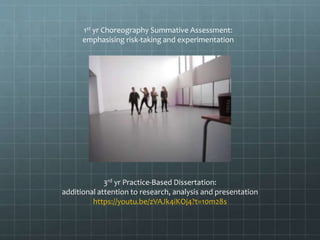
1st yr Choreography Summative Assessment:
emphasising risk-taking and experimentation
3rd yr Practice-Based Dissertation:
additional attention to research, analysis and presentation
https://youtu.be/zVAJk4iKOj4?t=10m28s
Assessment Literacy is a double-edged
sword. Students who are too focused on
assessment will be unwilling to take risks
and discover their own voices in a creative
environment. Assessment tasks and criteria
must be designed to reward even
“inappropriate” choices as students re-
invent themselves and develop new
movement vocabularies, explore
compositional strategies and form their
artistic identities.
Thank you!
Julia K. Gleich MA, MFA
Head of Choreography, London Studio Centre
Julia@GleichDances.org

Creatively Assessing Creativity

  • 1.
    Creatively Assessing Creativity Strategies fornurturing creative students Julia K. Gleich MA, MFA Head of Choreography, London Studio Centre Julia@GleichDances.org
  • 2.
    Issues How to “preparefor assessment” in a context of creativity Prior learning Tick-boxing / Goal-oriented-ness Subjectivity House styles New ideas and risk-taking
  • 3.
    Creativity Pleasure Choice-making Re-invention No right andwrong Truth? Peer feedback without judgment or preferences Liz Lerman’s Critical Response Process http://www.lizlerman.com/crpLL.html
  • 4.
    Ways to assesslearning: 1st Year Choreography Eyes closed study: Observation of simple tasks with group peer feedback moderated by tutor. Space study: Concept task with single peer written feedback* (anonymous) and tutor written comments Lec-Dem: Group task with tutor and student feedback in front of class Short work – with single authorship: Product-oriented task with written feedback and mark *Using assigned questions.
  • 5.
    *Sample Questions Identify somethingin the study that stood out to you – a specific movement, an idea, a spatial choice, speed/dynamic – something that caught your attention, an “aha” moment. Give your overall impression of the work – what did it remind you of? Was there familiar movement or was it all new to you? Did you feel there was a character/narrative or did the study stay abstract? What did the study make you think about? Mention something that you think didn’t work. Was the study too long or short? Too much movement variety or too little?
  • 6.
    1st yr ChoreographySummative Assessment: emphasising risk-taking and experimentation 3rd yr Practice-Based Dissertation: additional attention to research, analysis and presentation https://youtu.be/zVAJk4iKOj4?t=10m28s
  • 7.
    Assessment Literacy isa double-edged sword. Students who are too focused on assessment will be unwilling to take risks and discover their own voices in a creative environment. Assessment tasks and criteria must be designed to reward even “inappropriate” choices as students re- invent themselves and develop new movement vocabularies, explore compositional strategies and form their artistic identities.
  • 8.
    Thank you! Julia K.Gleich MA, MFA Head of Choreography, London Studio Centre Julia@GleichDances.org