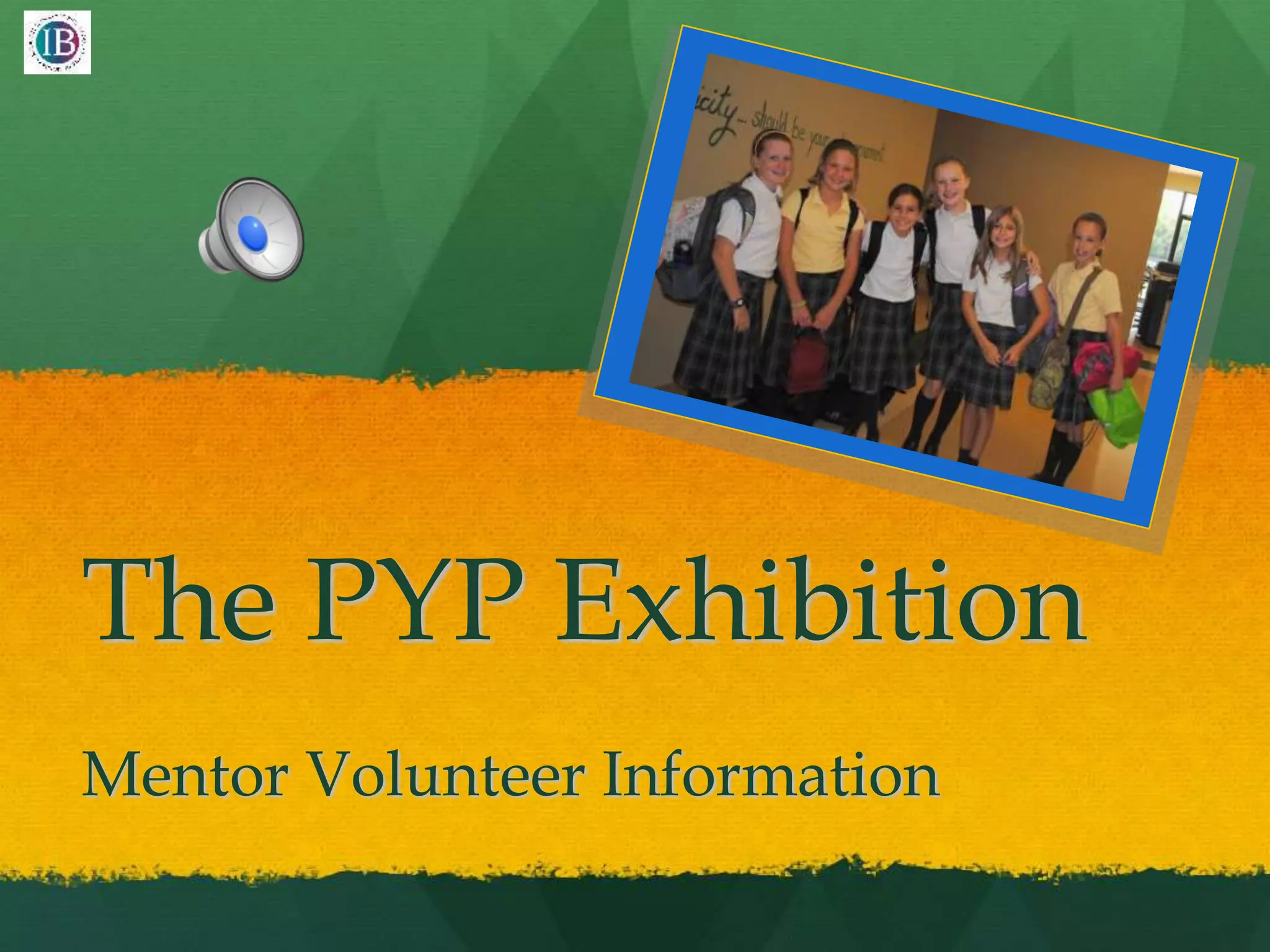
The PYP Exhibition
Mentor Volunteer Information
What Is the “Exhibition”?
The fifth-grade Exhibition is the
culminating activity of the
International Baccalaureate’s PYP
Programme. It occurs in the
student’s final/graduating year of
the programme.
“Exhibition” = Inquiry
The Exhibition is:
A group inquiry
An inquiry that starts from personal
interest and passions then extends into
real-world issues
An inquiry that requires students to
apply their learning from previous years
Exhibition
Requirements
The subject of the inquiry must be a
real-world issue.
Students must be involved in all
stages of planning:
-the issue
-the learning outcomes
-the activities
-the assessment
Exhibition
Requirements
(continued)
The Exhibition should include:
-examples of written work
-oral presentations
-examples of technology
-performances in any medium –
dance, drama, film, video, mixed
media
Exhibition
Requirements
(continued)
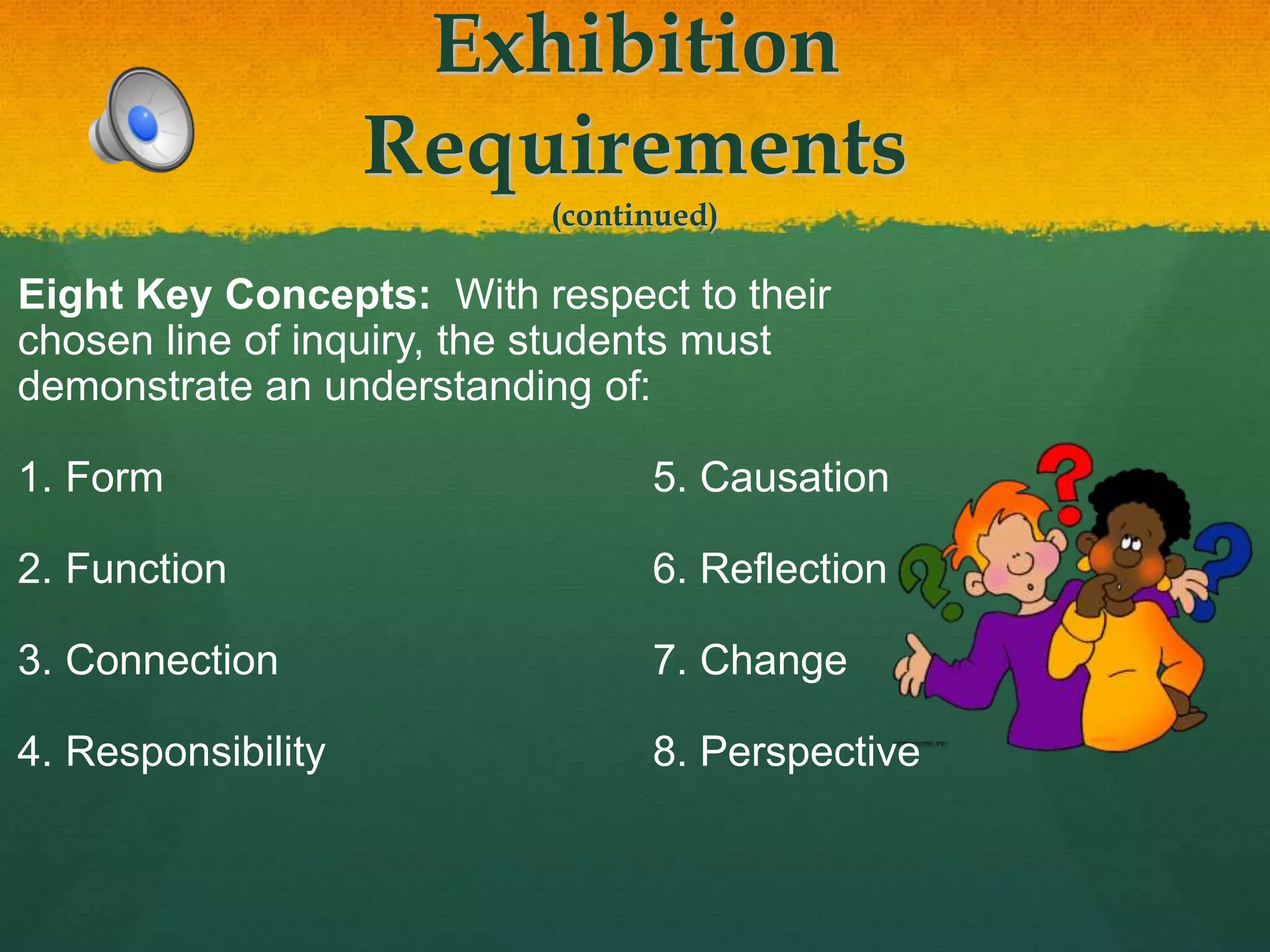
Eight Key Concepts: With respect to their
chosen line of inquiry, the students must
demonstrate an understanding of:
1. Form 5. Causation
2. Function 6. Reflection
3. Connection 7. Change
4. Responsibility 8. Perspective
The Exhibition:
Non-Negotiable Features
(con’t)
Five Transdisciplinary Skill
Sets: Students must use skills
from all areas.
1.Thinking Skills
2.Social Skills
3.Communication Skills
4.Self-Management Skills
5.Research Skills
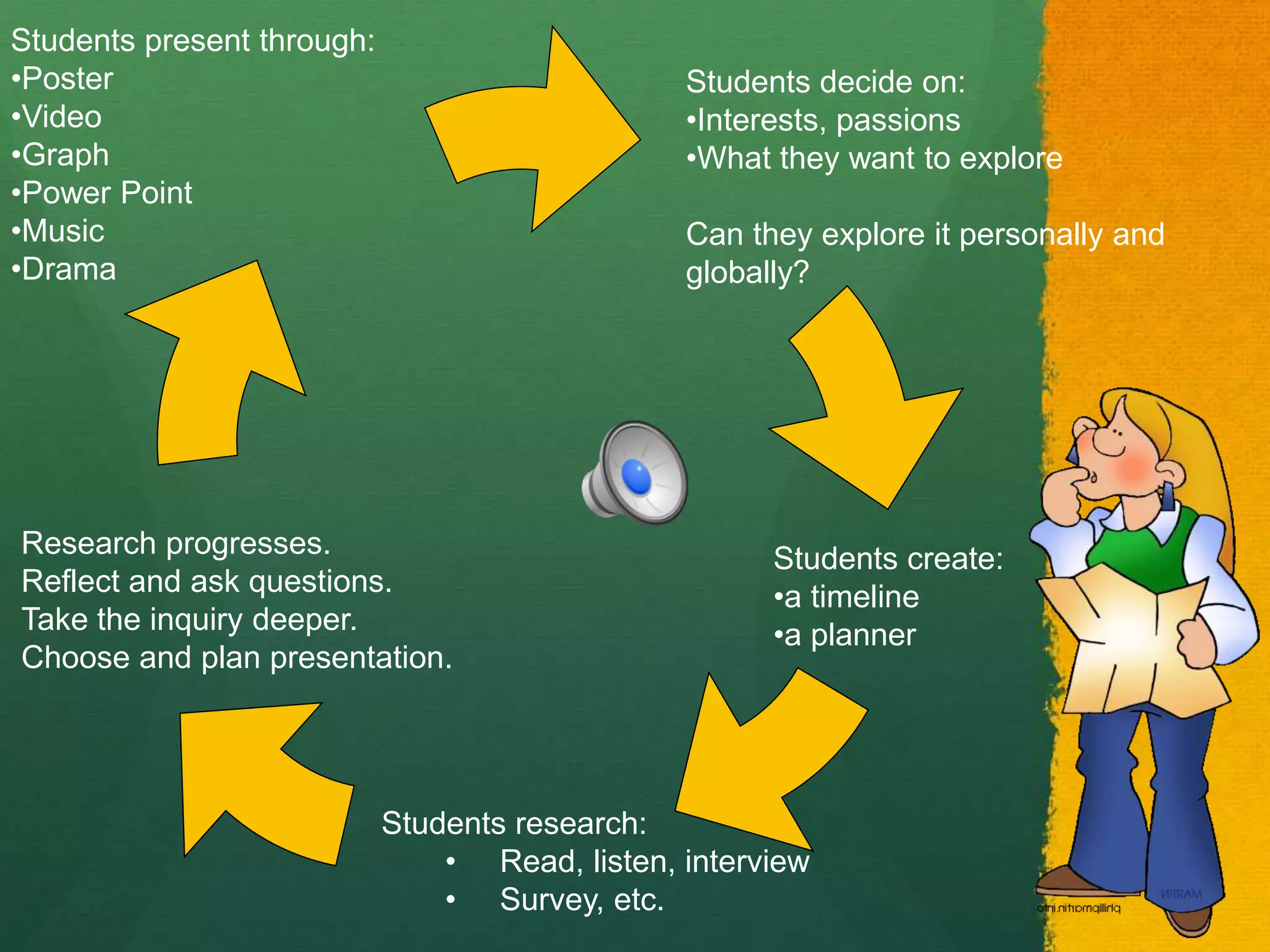
Students present through:
•Poster
•Video
•Graph
•Power Point
•Music
•Drama
Research progresses.
Reflect and ask questions.
Take the inquiry deeper.
Choose and plan presentation.
Students research:
• Read, listen, interview
• Survey, etc.
Students create:
•a timeline
•a planner
Students decide on:
•Interests, passions
•What they want to explore
Can they explore it personally and
globally?
Student Commitment
February: The students start brainstorming
ideas and concepts.
March-April: The students spend about six
weeks working on their inquiries.
The students will continue having math and
literacy lessons during the Exhibition time.
Part of each day will be used working on
inquiries as the schedule permits.
Student Homework
The children will have homework during this time.
The children may use their time at home to
research and prepare for the work in class.
The actual work should be done in class so the
teacher can keep track of progress.
Mentor’s Role
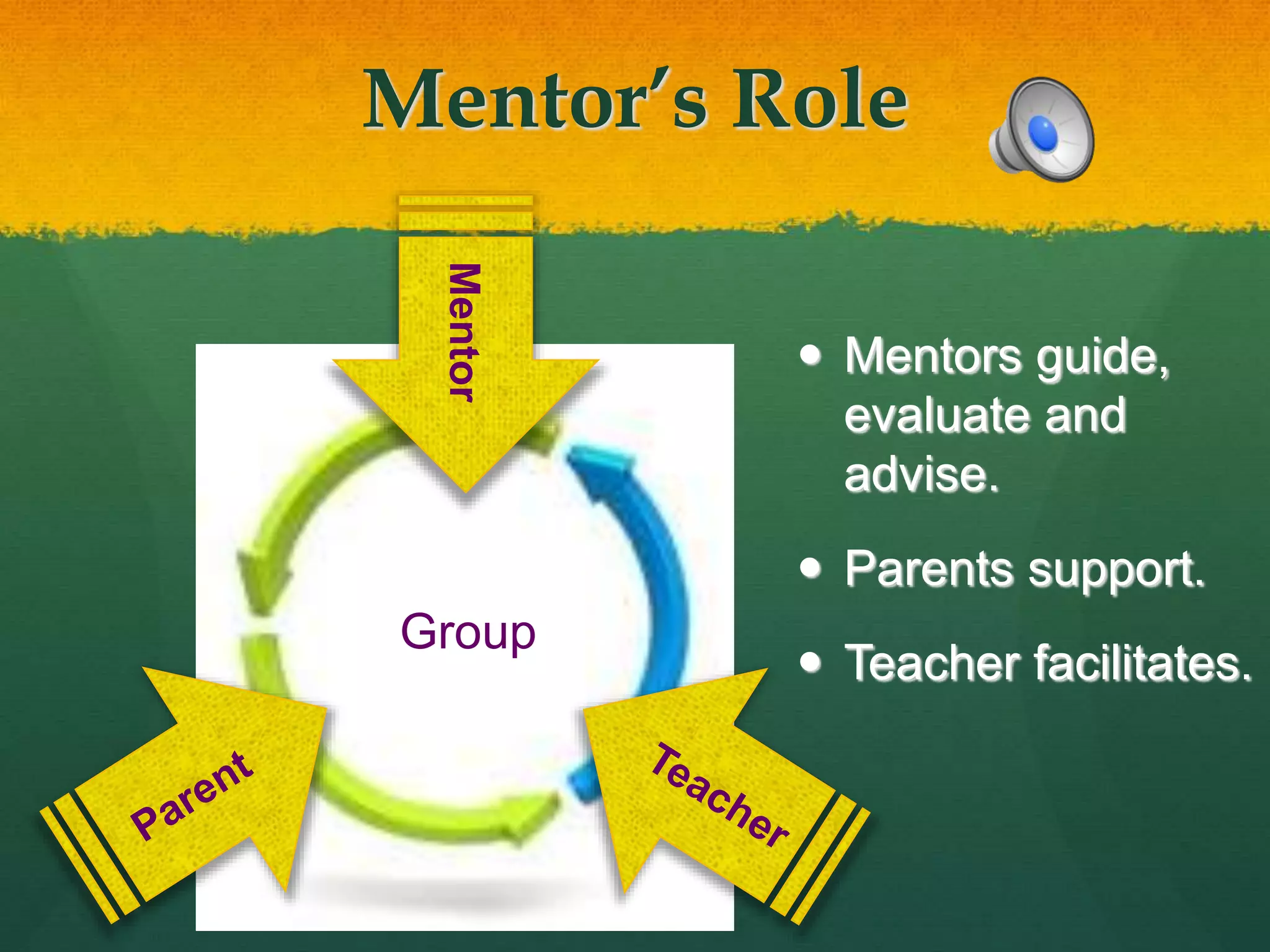
 Mentors guide,
evaluate and
advise.
 Parents support.
 Teacher facilitates.
Mentor
Group
Mentor’s Commitment
Mentors meet with student groups twice a week
for one-two hours each time for the duration of the
Exhibition process (5 weeks). They will also be
required to complete a thorough daily reflection to
the teachers. Mentors will also be with their
groups during presentations on April 2.
How Can Parents Help?
Parents can:
 keep informed of the process by reading
journals and teacher websites
 support and encourage their children
 provide knowledge
 help to locate resources – people, places,
media and information
It’s the Journey More
Than the Destination
“Exhibitions are the best way to
measure learning, because they put the
kids right in the midst of their learning”
Dennis Littky
We assess the process more than the product.
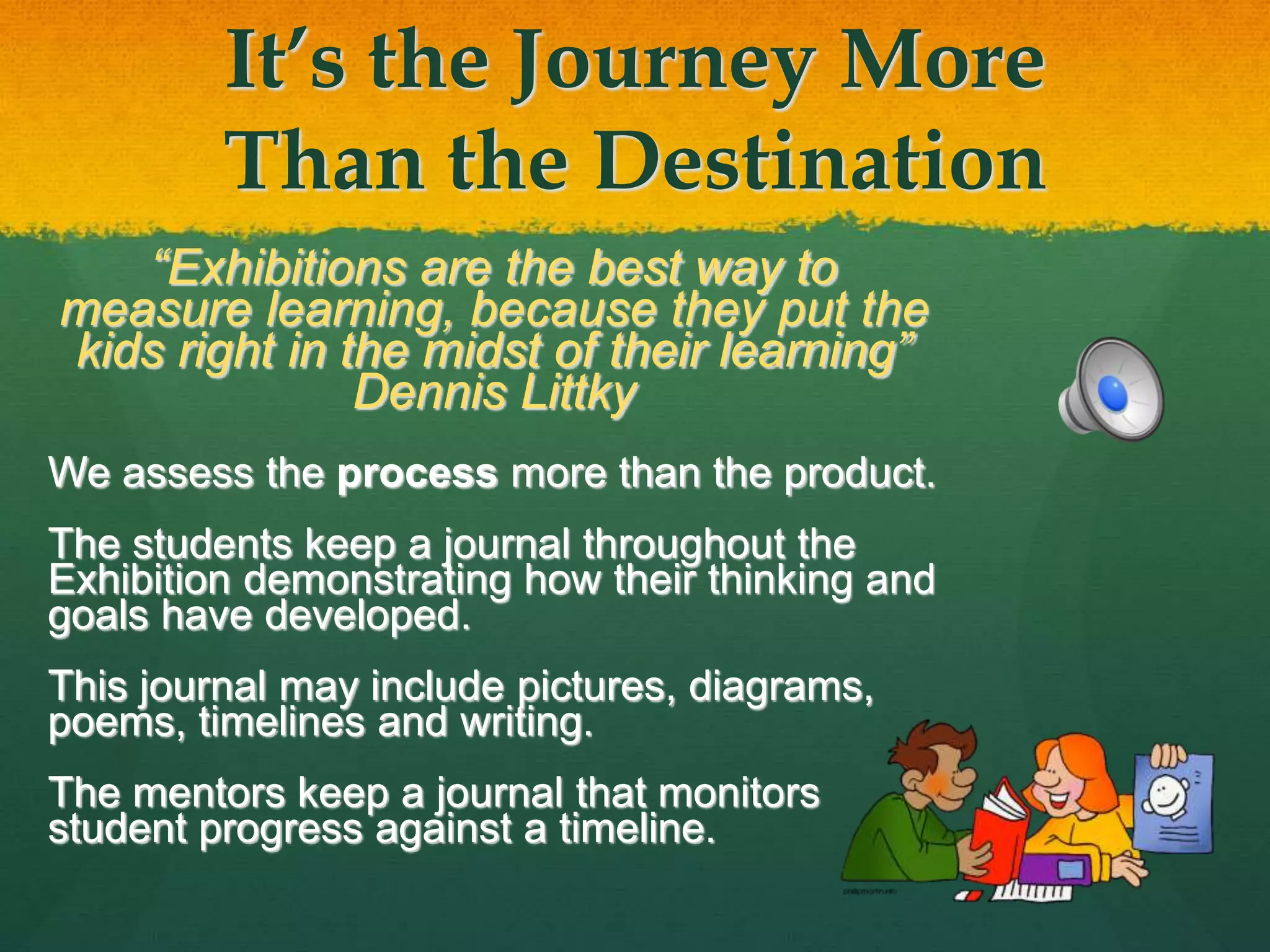
The students keep a journal throughout the
Exhibition demonstrating how their thinking and
goals have developed.
This journal may include pictures, diagrams,
poems, timelines and writing.
The mentors keep a journal that monitors
student progress against a timeline.
Rubrics
Each inquiry has four scoring rubrics that
assesses a different aspect of the Exhibition.
Rubric 1: Journal
Rubric 2: Independent Oral/Written Project
Rubric 3: Final Multimedia Project
Rubric 4: Collaborative work skills: (social
skills, quality of work, and time management)
Assessment
Assessment of the process and end-product
takes place at all levels.
Children will self assess using the rubrics.
Class teacher will use the rubrics to assess.
Mentors will assess the group dynamics
component of the process—using a rubric.
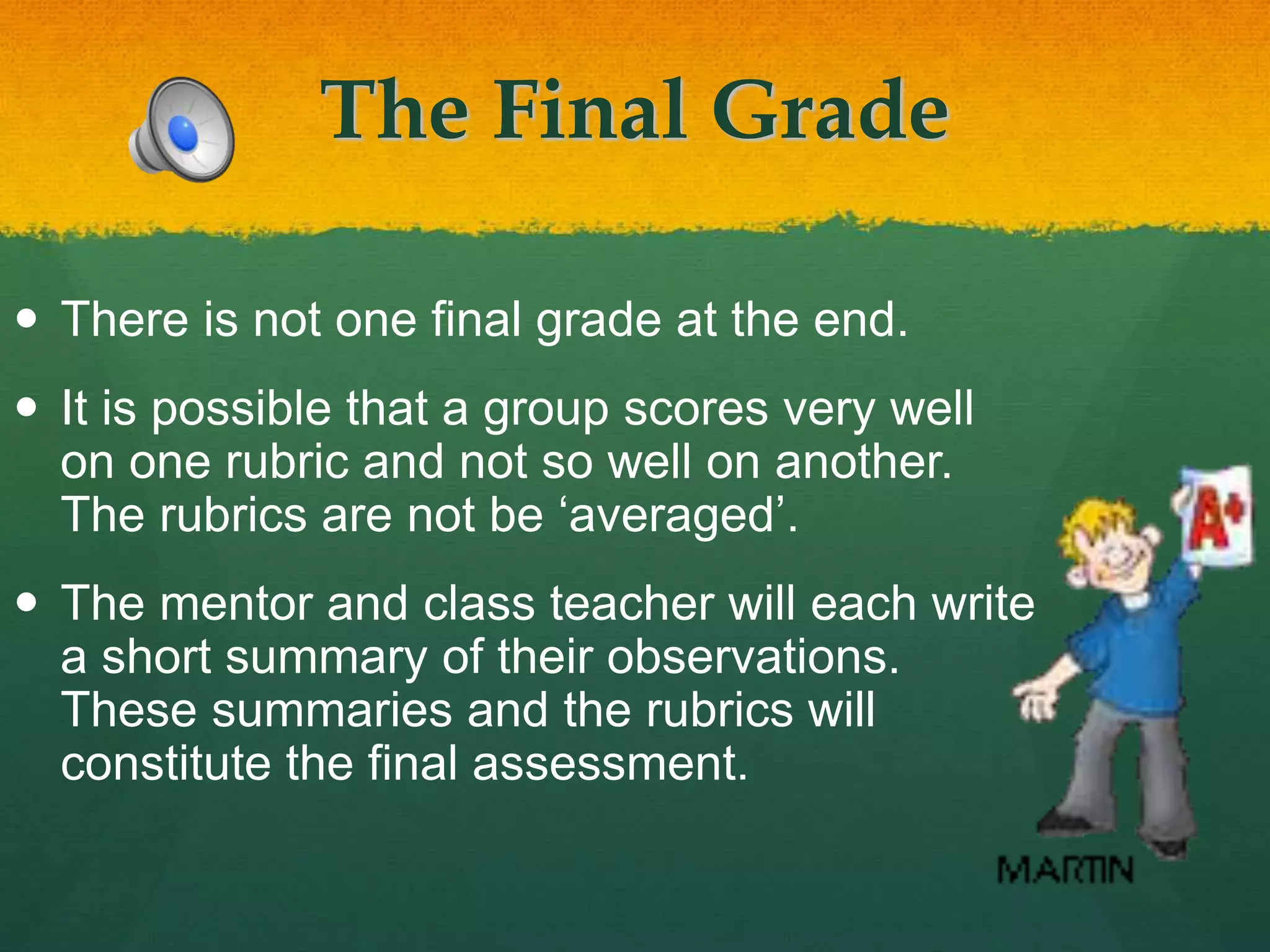
The Final Grade
 There is not one final grade at the end.
 It is possible that a group scores very well
on one rubric and not so well on another.
The rubrics are not be ‘averaged’.
 The mentor and class teacher will each write
a short summary of their observations.
These summaries and the rubrics will
constitute the final assessment.
Something for Us All to
Remember…
 As with any inquiry there
will be times when it
seems that students are
not being very productive.
 Sometimes there will be
lot of discussion and
thought, but this will not
result in anything that can
be seen.
Thanks to
?Forum for
Questions
Notre Dame Academy for the
framework of this ppt

Exhibition digital presentation

  • 1.
    The PYP Exhibition MentorVolunteer Information
  • 2.
    What Is the“Exhibition”? The fifth-grade Exhibition is the culminating activity of the International Baccalaureate’s PYP Programme. It occurs in the student’s final/graduating year of the programme.
  • 3.
    “Exhibition” = Inquiry TheExhibition is: A group inquiry An inquiry that starts from personal interest and passions then extends into real-world issues An inquiry that requires students to apply their learning from previous years
  • 4.
    Exhibition Requirements The subject ofthe inquiry must be a real-world issue. Students must be involved in all stages of planning: -the issue -the learning outcomes -the activities -the assessment
  • 5.
    Exhibition Requirements (continued) The Exhibition shouldinclude: -examples of written work -oral presentations -examples of technology -performances in any medium – dance, drama, film, video, mixed media
  • 6.
    Exhibition Requirements (continued) Eight Key Concepts:With respect to their chosen line of inquiry, the students must demonstrate an understanding of: 1. Form 5. Causation 2. Function 6. Reflection 3. Connection 7. Change 4. Responsibility 8. Perspective
  • 7.
    The Exhibition: Non-Negotiable Features (con’t) FiveTransdisciplinary Skill Sets: Students must use skills from all areas. 1.Thinking Skills 2.Social Skills 3.Communication Skills 4.Self-Management Skills 5.Research Skills
  • 8.
    Students present through: •Poster •Video •Graph •PowerPoint •Music •Drama Research progresses. Reflect and ask questions. Take the inquiry deeper. Choose and plan presentation. Students research: • Read, listen, interview • Survey, etc. Students create: •a timeline •a planner Students decide on: •Interests, passions •What they want to explore Can they explore it personally and globally?
  • 9.
    Student Commitment February: Thestudents start brainstorming ideas and concepts. March-April: The students spend about six weeks working on their inquiries. The students will continue having math and literacy lessons during the Exhibition time. Part of each day will be used working on inquiries as the schedule permits.
  • 10.
    Student Homework The childrenwill have homework during this time. The children may use their time at home to research and prepare for the work in class. The actual work should be done in class so the teacher can keep track of progress.
  • 11.
    Mentor’s Role  Mentorsguide, evaluate and advise.  Parents support.  Teacher facilitates. Mentor Group
  • 12.
    Mentor’s Commitment Mentors meetwith student groups twice a week for one-two hours each time for the duration of the Exhibition process (5 weeks). They will also be required to complete a thorough daily reflection to the teachers. Mentors will also be with their groups during presentations on April 2.
  • 13.
    How Can ParentsHelp? Parents can:  keep informed of the process by reading journals and teacher websites  support and encourage their children  provide knowledge  help to locate resources – people, places, media and information
  • 14.
    It’s the JourneyMore Than the Destination “Exhibitions are the best way to measure learning, because they put the kids right in the midst of their learning” Dennis Littky We assess the process more than the product. The students keep a journal throughout the Exhibition demonstrating how their thinking and goals have developed. This journal may include pictures, diagrams, poems, timelines and writing. The mentors keep a journal that monitors student progress against a timeline.
  • 15.
    Rubrics Each inquiry hasfour scoring rubrics that assesses a different aspect of the Exhibition. Rubric 1: Journal Rubric 2: Independent Oral/Written Project Rubric 3: Final Multimedia Project Rubric 4: Collaborative work skills: (social skills, quality of work, and time management)
  • 16.
    Assessment Assessment of theprocess and end-product takes place at all levels. Children will self assess using the rubrics. Class teacher will use the rubrics to assess. Mentors will assess the group dynamics component of the process—using a rubric.
  • 17.
    The Final Grade There is not one final grade at the end.  It is possible that a group scores very well on one rubric and not so well on another. The rubrics are not be ‘averaged’.  The mentor and class teacher will each write a short summary of their observations. These summaries and the rubrics will constitute the final assessment.
  • 18.
    Something for UsAll to Remember…  As with any inquiry there will be times when it seems that students are not being very productive.  Sometimes there will be lot of discussion and thought, but this will not result in anything that can be seen.
  • 19.
    Thanks to ?Forum for Questions NotreDame Academy for the framework of this ppt