An exploration of feedback in
Midwifery education
Teaching and Learning Conference
2015
Jo Killingley
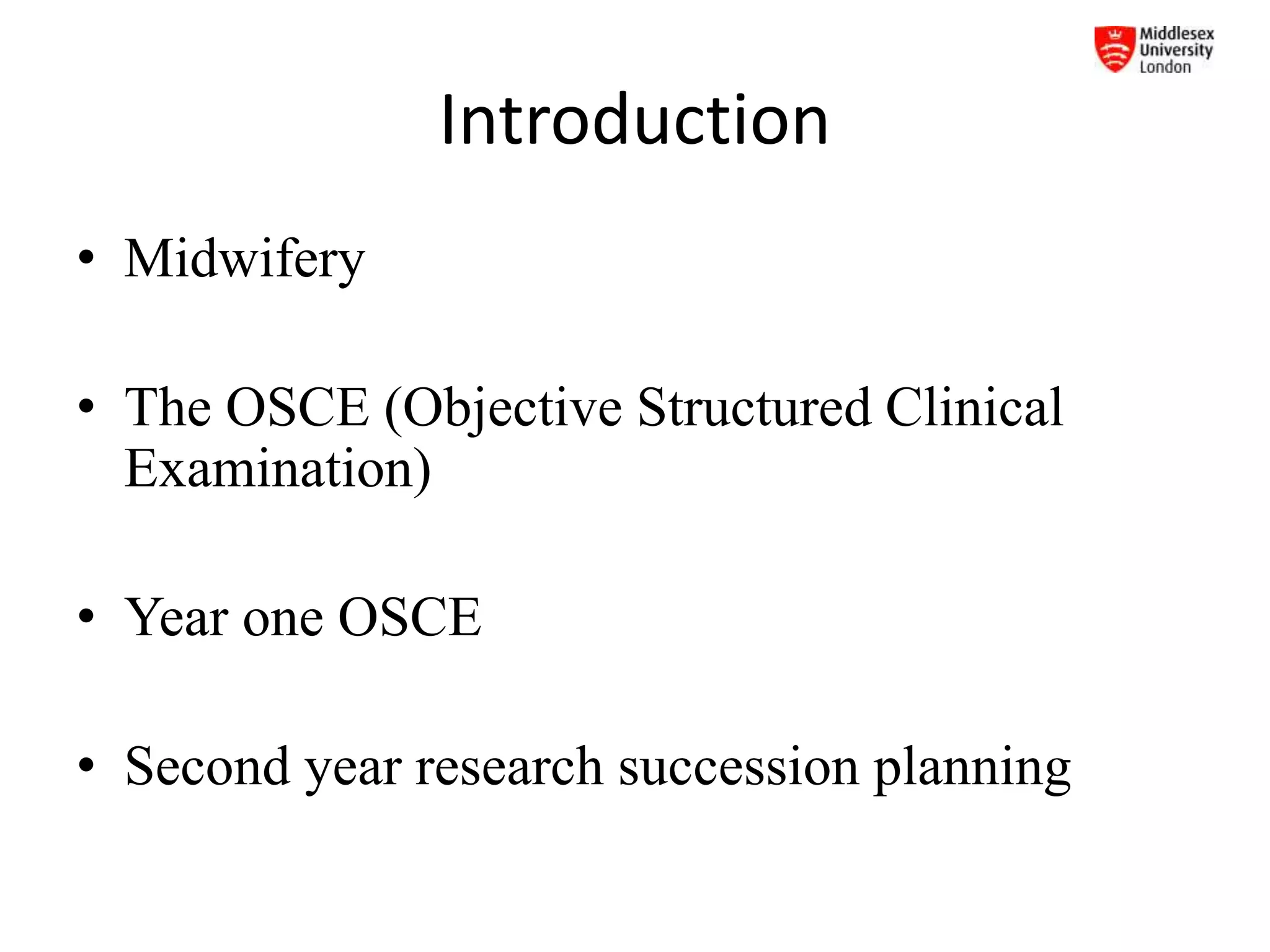
Introduction
• Midwifery
• The OSCE (Objective Structured Clinical
Examination)
• Year one OSCE
• Second year research succession planning
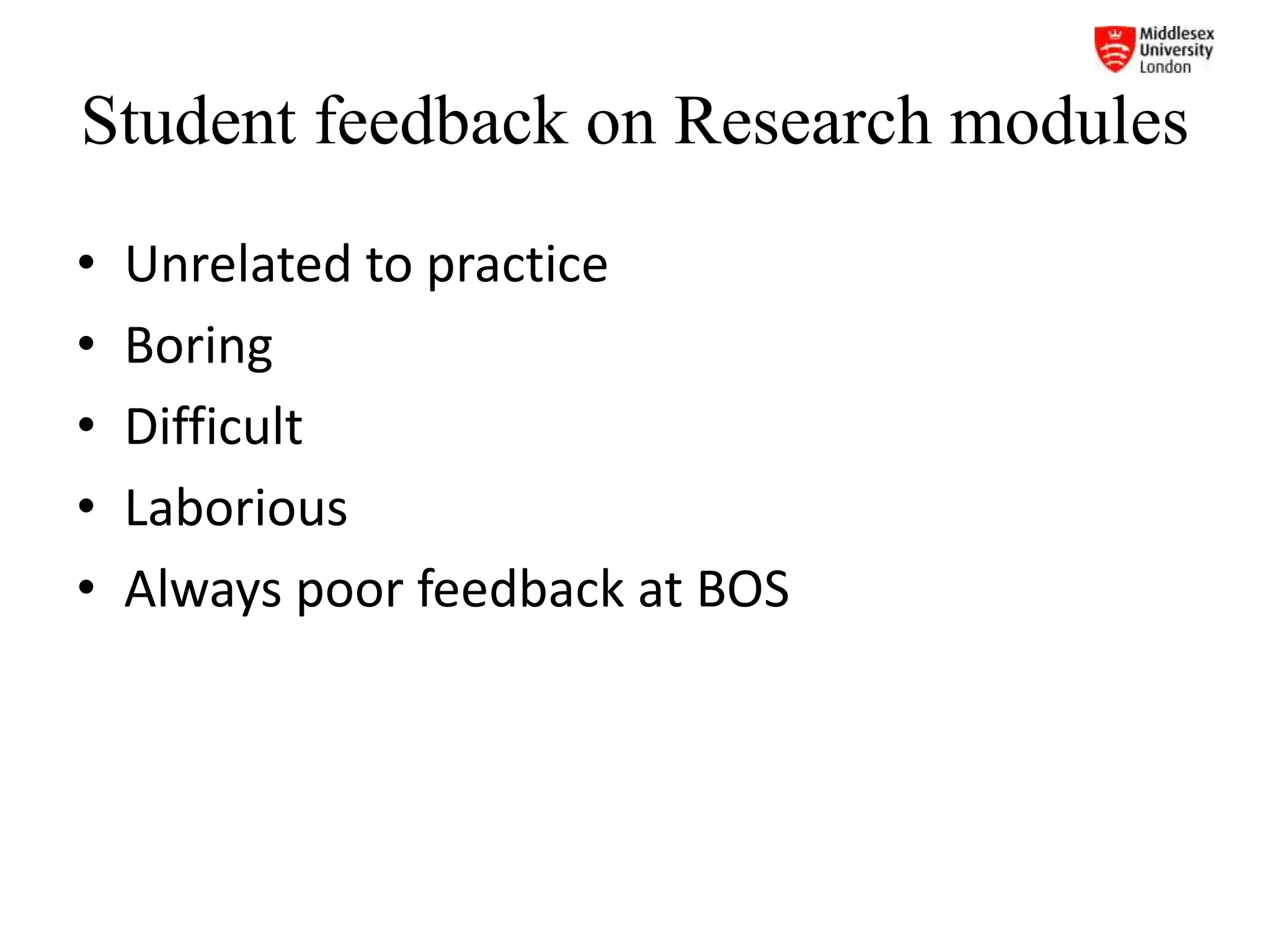
Student feedback on Research modules
• Unrelated to practice
• Boring
• Difficult
• Laborious
• Always poor feedback at BOS
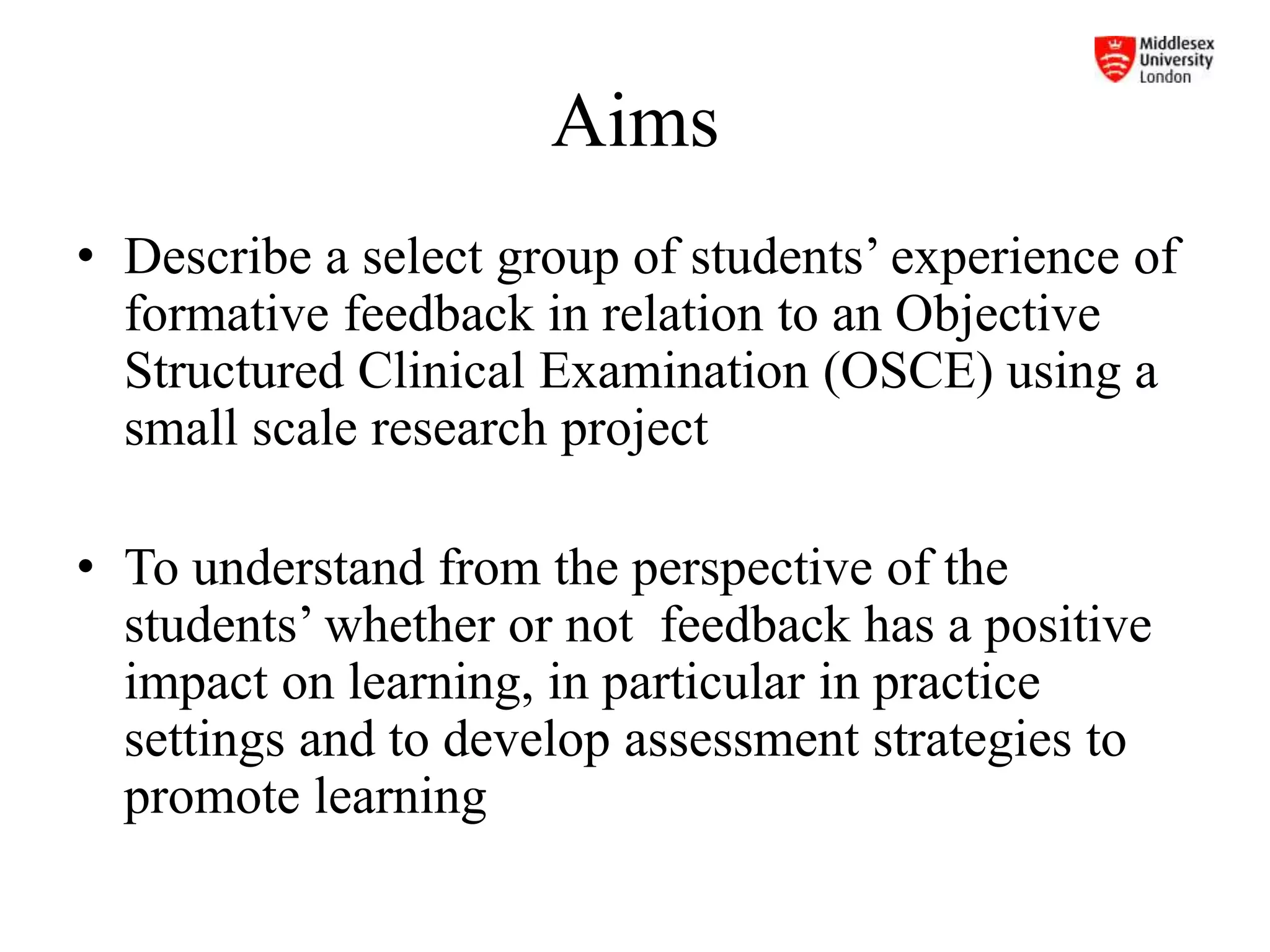
Aims
• Describe a select group of students’ experience of
formative feedback in relation to an Objective
Structured Clinical Examination (OSCE) using a
small scale research project
• To understand from the perspective of the
students’ whether or not feedback has a positive
impact on learning, in particular in practice
settings and to develop assessment strategies to
promote learning
Objectives
• To determine the student’s experiences of OSCE
feedback
• To explore areas that could help students take control of
their own learning
• To facilitate learning through structured OSCE
feedback
• To disseminate good practice in assessment feedback
Research Question
• Do student midwives perceive OSCE feedback
as useful in relation to their learning with
particular emphasis on learning in practice
settings?
Methodology
• Qualitative paradigm
• Method of data collection: focus group
• Semi structured interview guide
• Sampling: purposive
• Inclusion: all student who had passed their
OSCE
• Data analysis: thematic analysis
• Ethics: role conflict
Introduction
• Learning is a perception and an understanding
of the world.
• Learning is an emotional journey involving
many factors
• Learning involves assessment and feedback
• Opportunity
Literature review
• Specificity
• Behaviour focused
• Clarity
• Timeliness
• OSCE
Project findings
Objectives:
1. To determine the student’s experience of OSCE
feedback
2. To explore areas that could help students take
control of their learning
3. To facilitate learning through structured OSCE
feedback and to disseminate in other areas of
teaching and assessment
4. To facilitate learning and high standards of
proficiency through OSCE feedback
Student quote
“Enquiry based learning started in the first year
and set our standards which should be reflected
in the OSCE and then the feedback”
Project limitations
• Data collection closer to the student experience
• Focus group size
Teachers are responsible for designing
curriculum, assessment, instruction, and
professional development to promote
understanding, rather than simply knowledge-
recall (Brown 2007).
Application to practice
Organisation
• “I knew where I was and felt safe in the guidance, not
worried and lost.”
• “I felt very uneasy at the start of the module but with
support from you and my peers, my confidence grew and I
actually really enjoyed it.”
• “Very structured lessons that follow a methodical
approach.”
• The lessons are the right length, not too long or
overwhelming.”
• “All information was on Moodle at the start of the year
which enabled me to be organised and prepare straight
away.”
Assessment for learning
• “I was so scared of research at first, but it was well
explained and we were so well supported.”
• “It has set us up brilliantly for our dissertation in
year 3.”
• “Strong guidance on and off-line.”
• “This module did not only help me complete these two
assignments, but also for other modules of the course.”
• “I felt we had a good understanding of the structure and
marking scheme before writing.”
• “Constructive and valuable feedback from class, drafts,
peer review and tutorials.”
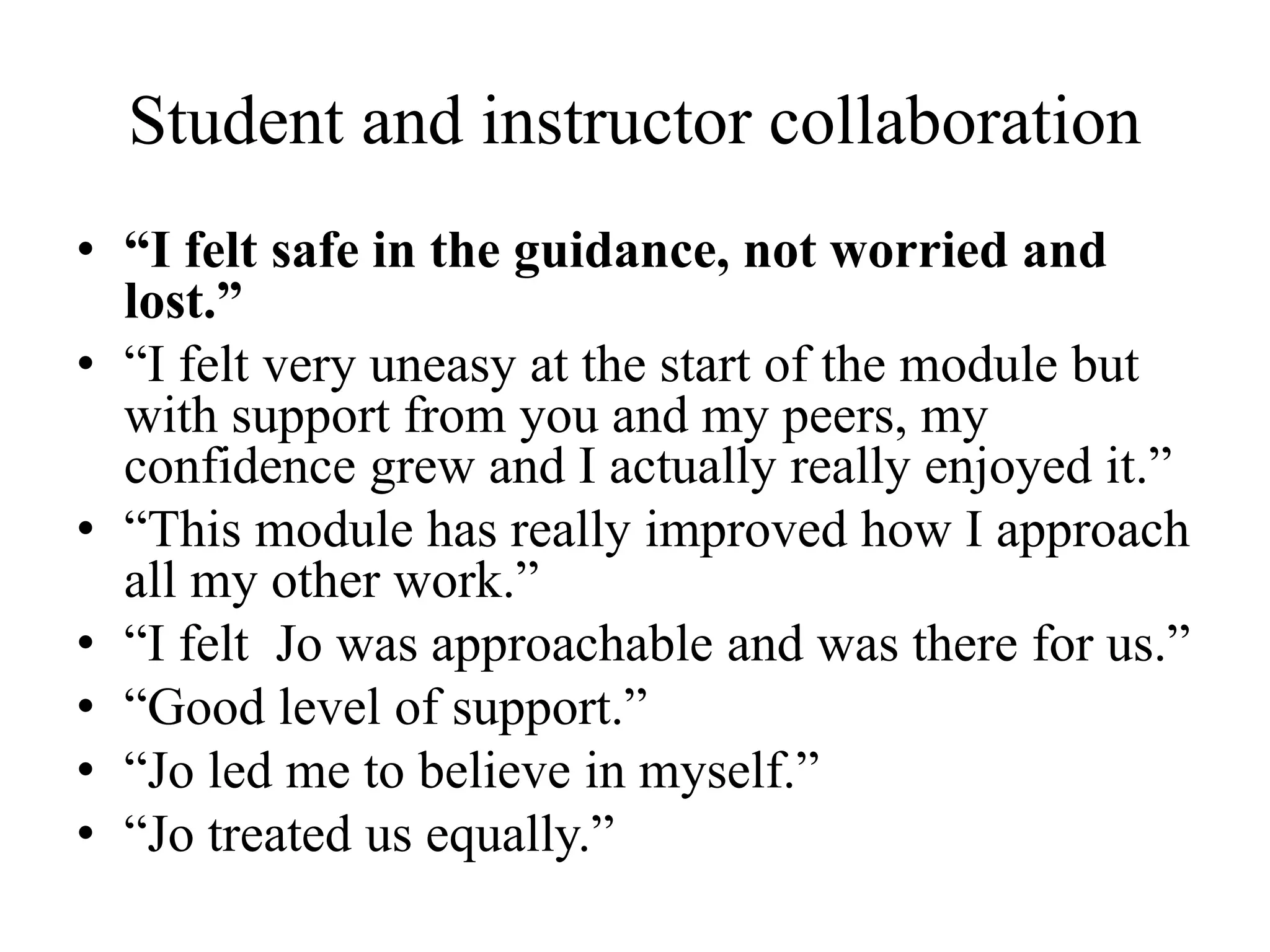
Student and instructor collaboration
• “I felt safe in the guidance, not worried and
lost.”
• “I felt very uneasy at the start of the module but
with support from you and my peers, my
confidence grew and I actually really enjoyed it.”
• “This module has really improved how I approach
all my other work.”
• “I felt Jo was approachable and was there for us.”
• “Good level of support.”
• “Jo led me to believe in myself.”
• “Jo treated us equally.”
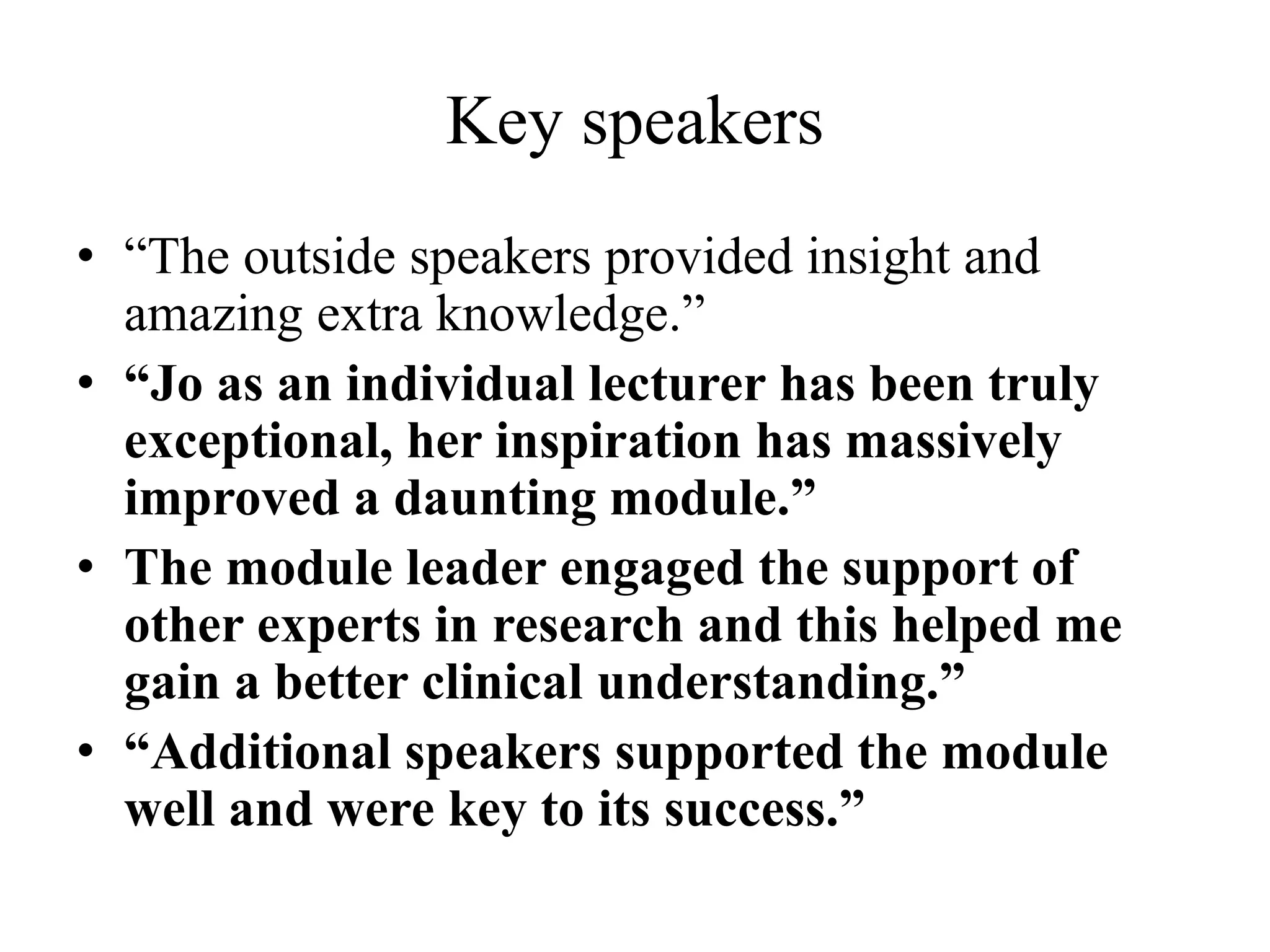
Key speakers
• “The outside speakers provided insight and
amazing extra knowledge.”
• “Jo as an individual lecturer has been truly
exceptional, her inspiration has massively
improved a daunting module.”
• The module leader engaged the support of
other experts in research and this helped me
gain a better clinical understanding.”
• “Additional speakers supported the module
well and were key to its success.”
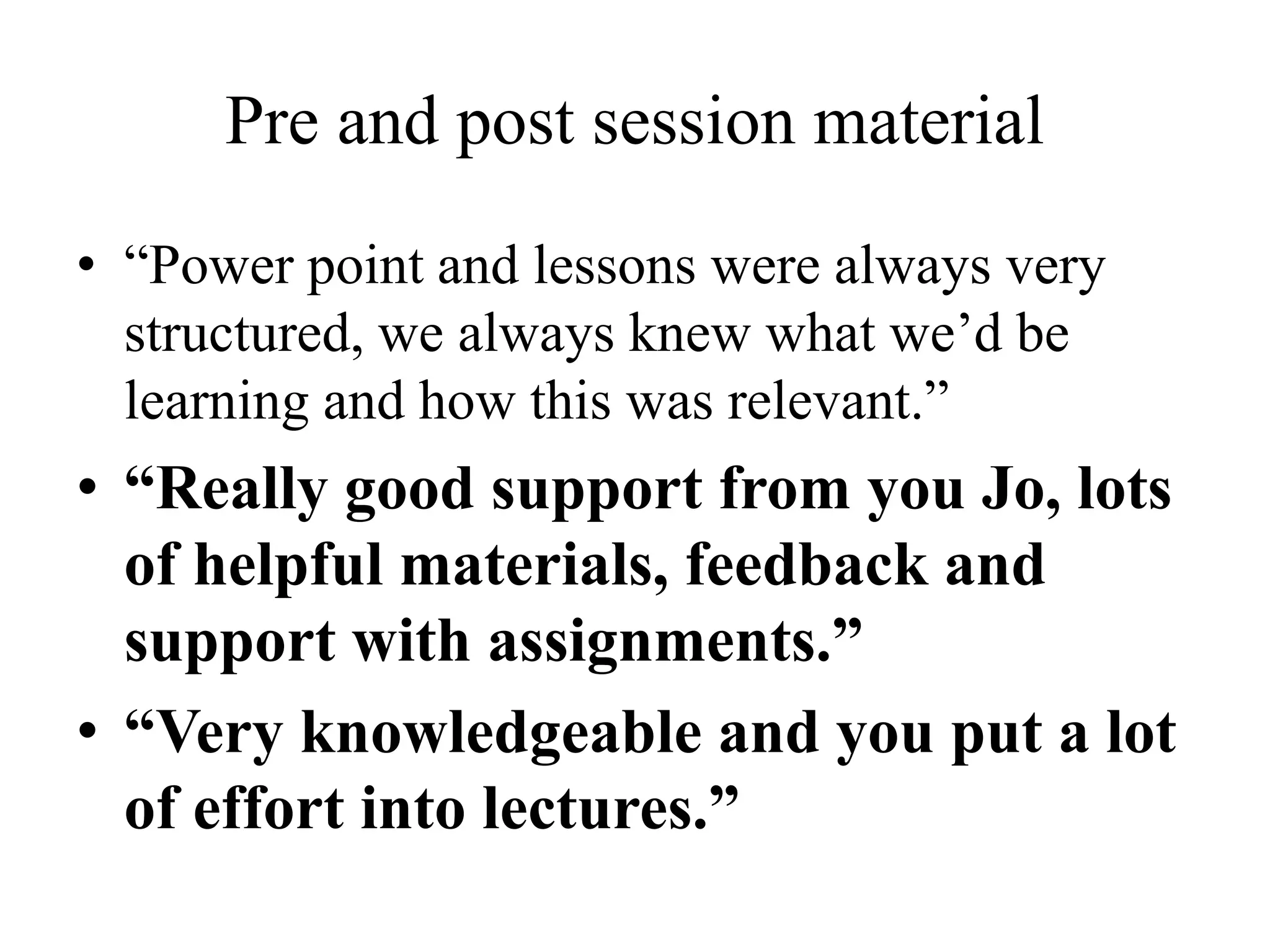
Pre and post session material
• “Power point and lessons were always very
structured, we always knew what we’d be
learning and how this was relevant.”
• “Really good support from you Jo, lots
of helpful materials, feedback and
support with assignments.”
• “Very knowledgeable and you put a lot
of effort into lectures.”
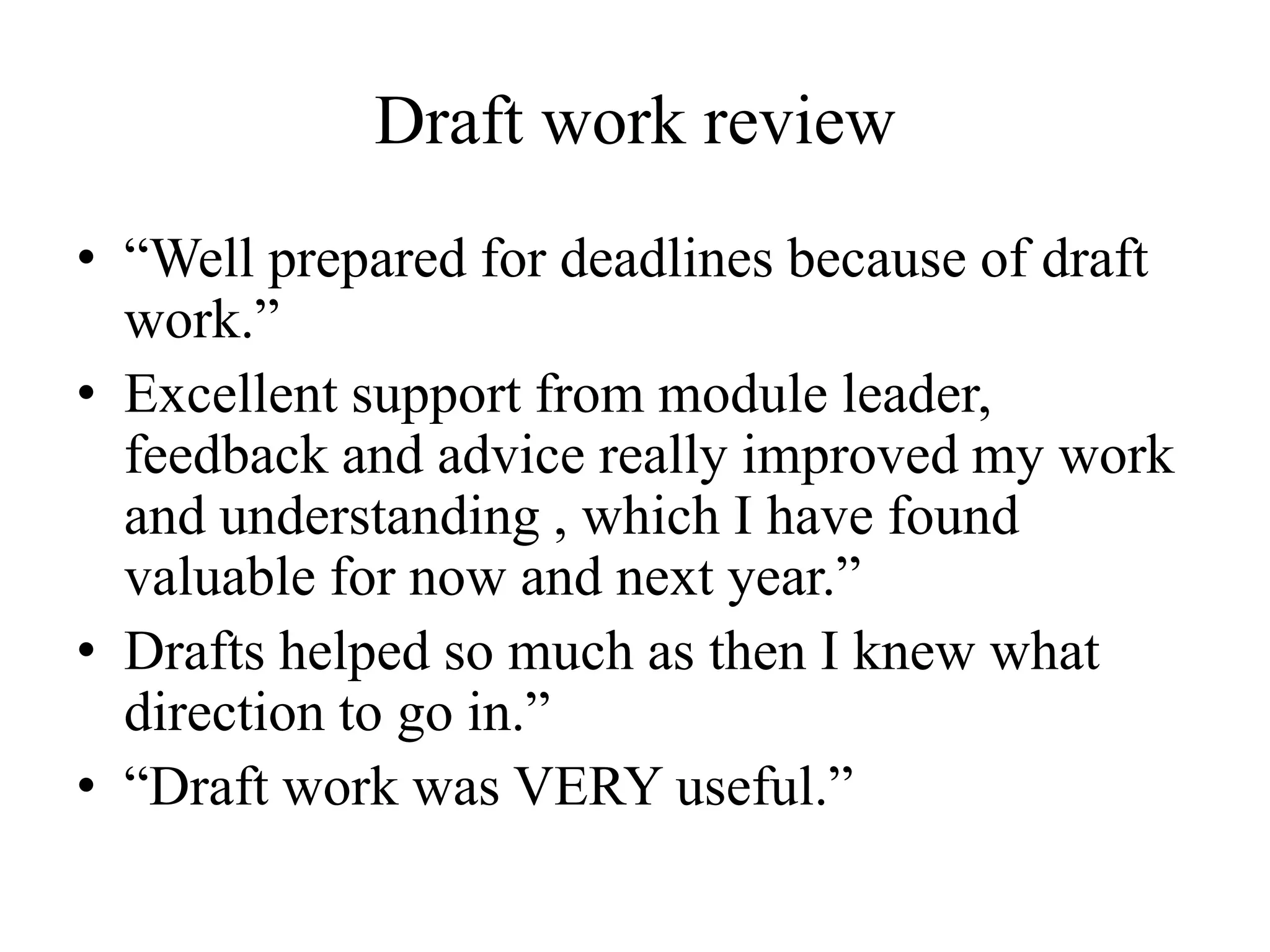
Draft work review
• “Well prepared for deadlines because of draft
work.”
• Excellent support from module leader,
feedback and advice really improved my work
and understanding , which I have found
valuable for now and next year.”
• Drafts helped so much as then I knew what
direction to go in.”
• “Draft work was VERY useful.”
Peer review
• “Draft and peer marking was a very useful
exercise to identify what was needed
regarding the marking criteria and get another
person to offer suggestions on your work.”
• “I peer marked a friend's too for another
module as it was so beneficial.”
• “Time frame for peer and draft review was
well timed.”
Conclusion
• Do student midwives perceive OSCE feedback as
useful in relation to their learning with particular
emphasis on learning in practice settings?
• Yes…………..but the impact of whether it is
deemed useful had several factors:
• Clear guidance which was timely effective and
appropriate
• Tutor-student dialogue
• Assessment shapes what students study
• Brief
Recommendations
• Continuity between modules in relation to
mode of assessment
• Clarity
• Constructive dialogue between assessor and
student following assessment feedback
Reflection
• Personal and professional perspective
• Visible improvement
• Listening to students and analysing their
motivations for learning
• PURA (Pan University Review of Assessment)
• Teaching and Learning Conference 2015
• Pan London Assessment Document
Questions

An Exploration of Feedback in Midwifery Education

  • 1.
    An exploration offeedback in Midwifery education Teaching and Learning Conference 2015 Jo Killingley
  • 2.
    Introduction • Midwifery • TheOSCE (Objective Structured Clinical Examination) • Year one OSCE • Second year research succession planning
  • 3.
    Student feedback onResearch modules • Unrelated to practice • Boring • Difficult • Laborious • Always poor feedback at BOS
  • 4.
    Aims • Describe aselect group of students’ experience of formative feedback in relation to an Objective Structured Clinical Examination (OSCE) using a small scale research project • To understand from the perspective of the students’ whether or not feedback has a positive impact on learning, in particular in practice settings and to develop assessment strategies to promote learning
  • 5.
    Objectives • To determinethe student’s experiences of OSCE feedback • To explore areas that could help students take control of their own learning • To facilitate learning through structured OSCE feedback • To disseminate good practice in assessment feedback
  • 6.
    Research Question • Dostudent midwives perceive OSCE feedback as useful in relation to their learning with particular emphasis on learning in practice settings?
  • 7.
    Methodology • Qualitative paradigm •Method of data collection: focus group • Semi structured interview guide • Sampling: purposive • Inclusion: all student who had passed their OSCE • Data analysis: thematic analysis • Ethics: role conflict
  • 8.
    Introduction • Learning isa perception and an understanding of the world. • Learning is an emotional journey involving many factors • Learning involves assessment and feedback • Opportunity
  • 9.
    Literature review • Specificity •Behaviour focused • Clarity • Timeliness • OSCE
  • 10.
    Project findings Objectives: 1. Todetermine the student’s experience of OSCE feedback 2. To explore areas that could help students take control of their learning 3. To facilitate learning through structured OSCE feedback and to disseminate in other areas of teaching and assessment 4. To facilitate learning and high standards of proficiency through OSCE feedback
  • 11.
    Student quote “Enquiry basedlearning started in the first year and set our standards which should be reflected in the OSCE and then the feedback”
  • 12.
    Project limitations • Datacollection closer to the student experience • Focus group size
  • 13.
    Teachers are responsiblefor designing curriculum, assessment, instruction, and professional development to promote understanding, rather than simply knowledge- recall (Brown 2007).
  • 14.
  • 15.
    Organisation • “I knewwhere I was and felt safe in the guidance, not worried and lost.” • “I felt very uneasy at the start of the module but with support from you and my peers, my confidence grew and I actually really enjoyed it.” • “Very structured lessons that follow a methodical approach.” • The lessons are the right length, not too long or overwhelming.” • “All information was on Moodle at the start of the year which enabled me to be organised and prepare straight away.”
  • 16.
    Assessment for learning •“I was so scared of research at first, but it was well explained and we were so well supported.” • “It has set us up brilliantly for our dissertation in year 3.” • “Strong guidance on and off-line.” • “This module did not only help me complete these two assignments, but also for other modules of the course.” • “I felt we had a good understanding of the structure and marking scheme before writing.” • “Constructive and valuable feedback from class, drafts, peer review and tutorials.”
  • 17.
    Student and instructorcollaboration • “I felt safe in the guidance, not worried and lost.” • “I felt very uneasy at the start of the module but with support from you and my peers, my confidence grew and I actually really enjoyed it.” • “This module has really improved how I approach all my other work.” • “I felt Jo was approachable and was there for us.” • “Good level of support.” • “Jo led me to believe in myself.” • “Jo treated us equally.”
  • 18.
    Key speakers • “Theoutside speakers provided insight and amazing extra knowledge.” • “Jo as an individual lecturer has been truly exceptional, her inspiration has massively improved a daunting module.” • The module leader engaged the support of other experts in research and this helped me gain a better clinical understanding.” • “Additional speakers supported the module well and were key to its success.”
  • 19.
    Pre and postsession material • “Power point and lessons were always very structured, we always knew what we’d be learning and how this was relevant.” • “Really good support from you Jo, lots of helpful materials, feedback and support with assignments.” • “Very knowledgeable and you put a lot of effort into lectures.”
  • 20.
    Draft work review •“Well prepared for deadlines because of draft work.” • Excellent support from module leader, feedback and advice really improved my work and understanding , which I have found valuable for now and next year.” • Drafts helped so much as then I knew what direction to go in.” • “Draft work was VERY useful.”
  • 21.
    Peer review • “Draftand peer marking was a very useful exercise to identify what was needed regarding the marking criteria and get another person to offer suggestions on your work.” • “I peer marked a friend's too for another module as it was so beneficial.” • “Time frame for peer and draft review was well timed.”
  • 22.
    Conclusion • Do studentmidwives perceive OSCE feedback as useful in relation to their learning with particular emphasis on learning in practice settings? • Yes…………..but the impact of whether it is deemed useful had several factors: • Clear guidance which was timely effective and appropriate • Tutor-student dialogue • Assessment shapes what students study • Brief
  • 23.
    Recommendations • Continuity betweenmodules in relation to mode of assessment • Clarity • Constructive dialogue between assessor and student following assessment feedback
  • 24.
    Reflection • Personal andprofessional perspective • Visible improvement • Listening to students and analysing their motivations for learning • PURA (Pan University Review of Assessment) • Teaching and Learning Conference 2015 • Pan London Assessment Document
  • 25.