Alexandra Pitt
Faith Dillon-Lee
Academic Writing and Language, LDU
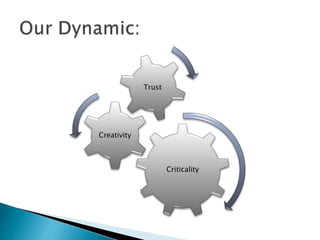
Criticality
Creativity
Trust
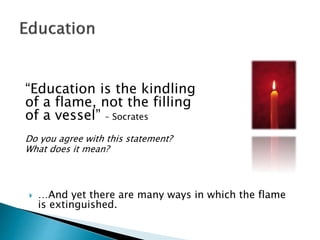
“Education is the kindling
of a flame, not the filling
of a vessel” – Socrates
Do you agree with this statement?
What does it mean?
 …And yet there are many ways in which the flame
is extinguished.
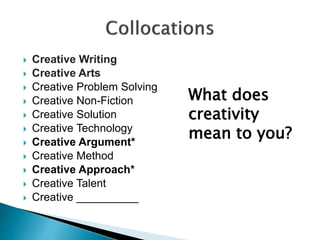
 Creative Writing
 Creative Arts
 Creative Problem Solving
 Creative Non-Fiction
 Creative Solution
 Creative Technology
 Creative Argument*
 Creative Method
 Creative Approach*
 Creative Talent
 Creative __________
What does
creativity
mean to you?
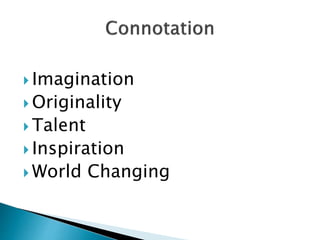
 Imagination
 Originality
 Talent
 Inspiration
 World Changing
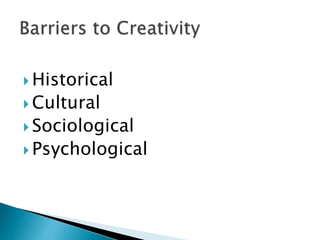
 Historical
 Cultural
 Sociological
 Psychological
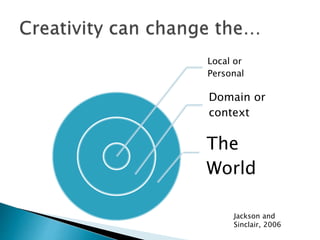
Local or
Personal
Domain or
context
The
World
Jackson and
Sinclair, 2006
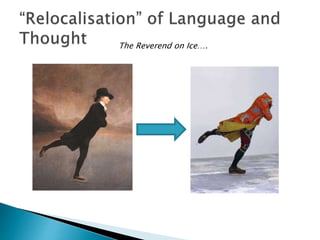
The Reverend on Ice….
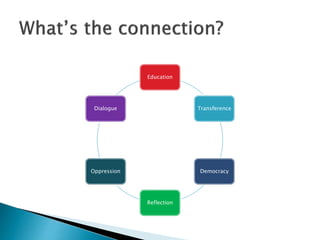
Education
Transference
Democracy
Reflection
Oppression
Dialogue
 Pennycook (2010:26) states that:
 “..much of what has been taken for granted
about language, society and mind has derived
from an intellectual tradition that has
emphasized structure and system rather than
activity and practice”
a. “… but I am not very creative”
b. “Am I allowed to do that?”
c. “Is that it? I thought it was much more
complicated than that”
d. “How did you score more than me on creativity?
I am supposed to be the creative one”
e. “…but that was so obvious”
f. “How am I supposed to be creative when I am
just a learner?”
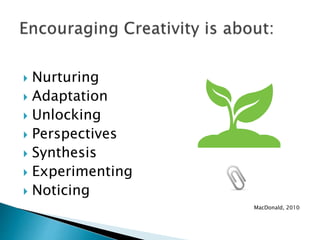
 Nurturing
 Adaptation
 Unlocking
 Perspectives
 Synthesis
 Experimenting
 Noticing
MacDonald, 2010
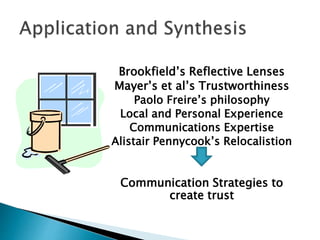
Brookfield’s Reflective Lenses
Mayer’s et al’s Trustworthiness
Paolo Freire’s philosophy
Local and Personal Experience
Communications Expertise
Alistair Pennycook’s Relocalistion
Communication Strategies to
create trust
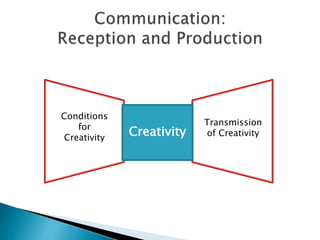
Creativity
Conditions
for
Creativity
Transmission
of Creativity
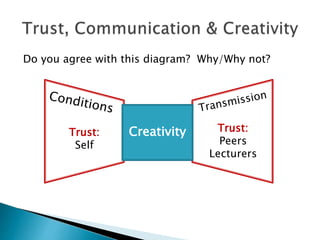
Do you agree with this diagram? Why/Why not?
CreativityTrust:
Self
Trust:
Peers
Lecturers
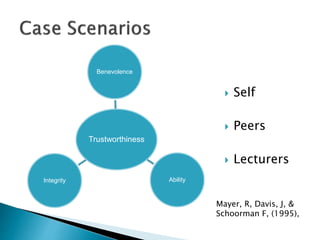
Trustworthiness
Benevolence
AbilityIntegrity
 Self
 Peers
 Lecturers
Mayer, R, Davis, J, &
Schoorman F, (1995),
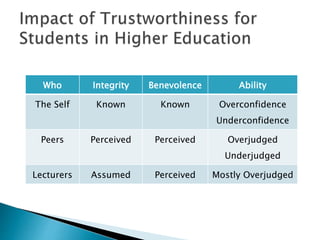
Who Integrity Benevolence Ability
The Self Known Known Overconfidence
Underconfidence
Peers Perceived Perceived Overjudged
Underjudged
Lecturers Assumed Perceived Mostly Overjudged
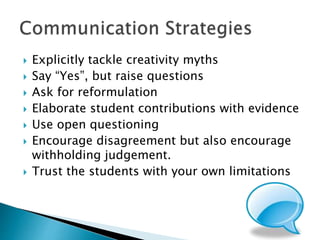
 Explicitly tackle creativity myths
 Say “Yes”, but raise questions
 Ask for reformulation
 Elaborate student contributions with evidence
 Use open questioning
 Encourage disagreement but also encourage
withholding judgement.
 Trust the students with your own limitations
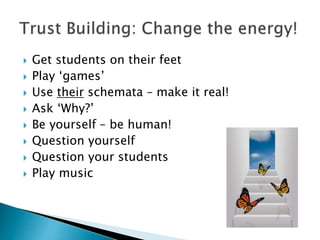
 Get students on their feet
 Play ‘games’
 Use their schemata – make it real!
 Ask ‘Why?’
 Be yourself – be human!
 Question yourself
 Question your students
 Play music
Where would you
take this now?
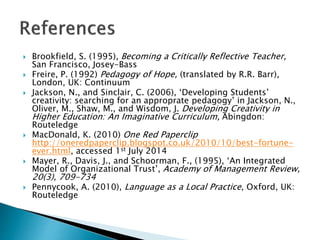
 Brookfield, S. (1995), Becoming a Critically Reflective Teacher,
San Francisco, Josey-Bass
 Freire, P. (1992) Pedagogy of Hope, (translated by R.R. Barr),
London, UK: Continuum
 Jackson, N., and Sinclair, C. (2006), ‘Developing Students’
creativity: searching for an approprate pedagogy’ in Jackson, N.,
Oliver, M., Shaw, M., and Wisdom, J. Developing Creativity in
Higher Education: An Imaginative Curriculum, Abingdon:
Routeledge
 MacDonald, K. (2010) One Red Paperclip
http://oneredpaperclip.blogspot.co.uk/2010/10/best-fortune-
ever.html, accessed 1st July 2014
 Mayer, R., Davis, J., and Schoorman, F., (1995), ‘An Integrated
Model of Organizational Trust’, Academy of Management Review,
20(3), 709-734
 Pennycook, A. (2010), Language as a Local Practice, Oxford, UK:
Routeledge

Faith Dillon and Alexandra Pitt 'Trust creativity, create trust'

  • 1.
  • 2.
  • 3.
    “Education is thekindling of a flame, not the filling of a vessel” – Socrates Do you agree with this statement? What does it mean?  …And yet there are many ways in which the flame is extinguished.
  • 4.
     Creative Writing Creative Arts  Creative Problem Solving  Creative Non-Fiction  Creative Solution  Creative Technology  Creative Argument*  Creative Method  Creative Approach*  Creative Talent  Creative __________ What does creativity mean to you?
  • 5.
     Imagination  Originality Talent  Inspiration  World Changing
  • 6.
     Historical  Cultural Sociological  Psychological
  • 7.
  • 8.
  • 9.
  • 10.
     Pennycook (2010:26)states that:  “..much of what has been taken for granted about language, society and mind has derived from an intellectual tradition that has emphasized structure and system rather than activity and practice”
  • 11.
    a. “… butI am not very creative” b. “Am I allowed to do that?” c. “Is that it? I thought it was much more complicated than that” d. “How did you score more than me on creativity? I am supposed to be the creative one” e. “…but that was so obvious” f. “How am I supposed to be creative when I am just a learner?”
  • 12.
     Nurturing  Adaptation Unlocking  Perspectives  Synthesis  Experimenting  Noticing MacDonald, 2010
  • 13.
    Brookfield’s Reflective Lenses Mayer’set al’s Trustworthiness Paolo Freire’s philosophy Local and Personal Experience Communications Expertise Alistair Pennycook’s Relocalistion Communication Strategies to create trust
  • 15.
  • 17.
    Do you agreewith this diagram? Why/Why not? CreativityTrust: Self Trust: Peers Lecturers
  • 18.
    Trustworthiness Benevolence AbilityIntegrity  Self  Peers Lecturers Mayer, R, Davis, J, & Schoorman F, (1995),
  • 19.
    Who Integrity BenevolenceAbility The Self Known Known Overconfidence Underconfidence Peers Perceived Perceived Overjudged Underjudged Lecturers Assumed Perceived Mostly Overjudged
  • 20.
     Explicitly tacklecreativity myths  Say “Yes”, but raise questions  Ask for reformulation  Elaborate student contributions with evidence  Use open questioning  Encourage disagreement but also encourage withholding judgement.  Trust the students with your own limitations
  • 21.
     Get studentson their feet  Play ‘games’  Use their schemata – make it real!  Ask ‘Why?’  Be yourself – be human!  Question yourself  Question your students  Play music
  • 22.
  • 23.
     Brookfield, S.(1995), Becoming a Critically Reflective Teacher, San Francisco, Josey-Bass  Freire, P. (1992) Pedagogy of Hope, (translated by R.R. Barr), London, UK: Continuum  Jackson, N., and Sinclair, C. (2006), ‘Developing Students’ creativity: searching for an approprate pedagogy’ in Jackson, N., Oliver, M., Shaw, M., and Wisdom, J. Developing Creativity in Higher Education: An Imaginative Curriculum, Abingdon: Routeledge  MacDonald, K. (2010) One Red Paperclip http://oneredpaperclip.blogspot.co.uk/2010/10/best-fortune- ever.html, accessed 1st July 2014  Mayer, R., Davis, J., and Schoorman, F., (1995), ‘An Integrated Model of Organizational Trust’, Academy of Management Review, 20(3), 709-734  Pennycook, A. (2010), Language as a Local Practice, Oxford, UK: Routeledge

Editor's Notes

  • #4 Nice way to start and establish that creativity is prevalent and not hard to find. It is nurturing it that is difficult.
  • #5 A selection of collocates that we need to be using more often – but a question for them to consider
  • #6 To show that creativity is coated in daunting prospects. Most people do not see themselves as creative and most are frightened by it because of these connotations.
  • #7 There are barriers therefore in these areas.
  • #8 There are levels of creativity and we need to move it away from world changing.
  • #9 This is from Pennycook (2010) Language as a Local Practice. The example given here of why we shouldn’t feel that all creativity has to be Imginative/Original/Talented/Inspirational/World Changing. The updated version of the Rev was sculpted by Yinka Shonibare, MBE, to highlight that the westernised ideal of a lone genius/tortured poet etc is a fallacy. We build on what has gone before, and we are always standing on the shoulders of giants. We simply relocate what has been done to our own, new local practice. He shows this in his sculpture, which ties in materials from all over the world to reimagine the original painting.
  • #10 How do these barriers and creativity interact
  • #11 But what is the system that we use? And is it actually useful? According to MacIntyre, practice (a practice) is good for it’s own purposes, it must not only serve an external end. In this way, he would not see teaching as a practice, as it only serve the end result of learning. This is in direct contradiction though to Frier, who would see education (semantic difference!) as a means towards freedom of thought. The key difference here is, I think, between the model of didactic teaching and dialogical facilitation, in which creativity and discussion as see for their own reward, as well as a movement towards criticality. However, in order to achieve this, the students must trust the teacher, and the teacher must trust the student.
  • #12 Some quotes for people to reflect on. What are the barriers here?
  • #13 Will find a suitable definition
  • #14 Based on our experience these are the tools that resonated with that and helped us to synthesise and clean the window of insight onto the matter. Of course another person might synthesise different material and we do not have qualitative data or robust
  • #15 One lens we looked through was that of communication (it is our area of expertise)
  • #16 Communication is central to creativity because it creates the conditions for creativity and then students need to actually transmit that creativity to us in a suitable way.
  • #17 Another lens we identified in our reflections was trust. – Trust and creativity
  • #18 A suggestion of how trust pertains to the diagram. They can discuss if they agree and think about how trust might relate to this.
  • #19 One Scenario