Design - Basic Principles 1
Research Proposal
Presented by: Tracey Dalton Date: 10th June 2014Module: Research Methods
‘The implementation of Post - Lecture Screencasts to
Increase Understanding:
A Case Study for Third Level Interior Design’
Design - Basic Principles 1
Context & Rationale
Brief Synopsis:
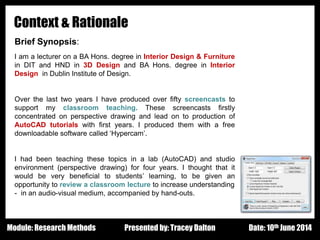
I am a lecturer on a BA Hons. degree in Interior Design & Furniture
in DIT and HND in 3D Design and BA Hons. degree in Interior
Design in Dublin Institute of Design.
Over the last two years I have produced over fifty screencasts to
support my classroom teaching. These screencasts firstly
concentrated on perspective drawing and lead on to production of
AutoCAD tutorials with first years. I produced them with a free
downloadable software called ‘Hypercam’.
I had been teaching these topics in a lab (AutoCAD) and studio
environment (perspective drawing) for four years. I thought that it
would be very beneficial to students’ learning, to be given an
opportunity to review a classroom lecture to increase understanding
- in an audio-visual medium, accompanied by hand-outs.
Presented by: Tracey Dalton Date: 10th June 2014Module: Research Methods
Design - Basic Principles 1
Context & Rationale
Why research the implementation of screencasts in a design setting?
Presented by: Tracey Dalton Date: 10th June 2014Module: Research Methods
In my experience as a design lecturer and design student ………
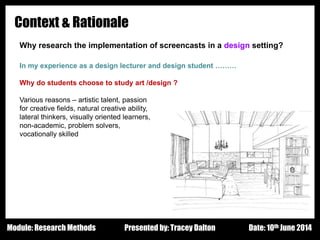
Why do students choose to study art /design ?
Various reasons – artistic talent, passion
for creative fields, natural creative ability,
lateral thinkers, visually oriented learners,
non-academic, problem solvers,
vocationally skilled
Design - Basic Principles 1
Context & Rationale
Why research the implementation of screencasts in a design setting?
Presented by: Tracey Dalton Date: 10th June 2014Module: Research Methods
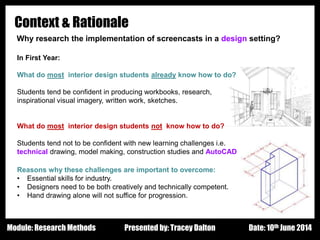
In First Year:
What do most interior design students already know how to do?
Students tend be confident in producing workbooks, research,
inspirational visual imagery, written work, sketches.
What do most interior design students not know how to do?
Students tend not to be confident with new learning challenges i.e.
technical drawing, model making, construction studies and AutoCAD
Reasons why these challenges are important to overcome:
• Essential skills for industry.
• Designers need to be both creatively and technically competent.
• Hand drawing alone will not suffice for progression.
Design - Basic Principles 1
Aim & Objectives
What do I want to find out from my research?
Can a blended learning approach help to overcome new learning
challenges in first year?
What are the benefits of screencasts for students’ learning of AutoCAD?
How do students feel about a blended approach to learning?
Would students welcome more blended approaches to learning?
What is the students’ user experience of the screencasts?
Presented by: Tracey Dalton Date: 10th June 2014Module: Research Methods
Re-cap of research question:
‘The Implementation of Post - Lecture Screencasts to Increase
Understanding: A Case Study for Third Level Interior Design’
Design - Basic Principles 1
Literature Review
How did I conduct my literature search?
Most of the literature on screencasting and blended
learning came from DIT library and library database searches:
Main Sources from Database and Web searches:
Google Scholar
Arrow@DIT
Journal of Information Technology Education
Advances in Engineering Education
Journal of Engineering Education
International Review of Research in Open & Distance Learning
Higher Education Authority (UK)
Infoworld Magazine
americanlibrariesmagazine.org
Presented by: Tracey Dalton Date: 10th June 2014Module: Research Methods
Design - Basic Principles 1
Literature Review
Presented by: Tracey Dalton Date: 10th June 2014Module: Research Methods
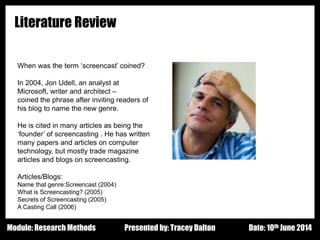
When was the term ‘screencast’ coined?
In 2004, Jon Udell, an analyst at
Microsoft, writer and architect –
coined the phrase after inviting readers of
his blog to name the new genre.
He is cited in many articles as being the
‘founder’ of screencasting . He has written
many papers and articles on computer
technology, but mostly trade magazine
articles and blogs on screencasting.
Articles/Blogs:
Name that genre:Screencast (2004)
What is Screencasting? (2005)
Secrets of Screencasting (2005)
A Casting Call (2006)
Design - Basic Principles 1
Literature Review
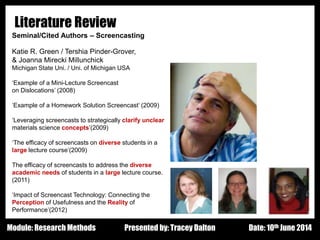
Seminal/Cited Authors – Screencasting
Katie R. Green / Tershia Pinder-Grover,
& Joanna Mirecki Millunchick
Michigan State Uni. / Uni. of Michigan USA
‘Example of a Mini-Lecture Screencast
on Dislocations’ (2008)
‘Example of a Homework Solution Screencast’ (2009)
‘Leveraging screencasts to strategically clarify unclear
materials science concepts’(2009)
‘The efficacy of screencasts on diverse students in a
large lecture course’(2009)
The efficacy of screencasts to address the diverse
academic needs of students in a large lecture course.
(2011)
‘Impact of Screencast Technology: Connecting the
Perception of Usefulness and the Reality of
Performance’(2012)
Presented by: Tracey Dalton Date: 10th June 2014Module: Research Methods
Design - Basic Principles 1
Literature Review
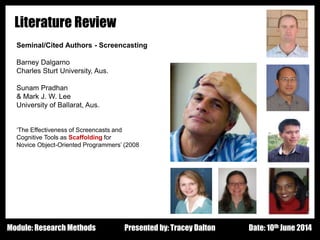
Seminal/Cited Authors - Screencasting
Barney Dalgarno
Charles Sturt University, Aus.
Sunam Pradhan
& Mark J. W. Lee
University of Ballarat, Aus.
‘The Effectiveness of Screencasts and
Cognitive Tools as Scaffolding for
Novice Object-Oriented Programmers’ (2008
Presented by: Tracey Dalton Date: 10th June 2014Module: Research Methods
Design - Basic Principles 1
Literature Review
Presented by: Tracey Dalton Date: 10th June 2014Module: Research Methods
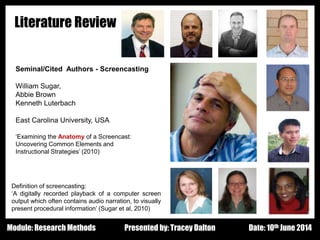
Seminal/Cited Authors - Screencasting
William Sugar,
Abbie Brown
Kenneth Luterbach
East Carolina University, USA
‘Examining the Anatomy of a Screencast:
Uncovering Common Elements and
Instructional Strategies’ (2010)
Definition of screencasting:
‘A digitally recorded playback of a computer screen
output which often contains audio narration, to visually
present procedural information’ (Sugar et al, 2010)
Design - Basic Principles 1
Literature Review
Other Seminal/Cited Authors – Screencasting
Betty, P. (2009). Assessing home grown library collections: Using Google
Analytics to track use of screencasts and Flash-based learning objects.
Evans, D. (2011) Using embryology screencasts: A useful addition to the
student learning experience?
Farkas, M. (2013) Just-for-me Training – Screencasting for personalized long –
term learning
Grabe, M. & Christopherson, K. (2008). Optional student use of online lecture
resources: Resource preferences, performance and lecture attendance.
Kopel, M. (2010) The Paradigm of Screencasting in E-Learning.
Lee, M. & Thompson, R. (2012) Talking with Students through Screencasting:
Experimentations with Video Feedback to Improve Student Learning
McGrann, R. (2005). Enhancing engineering computer-aided design education
using lectures recorded on the PC?
Rose, K. (2009). Student perceptions of the use of instructor-made videos in
online and face to face classes.
Winterbottom, S. (2007) Virtual lecturing: Delivering lectures using screencasting
and podcasting technology.
Presented by: Tracey Dalton Date: 10th June 2014Module: Research Methods
Design - Basic Principles 1
Literature Review
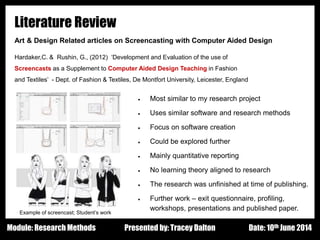
Art & Design Related articles on Screencasting with Computer Aided Design
Hardaker,C. & Rushin, G., (2012) ‘Development and Evaluation of the use of
Screencasts as a Supplement to Computer Aided Design Teaching in Fashion
and Textiles’ - Dept. of Fashion & Textiles, De Montfort University, Leicester, England
Presented by: Tracey Dalton Date: 10th June 2014Module: Research Methods
 Most similar to my research project
 Uses similar software and research methods
 Focus on software creation
 Could be explored further
 Mainly quantitative reporting
 No learning theory aligned to research
 The research was unfinished at time of publishing.
 Further work – exit questionnaire, profiling,
workshops, presentations and published paper.
Example of screencast; Student’s work
Design - Basic Principles 1
Literature Review
Further Reading:
Seminal/Cited Authors – Blended Learning & Instructional Design
Beetham, H. and Sharpe, R. (2007) (Eds.) Rethinking Pedagogy for a Digital Age.
Clark, Ruth Colvin & Mayer, Richard E. (2008) E-learning and the science of instruction:
proven guidelines for consumers and designers of multimedia learning.
Conole, G and Oliver, M. (2007) (Eds.) Contemporary perspectives in eLearning
Research: themes, methods and impact upon practice.
Gagne, R. (2005) Principles of instructional design.
Juwah, C. (2006) (Ed) Interactions in Online Education. Implications for Theory and
Practice.
Laurillard, D. (2002) Rethinking University Teaching: A Conversational Framework
for the Effective Use of Educational Technology.
Littlejohn,A. & Pegler,C. (2007). Preparing for blended e-learning.
Mayer, Richard E. (2009) Multimedia learning. Mayer is referenced often in the literature!
Reigeluth, Charles M. & Carr-Chellman, Alison A. (2009) Instructional-design theories and
models: Building a common knowledge base.
Presented by: Tracey Dalton Date: 10th June 2014Module: Research Methods
Design - Basic Principles 1
Literature Review
DIT / Past pupils papers reviewed – Blended Learning & Instructional Design
Russell, P., Ryder, G., Kerins, G., Phelan, M., (2013.) Creating, sharing and reusing
learning objects to enhance information literacy.
Seery, M. and Donnelly, R. (2011), The implementation of pre-lecture resources to reduce
in-class cognitive load: A case study for higher education chemistry.
Stuart, A. (2013) Engaging Students Learning Through a Blended Learning Environment.
Presented by: Tracey Dalton Date: 10th June 2014Module: Research Methods
Design - Basic Principles 1
Literature Review
Common strands in the literature:
• Focus on the technology itself
• Research with large lectures groups
• Use of quantitative rather than qualitative methods
• Science, technology, instructional education and engineering focussed research
• Assessing student creation of screencasts
• Student access and perception of screencasts
• Screencast implementation to scaffold learning and reduce cognitive load
Presented by: Tracey Dalton Date: 10th June 2014Module: Research Methods
Design - Basic Principles 1
Literature Review
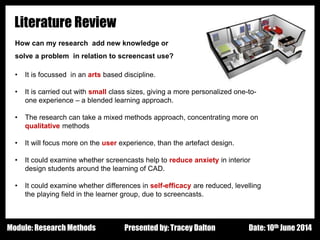
How can my research add new knowledge or
solve a problem in relation to screencast use?
• It is focussed in an arts based discipline.
• It is carried out with small class sizes, giving a more personalized one-to-
one experience – a blended learning approach.
• The research can take a mixed methods approach, concentrating more on
qualitative methods
• It will focus more on the user experience, than the artefact design.
• It could examine whether screencasts help to reduce anxiety in interior
design students around the learning of CAD.
• It could examine whether differences in self-efficacy are reduced, levelling
the playing field in the learner group, due to screencasts.
Presented by: Tracey Dalton Date: 10th June 2014Module: Research Methods
Design - Basic Principles 1
Research Design 1
Theoretical Perspective
Re-cap of research question:
‘The Implementation of Post - Lecture Screencasts to Increase Understanding:
A Case Study for Third Level Interior Design’
Ontology
My ontology comes more from an constructivist viewpoint as I
believe that the question proposes to solve a problem for students.
There is no one reality to the benefit of the screencasts
as the learners’ perception has many variables.
However, my ontology is not purely constructivist,
as there are some elements of the research which
can be assessed statistically.
Presented by: Tracey Dalton Date: 10th June 2014Module: Research Methods
Design - Basic Principles 1
Research Design 1
Theoretical Perspective
Re-cap of research question:
‘The Implementation of Post - Lecture Screencasts to Increase Understanding:
A Case Study for Third Level Interior Design’
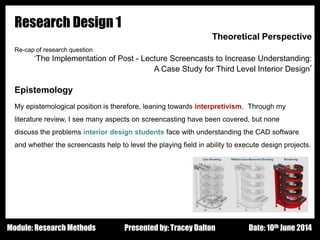
Epistemology
My epistemological position is therefore, leaning towards interpretivism. Through my
literature review, I see many aspects on screencasting have been covered, but none
discuss the problems interior design students face with understanding the CAD software
and whether the screencasts help to level the playing field in ability to execute design projects.
Presented by: Tracey Dalton Date: 10th June 2014Module: Research Methods
Design - Basic Principles 1
Research Design 2
Methodology
Re-cap of research question:
‘The Implementation of Post - Lecture Screencasts to Increase Understanding:
A Case Study for Third Level Interior Design’
Case Study – Why?
The research will focus on one instance of use of the screencasts, over one academic year.
I will be focussing on three groups of students who have used the screencasts.
These are not large groups, with a total of under 50 students.
Therefore, this will be a ‘collective’ case study, which will compare and contrast the results
from the three groups.
What groups?
Two groups of 1st year DIT interior design and furniture students – from academic year
2012/13 and 2013/4.
Students from Dublin Institute of Design - various years - using similar CAD screencasts.
Presented by: Tracey Dalton Date: 10th June 2014Module: Research Methods
Design - Basic Principles 1
Research Design 3 Research Methods
Triangulation
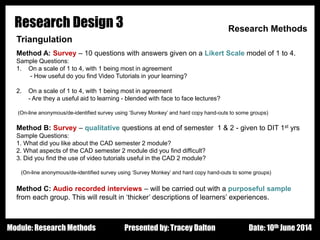
Method A: Survey – 10 questions with answers given on a Likert Scale model of 1 to 4.
Sample Questions:
1. On a scale of 1 to 4, with 1 being most in agreement
- How useful do you find Video Tutorials in your learning?
2. On a scale of 1 to 4, with 1 being most in agreement
- Are they a useful aid to learning - blended with face to face lectures?
(On-line anonymous/de-identified survey using ‘Survey Monkey’ and hard copy hand-outs to some groups)
Method B: Survey – qualitative questions at end of semester 1 & 2 - given to DIT 1st yrs
Sample Questions:
1. What did you like about the CAD semester 2 module?
2. What aspects of the CAD semester 2 module did you find difficult?
3. Did you find the use of video tutorials useful in the CAD 2 module?
(On-line anonymous/de-identified survey using ‘Survey Monkey’ and hard copy hand-outs to some groups)
Method C: Audio recorded interviews – will be carried out with a purposeful sample
from each group. This will result in ‘thicker’ descriptions of learners’ experiences.
Presented by: Tracey Dalton Date: 10th June 2014Module: Research Methods
Design - Basic Principles 1
Research Design 4
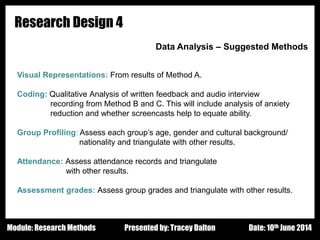
Data Analysis – Suggested Methods
Visual Representations: From results of Method A.
Coding: Qualitative Analysis of written feedback and audio interview
recording from Method B and C. This will include analysis of anxiety
reduction and whether screencasts help to equate ability.
Group Profiling: Assess each group’s age, gender and cultural background/
nationality and triangulate with other results.
Attendance: Assess attendance records and triangulate
with other results.
Assessment grades: Assess group grades and triangulate with other results.
Presented by: Tracey Dalton Date: 10th June 2014Module: Research Methods
Design - Basic Principles 1
Issues
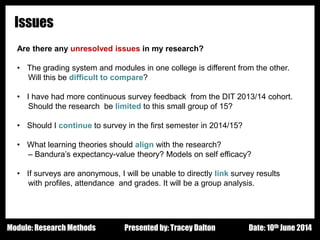
Are there any unresolved issues in my research?
• The grading system and modules in one college is different from the other.
Will this be difficult to compare?
• I have had more continuous survey feedback from the DIT 2013/14 cohort.
Should the research be limited to this small group of 15?
• Should I continue to survey in the first semester in 2014/15?
• What learning theories should align with the research?
– Bandura’s expectancy-value theory? Models on self efficacy?
• If surveys are anonymous, I will be unable to directly link survey results
with profiles, attendance and grades. It will be a group analysis.
Presented by: Tracey Dalton Date: 10th June 2014Module: Research Methods
Design - Basic Principles 1
Ethics
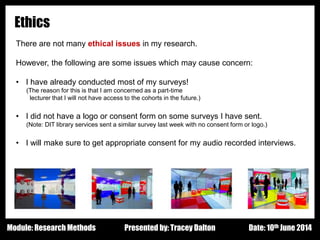
There are not many ethical issues in my research.
However, the following are some issues which may cause concern:
• I have already conducted most of my surveys!
(The reason for this is that I am concerned as a part-time
lecturer that I will not have access to the cohorts in the future.)
• I did not have a logo or consent form on some surveys I have sent.
(Note: DIT library services sent a similar survey last week with no consent form or logo.)
• I will make sure to get appropriate consent for my audio recorded interviews.
Presented by: Tracey Dalton Date: 10th June 2014Module: Research Methods
Design - Basic Principles 1
Limitations / Delimitations
What are the limitations to my research?
• The interviews will take place in the college buildings to avoid ethical issues.
• The research methods will have to conclude end of 2014 to allow for write up of results.
What are the delimitations to my research?
• I am not going to observe students viewing a screencast as this is not the
natural process for use, and may make students feel uneasy.
• I won’t be revising the screencasts as it is unnecessary to improve them for
their purpose. I will assess student satisfaction through surveys.
• I will not divide a group, giving half of them the use of screencasts, for ethical reasons.
• I will not use action research as a methodology, as it would involve two cycles or
more, which I don’t have time for with use of this artefact.
• I will avoid quantitative analysis, using inferential statistics, as I have no experience
with their use. However, if necessary, I will educate myself on their application.
Presented by: Tracey Dalton Date: 10th June 2014Module: Research Methods
Design - Basic Principles 1
Timescale
Survey Issue: Method A & B: April/May 2014
Presentation of Research Proposal: June 10th 2014
Submission to DIT Ethics Board: June 11th 2014
Research Proposal Submission: June 24th 2014
Review Surveys: July/August 2014
Commence Year 2 of MSc: September 2014
Feedback from DIT Ethics Board: September 2014
Audio Interview Questionnaire Design & Implementation: Sept to Nov 2014
Data Analysis/Triangulation of Results: December/January 2014/15
Commence Paper - Abstract - moving on sequentially to Conclusions: February 2015
Presented by: Tracey Dalton Date: 10th June 2014Module: Research Methods
Design - Basic Principles 1
References
Badevi, A. (2013) Ontology, Epistemology, Methodology - How it could be reflected in your
research report? Retrieved on 8th June 2014 from www.youtube.com
Creswell, J. W. (2014). Research Design (4th ed.) Thousand Oaks, California: Sage.
Denscombe, M. (2012) Research Proposals - A Practical Guide. Berkshire: Open University
Grix, J. (2002) Introducing Students to the Generic Terminology of Social Research. Politics:
2002 Vol 22(3), 175–186
Opie, C. (2004). Doing educational research: a guide to first-time researchers. London: Sage.
Punch, K. (2006). Developing Effective Research Proposals. London: Sage.
Presented by: Tracey Dalton Date: 10th June 2014Module: Research Methods

Research proposal presentation - 10 june 2014

  • 1.
    Design - BasicPrinciples 1 Research Proposal Presented by: Tracey Dalton Date: 10th June 2014Module: Research Methods ‘The implementation of Post - Lecture Screencasts to Increase Understanding: A Case Study for Third Level Interior Design’
  • 2.
    Design - BasicPrinciples 1 Context & Rationale Brief Synopsis: I am a lecturer on a BA Hons. degree in Interior Design & Furniture in DIT and HND in 3D Design and BA Hons. degree in Interior Design in Dublin Institute of Design. Over the last two years I have produced over fifty screencasts to support my classroom teaching. These screencasts firstly concentrated on perspective drawing and lead on to production of AutoCAD tutorials with first years. I produced them with a free downloadable software called ‘Hypercam’. I had been teaching these topics in a lab (AutoCAD) and studio environment (perspective drawing) for four years. I thought that it would be very beneficial to students’ learning, to be given an opportunity to review a classroom lecture to increase understanding - in an audio-visual medium, accompanied by hand-outs. Presented by: Tracey Dalton Date: 10th June 2014Module: Research Methods
  • 3.
    Design - BasicPrinciples 1 Context & Rationale Why research the implementation of screencasts in a design setting? Presented by: Tracey Dalton Date: 10th June 2014Module: Research Methods In my experience as a design lecturer and design student ……… Why do students choose to study art /design ? Various reasons – artistic talent, passion for creative fields, natural creative ability, lateral thinkers, visually oriented learners, non-academic, problem solvers, vocationally skilled
  • 4.
    Design - BasicPrinciples 1 Context & Rationale Why research the implementation of screencasts in a design setting? Presented by: Tracey Dalton Date: 10th June 2014Module: Research Methods In First Year: What do most interior design students already know how to do? Students tend be confident in producing workbooks, research, inspirational visual imagery, written work, sketches. What do most interior design students not know how to do? Students tend not to be confident with new learning challenges i.e. technical drawing, model making, construction studies and AutoCAD Reasons why these challenges are important to overcome: • Essential skills for industry. • Designers need to be both creatively and technically competent. • Hand drawing alone will not suffice for progression.
  • 5.
    Design - BasicPrinciples 1 Aim & Objectives What do I want to find out from my research? Can a blended learning approach help to overcome new learning challenges in first year? What are the benefits of screencasts for students’ learning of AutoCAD? How do students feel about a blended approach to learning? Would students welcome more blended approaches to learning? What is the students’ user experience of the screencasts? Presented by: Tracey Dalton Date: 10th June 2014Module: Research Methods Re-cap of research question: ‘The Implementation of Post - Lecture Screencasts to Increase Understanding: A Case Study for Third Level Interior Design’
  • 6.
    Design - BasicPrinciples 1 Literature Review How did I conduct my literature search? Most of the literature on screencasting and blended learning came from DIT library and library database searches: Main Sources from Database and Web searches: Google Scholar Arrow@DIT Journal of Information Technology Education Advances in Engineering Education Journal of Engineering Education International Review of Research in Open & Distance Learning Higher Education Authority (UK) Infoworld Magazine americanlibrariesmagazine.org Presented by: Tracey Dalton Date: 10th June 2014Module: Research Methods
  • 7.
    Design - BasicPrinciples 1 Literature Review Presented by: Tracey Dalton Date: 10th June 2014Module: Research Methods When was the term ‘screencast’ coined? In 2004, Jon Udell, an analyst at Microsoft, writer and architect – coined the phrase after inviting readers of his blog to name the new genre. He is cited in many articles as being the ‘founder’ of screencasting . He has written many papers and articles on computer technology, but mostly trade magazine articles and blogs on screencasting. Articles/Blogs: Name that genre:Screencast (2004) What is Screencasting? (2005) Secrets of Screencasting (2005) A Casting Call (2006)
  • 8.
    Design - BasicPrinciples 1 Literature Review Seminal/Cited Authors – Screencasting Katie R. Green / Tershia Pinder-Grover, & Joanna Mirecki Millunchick Michigan State Uni. / Uni. of Michigan USA ‘Example of a Mini-Lecture Screencast on Dislocations’ (2008) ‘Example of a Homework Solution Screencast’ (2009) ‘Leveraging screencasts to strategically clarify unclear materials science concepts’(2009) ‘The efficacy of screencasts on diverse students in a large lecture course’(2009) The efficacy of screencasts to address the diverse academic needs of students in a large lecture course. (2011) ‘Impact of Screencast Technology: Connecting the Perception of Usefulness and the Reality of Performance’(2012) Presented by: Tracey Dalton Date: 10th June 2014Module: Research Methods
  • 9.
    Design - BasicPrinciples 1 Literature Review Seminal/Cited Authors - Screencasting Barney Dalgarno Charles Sturt University, Aus. Sunam Pradhan & Mark J. W. Lee University of Ballarat, Aus. ‘The Effectiveness of Screencasts and Cognitive Tools as Scaffolding for Novice Object-Oriented Programmers’ (2008 Presented by: Tracey Dalton Date: 10th June 2014Module: Research Methods
  • 10.
    Design - BasicPrinciples 1 Literature Review Presented by: Tracey Dalton Date: 10th June 2014Module: Research Methods Seminal/Cited Authors - Screencasting William Sugar, Abbie Brown Kenneth Luterbach East Carolina University, USA ‘Examining the Anatomy of a Screencast: Uncovering Common Elements and Instructional Strategies’ (2010) Definition of screencasting: ‘A digitally recorded playback of a computer screen output which often contains audio narration, to visually present procedural information’ (Sugar et al, 2010)
  • 11.
    Design - BasicPrinciples 1 Literature Review Other Seminal/Cited Authors – Screencasting Betty, P. (2009). Assessing home grown library collections: Using Google Analytics to track use of screencasts and Flash-based learning objects. Evans, D. (2011) Using embryology screencasts: A useful addition to the student learning experience? Farkas, M. (2013) Just-for-me Training – Screencasting for personalized long – term learning Grabe, M. & Christopherson, K. (2008). Optional student use of online lecture resources: Resource preferences, performance and lecture attendance. Kopel, M. (2010) The Paradigm of Screencasting in E-Learning. Lee, M. & Thompson, R. (2012) Talking with Students through Screencasting: Experimentations with Video Feedback to Improve Student Learning McGrann, R. (2005). Enhancing engineering computer-aided design education using lectures recorded on the PC? Rose, K. (2009). Student perceptions of the use of instructor-made videos in online and face to face classes. Winterbottom, S. (2007) Virtual lecturing: Delivering lectures using screencasting and podcasting technology. Presented by: Tracey Dalton Date: 10th June 2014Module: Research Methods
  • 12.
    Design - BasicPrinciples 1 Literature Review Art & Design Related articles on Screencasting with Computer Aided Design Hardaker,C. & Rushin, G., (2012) ‘Development and Evaluation of the use of Screencasts as a Supplement to Computer Aided Design Teaching in Fashion and Textiles’ - Dept. of Fashion & Textiles, De Montfort University, Leicester, England Presented by: Tracey Dalton Date: 10th June 2014Module: Research Methods  Most similar to my research project  Uses similar software and research methods  Focus on software creation  Could be explored further  Mainly quantitative reporting  No learning theory aligned to research  The research was unfinished at time of publishing.  Further work – exit questionnaire, profiling, workshops, presentations and published paper. Example of screencast; Student’s work
  • 13.
    Design - BasicPrinciples 1 Literature Review Further Reading: Seminal/Cited Authors – Blended Learning & Instructional Design Beetham, H. and Sharpe, R. (2007) (Eds.) Rethinking Pedagogy for a Digital Age. Clark, Ruth Colvin & Mayer, Richard E. (2008) E-learning and the science of instruction: proven guidelines for consumers and designers of multimedia learning. Conole, G and Oliver, M. (2007) (Eds.) Contemporary perspectives in eLearning Research: themes, methods and impact upon practice. Gagne, R. (2005) Principles of instructional design. Juwah, C. (2006) (Ed) Interactions in Online Education. Implications for Theory and Practice. Laurillard, D. (2002) Rethinking University Teaching: A Conversational Framework for the Effective Use of Educational Technology. Littlejohn,A. & Pegler,C. (2007). Preparing for blended e-learning. Mayer, Richard E. (2009) Multimedia learning. Mayer is referenced often in the literature! Reigeluth, Charles M. & Carr-Chellman, Alison A. (2009) Instructional-design theories and models: Building a common knowledge base. Presented by: Tracey Dalton Date: 10th June 2014Module: Research Methods
  • 14.
    Design - BasicPrinciples 1 Literature Review DIT / Past pupils papers reviewed – Blended Learning & Instructional Design Russell, P., Ryder, G., Kerins, G., Phelan, M., (2013.) Creating, sharing and reusing learning objects to enhance information literacy. Seery, M. and Donnelly, R. (2011), The implementation of pre-lecture resources to reduce in-class cognitive load: A case study for higher education chemistry. Stuart, A. (2013) Engaging Students Learning Through a Blended Learning Environment. Presented by: Tracey Dalton Date: 10th June 2014Module: Research Methods
  • 15.
    Design - BasicPrinciples 1 Literature Review Common strands in the literature: • Focus on the technology itself • Research with large lectures groups • Use of quantitative rather than qualitative methods • Science, technology, instructional education and engineering focussed research • Assessing student creation of screencasts • Student access and perception of screencasts • Screencast implementation to scaffold learning and reduce cognitive load Presented by: Tracey Dalton Date: 10th June 2014Module: Research Methods
  • 16.
    Design - BasicPrinciples 1 Literature Review How can my research add new knowledge or solve a problem in relation to screencast use? • It is focussed in an arts based discipline. • It is carried out with small class sizes, giving a more personalized one-to- one experience – a blended learning approach. • The research can take a mixed methods approach, concentrating more on qualitative methods • It will focus more on the user experience, than the artefact design. • It could examine whether screencasts help to reduce anxiety in interior design students around the learning of CAD. • It could examine whether differences in self-efficacy are reduced, levelling the playing field in the learner group, due to screencasts. Presented by: Tracey Dalton Date: 10th June 2014Module: Research Methods
  • 17.
    Design - BasicPrinciples 1 Research Design 1 Theoretical Perspective Re-cap of research question: ‘The Implementation of Post - Lecture Screencasts to Increase Understanding: A Case Study for Third Level Interior Design’ Ontology My ontology comes more from an constructivist viewpoint as I believe that the question proposes to solve a problem for students. There is no one reality to the benefit of the screencasts as the learners’ perception has many variables. However, my ontology is not purely constructivist, as there are some elements of the research which can be assessed statistically. Presented by: Tracey Dalton Date: 10th June 2014Module: Research Methods
  • 18.
    Design - BasicPrinciples 1 Research Design 1 Theoretical Perspective Re-cap of research question: ‘The Implementation of Post - Lecture Screencasts to Increase Understanding: A Case Study for Third Level Interior Design’ Epistemology My epistemological position is therefore, leaning towards interpretivism. Through my literature review, I see many aspects on screencasting have been covered, but none discuss the problems interior design students face with understanding the CAD software and whether the screencasts help to level the playing field in ability to execute design projects. Presented by: Tracey Dalton Date: 10th June 2014Module: Research Methods
  • 19.
    Design - BasicPrinciples 1 Research Design 2 Methodology Re-cap of research question: ‘The Implementation of Post - Lecture Screencasts to Increase Understanding: A Case Study for Third Level Interior Design’ Case Study – Why? The research will focus on one instance of use of the screencasts, over one academic year. I will be focussing on three groups of students who have used the screencasts. These are not large groups, with a total of under 50 students. Therefore, this will be a ‘collective’ case study, which will compare and contrast the results from the three groups. What groups? Two groups of 1st year DIT interior design and furniture students – from academic year 2012/13 and 2013/4. Students from Dublin Institute of Design - various years - using similar CAD screencasts. Presented by: Tracey Dalton Date: 10th June 2014Module: Research Methods
  • 20.
    Design - BasicPrinciples 1 Research Design 3 Research Methods Triangulation Method A: Survey – 10 questions with answers given on a Likert Scale model of 1 to 4. Sample Questions: 1. On a scale of 1 to 4, with 1 being most in agreement - How useful do you find Video Tutorials in your learning? 2. On a scale of 1 to 4, with 1 being most in agreement - Are they a useful aid to learning - blended with face to face lectures? (On-line anonymous/de-identified survey using ‘Survey Monkey’ and hard copy hand-outs to some groups) Method B: Survey – qualitative questions at end of semester 1 & 2 - given to DIT 1st yrs Sample Questions: 1. What did you like about the CAD semester 2 module? 2. What aspects of the CAD semester 2 module did you find difficult? 3. Did you find the use of video tutorials useful in the CAD 2 module? (On-line anonymous/de-identified survey using ‘Survey Monkey’ and hard copy hand-outs to some groups) Method C: Audio recorded interviews – will be carried out with a purposeful sample from each group. This will result in ‘thicker’ descriptions of learners’ experiences. Presented by: Tracey Dalton Date: 10th June 2014Module: Research Methods
  • 21.
    Design - BasicPrinciples 1 Research Design 4 Data Analysis – Suggested Methods Visual Representations: From results of Method A. Coding: Qualitative Analysis of written feedback and audio interview recording from Method B and C. This will include analysis of anxiety reduction and whether screencasts help to equate ability. Group Profiling: Assess each group’s age, gender and cultural background/ nationality and triangulate with other results. Attendance: Assess attendance records and triangulate with other results. Assessment grades: Assess group grades and triangulate with other results. Presented by: Tracey Dalton Date: 10th June 2014Module: Research Methods
  • 22.
    Design - BasicPrinciples 1 Issues Are there any unresolved issues in my research? • The grading system and modules in one college is different from the other. Will this be difficult to compare? • I have had more continuous survey feedback from the DIT 2013/14 cohort. Should the research be limited to this small group of 15? • Should I continue to survey in the first semester in 2014/15? • What learning theories should align with the research? – Bandura’s expectancy-value theory? Models on self efficacy? • If surveys are anonymous, I will be unable to directly link survey results with profiles, attendance and grades. It will be a group analysis. Presented by: Tracey Dalton Date: 10th June 2014Module: Research Methods
  • 23.
    Design - BasicPrinciples 1 Ethics There are not many ethical issues in my research. However, the following are some issues which may cause concern: • I have already conducted most of my surveys! (The reason for this is that I am concerned as a part-time lecturer that I will not have access to the cohorts in the future.) • I did not have a logo or consent form on some surveys I have sent. (Note: DIT library services sent a similar survey last week with no consent form or logo.) • I will make sure to get appropriate consent for my audio recorded interviews. Presented by: Tracey Dalton Date: 10th June 2014Module: Research Methods
  • 24.
    Design - BasicPrinciples 1 Limitations / Delimitations What are the limitations to my research? • The interviews will take place in the college buildings to avoid ethical issues. • The research methods will have to conclude end of 2014 to allow for write up of results. What are the delimitations to my research? • I am not going to observe students viewing a screencast as this is not the natural process for use, and may make students feel uneasy. • I won’t be revising the screencasts as it is unnecessary to improve them for their purpose. I will assess student satisfaction through surveys. • I will not divide a group, giving half of them the use of screencasts, for ethical reasons. • I will not use action research as a methodology, as it would involve two cycles or more, which I don’t have time for with use of this artefact. • I will avoid quantitative analysis, using inferential statistics, as I have no experience with their use. However, if necessary, I will educate myself on their application. Presented by: Tracey Dalton Date: 10th June 2014Module: Research Methods
  • 25.
    Design - BasicPrinciples 1 Timescale Survey Issue: Method A & B: April/May 2014 Presentation of Research Proposal: June 10th 2014 Submission to DIT Ethics Board: June 11th 2014 Research Proposal Submission: June 24th 2014 Review Surveys: July/August 2014 Commence Year 2 of MSc: September 2014 Feedback from DIT Ethics Board: September 2014 Audio Interview Questionnaire Design & Implementation: Sept to Nov 2014 Data Analysis/Triangulation of Results: December/January 2014/15 Commence Paper - Abstract - moving on sequentially to Conclusions: February 2015 Presented by: Tracey Dalton Date: 10th June 2014Module: Research Methods
  • 26.
    Design - BasicPrinciples 1 References Badevi, A. (2013) Ontology, Epistemology, Methodology - How it could be reflected in your research report? Retrieved on 8th June 2014 from www.youtube.com Creswell, J. W. (2014). Research Design (4th ed.) Thousand Oaks, California: Sage. Denscombe, M. (2012) Research Proposals - A Practical Guide. Berkshire: Open University Grix, J. (2002) Introducing Students to the Generic Terminology of Social Research. Politics: 2002 Vol 22(3), 175–186 Opie, C. (2004). Doing educational research: a guide to first-time researchers. London: Sage. Punch, K. (2006). Developing Effective Research Proposals. London: Sage. Presented by: Tracey Dalton Date: 10th June 2014Module: Research Methods