Introduction to Sentiment Analysis
Rajesh Piryani
Department Of Computer Science
South Asian University, New Delhi
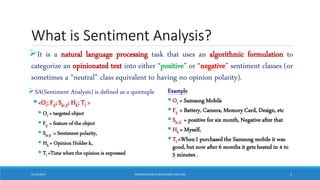
What is Sentiment Analysis?
It is a natural language processing task that uses an algorithmic formulation to
categorize an opinionated text into either “positive” or “negative” sentiment classes (or
sometimes a “neutral” class equivalent to having no opinion polarity).
SA(Sentiment Analysis) is defined as a quintuple
<Oi; Fij; Ski jl; Hk; Tl >
 Oi = targeted object
 Fij = feature of the object
 Ski jl = Sentiment polarity,
 Hk = Opinion Holder k,
 Tl =Time when the opinion is expressed
Example
Oi = Samsung Mobile
Fij = Battery, Camera, Memory Card, Design, etc
Ski jl = positive for six month, Negative after that
Hk = Myself,
Tl =When I purchased the Samsung mobile it was
good, but now after 6 months it gets heated in 4 to
5 minutes .
11/10/2017 INTRODUCTIONTO SENTIMENTANALYSIS 2
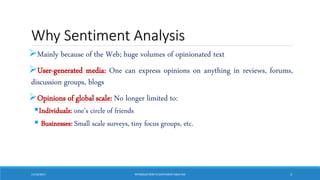
Why Sentiment Analysis
Mainly because of the Web; huge volumes of opinionated text
User-generated media: One can express opinions on anything in reviews, forums,
discussion groups, blogs
Opinions of global scale: No longer limited to:
Individuals: one’s circle of friends
 Businesses: Small scale surveys, tiny focus groups, etc.
11/10/2017 INTRODUCTIONTO SENTIMENTANALYSIS 3
Example 1
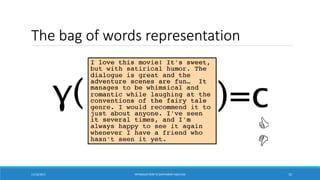
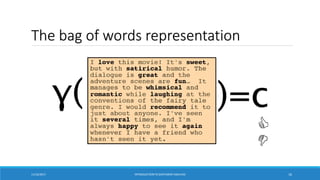
I love this movie! It's sweet, but with satirical humor. The dialogue is great and the
adventure scenes are fun… It manages to be whimsical and romantic while laughing at
the conventions of the fairy tale genre. I would recommend it to just about anyone.
I've seen it several times, and I'm always happy to see it again whenever I have a
friend who hasn't seen it yet.
11/10/2017 INTRODUCTIONTO SENTIMENTANALYSIS 4
Example 2
My XYZ CAR was delivered yesterday. It looks fabulous. We went on a long
highway drive the very second day of getting the car. It was smooth, comfortable and
wonderful drive. Had a wonderful experience with family. Its an awesome car. I am
loving it..!
11/10/2017 INTRODUCTIONTO SENTIMENTANALYSIS 5
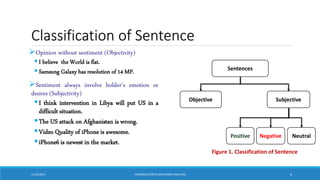
Classification of Sentence
Opinion without sentiment (Objectivity)
I believe the World is flat.
Samsung Galaxy has resolution of 14 MP.
Sentiment always involve holder’s emotion or
desires (Subjectivity)
I think intervention in Libya will put US in a
difficult situation.
The US attack on Afghanistan is wrong.
Video Quality of iPhone is awesome.
iPhone6 is newest in the market.
Sentences
Objective Subjective
Positive Negative Neutral
Figure 1. Classification of Sentence
11/10/2017 INTRODUCTIONTO SENTIMENTANALYSIS 6
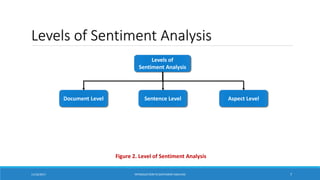
Levels of Sentiment Analysis
Levels of
Sentiment Analysis
Document Level Sentence Level Aspect Level
Figure 2. Level of Sentiment Analysis
11/10/2017 INTRODUCTIONTO SENTIMENTANALYSIS 7
Example 3
iPhone- User Review:
I bought an iPhone a few days ago. It was such a nice phone. The touch screen was
really cool. The voice quality was clear too. Although the battery life was not long, that
is ok for me. However, my mother was mad with me as I did not tell her before I
bought the phone. She also thought the phone was too expensive, and wanted me to
return it to the shop. …
11/10/2017 INTRODUCTIONTO SENTIMENTANALYSIS 8
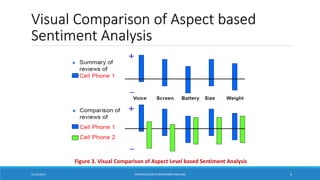
Visual Comparison of Aspect based
Sentiment Analysis
11/10/2017 INTRODUCTIONTO SENTIMENTANALYSIS 9
Figure 3. Visual Comparison of Aspect Level based Sentiment Analysis
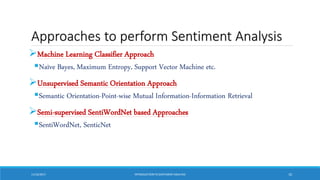
Approaches to perform Sentiment Analysis
Machine Learning Classifier Approach
Naïve Bayes, Maximum Entropy, Support Vector Machine etc.
Unsupervised Semantic Orientation Approach
Semantic Orientation-Point-wise Mutual Information-Information Retrieval
Semi-supervised SentiWordNet based Approaches
SentiWordNet, SenticNet
11/10/2017 INTRODUCTIONTO SENTIMENTANALYSIS 10
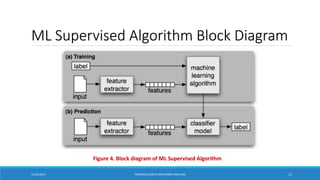
ML Supervised Algorithm Block Diagram
Figure 4. Block diagram of ML Supervised Algorithm
11/10/2017 INTRODUCTIONTO SENTIMENTANALYSIS 11
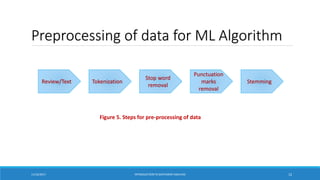
Preprocessing of data for ML Algorithm
Review/Text Tokenization
Stop word
removal
Punctuation
marks
removal
Stemming
11/10/2017 INTRODUCTIONTO SENTIMENTANALYSIS 12
Figure 5. Steps for pre-processing of data
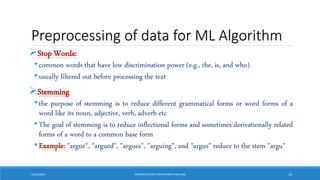
Preprocessing of data for ML Algorithm
Stop Words:
•common words that have low discrimination power (e.g., the, is, and who)
•usually filtered out before processing the text
Stemming
•the purpose of stemming is to reduce different grammatical forms or word forms of a
word like its noun, adjective, verb, adverb etc
•The goal of stemming is to reduce inflectional forms and sometimes derivationally related
forms of a word to a common base form
•Example: "argue", "argued", "argues", "arguing", and "argus" reduce to the stem "argu"
11/10/2017 INTRODUCTIONTO SENTIMENTANALYSIS 13
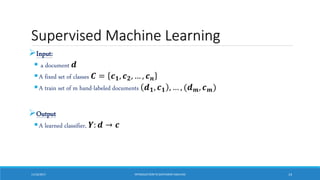
Supervised Machine Learning
Input:
 a document 𝒅
A fixed set of classes 𝑪 = 𝒄𝟏, 𝒄𝟐, … , 𝒄𝒏
A train set of m hand-labeled documents 𝒅𝟏, 𝒄𝟏 , … , (𝒅𝒎, 𝒄𝒎)
Output
A learned classifier, 𝒀: 𝒅 → 𝒄
11/10/2017 INTRODUCTIONTO SENTIMENTANALYSIS 14
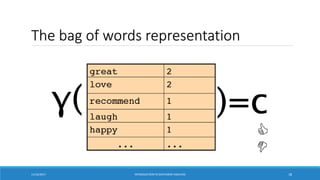
The bag of words representation
11/10/2017 INTRODUCTIONTO SENTIMENTANALYSIS 15
The bag of words representation
11/10/2017 INTRODUCTIONTO SENTIMENTANALYSIS 16
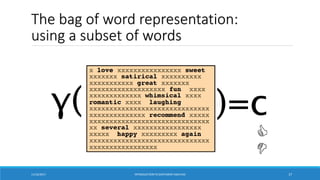
The bag of word representation:
using a subset of words
11/10/2017 INTRODUCTIONTO SENTIMENTANALYSIS 17
The bag of words representation
11/10/2017 INTRODUCTIONTO SENTIMENTANALYSIS 18
NB Machine Learning Approach
The probability of a document d being in class c is computed as
𝑷 𝒄 𝒅 ∝ 𝑷 𝒄
𝟏≤𝒌≤𝒏𝒅
𝑷( 𝒕𝒌|𝒄)
where, 𝑷(𝒕𝒌|𝒄) is the conditional probability of a term 𝒕𝒌 occurring in a document of class 𝒄.
The goal is to find the best class, i.e., Maximum A Posteriori Class as follows:
𝒄𝒎𝒂𝒑 = 𝒂𝒓𝒈𝒎𝒂𝒙𝒄∈𝑪 𝑷 𝒄 ∗
𝟏≤𝒌≤𝒏𝒅
𝑷( 𝒕𝒌|𝒄)
Which can be reframed as
𝒄𝒎𝒂𝒑 = 𝒂𝒓𝒈𝒎𝒂𝒙𝒄∈𝑪[𝒍𝒐𝒈 𝑷 𝒄 +
𝟏≤𝒌≤𝒏𝒅
𝒍𝒐𝒈 𝑷(𝒕𝒌|𝒄)]
11/10/2017 INTRODUCTIONTO SENTIMENTANALYSIS 19
NB Machine Learning Approach (Contd..)
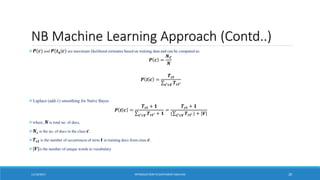
𝑷(𝒄) and 𝑷(𝒕𝒌|𝒄) are maximum likelihood estimates based on training data and can be computed as:
𝑷 𝒄 =
𝑵𝑪
𝑵
𝑷 𝒕 𝒄 =
𝑻𝒄𝒕
𝒕′∈𝑽 𝑻𝒄𝒕′
Laplace (add-1) smoothing for Naïve Bayes
𝑷 𝒕 𝒄 =
𝑻𝒄𝒕 + 𝟏
𝒕′∈𝑽 𝑻𝒄𝒕′ + 𝟏
=
𝑻𝒄𝒕 + 𝟏
( 𝒕′∈𝑽 𝑻𝒄𝒕′) + |𝑽|
where, 𝑵 is total no. of docs,
𝑵𝒄 is the no. of docs in the class 𝒄.
𝑻𝒄𝒕 is the number of occurrences of term 𝒕 in training docs from class 𝒄.
|𝑽|is the number of unique words in vocabulary
11/10/2017 INTRODUCTIONTO SENTIMENTANALYSIS 20
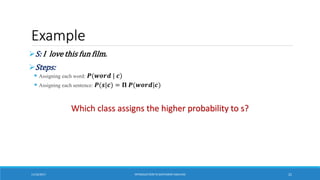
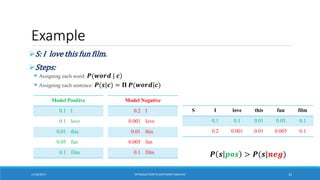
Example
S: I love this fun film.
Steps:
 Assigning each word: 𝑷(𝒘𝒐𝒓𝒅 | 𝒄)
 Assigning each sentence: 𝑷(𝒔|𝒄) = 𝚷 𝑷(𝒘𝒐𝒓𝒅|𝒄)
Which class assigns the higher probability to s?
11/10/2017 INTRODUCTIONTO SENTIMENTANALYSIS 21
Example
S: I love this fun film.
Steps:
 Assigning each word: 𝑷(𝒘𝒐𝒓𝒅 | 𝒄)
 Assigning each sentence: 𝑷(𝒔|𝒄) = 𝚷 𝑷(𝒘𝒐𝒓𝒅|𝒄)
Model Positive
0.1 I
0.1 love
0.01 this
0.05 fun
0.1 film
Model Negative
0.2 I
0.001 love
0.01 this
0.005 fun
0.1 film
S I love this fun film
0.1 0.1 0.01 0.05 0.1
0.2 0.001 0.01 0.005 0.1
𝑷 𝒔 𝒑𝒐𝒔 > 𝑷(𝒔|𝒏𝒆𝒈)
11/10/2017 INTRODUCTIONTO SENTIMENTANALYSIS 22
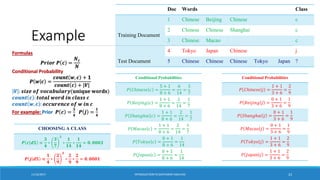
Example
Doc Words Class
Training Document
1 Chinese Beijing Chinese c
2 Chinese Chinese Shanghai c
3 Chinese Macao c
4 Tokyo Japan Chinese j
Test Document 5 Chinese Chinese Chinese Tokyo Japan ?
Formulas
𝑷𝒓𝒊𝒐𝒓 𝑷 𝒄 =
𝑵𝒄
𝑵
Conditional Probability
𝑷 𝒘 𝒄 =
𝒄𝒐𝒖𝒏𝒕 𝒘, 𝒄 + 𝟏
𝒄𝒐𝒖𝒏𝒕 𝒄 + |𝑽|
𝑽 : 𝒔𝒊𝒛𝒆 𝒐𝒇 𝒗𝒐𝒄𝒂𝒃𝒖𝒍𝒂𝒓𝒚(𝐮𝐧𝐢𝐪𝐮𝐞 𝐰𝐨𝐫𝐝𝐬)
𝒄𝒐𝒖𝒏𝒕 𝒄 : 𝒕𝒐𝒕𝒂𝒍 𝒘𝒐𝒓𝒅 𝒊𝒏 𝒄𝒍𝒂𝒔𝒔 𝒄
𝒄𝒐𝒖𝒏𝒕 𝒘, 𝒄 : 𝒐𝒄𝒄𝒖𝒓𝒆𝒏𝒄𝒆 𝒐𝒇 𝒘 𝒊𝒏 𝒄
For example: Prior 𝑷 𝒄 =
𝟑
𝟒
𝑷 𝒋 =
𝟏
𝟒
Conditional Probabilities
𝑃 𝐶ℎ𝑖𝑛𝑒𝑠𝑒 𝑐 =
5 + 1
8 + 6
=
6
14
=
3
7
𝑃 𝐵𝑒𝑖𝑗𝑖𝑛𝑔 𝑐 =
1 + 1
8 + 6
=
2
14
=
1
7
𝑃 𝑆ℎ𝑎𝑛𝑔ℎ𝑎𝑖 𝑐 =
1 + 1
8 + 6
=
2
14
=
1
7
𝑃 𝑀𝑎𝑐𝑎𝑜 𝑐 =
1 + 1
8 + 6
=
2
14
=
1
7
𝑃 𝑇𝑜𝑘𝑦𝑜 𝑐 =
0 + 1
8 + 6
=
1
14
𝑃 𝐽𝑎𝑝𝑎𝑛 𝑐 =
0 + 1
8 + 6
=
1
14
Conditional Probabilities
𝑃 𝐶ℎ𝑖𝑛𝑒𝑠𝑒 𝑗 =
1 + 1
3 + 6
=
2
9
𝑃 𝐵𝑒𝑖𝑗𝑖𝑛𝑔 𝑗 =
0 + 1
3 + 6
=
1
9
𝑃 𝑆ℎ𝑎𝑛𝑔ℎ𝑎𝑖 𝑗 =
0 + 1
3 + 6
=
1
9
𝑃 𝑀𝑎𝑐𝑎𝑜 𝑗 =
0 + 1
3 + 6
=
1
9
𝑃 𝑇𝑜𝑘𝑦𝑜 𝑗 =
1 + 1
3 + 6
=
2
9
𝑃 𝐽𝑎𝑝𝑎𝑛 𝑗 =
1 + 1
3 + 6
=
2
9
CHOOSING A CLASS
𝑷 𝒄 𝒅𝟓 ∝
𝟑
𝟒
∗
𝟑
𝟕
𝟑
∗
𝟏
𝟏𝟒
∗
𝟏
𝟏𝟒
≈ 𝟎. 𝟎𝟎𝟎𝟑
𝑷 𝒋 𝒅𝟓 ∝
𝟏
𝟒
∗
𝟐
𝟗
𝟑
∗
𝟐
𝟗
∗
𝟐
𝟗
≈ 𝟎. 𝟎𝟎𝟎𝟏
11/10/2017 INTRODUCTIONTO SENTIMENTANALYSIS 23
Algorithm
11/10/2017 INTRODUCTIONTO SENTIMENTANALYSIS 24
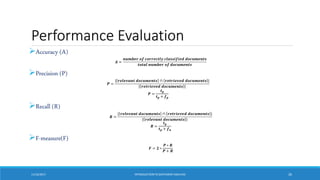
Performance Evaluation
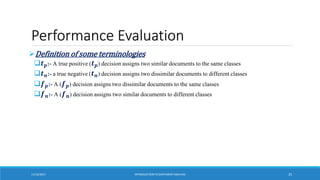
Definition of some terminologies
𝒕𝒑:- A true positive (𝒕𝒑) decision assigns two similar documents to the same classes
𝒕𝒏:- a true negative (𝒕𝒏) decision assigns two dissimilar documents to different classes
𝒇𝒑:- A (𝒇𝒑) decision assigns two dissimilar documents to the same classes
𝒇𝒏:- A (𝒇𝒏) decision assigns two similar documents to different classes
11/10/2017 INTRODUCTIONTO SENTIMENTANALYSIS 25
Performance Evaluation
Accuracy (A)
𝑨 =
𝒏𝒖𝒎𝒃𝒆𝒓 𝒐𝒇 𝒄𝒐𝒓𝒓𝒆𝒄𝒕𝒍𝒚 𝒄𝒍𝒂𝒔𝒔𝒊𝒇𝒊𝒆𝒅 𝒅𝒐𝒄𝒖𝒎𝒆𝒏𝒕𝒔
𝒕𝒐𝒕𝒂𝒍 𝒏𝒖𝒎𝒃𝒆𝒓 𝒐𝒇 𝒅𝒐𝒄𝒖𝒎𝒆𝒏𝒕𝒔
Precision (P)
𝑷 =
| 𝒓𝒆𝒍𝒆𝒗𝒂𝒏𝒕 𝒅𝒐𝒄𝒖𝒎𝒆𝒏𝒕𝒔 ∩ 𝒓𝒆𝒕𝒓𝒊𝒆𝒗𝒆𝒅 𝒅𝒐𝒄𝒖𝒎𝒆𝒏𝒕𝒔 |
| 𝒓𝒆𝒕𝒓𝒊𝒆𝒗𝒆𝒅 𝒅𝒐𝒄𝒖𝒎𝒆𝒏𝒕𝒔 |
𝑷 =
𝒕𝒑
𝒕𝒑 + 𝒇𝒑
Recall (R)
𝑹 =
| 𝒓𝒆𝒍𝒆𝒗𝒂𝒏𝒕 𝒅𝒐𝒄𝒖𝒎𝒆𝒏𝒕𝒔 ∩ 𝒓𝒆𝒕𝒓𝒊𝒆𝒗𝒆𝒅 𝒅𝒐𝒄𝒖𝒎𝒆𝒏𝒕𝒔 |
| 𝒓𝒆𝒍𝒆𝒗𝒂𝒏𝒕 𝒅𝒐𝒄𝒖𝒎𝒆𝒏𝒕𝒔 |
𝑹 =
𝒕𝒑
𝒕𝒑 + 𝒇𝒏
F-measure(F)
𝑭 = 𝟐 ∗
𝑷 ∗ 𝑹
𝑷 + 𝑹
11/10/2017 INTRODUCTIONTO SENTIMENTANALYSIS 26
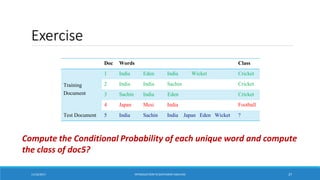
Exercise
Doc Words Class
Training
Document
1 India Eden India Wicket Cricket
2 India India Sachin Cricket
3 Sachin India Eden Cricket
4 Japan Mesi India Football
Test Document 5 India Sachin India Japan Eden Wicket ?
11/10/2017 INTRODUCTIONTO SENTIMENTANALYSIS 27
Compute the Conditional Probability of each unique word and compute
the class of doc5?
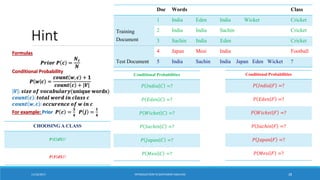
Hint
Doc Words Class
Training
Document
1 India Eden India Wicket Cricket
2 India India Sachin Cricket
3 Sachin India Eden Cricket
4 Japan Mesi India Football
Test Document 5 India Sachin India Japan Eden Wicket ?
Formulas
𝑷𝒓𝒊𝒐𝒓 𝑷 𝒄 =
𝑵𝒄
𝑵
Conditional Probability
𝑷 𝒘 𝒄 =
𝒄𝒐𝒖𝒏𝒕 𝒘, 𝒄 + 𝟏
𝒄𝒐𝒖𝒏𝒕 𝒄 + |𝑽|
𝑽 : 𝒔𝒊𝒛𝒆 𝒐𝒇 𝒗𝒐𝒄𝒂𝒃𝒖𝒍𝒂𝒓𝒚(𝐮𝐧𝐢𝐪𝐮𝐞 𝐰𝐨𝐫𝐝𝐬)
𝒄𝒐𝒖𝒏𝒕 𝒄 : 𝒕𝒐𝒕𝒂𝒍 𝒘𝒐𝒓𝒅 𝒊𝒏 𝒄𝒍𝒂𝒔𝒔 𝒄
𝒄𝒐𝒖𝒏𝒕 𝒘, 𝒄 : 𝒐𝒄𝒄𝒖𝒓𝒆𝒏𝒄𝒆 𝒐𝒇 𝒘 𝒊𝒏 𝒄
For example: Prior 𝑷 𝒄 =
𝟑
𝟒
𝑷 𝒋 =
𝟏
𝟒
Conditional Probabilities
𝑃 𝐼𝑛𝑑𝑖𝑎 𝐶 =?
𝑃 𝐸𝑑𝑒𝑛 𝐶 =?
𝑃 𝑊𝑖𝑐𝑘𝑒𝑡 𝐶 =?
𝑃 𝑆𝑎𝑐ℎ𝑖𝑛 𝐶 =?
𝑃 𝐽𝑎𝑝𝑎𝑛 𝐶 =?
𝑃 𝑀𝑒𝑠𝑖 𝐶 =?
11/10/2017 INTRODUCTIONTO SENTIMENTANALYSIS 28
Conditional Probabilities
𝑃 𝐼𝑛𝑑𝑖𝑎 𝐹 =?
𝑃 𝐸𝑑𝑒𝑛 𝐹 =?
𝑃 𝑊𝑖𝑐𝑘𝑒𝑡 𝐹 =?
𝑃 𝑆𝑎𝑐ℎ𝑖𝑛 𝐹 =?
𝑃 𝐽𝑎𝑝𝑎𝑛 𝐹 =?
𝑃 𝑀𝑒𝑠𝑖 𝐹 =?
CHOOSING A CLASS
𝑷 𝑪 𝒅𝟓 ?
𝑷 𝑭 𝒅𝟓 ?
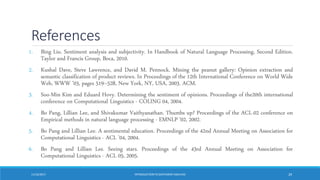
References
1. Bing Liu. Sentiment analysis and subjectivity. In Handbook of Natural Language Processing, Second Edition.
Taylor and Francis Group, Boca, 2010.
2. Kushal Dave, Steve Lawrence, and David M. Pennock. Mining the peanut gallery: Opinion extraction and
semantic classification of product reviews. In Proceedings of the 12th International Conference on World Wide
Web, WWW ’03, pages 519–528, New York, NY, USA, 2003. ACM.
3. Soo-Min Kim and Eduard Hovy. Determining the sentiment of opinions. Proceedings of the20th international
conference on Computational Linguistics - COLING 04, 2004.
4. Bo Pang, Lillian Lee, and Shivakumar Vaithyanathan. Thumbs up? Proceedings of the ACL-02 conference on
Empirical methods in natural language processing - EMNLP ’02, 2002.
5. Bo Pang and Lillian Lee. A sentimental education. Proceedings of the 42nd Annual Meeting on Association for
Computational Linguistics - ACL ’04, 2004.
6. Bo Pang and Lillian Lee. Seeing stars. Proceedings of the 43rd Annual Meeting on Association for
Computational Linguistics - ACL 05, 2005.
11/10/2017 INTRODUCTIONTO SENTIMENTANALYSIS 29
References
7. Michael Gamon. Sentiment classification on customer feedback data. Proceedings of the 20thinternational
conference on Computational Linguistics - COLING 04, 2004.
8. Daniel M. Bikel and Jeffrey Sorensen. If we want your opinion. International Conference on Semantic
Computing (ICSC 2007).
9. Kathleen T Durant and Michael D Smith. Mining sentiment classification from political web logs. In
Proceedings of Workshop on Web Mining and Web Usage Analysis of the 12th ACM SIGKDD International
Conference on Knowledge Discovery and Data Mining (WebKDD-2006), Philadelphia, PA, 2006.
10. Peter D. Turney. Mining the web for synonyms: Pmi-ir versus lsa on toefl. Lecture Notes in Computer
Science, page 491 to 502, 2001.
11. Peter D Turney. Thumbs up or thumbs down?: semantic orientation applied to unsupervised classification of
reviews. In Proceedings of the 40th annual meeting on association for computational linguistics, pages 417–
424. Association for Computational Linguistics, 2002.
12. Janyce Wiebe. Learning subjective adjectives from corpora. In AAAI/IAAI, pages 735–740,2000.
11/10/2017 INTRODUCTIONTO SENTIMENTANALYSIS 30
References
13. Vasileios Hatzivassiloglou and Kathleen R McKeown. Predicting the semantic orientation of
adjectives. In Proceedings of the 35th Annual Meeting of the Association for Computational
Linguistics and Eighth Conference of the European Chapter of the Association for Computational
Linguistics, pages 174–181. Association for Computational Linguistics, 1997.
14. VK Singh, R Piryani, A Uddin, and P Waila. Sentiment analysis of movie reviews: A new feature-
based heuristic for aspect-level sentiment classification. In Automation, Computing, Communication,
Control and Compressed Sensing (iMac4s), 2013 International Multi- Conference on, pages 712–717.
IEEE, 2013.
15. Prem Melville, Wojciech Gryc, and Richard D. Lawrence. Sentiment analysis of blogs by combining
lexical knowledge with text classification. Proceedings of the 15th ACM SIGKDD international
conference on Knowledge discovery and data mining - KDD ’09, 2009.
16. Robert T. Clemen and Robert L. Winkler. Combining probability distributions from experts in risk
analysis. Risk Analysis, 19(2):187 to 203, Apr 1999.
11/10/2017 INTRODUCTIONTO SENTIMENTANALYSIS 31
11/10/2017 INTRODUCTIONTO SENTIMENTANALYSIS 32

Introduction to sentiment analysis

  • 1.
    Introduction to SentimentAnalysis Rajesh Piryani Department Of Computer Science South Asian University, New Delhi
  • 2.
    What is SentimentAnalysis? It is a natural language processing task that uses an algorithmic formulation to categorize an opinionated text into either “positive” or “negative” sentiment classes (or sometimes a “neutral” class equivalent to having no opinion polarity). SA(Sentiment Analysis) is defined as a quintuple <Oi; Fij; Ski jl; Hk; Tl >  Oi = targeted object  Fij = feature of the object  Ski jl = Sentiment polarity,  Hk = Opinion Holder k,  Tl =Time when the opinion is expressed Example Oi = Samsung Mobile Fij = Battery, Camera, Memory Card, Design, etc Ski jl = positive for six month, Negative after that Hk = Myself, Tl =When I purchased the Samsung mobile it was good, but now after 6 months it gets heated in 4 to 5 minutes . 11/10/2017 INTRODUCTIONTO SENTIMENTANALYSIS 2
  • 3.
    Why Sentiment Analysis Mainlybecause of the Web; huge volumes of opinionated text User-generated media: One can express opinions on anything in reviews, forums, discussion groups, blogs Opinions of global scale: No longer limited to: Individuals: one’s circle of friends  Businesses: Small scale surveys, tiny focus groups, etc. 11/10/2017 INTRODUCTIONTO SENTIMENTANALYSIS 3
  • 4.
    Example 1 I lovethis movie! It's sweet, but with satirical humor. The dialogue is great and the adventure scenes are fun… It manages to be whimsical and romantic while laughing at the conventions of the fairy tale genre. I would recommend it to just about anyone. I've seen it several times, and I'm always happy to see it again whenever I have a friend who hasn't seen it yet. 11/10/2017 INTRODUCTIONTO SENTIMENTANALYSIS 4
  • 5.
    Example 2 My XYZCAR was delivered yesterday. It looks fabulous. We went on a long highway drive the very second day of getting the car. It was smooth, comfortable and wonderful drive. Had a wonderful experience with family. Its an awesome car. I am loving it..! 11/10/2017 INTRODUCTIONTO SENTIMENTANALYSIS 5
  • 6.
    Classification of Sentence Opinionwithout sentiment (Objectivity) I believe the World is flat. Samsung Galaxy has resolution of 14 MP. Sentiment always involve holder’s emotion or desires (Subjectivity) I think intervention in Libya will put US in a difficult situation. The US attack on Afghanistan is wrong. Video Quality of iPhone is awesome. iPhone6 is newest in the market. Sentences Objective Subjective Positive Negative Neutral Figure 1. Classification of Sentence 11/10/2017 INTRODUCTIONTO SENTIMENTANALYSIS 6
  • 7.
    Levels of SentimentAnalysis Levels of Sentiment Analysis Document Level Sentence Level Aspect Level Figure 2. Level of Sentiment Analysis 11/10/2017 INTRODUCTIONTO SENTIMENTANALYSIS 7
  • 8.
    Example 3 iPhone- UserReview: I bought an iPhone a few days ago. It was such a nice phone. The touch screen was really cool. The voice quality was clear too. Although the battery life was not long, that is ok for me. However, my mother was mad with me as I did not tell her before I bought the phone. She also thought the phone was too expensive, and wanted me to return it to the shop. … 11/10/2017 INTRODUCTIONTO SENTIMENTANALYSIS 8
  • 9.
    Visual Comparison ofAspect based Sentiment Analysis 11/10/2017 INTRODUCTIONTO SENTIMENTANALYSIS 9 Figure 3. Visual Comparison of Aspect Level based Sentiment Analysis
  • 10.
    Approaches to performSentiment Analysis Machine Learning Classifier Approach Naïve Bayes, Maximum Entropy, Support Vector Machine etc. Unsupervised Semantic Orientation Approach Semantic Orientation-Point-wise Mutual Information-Information Retrieval Semi-supervised SentiWordNet based Approaches SentiWordNet, SenticNet 11/10/2017 INTRODUCTIONTO SENTIMENTANALYSIS 10
  • 11.
    ML Supervised AlgorithmBlock Diagram Figure 4. Block diagram of ML Supervised Algorithm 11/10/2017 INTRODUCTIONTO SENTIMENTANALYSIS 11
  • 12.
    Preprocessing of datafor ML Algorithm Review/Text Tokenization Stop word removal Punctuation marks removal Stemming 11/10/2017 INTRODUCTIONTO SENTIMENTANALYSIS 12 Figure 5. Steps for pre-processing of data
  • 13.
    Preprocessing of datafor ML Algorithm Stop Words: •common words that have low discrimination power (e.g., the, is, and who) •usually filtered out before processing the text Stemming •the purpose of stemming is to reduce different grammatical forms or word forms of a word like its noun, adjective, verb, adverb etc •The goal of stemming is to reduce inflectional forms and sometimes derivationally related forms of a word to a common base form •Example: "argue", "argued", "argues", "arguing", and "argus" reduce to the stem "argu" 11/10/2017 INTRODUCTIONTO SENTIMENTANALYSIS 13
  • 14.
    Supervised Machine Learning Input: a document 𝒅 A fixed set of classes 𝑪 = 𝒄𝟏, 𝒄𝟐, … , 𝒄𝒏 A train set of m hand-labeled documents 𝒅𝟏, 𝒄𝟏 , … , (𝒅𝒎, 𝒄𝒎) Output A learned classifier, 𝒀: 𝒅 → 𝒄 11/10/2017 INTRODUCTIONTO SENTIMENTANALYSIS 14
  • 15.
    The bag ofwords representation 11/10/2017 INTRODUCTIONTO SENTIMENTANALYSIS 15
  • 16.
    The bag ofwords representation 11/10/2017 INTRODUCTIONTO SENTIMENTANALYSIS 16
  • 17.
    The bag ofword representation: using a subset of words 11/10/2017 INTRODUCTIONTO SENTIMENTANALYSIS 17
  • 18.
    The bag ofwords representation 11/10/2017 INTRODUCTIONTO SENTIMENTANALYSIS 18
  • 19.
    NB Machine LearningApproach The probability of a document d being in class c is computed as 𝑷 𝒄 𝒅 ∝ 𝑷 𝒄 𝟏≤𝒌≤𝒏𝒅 𝑷( 𝒕𝒌|𝒄) where, 𝑷(𝒕𝒌|𝒄) is the conditional probability of a term 𝒕𝒌 occurring in a document of class 𝒄. The goal is to find the best class, i.e., Maximum A Posteriori Class as follows: 𝒄𝒎𝒂𝒑 = 𝒂𝒓𝒈𝒎𝒂𝒙𝒄∈𝑪 𝑷 𝒄 ∗ 𝟏≤𝒌≤𝒏𝒅 𝑷( 𝒕𝒌|𝒄) Which can be reframed as 𝒄𝒎𝒂𝒑 = 𝒂𝒓𝒈𝒎𝒂𝒙𝒄∈𝑪[𝒍𝒐𝒈 𝑷 𝒄 + 𝟏≤𝒌≤𝒏𝒅 𝒍𝒐𝒈 𝑷(𝒕𝒌|𝒄)] 11/10/2017 INTRODUCTIONTO SENTIMENTANALYSIS 19
  • 20.
    NB Machine LearningApproach (Contd..) 𝑷(𝒄) and 𝑷(𝒕𝒌|𝒄) are maximum likelihood estimates based on training data and can be computed as: 𝑷 𝒄 = 𝑵𝑪 𝑵 𝑷 𝒕 𝒄 = 𝑻𝒄𝒕 𝒕′∈𝑽 𝑻𝒄𝒕′ Laplace (add-1) smoothing for Naïve Bayes 𝑷 𝒕 𝒄 = 𝑻𝒄𝒕 + 𝟏 𝒕′∈𝑽 𝑻𝒄𝒕′ + 𝟏 = 𝑻𝒄𝒕 + 𝟏 ( 𝒕′∈𝑽 𝑻𝒄𝒕′) + |𝑽| where, 𝑵 is total no. of docs, 𝑵𝒄 is the no. of docs in the class 𝒄. 𝑻𝒄𝒕 is the number of occurrences of term 𝒕 in training docs from class 𝒄. |𝑽|is the number of unique words in vocabulary 11/10/2017 INTRODUCTIONTO SENTIMENTANALYSIS 20
  • 21.
    Example S: I lovethis fun film. Steps:  Assigning each word: 𝑷(𝒘𝒐𝒓𝒅 | 𝒄)  Assigning each sentence: 𝑷(𝒔|𝒄) = 𝚷 𝑷(𝒘𝒐𝒓𝒅|𝒄) Which class assigns the higher probability to s? 11/10/2017 INTRODUCTIONTO SENTIMENTANALYSIS 21
  • 22.
    Example S: I lovethis fun film. Steps:  Assigning each word: 𝑷(𝒘𝒐𝒓𝒅 | 𝒄)  Assigning each sentence: 𝑷(𝒔|𝒄) = 𝚷 𝑷(𝒘𝒐𝒓𝒅|𝒄) Model Positive 0.1 I 0.1 love 0.01 this 0.05 fun 0.1 film Model Negative 0.2 I 0.001 love 0.01 this 0.005 fun 0.1 film S I love this fun film 0.1 0.1 0.01 0.05 0.1 0.2 0.001 0.01 0.005 0.1 𝑷 𝒔 𝒑𝒐𝒔 > 𝑷(𝒔|𝒏𝒆𝒈) 11/10/2017 INTRODUCTIONTO SENTIMENTANALYSIS 22
  • 23.
    Example Doc Words Class TrainingDocument 1 Chinese Beijing Chinese c 2 Chinese Chinese Shanghai c 3 Chinese Macao c 4 Tokyo Japan Chinese j Test Document 5 Chinese Chinese Chinese Tokyo Japan ? Formulas 𝑷𝒓𝒊𝒐𝒓 𝑷 𝒄 = 𝑵𝒄 𝑵 Conditional Probability 𝑷 𝒘 𝒄 = 𝒄𝒐𝒖𝒏𝒕 𝒘, 𝒄 + 𝟏 𝒄𝒐𝒖𝒏𝒕 𝒄 + |𝑽| 𝑽 : 𝒔𝒊𝒛𝒆 𝒐𝒇 𝒗𝒐𝒄𝒂𝒃𝒖𝒍𝒂𝒓𝒚(𝐮𝐧𝐢𝐪𝐮𝐞 𝐰𝐨𝐫𝐝𝐬) 𝒄𝒐𝒖𝒏𝒕 𝒄 : 𝒕𝒐𝒕𝒂𝒍 𝒘𝒐𝒓𝒅 𝒊𝒏 𝒄𝒍𝒂𝒔𝒔 𝒄 𝒄𝒐𝒖𝒏𝒕 𝒘, 𝒄 : 𝒐𝒄𝒄𝒖𝒓𝒆𝒏𝒄𝒆 𝒐𝒇 𝒘 𝒊𝒏 𝒄 For example: Prior 𝑷 𝒄 = 𝟑 𝟒 𝑷 𝒋 = 𝟏 𝟒 Conditional Probabilities 𝑃 𝐶ℎ𝑖𝑛𝑒𝑠𝑒 𝑐 = 5 + 1 8 + 6 = 6 14 = 3 7 𝑃 𝐵𝑒𝑖𝑗𝑖𝑛𝑔 𝑐 = 1 + 1 8 + 6 = 2 14 = 1 7 𝑃 𝑆ℎ𝑎𝑛𝑔ℎ𝑎𝑖 𝑐 = 1 + 1 8 + 6 = 2 14 = 1 7 𝑃 𝑀𝑎𝑐𝑎𝑜 𝑐 = 1 + 1 8 + 6 = 2 14 = 1 7 𝑃 𝑇𝑜𝑘𝑦𝑜 𝑐 = 0 + 1 8 + 6 = 1 14 𝑃 𝐽𝑎𝑝𝑎𝑛 𝑐 = 0 + 1 8 + 6 = 1 14 Conditional Probabilities 𝑃 𝐶ℎ𝑖𝑛𝑒𝑠𝑒 𝑗 = 1 + 1 3 + 6 = 2 9 𝑃 𝐵𝑒𝑖𝑗𝑖𝑛𝑔 𝑗 = 0 + 1 3 + 6 = 1 9 𝑃 𝑆ℎ𝑎𝑛𝑔ℎ𝑎𝑖 𝑗 = 0 + 1 3 + 6 = 1 9 𝑃 𝑀𝑎𝑐𝑎𝑜 𝑗 = 0 + 1 3 + 6 = 1 9 𝑃 𝑇𝑜𝑘𝑦𝑜 𝑗 = 1 + 1 3 + 6 = 2 9 𝑃 𝐽𝑎𝑝𝑎𝑛 𝑗 = 1 + 1 3 + 6 = 2 9 CHOOSING A CLASS 𝑷 𝒄 𝒅𝟓 ∝ 𝟑 𝟒 ∗ 𝟑 𝟕 𝟑 ∗ 𝟏 𝟏𝟒 ∗ 𝟏 𝟏𝟒 ≈ 𝟎. 𝟎𝟎𝟎𝟑 𝑷 𝒋 𝒅𝟓 ∝ 𝟏 𝟒 ∗ 𝟐 𝟗 𝟑 ∗ 𝟐 𝟗 ∗ 𝟐 𝟗 ≈ 𝟎. 𝟎𝟎𝟎𝟏 11/10/2017 INTRODUCTIONTO SENTIMENTANALYSIS 23
  • 24.
  • 25.
    Performance Evaluation Definition ofsome terminologies 𝒕𝒑:- A true positive (𝒕𝒑) decision assigns two similar documents to the same classes 𝒕𝒏:- a true negative (𝒕𝒏) decision assigns two dissimilar documents to different classes 𝒇𝒑:- A (𝒇𝒑) decision assigns two dissimilar documents to the same classes 𝒇𝒏:- A (𝒇𝒏) decision assigns two similar documents to different classes 11/10/2017 INTRODUCTIONTO SENTIMENTANALYSIS 25
  • 26.
    Performance Evaluation Accuracy (A) 𝑨= 𝒏𝒖𝒎𝒃𝒆𝒓 𝒐𝒇 𝒄𝒐𝒓𝒓𝒆𝒄𝒕𝒍𝒚 𝒄𝒍𝒂𝒔𝒔𝒊𝒇𝒊𝒆𝒅 𝒅𝒐𝒄𝒖𝒎𝒆𝒏𝒕𝒔 𝒕𝒐𝒕𝒂𝒍 𝒏𝒖𝒎𝒃𝒆𝒓 𝒐𝒇 𝒅𝒐𝒄𝒖𝒎𝒆𝒏𝒕𝒔 Precision (P) 𝑷 = | 𝒓𝒆𝒍𝒆𝒗𝒂𝒏𝒕 𝒅𝒐𝒄𝒖𝒎𝒆𝒏𝒕𝒔 ∩ 𝒓𝒆𝒕𝒓𝒊𝒆𝒗𝒆𝒅 𝒅𝒐𝒄𝒖𝒎𝒆𝒏𝒕𝒔 | | 𝒓𝒆𝒕𝒓𝒊𝒆𝒗𝒆𝒅 𝒅𝒐𝒄𝒖𝒎𝒆𝒏𝒕𝒔 | 𝑷 = 𝒕𝒑 𝒕𝒑 + 𝒇𝒑 Recall (R) 𝑹 = | 𝒓𝒆𝒍𝒆𝒗𝒂𝒏𝒕 𝒅𝒐𝒄𝒖𝒎𝒆𝒏𝒕𝒔 ∩ 𝒓𝒆𝒕𝒓𝒊𝒆𝒗𝒆𝒅 𝒅𝒐𝒄𝒖𝒎𝒆𝒏𝒕𝒔 | | 𝒓𝒆𝒍𝒆𝒗𝒂𝒏𝒕 𝒅𝒐𝒄𝒖𝒎𝒆𝒏𝒕𝒔 | 𝑹 = 𝒕𝒑 𝒕𝒑 + 𝒇𝒏 F-measure(F) 𝑭 = 𝟐 ∗ 𝑷 ∗ 𝑹 𝑷 + 𝑹 11/10/2017 INTRODUCTIONTO SENTIMENTANALYSIS 26
  • 27.
    Exercise Doc Words Class Training Document 1India Eden India Wicket Cricket 2 India India Sachin Cricket 3 Sachin India Eden Cricket 4 Japan Mesi India Football Test Document 5 India Sachin India Japan Eden Wicket ? 11/10/2017 INTRODUCTIONTO SENTIMENTANALYSIS 27 Compute the Conditional Probability of each unique word and compute the class of doc5?
  • 28.
    Hint Doc Words Class Training Document 1India Eden India Wicket Cricket 2 India India Sachin Cricket 3 Sachin India Eden Cricket 4 Japan Mesi India Football Test Document 5 India Sachin India Japan Eden Wicket ? Formulas 𝑷𝒓𝒊𝒐𝒓 𝑷 𝒄 = 𝑵𝒄 𝑵 Conditional Probability 𝑷 𝒘 𝒄 = 𝒄𝒐𝒖𝒏𝒕 𝒘, 𝒄 + 𝟏 𝒄𝒐𝒖𝒏𝒕 𝒄 + |𝑽| 𝑽 : 𝒔𝒊𝒛𝒆 𝒐𝒇 𝒗𝒐𝒄𝒂𝒃𝒖𝒍𝒂𝒓𝒚(𝐮𝐧𝐢𝐪𝐮𝐞 𝐰𝐨𝐫𝐝𝐬) 𝒄𝒐𝒖𝒏𝒕 𝒄 : 𝒕𝒐𝒕𝒂𝒍 𝒘𝒐𝒓𝒅 𝒊𝒏 𝒄𝒍𝒂𝒔𝒔 𝒄 𝒄𝒐𝒖𝒏𝒕 𝒘, 𝒄 : 𝒐𝒄𝒄𝒖𝒓𝒆𝒏𝒄𝒆 𝒐𝒇 𝒘 𝒊𝒏 𝒄 For example: Prior 𝑷 𝒄 = 𝟑 𝟒 𝑷 𝒋 = 𝟏 𝟒 Conditional Probabilities 𝑃 𝐼𝑛𝑑𝑖𝑎 𝐶 =? 𝑃 𝐸𝑑𝑒𝑛 𝐶 =? 𝑃 𝑊𝑖𝑐𝑘𝑒𝑡 𝐶 =? 𝑃 𝑆𝑎𝑐ℎ𝑖𝑛 𝐶 =? 𝑃 𝐽𝑎𝑝𝑎𝑛 𝐶 =? 𝑃 𝑀𝑒𝑠𝑖 𝐶 =? 11/10/2017 INTRODUCTIONTO SENTIMENTANALYSIS 28 Conditional Probabilities 𝑃 𝐼𝑛𝑑𝑖𝑎 𝐹 =? 𝑃 𝐸𝑑𝑒𝑛 𝐹 =? 𝑃 𝑊𝑖𝑐𝑘𝑒𝑡 𝐹 =? 𝑃 𝑆𝑎𝑐ℎ𝑖𝑛 𝐹 =? 𝑃 𝐽𝑎𝑝𝑎𝑛 𝐹 =? 𝑃 𝑀𝑒𝑠𝑖 𝐹 =? CHOOSING A CLASS 𝑷 𝑪 𝒅𝟓 ? 𝑷 𝑭 𝒅𝟓 ?
  • 29.
    References 1. Bing Liu.Sentiment analysis and subjectivity. In Handbook of Natural Language Processing, Second Edition. Taylor and Francis Group, Boca, 2010. 2. Kushal Dave, Steve Lawrence, and David M. Pennock. Mining the peanut gallery: Opinion extraction and semantic classification of product reviews. In Proceedings of the 12th International Conference on World Wide Web, WWW ’03, pages 519–528, New York, NY, USA, 2003. ACM. 3. Soo-Min Kim and Eduard Hovy. Determining the sentiment of opinions. Proceedings of the20th international conference on Computational Linguistics - COLING 04, 2004. 4. Bo Pang, Lillian Lee, and Shivakumar Vaithyanathan. Thumbs up? Proceedings of the ACL-02 conference on Empirical methods in natural language processing - EMNLP ’02, 2002. 5. Bo Pang and Lillian Lee. A sentimental education. Proceedings of the 42nd Annual Meeting on Association for Computational Linguistics - ACL ’04, 2004. 6. Bo Pang and Lillian Lee. Seeing stars. Proceedings of the 43rd Annual Meeting on Association for Computational Linguistics - ACL 05, 2005. 11/10/2017 INTRODUCTIONTO SENTIMENTANALYSIS 29
  • 30.
    References 7. Michael Gamon.Sentiment classification on customer feedback data. Proceedings of the 20thinternational conference on Computational Linguistics - COLING 04, 2004. 8. Daniel M. Bikel and Jeffrey Sorensen. If we want your opinion. International Conference on Semantic Computing (ICSC 2007). 9. Kathleen T Durant and Michael D Smith. Mining sentiment classification from political web logs. In Proceedings of Workshop on Web Mining and Web Usage Analysis of the 12th ACM SIGKDD International Conference on Knowledge Discovery and Data Mining (WebKDD-2006), Philadelphia, PA, 2006. 10. Peter D. Turney. Mining the web for synonyms: Pmi-ir versus lsa on toefl. Lecture Notes in Computer Science, page 491 to 502, 2001. 11. Peter D Turney. Thumbs up or thumbs down?: semantic orientation applied to unsupervised classification of reviews. In Proceedings of the 40th annual meeting on association for computational linguistics, pages 417– 424. Association for Computational Linguistics, 2002. 12. Janyce Wiebe. Learning subjective adjectives from corpora. In AAAI/IAAI, pages 735–740,2000. 11/10/2017 INTRODUCTIONTO SENTIMENTANALYSIS 30
  • 31.
    References 13. Vasileios Hatzivassiloglouand Kathleen R McKeown. Predicting the semantic orientation of adjectives. In Proceedings of the 35th Annual Meeting of the Association for Computational Linguistics and Eighth Conference of the European Chapter of the Association for Computational Linguistics, pages 174–181. Association for Computational Linguistics, 1997. 14. VK Singh, R Piryani, A Uddin, and P Waila. Sentiment analysis of movie reviews: A new feature- based heuristic for aspect-level sentiment classification. In Automation, Computing, Communication, Control and Compressed Sensing (iMac4s), 2013 International Multi- Conference on, pages 712–717. IEEE, 2013. 15. Prem Melville, Wojciech Gryc, and Richard D. Lawrence. Sentiment analysis of blogs by combining lexical knowledge with text classification. Proceedings of the 15th ACM SIGKDD international conference on Knowledge discovery and data mining - KDD ’09, 2009. 16. Robert T. Clemen and Robert L. Winkler. Combining probability distributions from experts in risk analysis. Risk Analysis, 19(2):187 to 203, Apr 1999. 11/10/2017 INTRODUCTIONTO SENTIMENTANALYSIS 31
  • 32.