

SRS(Software Requirement
Specification)
By: Akash Kumar Dhameja,
K12270,
BCA, IV Sem.
Index
• Definition
• Purpose of SRS
• SRS Format
• Types of reader for requirement specification
• Characteristics of SRS
• Importance of SRS
What is an SRS ?
• SRS is the official statement of what the system developers should
implement.
• SRS is a complete description of the behaviour of the system to be
developed.
• SRS should include both a definition of user requirements and a
specification of the system requirements.
• The SRS fully describes what the software will do and how it will be
expected to perform.
Purpose of SRS
• The SRS precisely defines the software product that will be built.
• SRS used to know all the requirements for the software development
and thus that will help in designing the software.
• It provides feedback to the customer.
SRS Format
Introduction
• Purpose
• Document
Conventions
• Product Scope
• Reference
Overall Description
• Product Perspective
• Product Functions
• User Classes and
Characteristics
• Operating Environment
• Design and Implementation
Constraints
• User Documentation
• Assumptions and
Dependencies
External
Interface
Requirements
• User Interfaces
• Hardware
Interfaces
• Software Interfaces
• Communications
Interfaces
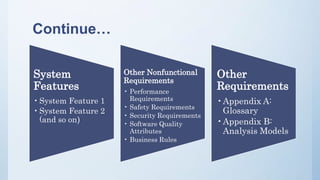
Continue…
System
Features
•System Feature 1
•System Feature 2
(and so on)
Other Nonfunctional
Requirements
• Performance
Requirements
• Safety Requirements
• Security Requirements
• Software Quality
Attributes
• Business Rules
Other
Requirements
•Appendix A:
Glossary
•Appendix B:
Analysis Models
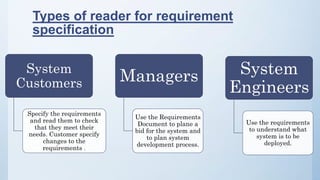
Types of reader for requirement
specification
System
Customers
Specify the requirements
and read them to check
that they meet their
needs. Customer specify
changes to the
requirements .
Managers
Use the Requirements
Document to plane a
bid for the system and
to plan system
development process.
System
Engineers
Use the requirements
to understand what
system is to be
deployed.
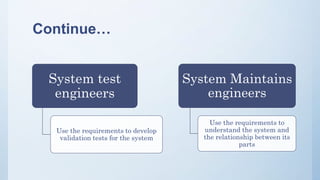
Continue…
System test
engineers
Use the requirements to develop
validation tests for the system
System Maintains
engineers
Use the requirements to
understand the system and
the relationship between its
parts
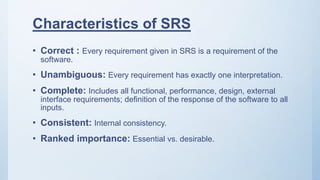
Characteristics of SRS
• Correct : Every requirement given in SRS is a requirement of the
software.
• Unambiguous: Every requirement has exactly one interpretation.
• Complete: Includes all functional, performance, design, external
interface requirements; definition of the response of the software to all
inputs.
• Consistent: Internal consistency.
• Ranked importance: Essential vs. desirable.
Continue…
• Verifiable: A requirement is verifiable if and only if there exists some
finite cost effective process with which a person or machine can check
that the SW meets the requirement.
• Modifiable: SRS must be structured to permit effective modifications
(e.g. don’t be redundant, keep requirements separate)
• Traceable: Origin of each requirement is clear.
what are the benefits of a great SRS?
The IEEE 830 standard defines the benefits of a good SRS:
• Establish the basis for agreement between the customers and the
suppliers on what the software product is to do.
• Reduce the development effort.
• Provide a basis for estimating costs and schedules.
• Provide a baseline for validation and verification.
• Serve as a basis for enhancement.
SRS(software requirement specification)

SRS(software requirement specification)

  • 1.
    SRS(Software Requirement Specification) By: AkashKumar Dhameja, K12270, BCA, IV Sem.
  • 2.
    Index • Definition • Purposeof SRS • SRS Format • Types of reader for requirement specification • Characteristics of SRS • Importance of SRS
  • 3.
    What is anSRS ? • SRS is the official statement of what the system developers should implement. • SRS is a complete description of the behaviour of the system to be developed. • SRS should include both a definition of user requirements and a specification of the system requirements. • The SRS fully describes what the software will do and how it will be expected to perform.
  • 4.
    Purpose of SRS •The SRS precisely defines the software product that will be built. • SRS used to know all the requirements for the software development and thus that will help in designing the software. • It provides feedback to the customer.
  • 5.
    SRS Format Introduction • Purpose •Document Conventions • Product Scope • Reference Overall Description • Product Perspective • Product Functions • User Classes and Characteristics • Operating Environment • Design and Implementation Constraints • User Documentation • Assumptions and Dependencies External Interface Requirements • User Interfaces • Hardware Interfaces • Software Interfaces • Communications Interfaces
  • 6.
    Continue… System Features •System Feature 1 •SystemFeature 2 (and so on) Other Nonfunctional Requirements • Performance Requirements • Safety Requirements • Security Requirements • Software Quality Attributes • Business Rules Other Requirements •Appendix A: Glossary •Appendix B: Analysis Models
  • 7.
    Types of readerfor requirement specification System Customers Specify the requirements and read them to check that they meet their needs. Customer specify changes to the requirements . Managers Use the Requirements Document to plane a bid for the system and to plan system development process. System Engineers Use the requirements to understand what system is to be deployed.
  • 8.
    Continue… System test engineers Use therequirements to develop validation tests for the system System Maintains engineers Use the requirements to understand the system and the relationship between its parts
  • 9.
    Characteristics of SRS •Correct : Every requirement given in SRS is a requirement of the software. • Unambiguous: Every requirement has exactly one interpretation. • Complete: Includes all functional, performance, design, external interface requirements; definition of the response of the software to all inputs. • Consistent: Internal consistency. • Ranked importance: Essential vs. desirable.
  • 10.
    Continue… • Verifiable: Arequirement is verifiable if and only if there exists some finite cost effective process with which a person or machine can check that the SW meets the requirement. • Modifiable: SRS must be structured to permit effective modifications (e.g. don’t be redundant, keep requirements separate) • Traceable: Origin of each requirement is clear.
  • 11.
    what are thebenefits of a great SRS? The IEEE 830 standard defines the benefits of a good SRS: • Establish the basis for agreement between the customers and the suppliers on what the software product is to do. • Reduce the development effort. • Provide a basis for estimating costs and schedules. • Provide a baseline for validation and verification. • Serve as a basis for enhancement.