Online Advertisement and the
AdWords Problem
PRESENTER
RAJESH PIRYANI
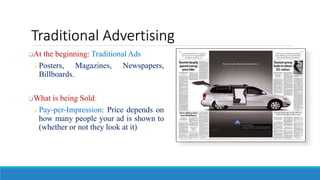
Traditional Advertising
At the beginning: Traditional Ads
 Posters, Magazines, Newspapers,
Billboards.
What is being Sold:
 Pay-per-Impression: Price depends on
how many people your ad is shown to
(whether or not they look at it)
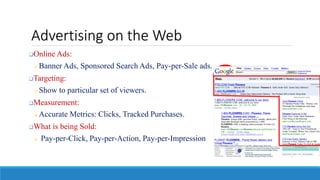
Advertising on the Web
Online Ads:
 Banner Ads, Sponsored Search Ads, Pay-per-Sale ads.
Targeting:
 Show to particular set of viewers.
Measurement:
 Accurate Metrics: Clicks, Tracked Purchases.
What is being Sold:
 Pay-per-Click, Pay-per-Action, Pay-per-Impression
Banner Ads
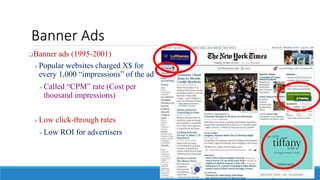
Banner ads (1995-2001)
Popular websites charged X$ for
every 1,000 “impressions” of the ad
Called “CPM” rate (Cost per
thousand impressions)
Low click-through rates
Low ROI for advertisers
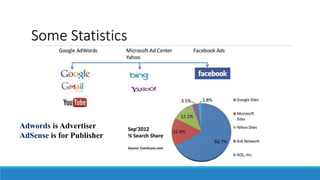
Some Statistics
Adwords is Advertiser
AdSense is for Publisher
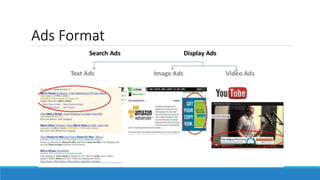
Ads Format
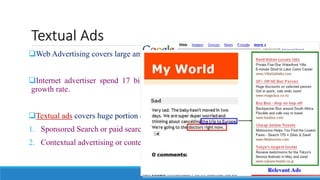
Textual Ads
Web Advertising covers large amount of internet environment.
Internet advertiser spend 17 billion dollars in US on advertising, with 20%
growth rate.
Textual ads covers huge portion of this market.
1. Sponsored Search or paid search advertising
2. Contextual advertising or context match
What is AdWords
Advertising system in which advertisers bid on certain keywords in order for their clickable
ads to appear in Google's search results
9
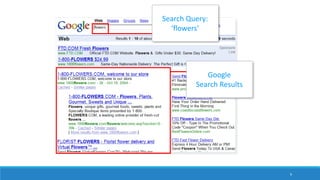
Search Query:
‘flowers’
Google
Search Results
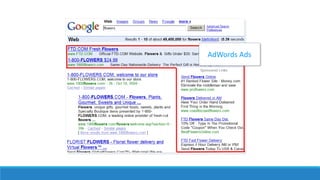
AdWords Ads
Understanding Adwords Technicalities
Keywords:
Ads are continuously matched to internet users interest based on your keywords
Use keywords match types to your advantage
 Broad Match
 Phrase Match
 Exact Match
 Negative Keywords
URL:
Two types of URL are used in an Adwords namely
Display URL
Actual URL
Broad Match
Keywords: buy flowers
Queries:
• buy flowers
• buy red flowers
• flowers buy
• New York buy flowers
Phrase Match
Keywords: “buy flowers”
Queries:
 Where can I buy flowers
 buy flowers in New Delhi
 buy red flowers (extra word)
 flowers buy (the words are
reversed)
Exact Match
Keywords: [buy flowers]
Queries:
 buy flowers
 Buy flowers (Capitalization
doesn’t matter)
Negative Match
Keywords: -cheap
Queries:
 buy cheap flowers
 cheap flowers in New York
Performance based advertising
Introduced by Overture around 2000
Advertisers bid on search keywords
When some one searches for that keywords, the highest bidder’s ad is shown
Advertisers is charged only if the ad is clicked on
Similar model adopted by Google with some changes around 2002
Called adwords
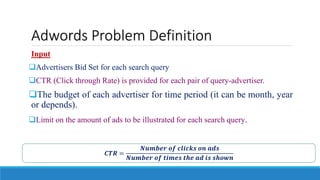
Adwords Problem Definition
Input
Advertisers Bid Set for each search query
CTR (Click through Rate) is provided for each pair of query-advertiser.
The budget of each advertiser for time period (it can be month, year
or depends).
Limit on the amount of ads to be illustrated for each search query.
𝑪𝑻𝑹 =
𝑵𝒖𝒎𝒃𝒆𝒓 𝒐𝒇 𝒄𝒍𝒊𝒄𝒌𝒔 𝒐𝒏 𝒂𝒅𝒔
𝑵𝒖𝒎𝒃𝒆𝒓 𝒐𝒇 𝒕𝒊𝒎𝒆𝒔 𝒕𝒉𝒆 𝒂𝒅 𝒊𝒔 𝒔𝒉𝒐𝒘𝒏
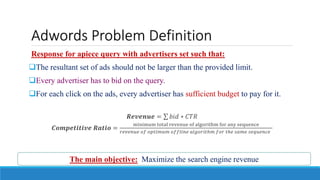
Adwords Problem Definition
Response for apiece query with advertisers set such that:
The resultant set of ads should not be larger than the provided limit.
Every advertiser has to bid on the query.
For each click on the ads, every advertiser has sufficient budget to pay for it.
𝑹𝒆𝒗𝒆𝒏𝒖𝒆 = 𝑏𝑖𝑑 ∗ 𝐶𝑇𝑅
𝑪𝒐𝒎𝒑𝒆𝒕𝒊𝒕𝒊𝒗𝒆 𝑹𝒂𝒕𝒊𝒐 =
minimum total revenue of algorithm for any sequence
𝑟𝑒𝑣𝑒𝑛𝑢𝑒 𝑜𝑓 𝑜𝑝𝑡𝑖𝑚𝑢𝑚 𝑜𝑓𝑓𝑙𝑖𝑛𝑒 𝑎𝑙𝑔𝑜𝑟𝑖𝑡ℎ𝑚 𝑓𝑜𝑟 𝑡ℎ𝑒 𝑠𝑎𝑚𝑒 𝑠𝑒𝑞𝑢𝑒𝑛𝑐𝑒
The main objective: Maximize the search engine revenue
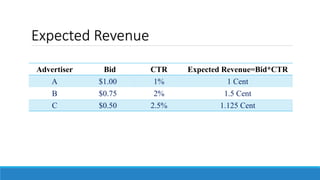
Expected Revenue
Advertiser Bid CTR Expected Revenue=Bid*CTR
A $1.00 1% 1 Cent
B $0.75 2% 1.5 Cent
C $0.50 2.5% 1.125 Cent
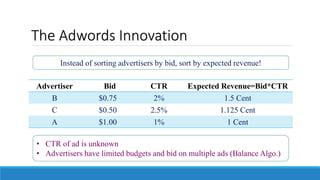
The Adwords Innovation
Advertiser Bid CTR Expected Revenue=Bid*CTR
B $0.75 2% 1.5 Cent
C $0.50 2.5% 1.125 Cent
A $1.00 1% 1 Cent
Instead of sorting advertisers by bid, sort by expected revenue!
• CTR of ad is unknown
• Advertisers have limited budgets and bid on multiple ads (Balance Algo.)
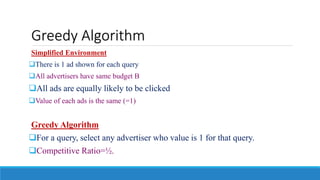
Greedy Algorithm
Simplified Environment
There is 1 ad shown for each query
All advertisers have same budget B
All ads are equally likely to be clicked
Value of each ads is the same (=1)
Greedy Algorithm
For a query, select any advertiser who value is 1 for that query.
Competitive Ratio=½.
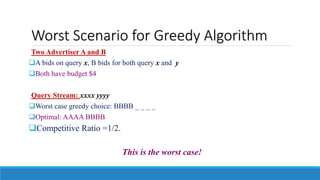
Worst Scenario for Greedy Algorithm
Two Advertiser A and B
A bids on query x, B bids for both query x and y
Both have budget $4
Query Stream: xxxx yyyy
Worst case greedy choice: BBBB _ _ _ _
Optimal: AAAA BBBB
Competitive Ratio =1/2.
This is the worst case!
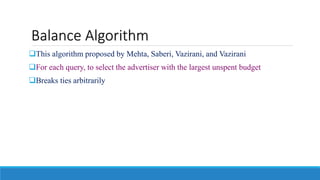
Balance Algorithm
This algorithm proposed by Mehta, Saberi, Vazirani, and Vazirani
For each query, to select the advertiser with the largest unspent budget
Breaks ties arbitrarily
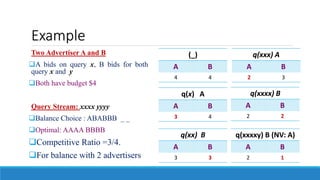
Example
Two Advertiser A and B
A bids on query x, B bids for both
query x and y
Both have budget $4
Query Stream: xxxx yyyy
Balance Choice : ABABBB _ _
Optimal: AAAA BBBB
Competitive Ratio =3/4.
For balance with 2 advertisers
(_)
A B
4 4
q(x) A
A B
3 4
q(xx) B
A B
3 3
q(xxx) A
A B
2 3
q(xxxx) B
A B
2 2
q(xxxxy) B (NV: A)
A B
2 1
Implementation
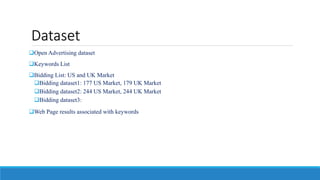
Dataset
Open Advertising dataset
Keywords List
Bidding List: US and UK Market
Bidding dataset1: 177 US Market, 179 UK Market
Bidding dataset2: 244 US Market, 244 UK Market
Bidding dataset3:
Web Page results associated with keywords
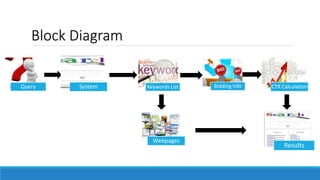
Block Diagram
Keywords List Bidding Info
Webpages
System CTR Calculation
Results
Query
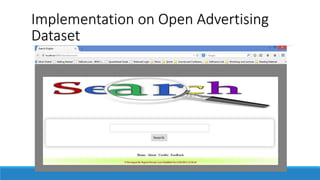
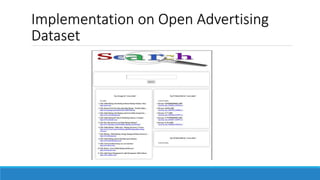
Implementation on Open Advertising
Dataset
Implementation on Open Advertising
Dataset
Reference
Book:
Mining Massive Dataset
By Jure Leskovec, Anand Rajaraman, Jeff Ullman
Papers:
A. Broder, M. Fontoura, V. Josifovski, and L. Riedel, “A semantic approach to
contextual advertising,” Proceedings of the 30th annual international ACM
SIGIR conference on Research and development in information retrieval - SIGIR
’07, 2007.
T.-K. Fan and C.-H. Chang, “Blogger-Centric Contextual Advertising,” Expert
Systems with Applications, vol. 38, no. 3, pp. 1777–1788, Mar. 2011.
Thank you

Online Advertisements and the AdWords Problem

  • 1.
    Online Advertisement andthe AdWords Problem PRESENTER RAJESH PIRYANI
  • 2.
    Traditional Advertising At thebeginning: Traditional Ads  Posters, Magazines, Newspapers, Billboards. What is being Sold:  Pay-per-Impression: Price depends on how many people your ad is shown to (whether or not they look at it)
  • 3.
    Advertising on theWeb Online Ads:  Banner Ads, Sponsored Search Ads, Pay-per-Sale ads. Targeting:  Show to particular set of viewers. Measurement:  Accurate Metrics: Clicks, Tracked Purchases. What is being Sold:  Pay-per-Click, Pay-per-Action, Pay-per-Impression
  • 4.
    Banner Ads Banner ads(1995-2001) Popular websites charged X$ for every 1,000 “impressions” of the ad Called “CPM” rate (Cost per thousand impressions) Low click-through rates Low ROI for advertisers
  • 5.
    Some Statistics Adwords isAdvertiser AdSense is for Publisher
  • 6.
  • 7.
    Textual Ads Web Advertisingcovers large amount of internet environment. Internet advertiser spend 17 billion dollars in US on advertising, with 20% growth rate. Textual ads covers huge portion of this market. 1. Sponsored Search or paid search advertising 2. Contextual advertising or context match
  • 8.
    What is AdWords Advertisingsystem in which advertisers bid on certain keywords in order for their clickable ads to appear in Google's search results
  • 9.
  • 10.
  • 11.
    Understanding Adwords Technicalities Keywords: Adsare continuously matched to internet users interest based on your keywords Use keywords match types to your advantage  Broad Match  Phrase Match  Exact Match  Negative Keywords URL: Two types of URL are used in an Adwords namely Display URL Actual URL Broad Match Keywords: buy flowers Queries: • buy flowers • buy red flowers • flowers buy • New York buy flowers Phrase Match Keywords: “buy flowers” Queries:  Where can I buy flowers  buy flowers in New Delhi  buy red flowers (extra word)  flowers buy (the words are reversed) Exact Match Keywords: [buy flowers] Queries:  buy flowers  Buy flowers (Capitalization doesn’t matter) Negative Match Keywords: -cheap Queries:  buy cheap flowers  cheap flowers in New York
  • 12.
    Performance based advertising Introducedby Overture around 2000 Advertisers bid on search keywords When some one searches for that keywords, the highest bidder’s ad is shown Advertisers is charged only if the ad is clicked on Similar model adopted by Google with some changes around 2002 Called adwords
  • 13.
    Adwords Problem Definition Input AdvertisersBid Set for each search query CTR (Click through Rate) is provided for each pair of query-advertiser. The budget of each advertiser for time period (it can be month, year or depends). Limit on the amount of ads to be illustrated for each search query. 𝑪𝑻𝑹 = 𝑵𝒖𝒎𝒃𝒆𝒓 𝒐𝒇 𝒄𝒍𝒊𝒄𝒌𝒔 𝒐𝒏 𝒂𝒅𝒔 𝑵𝒖𝒎𝒃𝒆𝒓 𝒐𝒇 𝒕𝒊𝒎𝒆𝒔 𝒕𝒉𝒆 𝒂𝒅 𝒊𝒔 𝒔𝒉𝒐𝒘𝒏
  • 14.
    Adwords Problem Definition Responsefor apiece query with advertisers set such that: The resultant set of ads should not be larger than the provided limit. Every advertiser has to bid on the query. For each click on the ads, every advertiser has sufficient budget to pay for it. 𝑹𝒆𝒗𝒆𝒏𝒖𝒆 = 𝑏𝑖𝑑 ∗ 𝐶𝑇𝑅 𝑪𝒐𝒎𝒑𝒆𝒕𝒊𝒕𝒊𝒗𝒆 𝑹𝒂𝒕𝒊𝒐 = minimum total revenue of algorithm for any sequence 𝑟𝑒𝑣𝑒𝑛𝑢𝑒 𝑜𝑓 𝑜𝑝𝑡𝑖𝑚𝑢𝑚 𝑜𝑓𝑓𝑙𝑖𝑛𝑒 𝑎𝑙𝑔𝑜𝑟𝑖𝑡ℎ𝑚 𝑓𝑜𝑟 𝑡ℎ𝑒 𝑠𝑎𝑚𝑒 𝑠𝑒𝑞𝑢𝑒𝑛𝑐𝑒 The main objective: Maximize the search engine revenue
  • 15.
    Expected Revenue Advertiser BidCTR Expected Revenue=Bid*CTR A $1.00 1% 1 Cent B $0.75 2% 1.5 Cent C $0.50 2.5% 1.125 Cent
  • 16.
    The Adwords Innovation AdvertiserBid CTR Expected Revenue=Bid*CTR B $0.75 2% 1.5 Cent C $0.50 2.5% 1.125 Cent A $1.00 1% 1 Cent Instead of sorting advertisers by bid, sort by expected revenue! • CTR of ad is unknown • Advertisers have limited budgets and bid on multiple ads (Balance Algo.)
  • 17.
    Greedy Algorithm Simplified Environment Thereis 1 ad shown for each query All advertisers have same budget B All ads are equally likely to be clicked Value of each ads is the same (=1) Greedy Algorithm For a query, select any advertiser who value is 1 for that query. Competitive Ratio=½.
  • 18.
    Worst Scenario forGreedy Algorithm Two Advertiser A and B A bids on query x, B bids for both query x and y Both have budget $4 Query Stream: xxxx yyyy Worst case greedy choice: BBBB _ _ _ _ Optimal: AAAA BBBB Competitive Ratio =1/2. This is the worst case!
  • 19.
    Balance Algorithm This algorithmproposed by Mehta, Saberi, Vazirani, and Vazirani For each query, to select the advertiser with the largest unspent budget Breaks ties arbitrarily
  • 20.
    Example Two Advertiser Aand B A bids on query x, B bids for both query x and y Both have budget $4 Query Stream: xxxx yyyy Balance Choice : ABABBB _ _ Optimal: AAAA BBBB Competitive Ratio =3/4. For balance with 2 advertisers (_) A B 4 4 q(x) A A B 3 4 q(xx) B A B 3 3 q(xxx) A A B 2 3 q(xxxx) B A B 2 2 q(xxxxy) B (NV: A) A B 2 1
  • 21.
  • 22.
    Dataset Open Advertising dataset KeywordsList Bidding List: US and UK Market Bidding dataset1: 177 US Market, 179 UK Market Bidding dataset2: 244 US Market, 244 UK Market Bidding dataset3: Web Page results associated with keywords
  • 23.
    Block Diagram Keywords ListBidding Info Webpages System CTR Calculation Results Query
  • 24.
    Implementation on OpenAdvertising Dataset
  • 25.
    Implementation on OpenAdvertising Dataset
  • 26.
    Reference Book: Mining Massive Dataset ByJure Leskovec, Anand Rajaraman, Jeff Ullman Papers: A. Broder, M. Fontoura, V. Josifovski, and L. Riedel, “A semantic approach to contextual advertising,” Proceedings of the 30th annual international ACM SIGIR conference on Research and development in information retrieval - SIGIR ’07, 2007. T.-K. Fan and C.-H. Chang, “Blogger-Centric Contextual Advertising,” Expert Systems with Applications, vol. 38, no. 3, pp. 1777–1788, Mar. 2011.
  • 27.