 Chapter 3
 Lee J. Krajewski
 Manoj K. Malhothra
 Larry P. Ritzman
 Samir K. Srivastava
 Operations management is an area
of management concerned with designing
and controlling the process
of production and redesigning business
operations in the production
of goods or services. It involves the
responsibility of ensuring
that business operations are efficient in
terms of using as few resources as needed
and effective in meeting customer
requirements.
 Cost of Quality
 The challenge for businesses today is to satisfy their customers through
the exceptional performance of their processes.
 Cost of Quality
 When process fails to satisfy a customer, the failure is considered a
defect.
 Many companies spend significant time, effort, and expense on systems,
training, and organizational changes to improve the quality and
performance so that any process gaps can be determined. Gaps reflect
potential dissatisfied customers and additional costs for the firm. Most
experts estimate that the cost of quality range from 20 to 30 percent of
gross sales. These costs can be broken down into four major-categories;
 1. Prevention Cost 2. Appraisal Cost
 3. Internal failure Cost and 3. External Failure Cost
 The addition, there is a fifth category of costs associated with unethical
behavior in making quality decisions, and which can be significantly
higher than all the other four cost combined.
 Prevention Costs
 Prevention costs are associated with preventing defects before they happen.
The include the costs of redesigning the process to remove the causes of
poor performance, redesigning the service or product to make it simpler to
produce, training employees in the methods of continuous improvement, and
working with suppliers to increase the quality of purchased items or
contracted services. To prevent problems from happening, firms must invest
additional time, effort, and money.
 Appraisal Costs
 Are incurred when the firm assesses the level of performance of its
processes. As the costs of prevention increase and performance improves,
appraisal costs decrease because fewer resources are needed for quality
inspections and the subsequent search for causes of any problems that are
detected.
 Internal Failure Cost
◦ Internal failure cost result from defects that are discovered during the
production of a service or product. Defects fall into two main categories.
 1. Network, which is incurred if some aspect of a service must be
performed again or if a defective item must be rerouted to some
previous operations to correct the defect and;
 2. scrap, which is incurred if a defective item is unfit for further
processing. For example, an analysis of the viability of acquiring a
company might be sent back to the mergers and acquisitions
department if assessment of the company’s history of environmental
compliance is missing. The proposal for the purchase of the
company may be delayed, which may result is the loss of the
company purchase.
 External Failure Cost
 Arise when a defect is discovered after the customer receives the service of
product, dissatisfied customers talk about bad service or products to their
friends, who is turn tell others.
 External failure costs also include warranty service and litigation costs. A
warranty is a written guarantee that the producer will replace or repair
defective parts or perform the service to the customer’s satisfaction.
 Usually a warranty is given for some specified period.
 Ethical Failure Cost
 Societal and monetary costs associated with deceptively passing defective
services or products to internal or external customers such that it
jeopardizes (put in risk) the well being of stockholders, customers,
employees, partners, and creditors.
 Ethical Failure Cost
 Deceptive business practices are a source of major concern for service or
product quality. Deceptive business practice involves three elements;
◦ The conduct of the provider is internal and motivated by a desire to
exploit the customer.
◦ The provider conceals the truth based upon what is actually known to the
provider.
◦ The transaction is intended to generate a disproportionate economic
benefits to the provider at the expense of the customer.
◦ This behavior is unethical, diminishes the quality of the customers
experience, and may impose a substantial cost of society.
◦ Quality is all about increasing the satisfaction of customers.
 Srivastava (2008) opines that after focusing on Cost of Quality (CoQ)
at all levels within their internal firms need to consider the supply
chain upstream as a first step to addressing CoQ-Related issues
across their supply chains. Performance measures in the context of
the business process and supply chain interface levels, as well as the
three critical supply chain management flows:
 Forward, reverse and financial, need to be developed for this. He
determines CoQ at selected third-party contact manufacturing sites
of a wold-leading research-based pharmaceuticals firm in india. He
utilizes the blend of quality-costing, quality-loss and process-cost
approaches to estimate quality costs in monetary terms as per PAF
model, to judge the performance of five third-party contact sites.
The study highlights the importance and significance of calculating
CoQ in a real-world situation.
 Quality
 A term used by customers to describe their
general satisfaction with a service or product.
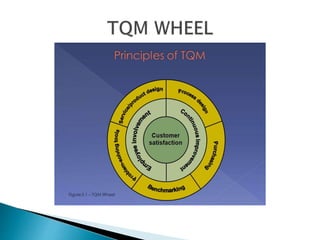
 Total Quality Management (TQM)
 A philosophy that stresses three principles
for achieving high levels of process
performance and quality;
1) Customer Satisfaction,
2) Employee involvement, and
3) Continuous improvement in performance.
Customers, internal or external, are satisfied when their expectations
regarding a service or product have been met or exceeded. Often,
customers use the general term quality to describe their level of
satisfaction, which cut across the nine competitive priorities.
 One or more of the following five definitions apply at ay one time.
1. Conformance to Specifications
although customers evaluate the service or product they receive, it
is the processes that produced the service or product that are really being
judged in this case, a process failure would be the process’s inability to
meet certain advertised or implied performance standards. Conformance to
specifications may relate to consist quality. On-time delivery, or delivery
speed.
2. Value
Another way customers define quality is through value, or how well the
service or product serves its intended purpose at a price customers are
willing to pay. How much value a service or product has in the mind of the
customer depends on the customer’s expectations before purchasing it.
3. Fitness for Use
When assessing how well a service or product performs its intended
purpose, the customer may consider the convenience of a service, the
mechanical features of a product, or other aspects such as appearance,
style, durability, reliability, craftsmanship, and serviceability.
 4. Support
 Often the service or product support provided by the company is
as important to customers as the quality of the service or
product itself. Customer get upset with a company if its financial
statements are incorrect, responses to its warranty claims are
delayed, its advertising is misleading, or tis employees are not
helpful when problems are incurred. Good support once the sale
has been made can reduce the consequences of quality failures.
5. Psychological Impressions
 People often evaluate the quality of a service or product on the
basis of psychological impressions: atmosphere image, or
aesthetics. In the prevision of services where the customer is in
close contact with the provider, the appearance and actions of
the provider are especially important. Nicely dressed, courteous,
friendly, and sympathetic employees can affect the customer’s
perception of service quality.
 One of the important element of TQM is employee involvement. A program in
employee involvement includes changing organizational culture and encouraging
teamwork.
 Cultural Change
 One of the main challenges in developing the proper culture for TQM is to define
Customer for each employee. In general customers are the internal or external.
External customers are the people or firms who but the service or product. Some
employees, especially those having little contact with external customers, may
have difficulty seeing how their jobs contribute to the whole effort.
 In TQM everyone must shar ethe view that quality control is an end in itself errors
or defects should be caught and corrected at the source, not passed along to an
internal or external customer, for example, a consulting team should make sure
its billable hours are correct before submitting them to the accounting
department. This philosophy is called quality at the source.
 Teams
 Employee involvement is a key tactic for improving processes and quality. One way
to achieves employee involvement is by the use of teams. The three approaches to
teamwork most often used;
 1. problem-solving teams
 2. Special-purpose teams and
 3. self-managed teams.
 All three use some amount of employee empowerment., which moves
responsibility for decisions further down the organizational chart-to the level
employee actually doing the job.
 Based on a Japanese concept called Kaizen, The philosophy of
continually seeking ways to improve processes.
 Continuous improvement involves identifying benchmarks of
excellent practice and instilling a sense of employee ownership
in the process.
 The focus of continuous improvement projects is to reduce
waste, such as reducing the length of time required to process
requests for loans at a bank, the amount of scrap generated at a
milling machine, or the number of employees injuries at a
construction site.
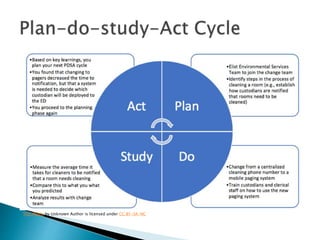
 Most rims actively engaged in continuous improvement train
their work teams to use the plan-do-study-act cycle for problem
solving.
 Another name for this approach is the Deming Wheel,
 Named after the renowned statistician. W. Edwards Deming who
taught quality improvement techniques to the Japanese after
World war II,
 Which lies in the heart of the continuous improvement
philosophy.
 The cycle comprises the following steps:
1. Plan. The team selects a process (an activity, method,
machine, or policy) that needs improvement. The team then
documents the selected process, usually by analyzing related data
sets; quantifiable goals of improvement; and discuss various ways
to achieve the goals. After assessing he benefits and costs pf the
alternatives, the team develops a plan with quantifiable measures
for improvement.
2. Do. The team implements the plan and monitors
progress. Data are collected continuously to measure the
improvements in the process. Any changes in the process are
documented, and further revisions are made as needed.
3. Study. The team analyzes the data collected during the do
step to find out how closely the results correspond to the goals set
in the plan. If major shortcomings exists, the team reevaluates the
plan or stops the projects.
4. Act. If the results are successful, the team documents the
revised process sot that it becomes the standard procedure for all
who may use it. The team may then instruct other employees in the
use of the revised process,
This Photo by Unknown Author is licensed under CC BY-SA-NC
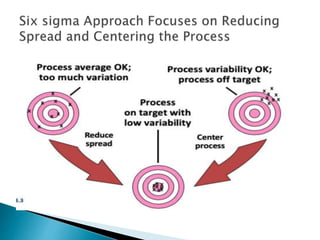
 A comprehensive and flexible system for
achieving, sustaining, and maximizing
business success by minimizing defects and
variability to processes.
 Six Sigma is a set of methodologies and tools
used to improve business processes by
reducing defects and errors, minimizing
variation, and increasing quality and
efficiency.
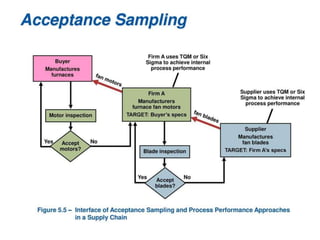
 The application of Statistical techniques to determine whether a quantity
of material should be accepted or rejected based on the inspection or
test of a sample.
 Relative to the specifications for the material the buyer is purchasing,
the buyer specify an acceptable quality level (AQL) which is the
statement of proportion of defective items (outside of specifications)
that the buyer will accept in a shipment. These days, that proportion is
getting very small, often measured in parts per ten-thousand. The idea
of acceptance sampling is to take s sample, rather than testing the entire
quantity of material, because that is often less expensive. Therein lies
the risk-the sample may not be representative of the entire lot of goods
from the supplier.
 1. A random sampling is taken from a large quantity of items and
tested or measured relative to the specification or quality measures of
interest.
 2. if the sample passes the rest (low number of defects), the entire
quantity of items is accepted.
 3. if the sample fails the test, either (a) the entire quantity of items is
subjected to 100 percent inspection and all defective items repaired or
replaced or (b) the entire quantity is returned to the supplier.
 SPC is the application of statistical techniques to determine
whether a process is delivering what customers want. In SPC,
tools called control charts are used primarily to detect defective
services or products or to indicate that the process has changed
and that services or products will deviate from their design
specifications, unless something is done to correct the situation.
 SPC can also be used to inform management of improved
process changes.
 Examples of Process changes that can be detected by SPC
include the following;
 A decrease in the average number of complaints pe day at a
hotel.
 A sudden increase in the proportion of defective gear boxes.
 An increase in the time to process a mortgage application
 A decline in the number of scrapped units at a milling machine
 An increase in the number of claimants receiving late payment
form an insurance company.
Ch 3 Quality and Performance (4).pptx

Ch 3 Quality and Performance (4).pptx

  • 2.
     Chapter 3 Lee J. Krajewski  Manoj K. Malhothra  Larry P. Ritzman  Samir K. Srivastava
  • 3.
     Operations managementis an area of management concerned with designing and controlling the process of production and redesigning business operations in the production of goods or services. It involves the responsibility of ensuring that business operations are efficient in terms of using as few resources as needed and effective in meeting customer requirements.
  • 4.
     Cost ofQuality  The challenge for businesses today is to satisfy their customers through the exceptional performance of their processes.  Cost of Quality  When process fails to satisfy a customer, the failure is considered a defect.  Many companies spend significant time, effort, and expense on systems, training, and organizational changes to improve the quality and performance so that any process gaps can be determined. Gaps reflect potential dissatisfied customers and additional costs for the firm. Most experts estimate that the cost of quality range from 20 to 30 percent of gross sales. These costs can be broken down into four major-categories;  1. Prevention Cost 2. Appraisal Cost  3. Internal failure Cost and 3. External Failure Cost  The addition, there is a fifth category of costs associated with unethical behavior in making quality decisions, and which can be significantly higher than all the other four cost combined.
  • 5.
     Prevention Costs Prevention costs are associated with preventing defects before they happen. The include the costs of redesigning the process to remove the causes of poor performance, redesigning the service or product to make it simpler to produce, training employees in the methods of continuous improvement, and working with suppliers to increase the quality of purchased items or contracted services. To prevent problems from happening, firms must invest additional time, effort, and money.  Appraisal Costs  Are incurred when the firm assesses the level of performance of its processes. As the costs of prevention increase and performance improves, appraisal costs decrease because fewer resources are needed for quality inspections and the subsequent search for causes of any problems that are detected.
  • 6.
     Internal FailureCost ◦ Internal failure cost result from defects that are discovered during the production of a service or product. Defects fall into two main categories.  1. Network, which is incurred if some aspect of a service must be performed again or if a defective item must be rerouted to some previous operations to correct the defect and;  2. scrap, which is incurred if a defective item is unfit for further processing. For example, an analysis of the viability of acquiring a company might be sent back to the mergers and acquisitions department if assessment of the company’s history of environmental compliance is missing. The proposal for the purchase of the company may be delayed, which may result is the loss of the company purchase.
  • 7.
     External FailureCost  Arise when a defect is discovered after the customer receives the service of product, dissatisfied customers talk about bad service or products to their friends, who is turn tell others.  External failure costs also include warranty service and litigation costs. A warranty is a written guarantee that the producer will replace or repair defective parts or perform the service to the customer’s satisfaction.  Usually a warranty is given for some specified period.  Ethical Failure Cost  Societal and monetary costs associated with deceptively passing defective services or products to internal or external customers such that it jeopardizes (put in risk) the well being of stockholders, customers, employees, partners, and creditors.
  • 8.
     Ethical FailureCost  Deceptive business practices are a source of major concern for service or product quality. Deceptive business practice involves three elements; ◦ The conduct of the provider is internal and motivated by a desire to exploit the customer. ◦ The provider conceals the truth based upon what is actually known to the provider. ◦ The transaction is intended to generate a disproportionate economic benefits to the provider at the expense of the customer. ◦ This behavior is unethical, diminishes the quality of the customers experience, and may impose a substantial cost of society. ◦ Quality is all about increasing the satisfaction of customers.
  • 9.
     Srivastava (2008)opines that after focusing on Cost of Quality (CoQ) at all levels within their internal firms need to consider the supply chain upstream as a first step to addressing CoQ-Related issues across their supply chains. Performance measures in the context of the business process and supply chain interface levels, as well as the three critical supply chain management flows:  Forward, reverse and financial, need to be developed for this. He determines CoQ at selected third-party contact manufacturing sites of a wold-leading research-based pharmaceuticals firm in india. He utilizes the blend of quality-costing, quality-loss and process-cost approaches to estimate quality costs in monetary terms as per PAF model, to judge the performance of five third-party contact sites. The study highlights the importance and significance of calculating CoQ in a real-world situation.
  • 10.
     Quality  Aterm used by customers to describe their general satisfaction with a service or product.  Total Quality Management (TQM)  A philosophy that stresses three principles for achieving high levels of process performance and quality; 1) Customer Satisfaction, 2) Employee involvement, and 3) Continuous improvement in performance.
  • 12.
    Customers, internal orexternal, are satisfied when their expectations regarding a service or product have been met or exceeded. Often, customers use the general term quality to describe their level of satisfaction, which cut across the nine competitive priorities.  One or more of the following five definitions apply at ay one time. 1. Conformance to Specifications although customers evaluate the service or product they receive, it is the processes that produced the service or product that are really being judged in this case, a process failure would be the process’s inability to meet certain advertised or implied performance standards. Conformance to specifications may relate to consist quality. On-time delivery, or delivery speed. 2. Value Another way customers define quality is through value, or how well the service or product serves its intended purpose at a price customers are willing to pay. How much value a service or product has in the mind of the customer depends on the customer’s expectations before purchasing it. 3. Fitness for Use When assessing how well a service or product performs its intended purpose, the customer may consider the convenience of a service, the mechanical features of a product, or other aspects such as appearance, style, durability, reliability, craftsmanship, and serviceability.
  • 13.
     4. Support Often the service or product support provided by the company is as important to customers as the quality of the service or product itself. Customer get upset with a company if its financial statements are incorrect, responses to its warranty claims are delayed, its advertising is misleading, or tis employees are not helpful when problems are incurred. Good support once the sale has been made can reduce the consequences of quality failures. 5. Psychological Impressions  People often evaluate the quality of a service or product on the basis of psychological impressions: atmosphere image, or aesthetics. In the prevision of services where the customer is in close contact with the provider, the appearance and actions of the provider are especially important. Nicely dressed, courteous, friendly, and sympathetic employees can affect the customer’s perception of service quality.
  • 14.
     One ofthe important element of TQM is employee involvement. A program in employee involvement includes changing organizational culture and encouraging teamwork.  Cultural Change  One of the main challenges in developing the proper culture for TQM is to define Customer for each employee. In general customers are the internal or external. External customers are the people or firms who but the service or product. Some employees, especially those having little contact with external customers, may have difficulty seeing how their jobs contribute to the whole effort.  In TQM everyone must shar ethe view that quality control is an end in itself errors or defects should be caught and corrected at the source, not passed along to an internal or external customer, for example, a consulting team should make sure its billable hours are correct before submitting them to the accounting department. This philosophy is called quality at the source.  Teams  Employee involvement is a key tactic for improving processes and quality. One way to achieves employee involvement is by the use of teams. The three approaches to teamwork most often used;  1. problem-solving teams  2. Special-purpose teams and  3. self-managed teams.  All three use some amount of employee empowerment., which moves responsibility for decisions further down the organizational chart-to the level employee actually doing the job.
  • 15.
     Based ona Japanese concept called Kaizen, The philosophy of continually seeking ways to improve processes.  Continuous improvement involves identifying benchmarks of excellent practice and instilling a sense of employee ownership in the process.  The focus of continuous improvement projects is to reduce waste, such as reducing the length of time required to process requests for loans at a bank, the amount of scrap generated at a milling machine, or the number of employees injuries at a construction site.  Most rims actively engaged in continuous improvement train their work teams to use the plan-do-study-act cycle for problem solving.  Another name for this approach is the Deming Wheel,  Named after the renowned statistician. W. Edwards Deming who taught quality improvement techniques to the Japanese after World war II,  Which lies in the heart of the continuous improvement philosophy.
  • 16.
     The cyclecomprises the following steps: 1. Plan. The team selects a process (an activity, method, machine, or policy) that needs improvement. The team then documents the selected process, usually by analyzing related data sets; quantifiable goals of improvement; and discuss various ways to achieve the goals. After assessing he benefits and costs pf the alternatives, the team develops a plan with quantifiable measures for improvement. 2. Do. The team implements the plan and monitors progress. Data are collected continuously to measure the improvements in the process. Any changes in the process are documented, and further revisions are made as needed. 3. Study. The team analyzes the data collected during the do step to find out how closely the results correspond to the goals set in the plan. If major shortcomings exists, the team reevaluates the plan or stops the projects. 4. Act. If the results are successful, the team documents the revised process sot that it becomes the standard procedure for all who may use it. The team may then instruct other employees in the use of the revised process,
  • 17.
    This Photo byUnknown Author is licensed under CC BY-SA-NC
  • 18.
     A comprehensiveand flexible system for achieving, sustaining, and maximizing business success by minimizing defects and variability to processes.  Six Sigma is a set of methodologies and tools used to improve business processes by reducing defects and errors, minimizing variation, and increasing quality and efficiency.
  • 20.
     The applicationof Statistical techniques to determine whether a quantity of material should be accepted or rejected based on the inspection or test of a sample.  Relative to the specifications for the material the buyer is purchasing, the buyer specify an acceptable quality level (AQL) which is the statement of proportion of defective items (outside of specifications) that the buyer will accept in a shipment. These days, that proportion is getting very small, often measured in parts per ten-thousand. The idea of acceptance sampling is to take s sample, rather than testing the entire quantity of material, because that is often less expensive. Therein lies the risk-the sample may not be representative of the entire lot of goods from the supplier.  1. A random sampling is taken from a large quantity of items and tested or measured relative to the specification or quality measures of interest.  2. if the sample passes the rest (low number of defects), the entire quantity of items is accepted.  3. if the sample fails the test, either (a) the entire quantity of items is subjected to 100 percent inspection and all defective items repaired or replaced or (b) the entire quantity is returned to the supplier.
  • 22.
     SPC isthe application of statistical techniques to determine whether a process is delivering what customers want. In SPC, tools called control charts are used primarily to detect defective services or products or to indicate that the process has changed and that services or products will deviate from their design specifications, unless something is done to correct the situation.  SPC can also be used to inform management of improved process changes.  Examples of Process changes that can be detected by SPC include the following;  A decrease in the average number of complaints pe day at a hotel.  A sudden increase in the proportion of defective gear boxes.  An increase in the time to process a mortgage application  A decline in the number of scrapped units at a milling machine  An increase in the number of claimants receiving late payment form an insurance company.