Tracy Pi
孟廣平
©Techman 2013
TPRS Workshop
Massapequa
Berner Middle & High School
Massapequa, New York
Long Island
(c)TracyPi,NYUProjectDCLTForum
新年快乐!
恭喜发财!
喜气洋洋!
三阳开泰!
洋洋得意!
洋洋洒洒!
青春洋溢!
羊年行大运!
(c)TracyPi,NYUProjectDCLTForum
WELCOME!
“SPEED
IMPRESSES,
SLOW
CONNECTS!”
TPRS
(c)TracyPi,NYUProjectDCLTForum
STEPHEN KRASHEN SAYS:
 INPUT + 1
“We acquire language when we understand what we hear and
read, when we understand what people are saying to us, not
how they say it.”
 STUDYING GRAMMAR SUCKS
“Consciously learned rules have very limited functions: We use
them to edit what we say and write, but this is hard to do, and
sometimes they can help make input comprehensible, but this
is rare.”
(c)TracyPi,NYUProjectDCLTForum
STEPHEN KRASHEN SAYS:
 INPUT BEFORE OUTPUT
“We do not acquire language by producing it; only by
understanding it.”
 YOU SEE, OUTPUT COMES AFTER INPUT
“The ability to produce is the result of language
acquisition, not the cause.”
 IMMERSION STARTS AT HOME/CLASS
“Even if you live in the country where the language is
spoken, it is hard to get comprehensible input from the
“outside world”, especially if you are an adult.”
(c)TracyPi,NYUProjectDCLTForum
STEPHEN KRASHEN SAYS:
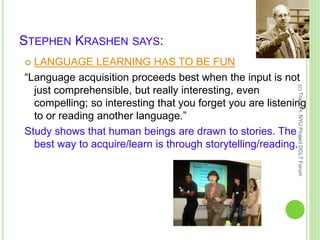
 LANGUAGE LEARNING HAS TO BE FUN
“Language acquisition proceeds best when the input is not
just comprehensible, but really interesting, even
compelling; so interesting that you forget you are listening
to or reading another language.”
Study shows that human beings are drawn to stories. The
best way to acquire/learn is through storytelling/reading.
(c)TracyPi,NYUProjectDCLTForum
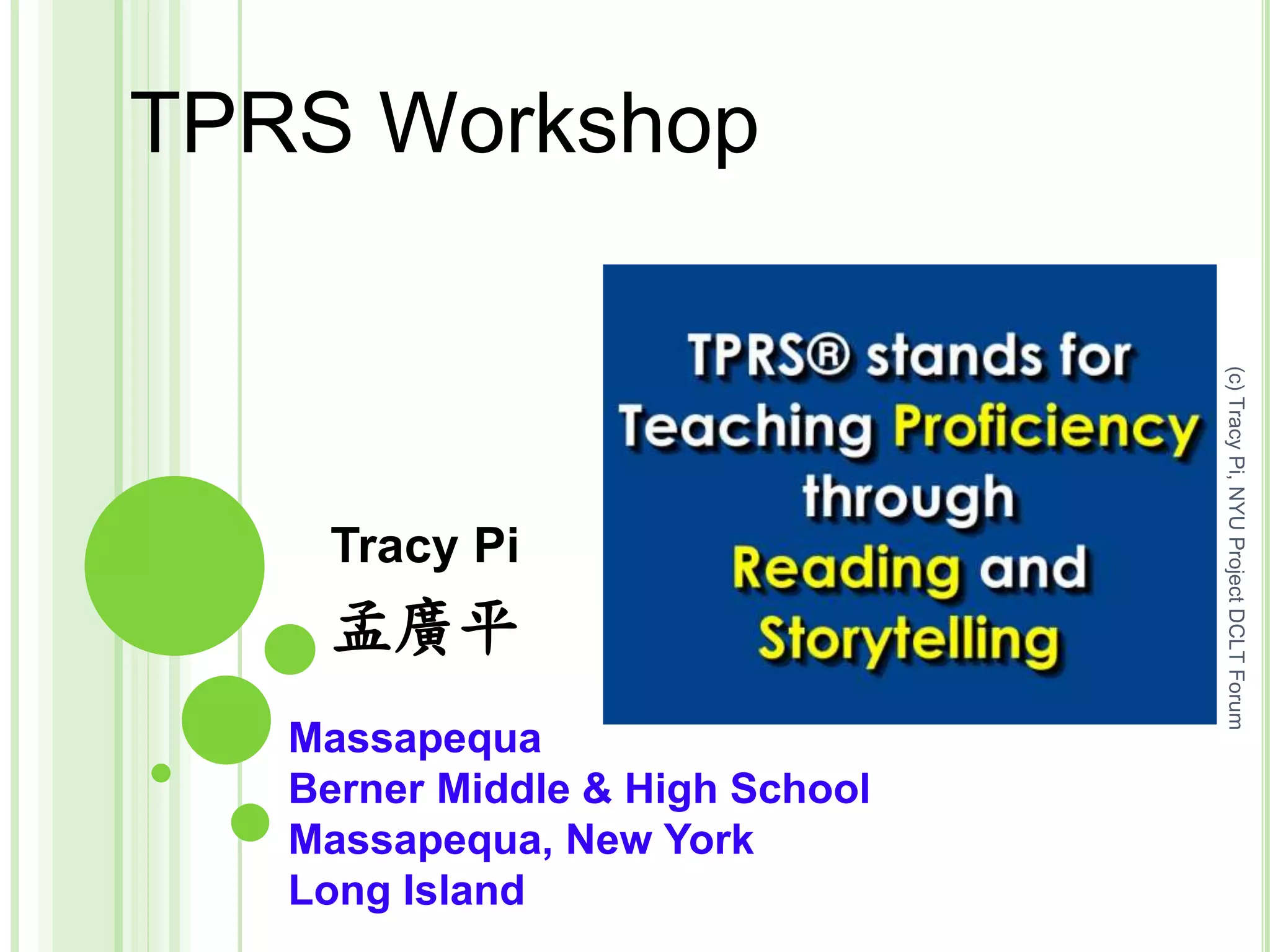
TPRS
•TPR Storytelling is a method for teaching foreign
languages that was invented by Blaine Ray, a Spanish
teacher in Bakersfield, California, in 1990. Blaine Ray
•TPRS is a method of second-language teaching that uses
highly-interactive stories to provide comprehensible input
and create an atmosphere of immersion in the classroom.
•90% Target Language Questions & Logic Words.pptx
•If we truly want our students to be able to speak and write
at any level, we must change the way we teach.
(c)TracyPi,NYUProjectDCLTForum
INPUT SHOULD BE
COMPREHENSIBLE 理解
COMPELLING 引人注目
CONTEXTUALIZED 语境
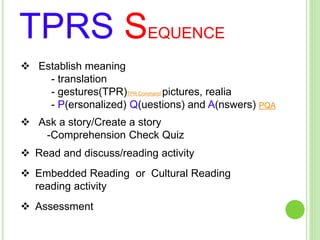
TPRS SEQUENCE
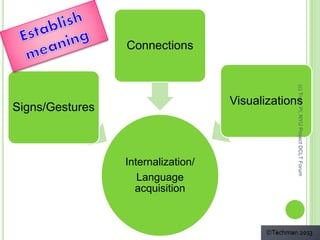
 Establish meaning
- translation
- gestures(TPR)TPR Command pictures, realia
- P(ersonalized) Q(uestions) and A(nswers) PQA
 Ask a story/Create a story
-Comprehension Check Quiz
 Read and discuss/reading activity
 Embedded Reading or Cultural Reading
reading activity
 Assessment
Internalization/
Language
acquisition
Signs/Gestures
Connections
Visualizations
(c)TracyPi,NYUProjectDCLTForum
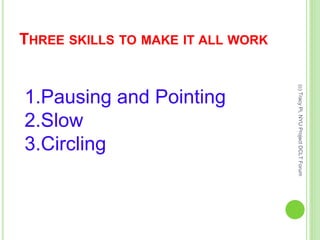
THREE SKILLS TO MAKE IT ALL WORK
1.Pausing and Pointing
2.Slow
3.Circling
(c)TracyPi,NYUProjectDCLTForum
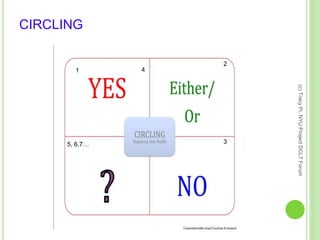
CIRCLING
1
2
4
35, 6,7…
(c)TracyPi,NYUProjectDCLTForum
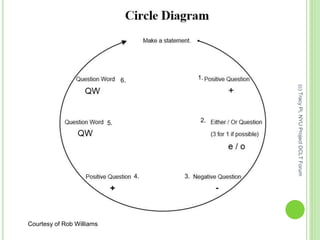
Courtesy of Rob Williams
1.
4.
2.
3.
6.
5.
(c)TracyPi,NYUProjectDCLTForum
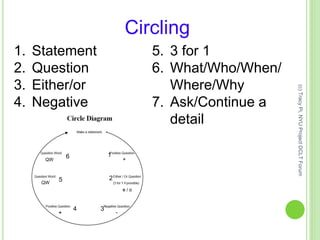
Circling
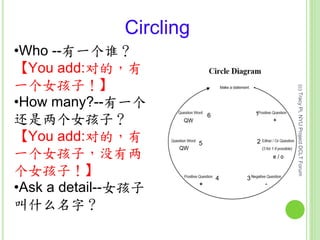
1. Statement
2. Question
3. Either/or
4. Negative
5. 3 for 1
6. What/Who/When/
Where/Why
7. Ask/Continue a
detail
1
4
2
3
6
5
(c)TracyPi,NYUProjectDCLTForum
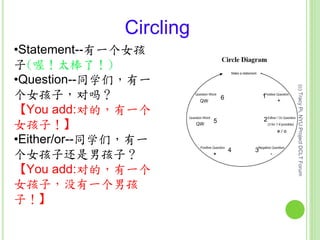
Circling
•Statement--有一个女孩
子(喔!太棒了!)
•Question--同学们,有一
个女孩子,对吗?
【You add:对的,有一个
女孩子!】
•Either/or--同学们,有一
个女孩子还是男孩子?
【You add:对的,有一个
女孩子,没有一个男孩
子!】
1
4
2
3
6
5
(c)TracyPi,NYUProjectDCLTForum
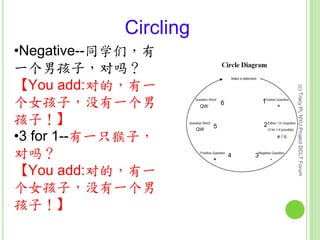
Circling
•Negative--同学们,有
一个男孩子,对吗?
【You add:对的,有一
个女孩子,没有一个男
孩子!】
•3 for 1--有一只猴子,
对吗?
【You add:对的,有一
个女孩子,没有一个男
孩子!】
1
4
2
3
6
5
(c)TracyPi,NYUProjectDCLTForum
Circling
•Who --有一个谁?
【You add:对的,有
一个女孩子!】
•How many?--有一个
还是两个女孩子?
【You add:对的,有
一个女孩子,没有两
个女孩子!】
•Ask a detail--女孩子
叫什么名字?
1
4
2
3
6
5
(c)TracyPi,NYUProjectDCLTForum
SUBJECT + VERB + ANYTHING
ELSE
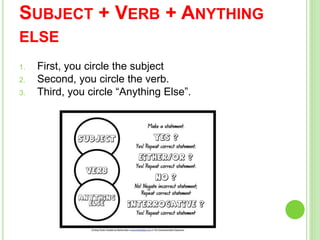
1. First, you circle the subject
2. Second, you circle the verb.
3. Third, you circle “Anything Else”.
SUBJECT + VERB + ANYTHING
ELSE
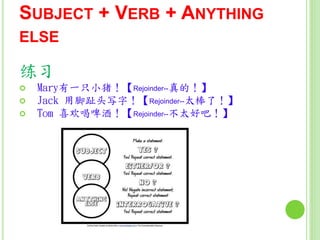
练习
 Mary有一只小猪!【Rejoinder--真的!】
 Jack 用脚趾头写字!【Rejoinder--太棒了!】
 Tom 喜欢喝啤酒!【Rejoinder--不太好吧!】
SUBJECT + VERB + ANYTHING
ELSE
练习
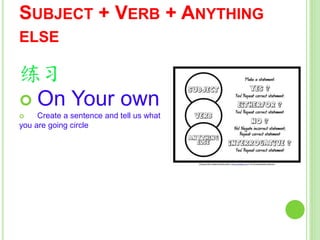
 On Your own
 Create a sentence and tell us what
you are going circle
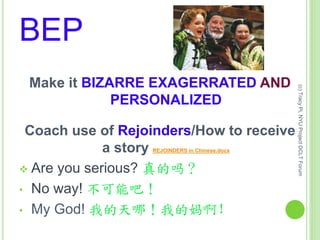
BEP
Make it BIZARRE EXAGERRATED AND
PERSONALIZED
Coach use of Rejoinders/How to receive
a story REJOINDERS in Chinese.docx
 Are you serious? 真的吗?
• No way! 不可能吧!
• My God! 我的天哪!我的妈啊!
(c)TracyPi,NYUProjectDCLTForum
STORYTELLING
1.Storytelling
2.Create the story
•90% Target Language Questions & Logic Words.pptx
(c)TracyPi,NYUProjectDCLTForum
CREATE THE STORY
• Tom 有一个女朋友!
• Tom 明天去BoraBora旅游!
• who,with whom,when,where,how much
you spend,etc…
• Created Story
(c)TracyPi,NYUProjectDCLTForum
WHAT IS AN “EMBEDDED
READING”?
It is a series of
- three or more readings
- of increasing difficulty
- from the same outline
(c)TracyPi,NYUProjectDCLTForum
HOW TO CREATE AN EMBEDDED READING
EMBEDDED READING
1. The first reading is at a basic level, easy for any student to
understand. It is a summary or an outline.
2. Each succeeding level adds sentences with additional information
and/or details.
3. The final version is the most challenging. However….
Each and every version of the reading contains the basic reading…
…. and each subsequent level within it.
This scaffolding of the story builds success!!!
© Clarcq, Whaley 2011
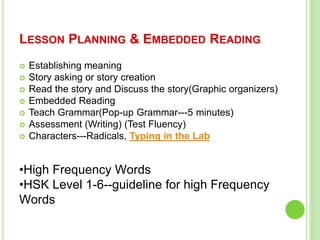
LESSON PLANNING & EMBEDDED READING
 Establishing meaning
 Story asking or story creation
 Read the story and Discuss the story(Graphic organizers)
 Embedded Reading
 Teach Grammar(Pop-up Grammar---5 minutes)
 Assessment (Writing) (Test Fluency)
 Characters---Radicals, Typing in the Lab
•High Frequency Words
•HSK Level 1-6--guideline for high Frequency
Words
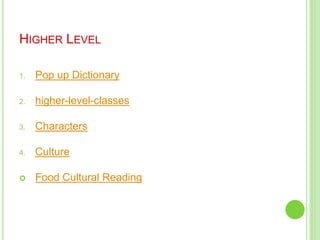
HIGHER LEVEL
1. Pop up Dictionary
2. higher-level-classes
3. Characters
4. Culture
 Food Cultural Reading
TPRS WORKSHOP
 Tracy Pi tracipi@gmail.com
 孟廣平
(c)TracyPi,NYUProjectDCLTForum

Tprs in the chinese classroom

Editor's Notes

  • #8 1. Watch Blaine Ray’s Youtube. 2. 90% Target Language--ACTFL--Bill
  • #9 1.Clueless? 2.Dramatize 3. In a Story
  • #10 2. Open “TPR” Command 4. Open “PQA” document
  • #12 说话要清楚!慢!重复!根据调查,语言初学者一个生词要重复75-150次才能 pick up!
  • #18 名字的问题?中文名字还是英文名字?
  • #19 熟练了以后,不按牌理出牌!
  • #20 熟练了以后,不按牌理出牌!
  • #21 熟练了以后,不按牌理出牌!
  • #23 说话要简洁!Right to the point!
  • #24 When you are doing PQA with this type of sentence, you are already asking many “W” questions.
  • #25 Don’t add the sentence structures. Just add more nouns/adjectives. In more details.