LANGUAGE LEARNING THROUGH
                           STORYTELLING:
               A LOOK AT THE DEVELOPMENT OF
          COMMUNICATION STRATEGIES IN A CLIL
                           ENVIRONMENT


Francisco Salgado-Robles      2nd Graduate Colloquium on Bilingual Education
                            Universidad Pablo de Olavide – Sevilla [04/05/2010]
Rationale
2


       Content and Language Integrated Learning
        (CLIL) “refers to situations where subjects, or
        parts of subjects, are taught through a foreign
        language with dual-focused aims, namely the
        learning of content, and the simultaneous
        learning of a foreign language” (Marsh, 1994)

       E.g., the subject can be entirely unrelated to
        language learning, such as science lessons
        taught in English in a school in Spain
Rationale (Con‟t)
3


       Oral fluency gains

       The non-CLIL oriented research reveals that
        learners (NNS) encounter inevitable difficulties
        to communicate in an L2

       Teaching Proficiency through Reading and
        Storytelling (TPRS) helps NNS become
        proficient in speaking and understanding a new
        language (Ray & Seely, 2004)
Teaching Proficiency through
4
    Reading and Storytelling
       Combination of elements of Total Physical
        Response (TPR) and storytelling styles to teach
        language (Ray, 1990)

       Learning of an L2 in a natural way through
        hearing stories told in the target language

       Effective in all sectors of education because
        NNSs do not view their exposure to the L2 as
        tedious “learning”, but they enjoy its acquisition
        in an effortless and fun way
Teaching Proficiency through
5
    Reading and Storytelling (Con‟t)
       NNSs “feel included and validated”
        (Davidheiser, 2002) because stories are
        personalized and comprehensible

       Reduction of the affective filter by not prompting
        students to speak before they are ready

       Greater student retention, increase of fluency in
        speaking and writing, and less failure rate on
        tests
Communication Strategies
6


       “A mutual attempt of two interlocutors to agree on a meaning in
        situations where requisite meaning structures do not seem to be
        shared” (Tarone,1980:288)

       Tarone‟s Taxonomy of CS (1981):
           Paraphrase:
               Approximation
               Word coinage
               Circumlocution
           Borrowing:
               Literal translation
               Language switch
               Appeal for assistance
               Mime
           Avoidance:
               Topic avoidance
               Message abandonment
Communication Strategies
7
    (Con‟t)
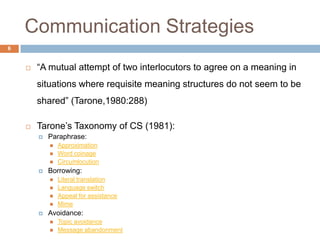
       Paraphrase: Approximation
           The   speaker substitutes the desired unknown target
           language item for a new one, which is assumed to
           share enough semantic features with it to be correctly
           interpreted, e.g.:
                “pipe” for “water pipe”
Communication Strategies
8
    (Con‟t)
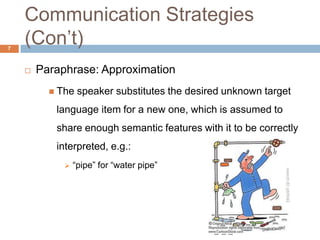
       Paraphrase: Word coinage
           The   learner makes up a new word following the target
           language rules of derivation and composition, e.g.:
                “airball” for “balloon”
Communication Strategies
9
    (Con‟t)
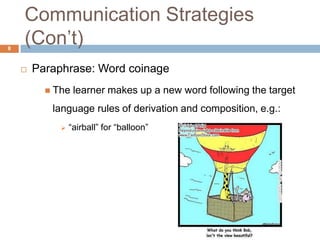
       Paraphrase: Circumlocution
           The   learner describes an object or action instead of
           using the appropriate target language item, e.g.:
                „it´s like ja- jacket without the arms?‟ (“waistcoat”)
Communication Strategies
10
     (Con‟t)
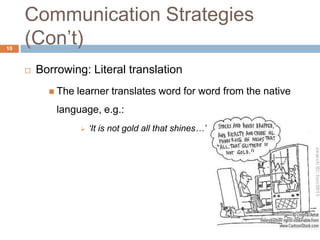
        Borrowing: Literal translation
            The   learner translates word for word from the native
             language, e.g.:
                      „It is not gold all that shines…‟
Communication Strategies
11
     (Con‟t)
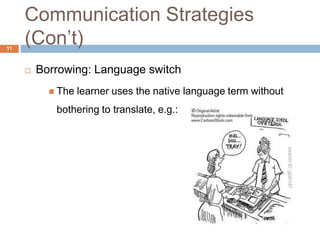
        Borrowing: Language switch
            The   learner uses the native language term without
            bothering to translate, e.g.:
Communication Strategies
12
     (Con‟t)
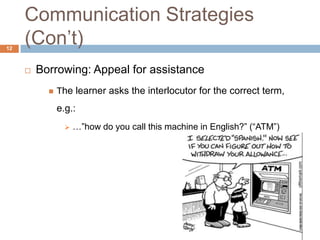
        Borrowing: Appeal for assistance
              The learner asks the interlocutor for the correct term,
               e.g.:
                    …”how do you call this machine in English?” (“ATM”)
Communication Strategies
13
     (Con‟t)
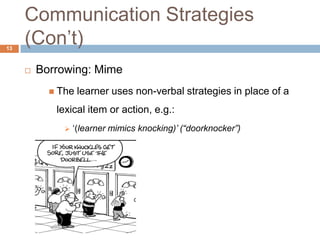
        Borrowing: Mime
            The   learner uses non-verbal strategies in place of a
            lexical item or action, e.g.:
                 „(learner mimics knocking)‟ (“doorknocker”)
Communication Strategies
14
     (Con‟t)
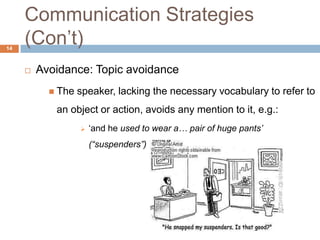
        Avoidance: Topic avoidance
            The   speaker, lacking the necessary vocabulary to refer to
            an object or action, avoids any mention to it, e.g.:
                      „and he used to wear a… pair of huge pants‟
                       (“suspenders”)
Communication Strategies
15
     (Con‟t)
        Avoidance: Message abandonment
            The   speaker begins to talk about a concept but,
            feeling unable to continue, stops before reaching their
            communicative goal, e.g.:
                      „… a shirt with … eh … umm … … I don‟t know‟ (“tie”)
Goal
16


        In the light of the increase of comprehension in
         listening, speaking, reading and writing in a
         regular foreign language classroom (McKay,
         2000), this research proposal aims to examine
         the impact of this teaching technique on NNSs‟
         oral performance

        Given the limited research about interactional
         situations within a CLIL environment, a look at
         the development of communication strategies
         employed in a bilingual context is, therefore,
Participants
17


        2nd CSE
        4th CSE    Experimental        Control Group
                       Group
        2nd BACH
                    CLIL students   Non-CLIL students


                              Pretest
                              Midtest
                              Posttest
Tasks: Sharing some stories…
18


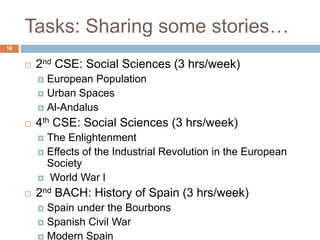
        2nd CSE: Social Sciences (3 hrs/week)
          European Population
          Urban Spaces
          Al-Andalus

        4th CSE: Social Sciences (3 hrs/week)
          The Enlightenment
          Effects of the Industrial Revolution in the European
           Society
          World War I

        2nd BACH: History of Spain (3 hrs/week)
          Spain under the Bourbons
          Spanish Civil War
          Modern Spain
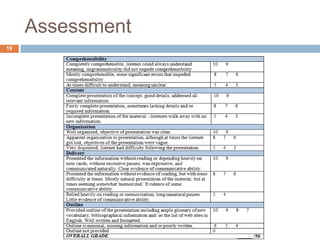
Assessment
19
Conclusions
20


        TPRS helps NNSs…
            … learn an L2 in a natural way through hearing stories
             told in the target language

            … become proficient in speaking and understanding a
             new language (Ray & Seely, 2004)

        In short, this study hopes to contribute to the
         minimal research dedicated to the SLA and CLIL
         areas from an interactionist approach
21   Questions? Doubts? Comments?
22
     Francisco Salgado Robles
     (fasalrob@alumno.upo.es)
References
23

        Davidheiser, J. (2002) Teaching German with TPRS (Total Physical Response
         Storytelling). Die Unterrichtspraxis, 35.1, 25-35.


        Marsh, D. (1994). Bilingual Education & Content and Language Integrated
         Learning. International Association for Cross-cultural Communication. University
         of Sorbonne. Paris.


        Ray, B. & Seely, C., (2002). Fluency Through TPR Storytelling: Achieving Real
         Language Acquisition in School. Berkeley, CA: Command Performance Language
         Institute.


        Tarone, E. (1980). Communication strategies, foreigner talk, and repair in
         interlanguage. Language Learning, 30, 417–431.


        ________(1981). Some thoughts on the notion of communication strategy.
         TESOL Quarterly,15, 285-295.

Language Learning through Storytelling

  • 1.
    LANGUAGE LEARNING THROUGH STORYTELLING: A LOOK AT THE DEVELOPMENT OF COMMUNICATION STRATEGIES IN A CLIL ENVIRONMENT Francisco Salgado-Robles 2nd Graduate Colloquium on Bilingual Education Universidad Pablo de Olavide – Sevilla [04/05/2010]
  • 2.
    Rationale 2  Content and Language Integrated Learning (CLIL) “refers to situations where subjects, or parts of subjects, are taught through a foreign language with dual-focused aims, namely the learning of content, and the simultaneous learning of a foreign language” (Marsh, 1994)  E.g., the subject can be entirely unrelated to language learning, such as science lessons taught in English in a school in Spain
  • 3.
    Rationale (Con‟t) 3  Oral fluency gains  The non-CLIL oriented research reveals that learners (NNS) encounter inevitable difficulties to communicate in an L2  Teaching Proficiency through Reading and Storytelling (TPRS) helps NNS become proficient in speaking and understanding a new language (Ray & Seely, 2004)
  • 4.
    Teaching Proficiency through 4 Reading and Storytelling  Combination of elements of Total Physical Response (TPR) and storytelling styles to teach language (Ray, 1990)  Learning of an L2 in a natural way through hearing stories told in the target language  Effective in all sectors of education because NNSs do not view their exposure to the L2 as tedious “learning”, but they enjoy its acquisition in an effortless and fun way
  • 5.
    Teaching Proficiency through 5 Reading and Storytelling (Con‟t)  NNSs “feel included and validated” (Davidheiser, 2002) because stories are personalized and comprehensible  Reduction of the affective filter by not prompting students to speak before they are ready  Greater student retention, increase of fluency in speaking and writing, and less failure rate on tests
  • 6.
    Communication Strategies 6  “A mutual attempt of two interlocutors to agree on a meaning in situations where requisite meaning structures do not seem to be shared” (Tarone,1980:288)  Tarone‟s Taxonomy of CS (1981):  Paraphrase:  Approximation  Word coinage  Circumlocution  Borrowing:  Literal translation  Language switch  Appeal for assistance  Mime  Avoidance:  Topic avoidance  Message abandonment
  • 7.
    Communication Strategies 7 (Con‟t)  Paraphrase: Approximation  The speaker substitutes the desired unknown target language item for a new one, which is assumed to share enough semantic features with it to be correctly interpreted, e.g.:  “pipe” for “water pipe”
  • 8.
    Communication Strategies 8 (Con‟t)  Paraphrase: Word coinage  The learner makes up a new word following the target language rules of derivation and composition, e.g.:  “airball” for “balloon”
  • 9.
    Communication Strategies 9 (Con‟t)  Paraphrase: Circumlocution  The learner describes an object or action instead of using the appropriate target language item, e.g.:  „it´s like ja- jacket without the arms?‟ (“waistcoat”)
  • 10.
    Communication Strategies 10 (Con‟t)  Borrowing: Literal translation  The learner translates word for word from the native language, e.g.:  „It is not gold all that shines…‟
  • 11.
    Communication Strategies 11 (Con‟t)  Borrowing: Language switch  The learner uses the native language term without bothering to translate, e.g.:
  • 12.
    Communication Strategies 12 (Con‟t)  Borrowing: Appeal for assistance  The learner asks the interlocutor for the correct term, e.g.:  …”how do you call this machine in English?” (“ATM”)
  • 13.
    Communication Strategies 13 (Con‟t)  Borrowing: Mime  The learner uses non-verbal strategies in place of a lexical item or action, e.g.:  „(learner mimics knocking)‟ (“doorknocker”)
  • 14.
    Communication Strategies 14 (Con‟t)  Avoidance: Topic avoidance  The speaker, lacking the necessary vocabulary to refer to an object or action, avoids any mention to it, e.g.:  „and he used to wear a… pair of huge pants‟ (“suspenders”)
  • 15.
    Communication Strategies 15 (Con‟t)  Avoidance: Message abandonment  The speaker begins to talk about a concept but, feeling unable to continue, stops before reaching their communicative goal, e.g.:  „… a shirt with … eh … umm … … I don‟t know‟ (“tie”)
  • 16.
    Goal 16  In the light of the increase of comprehension in listening, speaking, reading and writing in a regular foreign language classroom (McKay, 2000), this research proposal aims to examine the impact of this teaching technique on NNSs‟ oral performance  Given the limited research about interactional situations within a CLIL environment, a look at the development of communication strategies employed in a bilingual context is, therefore,
  • 17.
    Participants 17  2nd CSE  4th CSE Experimental Control Group Group  2nd BACH CLIL students Non-CLIL students Pretest Midtest Posttest
  • 18.
    Tasks: Sharing somestories… 18  2nd CSE: Social Sciences (3 hrs/week)  European Population  Urban Spaces  Al-Andalus  4th CSE: Social Sciences (3 hrs/week)  The Enlightenment  Effects of the Industrial Revolution in the European Society  World War I  2nd BACH: History of Spain (3 hrs/week)  Spain under the Bourbons  Spanish Civil War  Modern Spain
  • 19.
  • 20.
    Conclusions 20  TPRS helps NNSs…  … learn an L2 in a natural way through hearing stories told in the target language  … become proficient in speaking and understanding a new language (Ray & Seely, 2004)  In short, this study hopes to contribute to the minimal research dedicated to the SLA and CLIL areas from an interactionist approach
  • 21.
    21 Questions? Doubts? Comments?
  • 22.
    22 Francisco Salgado Robles (fasalrob@alumno.upo.es)
  • 23.
    References 23  Davidheiser, J. (2002) Teaching German with TPRS (Total Physical Response Storytelling). Die Unterrichtspraxis, 35.1, 25-35.  Marsh, D. (1994). Bilingual Education & Content and Language Integrated Learning. International Association for Cross-cultural Communication. University of Sorbonne. Paris.  Ray, B. & Seely, C., (2002). Fluency Through TPR Storytelling: Achieving Real Language Acquisition in School. Berkeley, CA: Command Performance Language Institute.  Tarone, E. (1980). Communication strategies, foreigner talk, and repair in interlanguage. Language Learning, 30, 417–431.  ________(1981). Some thoughts on the notion of communication strategy. TESOL Quarterly,15, 285-295.