Total
Physical
 Response
(TPR)


            PONTIFICIA UNIVERSIDAD CATOLICA MADRE Y MAESTRA
                                       TESL TRAINING COURSE
                                      PROF.: MANUEL PERALTA
                                    SANTIAGO, FEBRUARY 2012
 Todevelop listening comprehension before
 speaking.


 Tohelp students connect the expressions in
 the target language with the movement that
 can convey the meaning.
Creator of the TPR
 The now gives
 The teacher gives a         commands randomly.
  command and                When students make
  performs with the           an error, the teacher
  students who remain         repeats correctly
  silent.                     while acting it.
 The teacher sits down      The teacher writes
  and gives new               the new commands on
  commands.                   the board.
 After the first six are    The teacher asks a
  mastered, other             student to give the
  commands are added.         commands.
 Use   of commands to direct behavior

 Rolereversal. Students commanding
 the teacher and other students.

 Action   sequence.
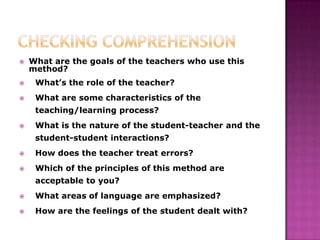
   What are the goals of the teachers who use this
    method?
    What’s the role of the teacher?
    What are some characteristics of the
     teaching/learning process?
    What is the nature of the student-teacher and the
     student-student interactions?
    How does the teacher treat errors?
    Which of the principles of this method are
     acceptable to you?
    What areas of language are emphasized?
    How are the feelings of the student dealt with?

TPR

  • 1.
    Total Physical Response (TPR) PONTIFICIA UNIVERSIDAD CATOLICA MADRE Y MAESTRA TESL TRAINING COURSE PROF.: MANUEL PERALTA SANTIAGO, FEBRUARY 2012
  • 2.
     Todevelop listeningcomprehension before speaking.  Tohelp students connect the expressions in the target language with the movement that can convey the meaning.
  • 3.
  • 4.
     The nowgives  The teacher gives a commands randomly. command and  When students make performs with the an error, the teacher students who remain repeats correctly silent. while acting it.  The teacher sits down  The teacher writes and gives new the new commands on commands. the board.  After the first six are  The teacher asks a mastered, other student to give the commands are added. commands.
  • 5.
     Use of commands to direct behavior  Rolereversal. Students commanding the teacher and other students.  Action sequence.
  • 6.
    What are the goals of the teachers who use this method?  What’s the role of the teacher?  What are some characteristics of the teaching/learning process?  What is the nature of the student-teacher and the student-student interactions?  How does the teacher treat errors?  Which of the principles of this method are acceptable to you?  What areas of language are emphasized?  How are the feelings of the student dealt with?