SUBMITTED BY:-
SUGGESTED BY:-
Dr. Sanjeev kumar
Dr. Amit singh
Dr. Rashmi
DEPARTMENT OF VETERINARY AND ANIMAL HUSBANDRY EXTENSION EDUCATION
CONTENT
1. WHAT IS ICAR
2. MANDATE OF ICAR
3. STRUCTURE OF ICAR
4. DIVISIONS OF ICAR
5. INSTITUTES OF ICAR
6. MILESTONES OF ICAR
7. ACHEIVEMENTS OF ICAR
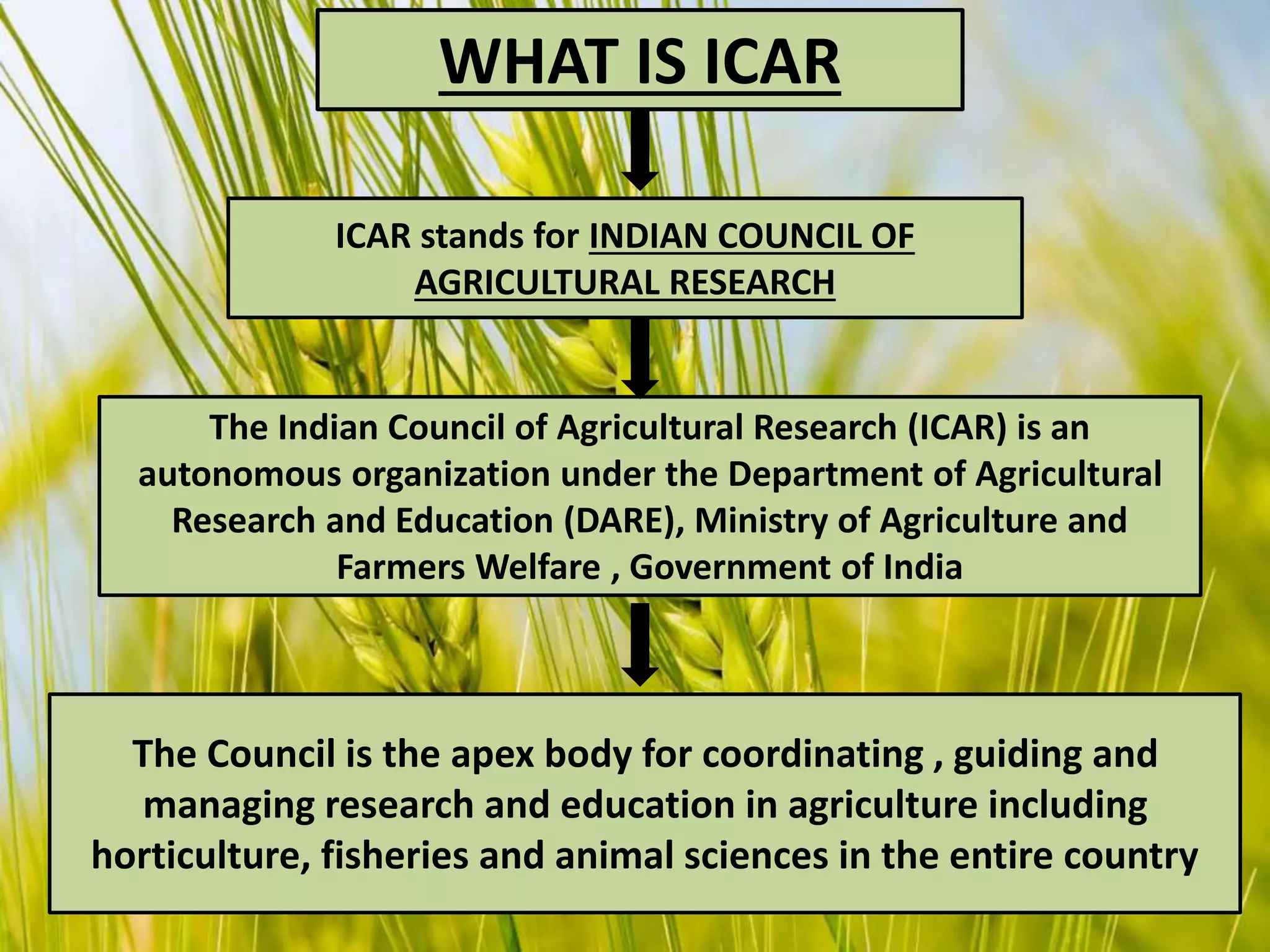
WHAT IS ICAR
The Indian Council of Agricultural Research (ICAR) is an
autonomous organization under the Department of Agricultural
Research and Education (DARE), Ministry of Agriculture and
Farmers Welfare , Government of India
ICAR stands for INDIAN COUNCIL OF
AGRICULTURAL RESEARCH
The Council is the apex body for coordinating , guiding and
managing research and education in agriculture including
horticulture, fisheries and animal sciences in the entire country
It was established on
16 July 1929 as a
registered society
under the Societies
Registration Act
ICAR has its
headquarters at New
Delhi. Minister of
agriculture is the
president of ICAR
With 101 ICAR institutes and 71
agricultural universities spread
across the country this is one of
the largest national agricultural
systems in the world
MINISTERS
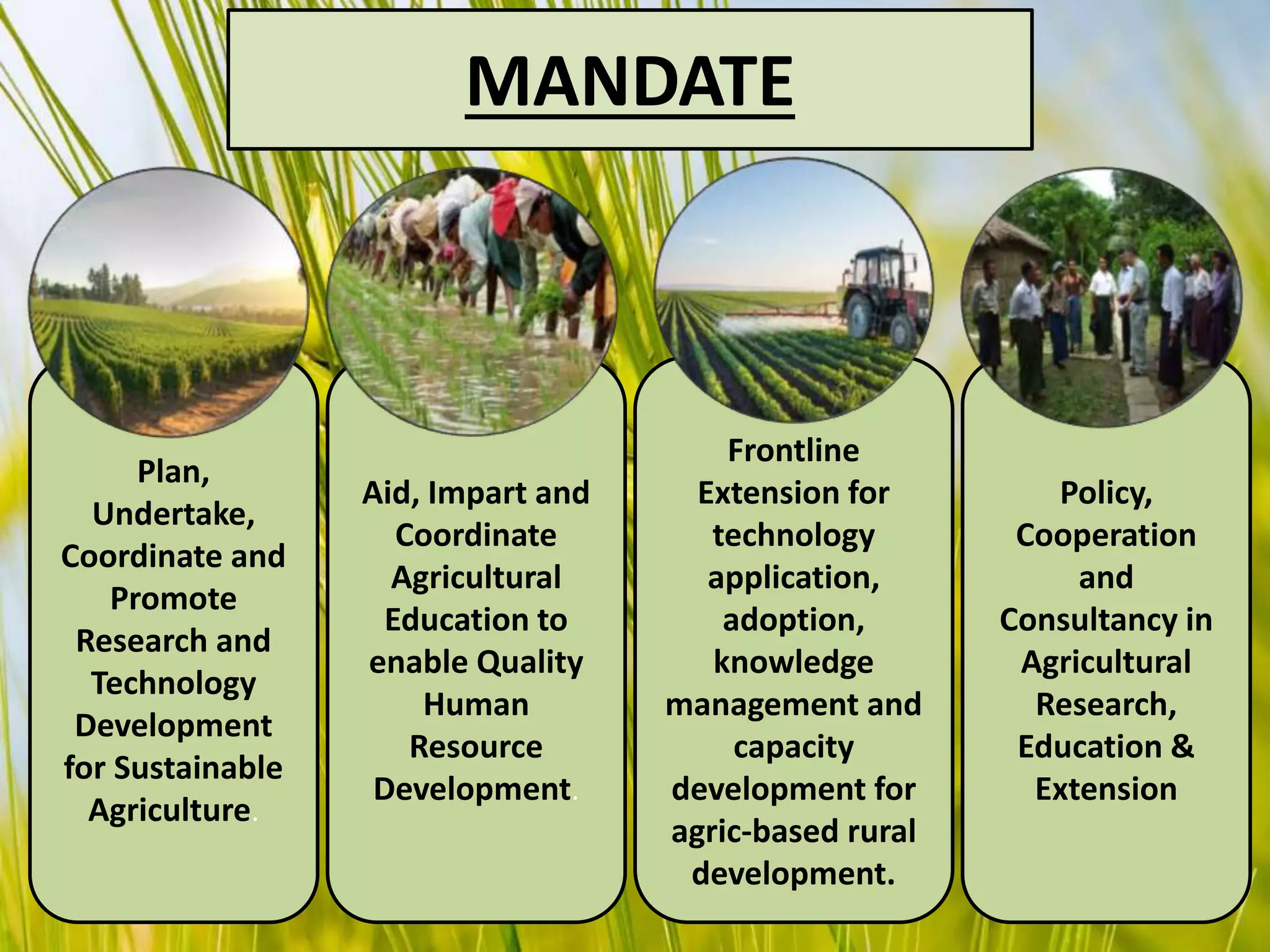
MANDATE
Plan,
Undertake,
Coordinate and
Promote
Research and
Technology
Development
for Sustainable
Agriculture.
Aid, Impart and
Coordinate
Agricultural
Education to
enable Quality
Human
Resource
Development.
Policy,
Cooperation
and
Consultancy in
Agricultural
Research,
Education &
Extension
Frontline
Extension for
technology
application,
adoption,
knowledge
management and
capacity
development for
agric-based rural
development.
3.ORGANIZATION
STRUCTURE
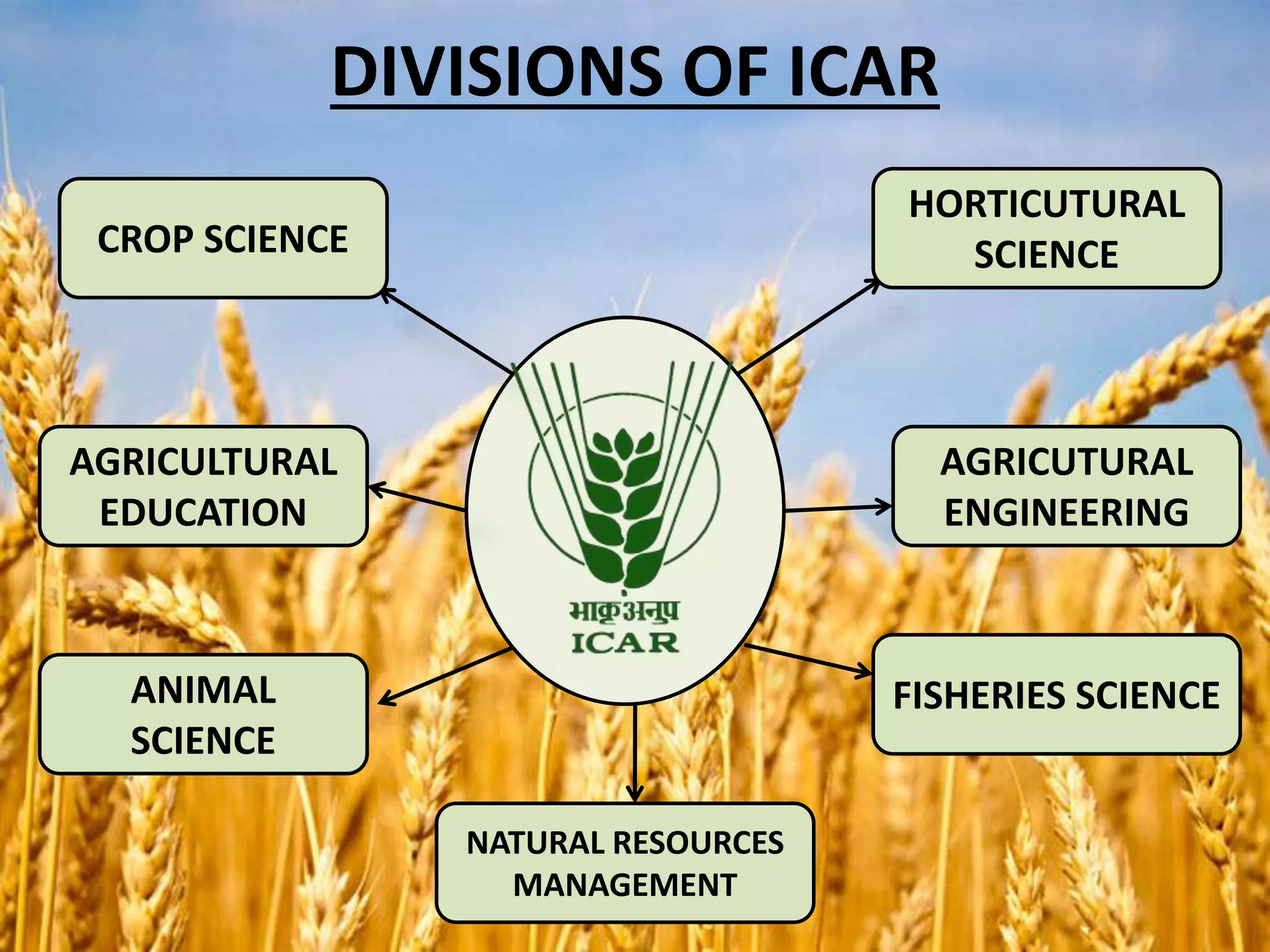
DIVISIONS OF ICAR
CROP SCIENCE
FISHERIES SCIENCE
ANIMAL
SCIENCE
AGRICULTURAL
EDUCATION
NATURAL RESOURCES
MANAGEMENT
AGRICUTURAL
ENGINEERING
HORTICUTURAL
SCIENCE
CROP SCIENCE
Harnessing conventional and modern scientific knowledge, tools, and
cutting-edge of science for development of improved crop
varieties/hybrids suited to diverse agro-ecologies and situations, and
efficient, economic, eco-friendly and sustainable crop production
Conservation and sustainable use of genetic resources
of plants, insects and other invertebrates, and
agriculturally important microorganisms
Refinement of seed-production technologies and production of
breeder seed with added emphasis on hybrid cultivars
HORTICULTURE
SCIENCE
Horticulture Division vested with the responsibility of overseeing the overall
accelerated development of horticulture in national perspective for improving
nutritional, ecological and livelihood security.
Enhancing the
shelf life of
perishable fruits,
vegetables,
flowers.
Increasing the value
of production by
reducing variability in
yield, quality,
reducing crop loss
and increasing
marketability
Developing system for
productive use of
nutrients, water and
reducing impact of pest
through the use of
innovative diagnostic
techniques.
Develop the
production system
that minimizes the
production of wastes
and maximizes the
re-use of waste.
FISHERIES SCIENCE
Sustainable growth of Indian fisheries and aquaculture by interfacing research,
education and extension resulting in a proper fit between the human needs
and the habitat, with an important role in global fisheries.
Development of diagnostics, vaccines
and disease management measures for
current and emerging diseases.
Development of diagnostics, vaccines
and disease management measures for
current and emerging diseases.
Breeding and rearing of ornamental fin
fishes and shellfishes of freshwater and
marine origin.
Reduction of harvest and post-harvest
losses of fish through mitigation
measures.
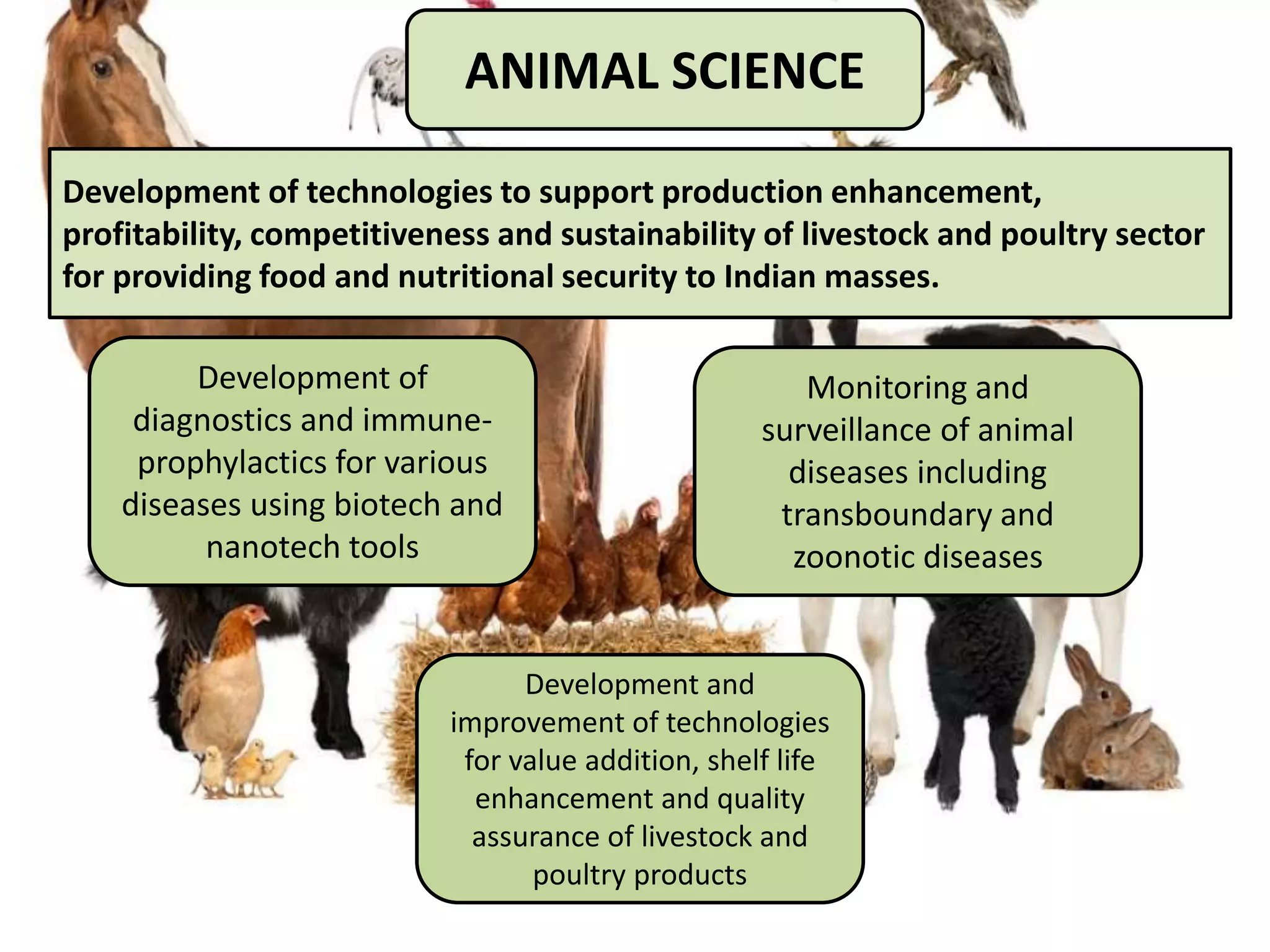
ANIMAL SCIENCE
Development of technologies to support production enhancement,
profitability, competitiveness and sustainability of livestock and poultry sector
for providing food and nutritional security to Indian masses.
Development of
diagnostics and immune-
prophylactics for various
diseases using biotech and
nanotech tools
Development and
improvement of technologies
for value addition, shelf life
enhancement and quality
assurance of livestock and
poultry products
Monitoring and
surveillance of animal
diseases including
transboundary and
zoonotic diseases
MANAGEMENT OF
NATURAL RESOURCES
Sustainable management of natural resources for achieving food,
nutritional, environmental and livelihood security in the country.
Land Resource
Inventory,
Characterization
& Agricultural
Land Use
Planning
Integrated Water
Management &
Waste Water
Utilization
Nutrient and
Bio-waste
Management
Climate Resilient
Agriculture and
abiotic stress
management
Strengthening and streamlining of higher agricultural education
system to enhance the quality of human resources in agri-supply
chain to meet future challenges in agriculture sector in the
country
Plan, promote and
coordinate agricultural
education in the
country.
Enhance the quality and
relevance of higher
agricultural education
in the country.
Strengthen the Agricultural
University system for
developing quality human
resource in agriculture and
allied sciences
To make Indian agriculture sustainable, profitable and competitive
enterprise through engineering interventions of farm mechanization,
value addition and energy management in production and post-harvest
operations.
Increasing work efficiency for human, animal and mechanical
systems and reduction of occupational hazards in agricultural
operations.
Development of precision machinery and strategies for
carrying out timely and efficient agricultural operations in
irrigated, rain-fed and hill agriculture, horticulture, livestock
and fisheries production.
Application of robotics and drones in production agriculture,
electromagnetic waves in food processing.
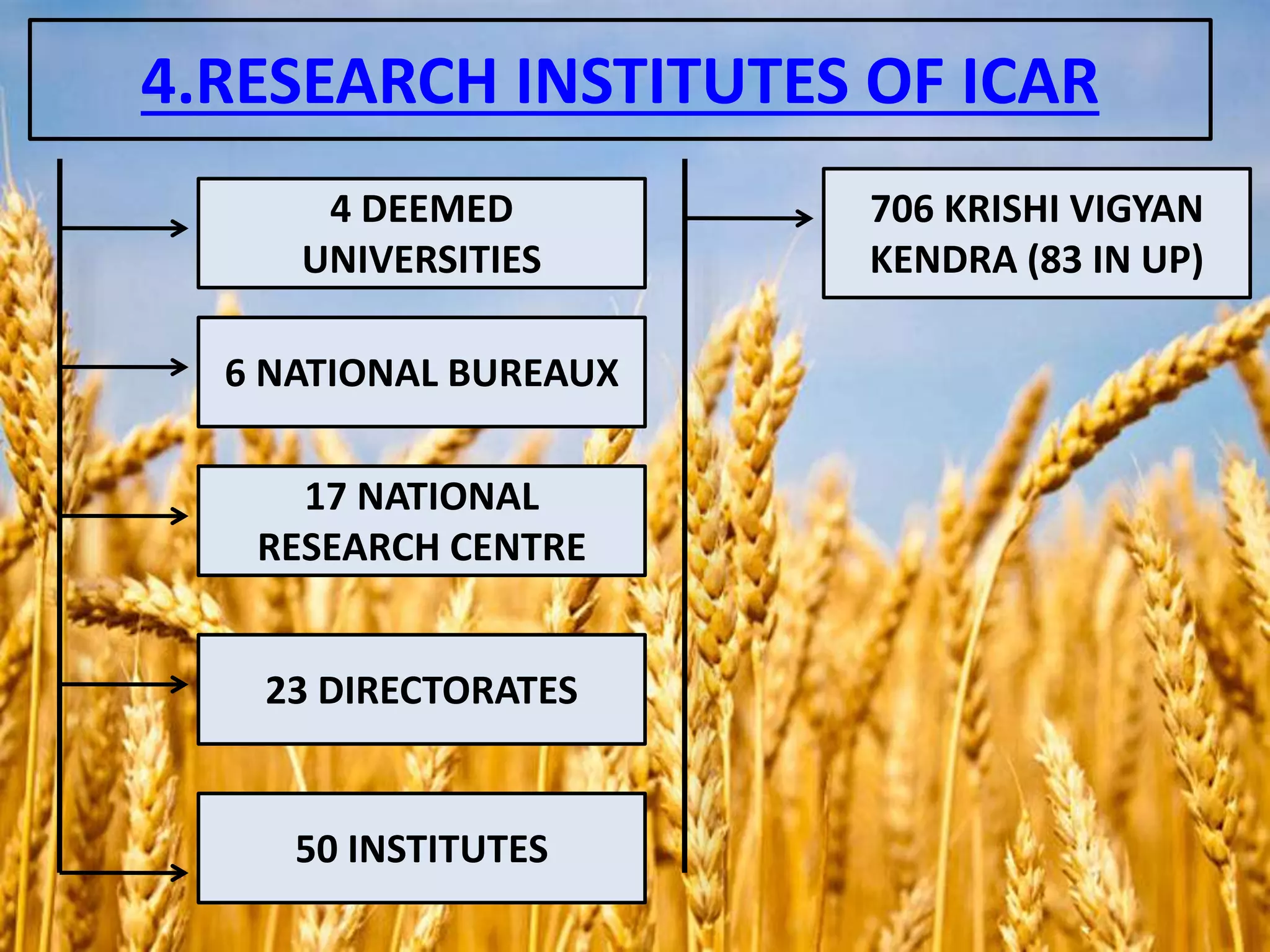
4.RESEARCH INSTITUTES OF ICAR
4 DEEMED
UNIVERSITIES
6 NATIONAL BUREAUX
17 NATIONAL
RESEARCH CENTRE
23 DIRECTORATES
50 INSTITUTES
706 KRISHI VIGYAN
KENDRA (83 IN UP)
MILESTONES OF ICAR
1957
Initiation of
First AICR on
maize
1960
establishment
of first state
agriculture
university
pantangar
1973 creation of
department of
agriculture
research and
education
1974 opening
of first krishi
vigyan
kendra at
puducherry
1979 Launch
of lab to land
programme
and NARP
1995 Intiation
of Institution
village linkage
programme
2004 king
baoudoin
award
2005
launching
of National
agricultural
innovation
project
2019 launch
of itegrated
Mobile app
KISSAN
1
2
3
4
5
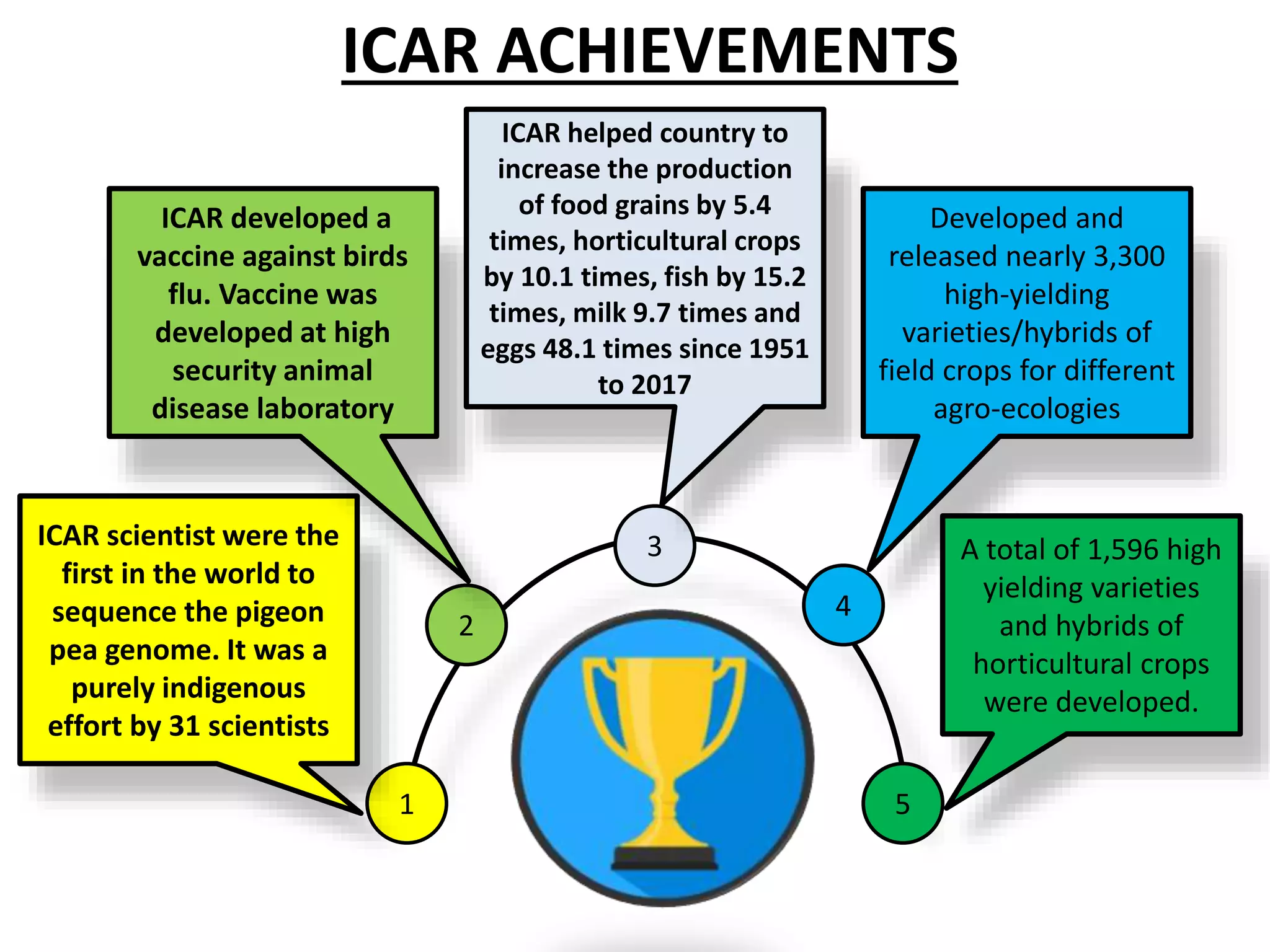
ICAR scientist were the
first in the world to
sequence the pigeon
pea genome. It was a
purely indigenous
effort by 31 scientists
ICAR developed a
vaccine against birds
flu. Vaccine was
developed at high
security animal
disease laboratory
ICAR helped country to
increase the production
of food grains by 5.4
times, horticultural crops
by 10.1 times, fish by 15.2
times, milk 9.7 times and
eggs 48.1 times since 1951
to 2017
Developed and
released nearly 3,300
high-yielding
varieties/hybrids of
field crops for different
agro-ecologies
A total of 1,596 high
yielding varieties
and hybrids of
horticultural crops
were developed.
ICAR ACHIEVEMENTS
Presentation on icar

Presentation on icar

  • 1.
    SUBMITTED BY:- SUGGESTED BY:- Dr.Sanjeev kumar Dr. Amit singh Dr. Rashmi DEPARTMENT OF VETERINARY AND ANIMAL HUSBANDRY EXTENSION EDUCATION
  • 2.
    CONTENT 1. WHAT ISICAR 2. MANDATE OF ICAR 3. STRUCTURE OF ICAR 4. DIVISIONS OF ICAR 5. INSTITUTES OF ICAR 6. MILESTONES OF ICAR 7. ACHEIVEMENTS OF ICAR
  • 3.
    WHAT IS ICAR TheIndian Council of Agricultural Research (ICAR) is an autonomous organization under the Department of Agricultural Research and Education (DARE), Ministry of Agriculture and Farmers Welfare , Government of India ICAR stands for INDIAN COUNCIL OF AGRICULTURAL RESEARCH The Council is the apex body for coordinating , guiding and managing research and education in agriculture including horticulture, fisheries and animal sciences in the entire country
  • 4.
    It was establishedon 16 July 1929 as a registered society under the Societies Registration Act ICAR has its headquarters at New Delhi. Minister of agriculture is the president of ICAR With 101 ICAR institutes and 71 agricultural universities spread across the country this is one of the largest national agricultural systems in the world
  • 5.
  • 6.
    MANDATE Plan, Undertake, Coordinate and Promote Research and Technology Development forSustainable Agriculture. Aid, Impart and Coordinate Agricultural Education to enable Quality Human Resource Development. Policy, Cooperation and Consultancy in Agricultural Research, Education & Extension Frontline Extension for technology application, adoption, knowledge management and capacity development for agric-based rural development.
  • 7.
  • 8.
    DIVISIONS OF ICAR CROPSCIENCE FISHERIES SCIENCE ANIMAL SCIENCE AGRICULTURAL EDUCATION NATURAL RESOURCES MANAGEMENT AGRICUTURAL ENGINEERING HORTICUTURAL SCIENCE
  • 9.
    CROP SCIENCE Harnessing conventionaland modern scientific knowledge, tools, and cutting-edge of science for development of improved crop varieties/hybrids suited to diverse agro-ecologies and situations, and efficient, economic, eco-friendly and sustainable crop production Conservation and sustainable use of genetic resources of plants, insects and other invertebrates, and agriculturally important microorganisms Refinement of seed-production technologies and production of breeder seed with added emphasis on hybrid cultivars
  • 10.
    HORTICULTURE SCIENCE Horticulture Division vestedwith the responsibility of overseeing the overall accelerated development of horticulture in national perspective for improving nutritional, ecological and livelihood security. Enhancing the shelf life of perishable fruits, vegetables, flowers. Increasing the value of production by reducing variability in yield, quality, reducing crop loss and increasing marketability Developing system for productive use of nutrients, water and reducing impact of pest through the use of innovative diagnostic techniques. Develop the production system that minimizes the production of wastes and maximizes the re-use of waste.
  • 11.
    FISHERIES SCIENCE Sustainable growthof Indian fisheries and aquaculture by interfacing research, education and extension resulting in a proper fit between the human needs and the habitat, with an important role in global fisheries. Development of diagnostics, vaccines and disease management measures for current and emerging diseases. Development of diagnostics, vaccines and disease management measures for current and emerging diseases. Breeding and rearing of ornamental fin fishes and shellfishes of freshwater and marine origin. Reduction of harvest and post-harvest losses of fish through mitigation measures.
  • 12.
    ANIMAL SCIENCE Development oftechnologies to support production enhancement, profitability, competitiveness and sustainability of livestock and poultry sector for providing food and nutritional security to Indian masses. Development of diagnostics and immune- prophylactics for various diseases using biotech and nanotech tools Development and improvement of technologies for value addition, shelf life enhancement and quality assurance of livestock and poultry products Monitoring and surveillance of animal diseases including transboundary and zoonotic diseases
  • 13.
    MANAGEMENT OF NATURAL RESOURCES Sustainablemanagement of natural resources for achieving food, nutritional, environmental and livelihood security in the country. Land Resource Inventory, Characterization & Agricultural Land Use Planning Integrated Water Management & Waste Water Utilization Nutrient and Bio-waste Management Climate Resilient Agriculture and abiotic stress management
  • 14.
    Strengthening and streamliningof higher agricultural education system to enhance the quality of human resources in agri-supply chain to meet future challenges in agriculture sector in the country Plan, promote and coordinate agricultural education in the country. Enhance the quality and relevance of higher agricultural education in the country. Strengthen the Agricultural University system for developing quality human resource in agriculture and allied sciences
  • 15.
    To make Indianagriculture sustainable, profitable and competitive enterprise through engineering interventions of farm mechanization, value addition and energy management in production and post-harvest operations. Increasing work efficiency for human, animal and mechanical systems and reduction of occupational hazards in agricultural operations. Development of precision machinery and strategies for carrying out timely and efficient agricultural operations in irrigated, rain-fed and hill agriculture, horticulture, livestock and fisheries production. Application of robotics and drones in production agriculture, electromagnetic waves in food processing.
  • 16.
    4.RESEARCH INSTITUTES OFICAR 4 DEEMED UNIVERSITIES 6 NATIONAL BUREAUX 17 NATIONAL RESEARCH CENTRE 23 DIRECTORATES 50 INSTITUTES 706 KRISHI VIGYAN KENDRA (83 IN UP)
  • 17.
    MILESTONES OF ICAR 1957 Initiationof First AICR on maize 1960 establishment of first state agriculture university pantangar 1973 creation of department of agriculture research and education 1974 opening of first krishi vigyan kendra at puducherry 1979 Launch of lab to land programme and NARP 1995 Intiation of Institution village linkage programme 2004 king baoudoin award 2005 launching of National agricultural innovation project 2019 launch of itegrated Mobile app KISSAN
  • 18.
    1 2 3 4 5 ICAR scientist werethe first in the world to sequence the pigeon pea genome. It was a purely indigenous effort by 31 scientists ICAR developed a vaccine against birds flu. Vaccine was developed at high security animal disease laboratory ICAR helped country to increase the production of food grains by 5.4 times, horticultural crops by 10.1 times, fish by 15.2 times, milk 9.7 times and eggs 48.1 times since 1951 to 2017 Developed and released nearly 3,300 high-yielding varieties/hybrids of field crops for different agro-ecologies A total of 1,596 high yielding varieties and hybrids of horticultural crops were developed. ICAR ACHIEVEMENTS