Lesson Plan Seven
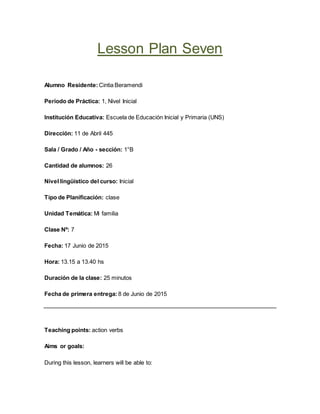
Alumno Residente:Cintia Beramendi
Período de Práctica: 1, Nivel Inicial
Institución Educativa: Escuela de Educación Inicial y Primaria (UNS)
Dirección: 11 de Abril 445
Sala / Grado / Año - sección: 1°B
Cantidad de alumnos: 26
Nivel lingüístico del curso: Inicial
Tipo de Planificación: clase
Unidad Temática: Mi familia
Clase Nº: 7
Fecha: 17 Junio de 2015
Hora: 13.15 a 13.40 hs
Duración de la clase: 25 minutos
Fecha de primera entrega: 8 de Junio de 2015
Teaching points: action verbs
Aims or goals:
During this lesson, learners will be able to:
 Recognize simple questions such as “What’s your name? “Who is he/she?”
 Recognize simple structures such us “This is my dad”.
 Recognize new vocabulary related to action verbs
 Participate communicatively in different activities.
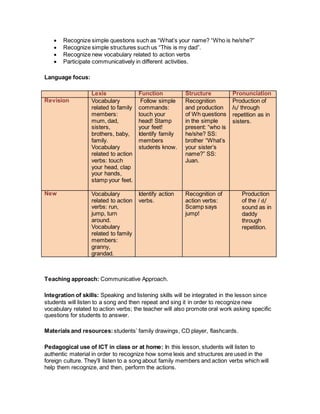
Language focus:
Lexis Function Structure Pronunciation
Revision Vocabulary
related to family
members:
mum, dad,
sisters,
brothers, baby,
family.
Vocabulary
related to action
verbs: touch
your head, clap
your hands,
stamp your feet.
Follow simple
commands:
touch your
head! Stamp
your feet!
Identify family
members
students know.
Recognition
and production
of Wh questions
in the simple
present: “who is
he/she? SS:
brother “What’s
your sister’s
name?” SS:
Juan.
Production of
/s/ through
repetition as in
sisters.
New Vocabulary
related to action
verbs: run,
jump, turn
around.
Vocabulary
related to family
members:
granny,
grandad.
Identify action
verbs.
Recognition of
action verbs:
Scamp says
jump!
Production
of the / d/
sound as in
daddy
through
repetition.
Teaching approach: Communicative Approach.
Integration of skills: Speaking and listening skills will be integrated in the lesson since
students will listen to a song and then repeat and sing it in order to recognize new
vocabulary related to action verbs; the teacher will also promote oral work asking specific
questions for students to answer.
Materials and resources: students’ family drawings, CD player, flashcards.
Pedagogical use of ICT in class or at home: In this lesson, students will listen to
authentic material in order to recognize how some lexis and structures are used in the
foreign culture. They’ll listen to a song about family members and action verbs which will
help them recognize, and then, perform the actions.
In case the device doesn’t work, I’ll record the songs on a pen drive and play it on a small
speaker.
Seating arrangement: students will be sitting in groups of 4 or 5, and standing up
according to the activity.
Possible problems / difficulties and their possible solutions during the class:
Students may resort to their mother tongue when trying to participate during the lesson, so
the teacher will give them the equivalent of the word or phrase in the foreign language for
them to repeat.
Classroom management strategies:
The teacher will let students know when the lesson has started and finished by playing a
routine “Hello” and “Goodbye” song. Besides, she will work with a song and TPR activities
which students really like so as to maintain motivation and avoid boredom.
Potential problems students may have with the language:
Students may have problems in understanding what some action verbs mean, so the
teacher will demonstrate while naming different action verbs, and ask students to perform
them.
Assessment:
Students will be assessed individually when the teacher asks specific questions and in
groups when collaborating and participating along the activities.
Procedures:
Routine: 5 minutes
Purpose: To greet students and let them know that the lesson has started.
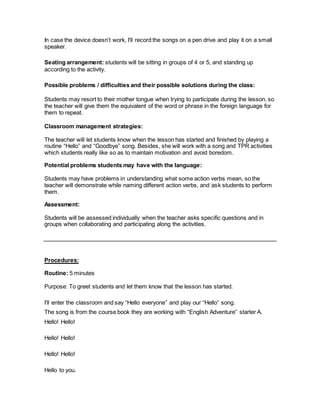
I’ll enter the classroom and say “Hello everyone” and play our “Hello” song.
The song is from the course book they are working with “English Adventure” starter A.
Hello! Hello!
Hello! Hello!
Hello! Hello!
Hello to you.
(repeated twice)
Then, I’ll throw a soft ball to one of the students and say “I’m Cintia, What’s your name?”
and the student will say “I’m ____” I’ll do this with different students.
Transition: Very good children!
Warm up: 5 minutes
Purpose: To contextualize the topics.
I’ll say, ok kids, Can you show me your drawings of your family members? (This is a task
they’ve done with their teacher in previous lessons) Very good! (I’ll go student by student
and ask “Who is he/she? SS: brother T: what’s your brother’s name? SS: juan! T: very
good! (I’ll help students understand the questions and help them answer them miming and
exemplifying).
Transition: Very good!
Presentation:4 minutes
Purpose: to introduce new vocabulary and structures.
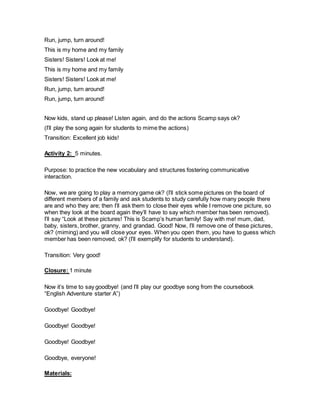
Now, Do you remember the dog family? (I’ll show students the picture I brought the
previous class) SS: yes!! Ok, now Scamp (pointing to it) wants you to do something!
Please, stand up! Scamp says touch your head! (miming) very good! Now Scamp says
clap your hands! (miming) Excellent! Scamp says stamp your feet! Very good! Now,
Scamp says run (miming); and now jump! Excellent! Now Scamp says turn around!
Transition: Very good!! Sit down please!
Activity 1: 5 minutes
Purpose: to recognize the vocabulary and structures presented.
Now, Scamp wants you to listen to him singing a song!
The song is from the coursebook “English Adventure starter A”
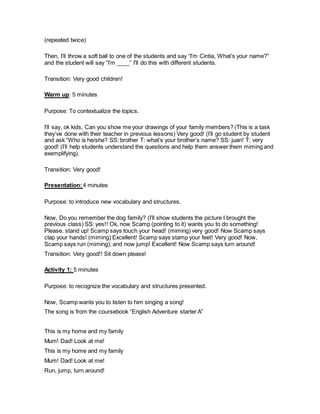
This is my home and my family
Mum! Dad! Look at me!
This is my home and my family
Mum! Dad! Look at me!
Run, jump, turn around!
This is my home and my family
Sisters! Sisters! Look at me!
This is my home and my family
Sisters! Sisters! Look at me!
Run, jump, turn around!
Now kids, stand up please! Listen again, and do the actions Scamp says ok?
(I’ll play the song again for students to mime the actions)
Transition: Excellent job kids!
Activity 2: 5 minutes.
Purpose: to practice the new vocabulary and structures fostering communicative
interaction.
Now, we are going to play a memory game ok? (I’ll stick some pictures on the board of
different members of a family and ask students to study carefully how many people there
are and who they are; then I’ll ask them to close their eyes while I remove one picture, so
when they look at the board again they’ll have to say which member has been removed).
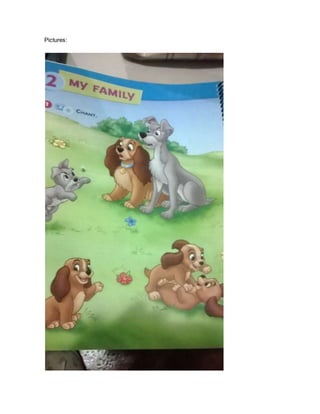
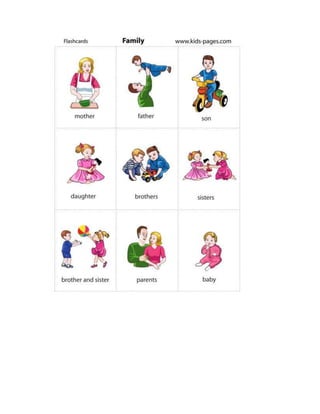
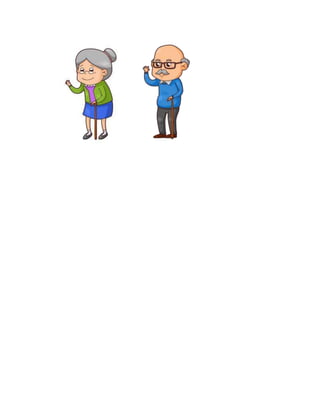
I’ll say “Look at these pictures! This is Scamp’s human family! Say with me! mum, dad,
baby, sisters, brother, granny, and grandad. Good! Now, I’ll remove one of these pictures,
ok? (miming) and you will close your eyes. When you open them, you have to guess which
member has been removed, ok? (I’ll exemplify for students to understand).
Transition: Very good!
Closure: 1 minute
Now it’s time to say goodbye! (and I’ll play our goodbye song from the coursebook
“English Adventure starter A”)
Goodbye! Goodbye!
Goodbye! Goodbye!
Goodbye! Goodbye!
Goodbye, everyone!
Materials:
Pictures:
Tpd beramendi-lesson plan 7

Tpd beramendi-lesson plan 7

  • 1.
    Lesson Plan Seven AlumnoResidente:Cintia Beramendi Período de Práctica: 1, Nivel Inicial Institución Educativa: Escuela de Educación Inicial y Primaria (UNS) Dirección: 11 de Abril 445 Sala / Grado / Año - sección: 1°B Cantidad de alumnos: 26 Nivel lingüístico del curso: Inicial Tipo de Planificación: clase Unidad Temática: Mi familia Clase Nº: 7 Fecha: 17 Junio de 2015 Hora: 13.15 a 13.40 hs Duración de la clase: 25 minutos Fecha de primera entrega: 8 de Junio de 2015 Teaching points: action verbs Aims or goals: During this lesson, learners will be able to:
  • 2.
     Recognize simplequestions such as “What’s your name? “Who is he/she?”  Recognize simple structures such us “This is my dad”.  Recognize new vocabulary related to action verbs  Participate communicatively in different activities. Language focus: Lexis Function Structure Pronunciation Revision Vocabulary related to family members: mum, dad, sisters, brothers, baby, family. Vocabulary related to action verbs: touch your head, clap your hands, stamp your feet. Follow simple commands: touch your head! Stamp your feet! Identify family members students know. Recognition and production of Wh questions in the simple present: “who is he/she? SS: brother “What’s your sister’s name?” SS: Juan. Production of /s/ through repetition as in sisters. New Vocabulary related to action verbs: run, jump, turn around. Vocabulary related to family members: granny, grandad. Identify action verbs. Recognition of action verbs: Scamp says jump! Production of the / d/ sound as in daddy through repetition. Teaching approach: Communicative Approach. Integration of skills: Speaking and listening skills will be integrated in the lesson since students will listen to a song and then repeat and sing it in order to recognize new vocabulary related to action verbs; the teacher will also promote oral work asking specific questions for students to answer. Materials and resources: students’ family drawings, CD player, flashcards. Pedagogical use of ICT in class or at home: In this lesson, students will listen to authentic material in order to recognize how some lexis and structures are used in the foreign culture. They’ll listen to a song about family members and action verbs which will help them recognize, and then, perform the actions.
  • 3.
    In case thedevice doesn’t work, I’ll record the songs on a pen drive and play it on a small speaker. Seating arrangement: students will be sitting in groups of 4 or 5, and standing up according to the activity. Possible problems / difficulties and their possible solutions during the class: Students may resort to their mother tongue when trying to participate during the lesson, so the teacher will give them the equivalent of the word or phrase in the foreign language for them to repeat. Classroom management strategies: The teacher will let students know when the lesson has started and finished by playing a routine “Hello” and “Goodbye” song. Besides, she will work with a song and TPR activities which students really like so as to maintain motivation and avoid boredom. Potential problems students may have with the language: Students may have problems in understanding what some action verbs mean, so the teacher will demonstrate while naming different action verbs, and ask students to perform them. Assessment: Students will be assessed individually when the teacher asks specific questions and in groups when collaborating and participating along the activities. Procedures: Routine: 5 minutes Purpose: To greet students and let them know that the lesson has started. I’ll enter the classroom and say “Hello everyone” and play our “Hello” song. The song is from the course book they are working with “English Adventure” starter A. Hello! Hello! Hello! Hello! Hello! Hello! Hello to you.
  • 4.
    (repeated twice) Then, I’llthrow a soft ball to one of the students and say “I’m Cintia, What’s your name?” and the student will say “I’m ____” I’ll do this with different students. Transition: Very good children! Warm up: 5 minutes Purpose: To contextualize the topics. I’ll say, ok kids, Can you show me your drawings of your family members? (This is a task they’ve done with their teacher in previous lessons) Very good! (I’ll go student by student and ask “Who is he/she? SS: brother T: what’s your brother’s name? SS: juan! T: very good! (I’ll help students understand the questions and help them answer them miming and exemplifying). Transition: Very good! Presentation:4 minutes Purpose: to introduce new vocabulary and structures. Now, Do you remember the dog family? (I’ll show students the picture I brought the previous class) SS: yes!! Ok, now Scamp (pointing to it) wants you to do something! Please, stand up! Scamp says touch your head! (miming) very good! Now Scamp says clap your hands! (miming) Excellent! Scamp says stamp your feet! Very good! Now, Scamp says run (miming); and now jump! Excellent! Now Scamp says turn around! Transition: Very good!! Sit down please! Activity 1: 5 minutes Purpose: to recognize the vocabulary and structures presented. Now, Scamp wants you to listen to him singing a song! The song is from the coursebook “English Adventure starter A” This is my home and my family Mum! Dad! Look at me! This is my home and my family Mum! Dad! Look at me! Run, jump, turn around!
  • 5.
    Run, jump, turnaround! This is my home and my family Sisters! Sisters! Look at me! This is my home and my family Sisters! Sisters! Look at me! Run, jump, turn around! Run, jump, turn around! Now kids, stand up please! Listen again, and do the actions Scamp says ok? (I’ll play the song again for students to mime the actions) Transition: Excellent job kids! Activity 2: 5 minutes. Purpose: to practice the new vocabulary and structures fostering communicative interaction. Now, we are going to play a memory game ok? (I’ll stick some pictures on the board of different members of a family and ask students to study carefully how many people there are and who they are; then I’ll ask them to close their eyes while I remove one picture, so when they look at the board again they’ll have to say which member has been removed). I’ll say “Look at these pictures! This is Scamp’s human family! Say with me! mum, dad, baby, sisters, brother, granny, and grandad. Good! Now, I’ll remove one of these pictures, ok? (miming) and you will close your eyes. When you open them, you have to guess which member has been removed, ok? (I’ll exemplify for students to understand). Transition: Very good! Closure: 1 minute Now it’s time to say goodbye! (and I’ll play our goodbye song from the coursebook “English Adventure starter A”) Goodbye! Goodbye! Goodbye! Goodbye! Goodbye! Goodbye! Goodbye, everyone! Materials:
  • 6.