I.F.D.C. LENGUAS VIVAS
TALLER DE PRÁCTICA DOCENTE
ALUMNO RESIDENTE: Nadya Rutherford
Período de Práctica: Primary School
Institución Educativa: School n° 4 `Florentino Ameghino´
Dirección: Vieytes 775 – Puerto San Julián – Santa Cruz
Sala / Grado / Año - sección: 5° `B´
Cantidad de alumnos: 23
Nivel lingüístico del curso: elementary
Tipo de Planificación: clase
Unidad Temática: 3
Clase Nº: 4
Fecha: 5/07/2017
Hora: 9:05 – 9:45 am
Duración de la clase: 40 minutes
Fecha de entrega: 30/06/2017
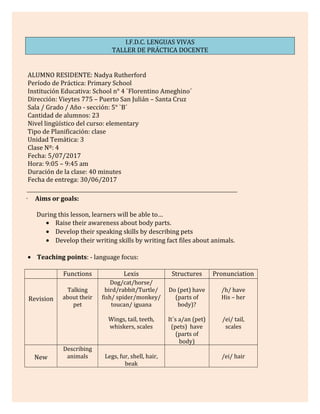
· Aims or goals:
During this lesson, learners will be able to…
• Raise their awareness about body parts.
• Develop their speaking skills by describing pets
• Develop their writing skills by writing fact files about animals.
• Teaching points: - language focus:
Functions Lexis Structures Pronunciation
Revision
Talking
about their
pet
Dog/cat/horse/
bird/rabbit/Turtle/
fish/ spider/monkey/
toucan/ iguana
Wings, tail, teeth,
whiskers, scales
Do (pet) have
(parts of
body)?
It´s a/an (pet)
(pets) have
(parts of
body)
/h/ have
His – her
/ei/ tail,
scales
New
Describing
animals Legs, fur, shell, hair,
beak
/ei/ hair
· Teaching approach or combination of methods / approaches:
Τhis plan follows the PPP (Presentation, practice, production) approach, which is integrated
with a CLIL (content and language integrated learning) approach, because the students learn
the topics in a coherent and meaningful context.
· Integration of skills: What skills will be integrated and how?
Speaking is integrated constantly in the class, and especially in two speaking activities about
pets. Listening is integrated through a song and the teacher´s instructions and questions, in L2
all the time. Writing is integrated when the students have to write fact files about different
pets.
· Materials and resources: computer, internet connection, TV, speaker, copies for the
students
· Pedagogical use of ICT in class or at home: the students watch a video at the
presentation stage. A blog was created to work at home and do homework.
· Seating arrangement: Three big tables in the English classroom are fixed to the
floor. The students sit around them.
· Possible problems / difficulties and possible solutions during the class: in case
there wasn´t internet connection, I would use internet from my mobile phone. If it
didn´t work, I would sing and use the whiteboard to present the topics.
The students may get distracted or not pay attention at some point in the class. If
that happened, I would say: ´1, 2, 3, eyes on me!´
· Assessment: what will be assessed and how: the students´ pronunciation, listening
and speaking will be assessed by singing songs and getting the students to talk about
their pets; grammar and vocabulary will be assessed through writing activities and
games.
STAGES IN THE LESSON
ROUTINE (5´)
Purpose: to greet the students.
At the beginning of the lesson, the students make a line outside their classroom and they
walk into the English classroom. It takes about five minutes.
T: Hello. Good morning!
T: How are you today?
S: Fine, thanks. How are you?
T: Great!
Transition: Fantastic! Now let´s talk about parts of the body!
WARM-UP (5´)
Purpose: to revise some of the contents the students have already studied.
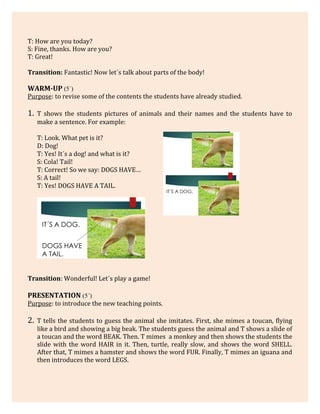
1. T shows the students pictures of animals and their names and the students have to
make a sentence. For example:
T: Look. What pet is it?
D: Dog!
T: Yes! It´s a dog! and what is it?
S: Cola! Tail!
T: Correct! So we say: DOGS HAVE…
S: A tail!
T: Yes! DOGS HAVE A TAIL.
Transition: Wonderful! Let´s play a game!
PRESENTATION (5´)
Purpose: to introduce the new teaching points.
2. T tells the students to guess the animal she imitates. First, she mimes a toucan, flying
like a bird and showing a big beak. The students guess the animal and T shows a slide of
a toucan and the word BEAK. Then. T mimes a monkey and then shows the students the
slide with the word HAIR in it. Then, turtle, really slow, and shows the word SHELL.
After that, T mimes a hamster and shows the word FUR. Finally, T mimes an iguana and
then introduces the word LEGS.
T: Look at me. What pet am I?
S: Bird.
T: Mmm..similar. Look! (showing a big beak).
S: Toucan!
T: Yes!! It´s a toucan. (showing a PowerPoint slide) TOUCANS HAVE A BEAK. DO you have a
beak?
S: No!
T: No, you don´t. You don´t have a beak. Now look at me. TABLE 1: what animal am I? think!
S: Monkey.
T: Correct! It´s a monkey. MONKEYS HAVE HAIR. Do you have hair? (showing her hair)
S: Yes!!
T: Yes! I have hair and you have hair. TABLE 2: What animal am I?
S: It´s a turtle!
T: Excellent! TURTLES HAVE A SHELL. Do you have a shell?
S: Noo!
T: No, you don´t. You don´t have a shell. TABLE 3: What animal am I?
S: It´s a hamster.
T: Fantastic! HAMSTERS HAVE FUR. Do you have fur?
S: No!
T: No, you don´t. You don´t have fur. Finally: What animal am I?
S: (Students will probably say lots of animals until one of them says IGUANA!)
T: Great! IGUANAS HAVE LEGS. Do you have legs?
S: Yes!!
T: Yes, you do. You have legs.
Transition: Now we are going to write about pets!
DEVELOPMENT (15´)
Purpose: to practise the new teaching points.
3. T sticks pictures about parts of the body next to the board. She tells the students that
they have to complete with HAVE or DON´T HAVE. (5´)
Complete with HAVE or DON´T HAVE.
1. I _________ A TAIL.
2. I __________ HAIR.
3. I __________ LEGS.
4. I ___________ WINGS.
5. I ______________ A SHELL.
4. T tells the students that they are going to write information about pets. T shows S the
picture of an iguana and she asks S what pet it is and some questions. T writes the
information on the board, writing the name of the pet and the part of the body in a
different colour so that the students know it changes. (10´)
T: What pet is it?
S: Monkey!
T: Yes! It´s a monkey. Do monkeys have wings?
S: Noo!
T: Great. Do monkeys have legs?
S: Yes!
T: Very good! Monkeys have legs. Do monkeys have teeth?
S: Yes!
T: Correct! Monkeys have teeth. Do monkeys have a tail?
S: Yes!
T: Great! Monkeys have a tail.
IT´S A MONKEY
MONKEYS HAVE LEGS.
MONKEYS HAVE TEETH.
MONKEYS HAVE A TAIL.
MONKEYS DON´T HAVE WINGS.
T: Fantastic! I will give you a piece of paper with a pet. In pairs, you have to complete it
with information about the pet. Who can explain the activity?
S: Me (explains in L1)
T: Good! Come on!
T monitors the activity by walking next to the students to see if they need any help.
Transition: Now let´s play a game!
CLOSURE (3´)
Purpose: to check the students´ understanding of the topics studied today.
T tells the students she will say a part of the body and the S have to say what animal it is.
T: Listen! I HAVE WINGS. I HAVE A BEAK. I DON´T HAVE SCALES. What pet is it? (repeats it
again)
S: Toucan!
T: Yes!! It´s a TOUCAN! Now, table 1: I HAVE LEGS. I DON´T HAVE HAIR. I HAVE SCALES.
What pet is it?
S: Monkey!
T: Do monkeys have scales? Are you sure?
S: Iguana!
T: Excellent! IT´S an iguana, remember. Table 2: I HAVE LEGS. I HAVE A SHELL. I DON´T
HAVE FUR. What pet is it?
S: It´s a turtle!
T: Yes!! Table 3: I HAVE LEGS. I HAVE A TAIL. I DON´T HAVE WINGS. What pet is it?
S: It´s a dog!
T: Fantastic!!
Transition: Finally, homework!
HOMEWORK (2´)
Purpose: to continue practising the contents at home.
The T tells the students that they have homework in their BLOG.
T: People! You have HOMEWORK in your BLOG! You have PUZZLES! What are puzzles?
S: Rompecabezas!
T: Yess! Copy this:
After lesson 1, I will include the following games in the blog:
PUZZLES!
http://www.thekidzpage.com/onlinejigsawpuzzles/animals/pet-animal-jigsaw-
puzzles.html
https://www.jigidi.com/jigsaw-puzzles/animals/small
http://onlinejigsawpuzzles.net/animals.htm
Write the name of the puzzle you play and the pets in your English folder. / Escribí el
nombre del juego que elegiste y las mascotas en tu cuaderno de clase:
Puzzle:
Pets:
ROUTINE (5´)
Purpose: to say goodbye to the students.
At the end of the lesson, the students make a line outside the English classroom and they
walk into their classroom. It takes about five minutes.
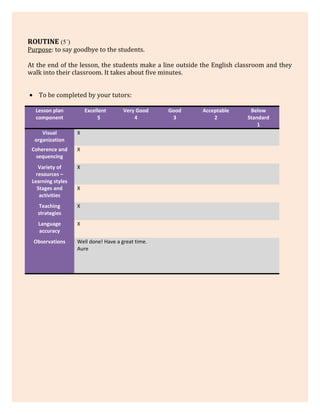
• To be completed by your tutors:
Lesson plan
component
Excellent
5
Very Good
4
Good
3
Acceptable
2
Below
Standard
1
Visual
organization
X
Coherence and
sequencing
X
Variety of
resources –
Learning styles
X
Stages and
activities
X
Teaching
strategies
X
Language
accuracy
X
Observations Well done! Have a great time.
Aure

Lesson 4

  • 1.
    I.F.D.C. LENGUAS VIVAS TALLERDE PRÁCTICA DOCENTE ALUMNO RESIDENTE: Nadya Rutherford Período de Práctica: Primary School Institución Educativa: School n° 4 `Florentino Ameghino´ Dirección: Vieytes 775 – Puerto San Julián – Santa Cruz Sala / Grado / Año - sección: 5° `B´ Cantidad de alumnos: 23 Nivel lingüístico del curso: elementary Tipo de Planificación: clase Unidad Temática: 3 Clase Nº: 4 Fecha: 5/07/2017 Hora: 9:05 – 9:45 am Duración de la clase: 40 minutes Fecha de entrega: 30/06/2017 · Aims or goals: During this lesson, learners will be able to… • Raise their awareness about body parts. • Develop their speaking skills by describing pets • Develop their writing skills by writing fact files about animals. • Teaching points: - language focus: Functions Lexis Structures Pronunciation Revision Talking about their pet Dog/cat/horse/ bird/rabbit/Turtle/ fish/ spider/monkey/ toucan/ iguana Wings, tail, teeth, whiskers, scales Do (pet) have (parts of body)? It´s a/an (pet) (pets) have (parts of body) /h/ have His – her /ei/ tail, scales New Describing animals Legs, fur, shell, hair, beak /ei/ hair
  • 2.
    · Teaching approachor combination of methods / approaches: Τhis plan follows the PPP (Presentation, practice, production) approach, which is integrated with a CLIL (content and language integrated learning) approach, because the students learn the topics in a coherent and meaningful context. · Integration of skills: What skills will be integrated and how? Speaking is integrated constantly in the class, and especially in two speaking activities about pets. Listening is integrated through a song and the teacher´s instructions and questions, in L2 all the time. Writing is integrated when the students have to write fact files about different pets. · Materials and resources: computer, internet connection, TV, speaker, copies for the students · Pedagogical use of ICT in class or at home: the students watch a video at the presentation stage. A blog was created to work at home and do homework. · Seating arrangement: Three big tables in the English classroom are fixed to the floor. The students sit around them. · Possible problems / difficulties and possible solutions during the class: in case there wasn´t internet connection, I would use internet from my mobile phone. If it didn´t work, I would sing and use the whiteboard to present the topics. The students may get distracted or not pay attention at some point in the class. If that happened, I would say: ´1, 2, 3, eyes on me!´ · Assessment: what will be assessed and how: the students´ pronunciation, listening and speaking will be assessed by singing songs and getting the students to talk about their pets; grammar and vocabulary will be assessed through writing activities and games. STAGES IN THE LESSON ROUTINE (5´) Purpose: to greet the students. At the beginning of the lesson, the students make a line outside their classroom and they walk into the English classroom. It takes about five minutes. T: Hello. Good morning! T: Hello. Good morning!
  • 3.
    T: How areyou today? S: Fine, thanks. How are you? T: Great! Transition: Fantastic! Now let´s talk about parts of the body! WARM-UP (5´) Purpose: to revise some of the contents the students have already studied. 1. T shows the students pictures of animals and their names and the students have to make a sentence. For example: T: Look. What pet is it? D: Dog! T: Yes! It´s a dog! and what is it? S: Cola! Tail! T: Correct! So we say: DOGS HAVE… S: A tail! T: Yes! DOGS HAVE A TAIL. Transition: Wonderful! Let´s play a game! PRESENTATION (5´) Purpose: to introduce the new teaching points. 2. T tells the students to guess the animal she imitates. First, she mimes a toucan, flying like a bird and showing a big beak. The students guess the animal and T shows a slide of a toucan and the word BEAK. Then. T mimes a monkey and then shows the students the slide with the word HAIR in it. Then, turtle, really slow, and shows the word SHELL. After that, T mimes a hamster and shows the word FUR. Finally, T mimes an iguana and then introduces the word LEGS.
  • 4.
    T: Look atme. What pet am I? S: Bird. T: Mmm..similar. Look! (showing a big beak). S: Toucan! T: Yes!! It´s a toucan. (showing a PowerPoint slide) TOUCANS HAVE A BEAK. DO you have a beak? S: No! T: No, you don´t. You don´t have a beak. Now look at me. TABLE 1: what animal am I? think! S: Monkey. T: Correct! It´s a monkey. MONKEYS HAVE HAIR. Do you have hair? (showing her hair) S: Yes!! T: Yes! I have hair and you have hair. TABLE 2: What animal am I? S: It´s a turtle! T: Excellent! TURTLES HAVE A SHELL. Do you have a shell? S: Noo! T: No, you don´t. You don´t have a shell. TABLE 3: What animal am I? S: It´s a hamster. T: Fantastic! HAMSTERS HAVE FUR. Do you have fur? S: No! T: No, you don´t. You don´t have fur. Finally: What animal am I? S: (Students will probably say lots of animals until one of them says IGUANA!) T: Great! IGUANAS HAVE LEGS. Do you have legs? S: Yes!! T: Yes, you do. You have legs. Transition: Now we are going to write about pets! DEVELOPMENT (15´) Purpose: to practise the new teaching points. 3. T sticks pictures about parts of the body next to the board. She tells the students that they have to complete with HAVE or DON´T HAVE. (5´) Complete with HAVE or DON´T HAVE. 1. I _________ A TAIL. 2. I __________ HAIR. 3. I __________ LEGS. 4. I ___________ WINGS. 5. I ______________ A SHELL. 4. T tells the students that they are going to write information about pets. T shows S the
  • 5.
    picture of aniguana and she asks S what pet it is and some questions. T writes the information on the board, writing the name of the pet and the part of the body in a different colour so that the students know it changes. (10´) T: What pet is it? S: Monkey! T: Yes! It´s a monkey. Do monkeys have wings? S: Noo! T: Great. Do monkeys have legs? S: Yes! T: Very good! Monkeys have legs. Do monkeys have teeth? S: Yes! T: Correct! Monkeys have teeth. Do monkeys have a tail? S: Yes! T: Great! Monkeys have a tail. IT´S A MONKEY MONKEYS HAVE LEGS. MONKEYS HAVE TEETH. MONKEYS HAVE A TAIL. MONKEYS DON´T HAVE WINGS. T: Fantastic! I will give you a piece of paper with a pet. In pairs, you have to complete it with information about the pet. Who can explain the activity? S: Me (explains in L1) T: Good! Come on! T monitors the activity by walking next to the students to see if they need any help. Transition: Now let´s play a game! CLOSURE (3´) Purpose: to check the students´ understanding of the topics studied today. T tells the students she will say a part of the body and the S have to say what animal it is. T: Listen! I HAVE WINGS. I HAVE A BEAK. I DON´T HAVE SCALES. What pet is it? (repeats it
  • 6.
    again) S: Toucan! T: Yes!!It´s a TOUCAN! Now, table 1: I HAVE LEGS. I DON´T HAVE HAIR. I HAVE SCALES. What pet is it? S: Monkey! T: Do monkeys have scales? Are you sure? S: Iguana! T: Excellent! IT´S an iguana, remember. Table 2: I HAVE LEGS. I HAVE A SHELL. I DON´T HAVE FUR. What pet is it? S: It´s a turtle! T: Yes!! Table 3: I HAVE LEGS. I HAVE A TAIL. I DON´T HAVE WINGS. What pet is it? S: It´s a dog! T: Fantastic!! Transition: Finally, homework! HOMEWORK (2´) Purpose: to continue practising the contents at home. The T tells the students that they have homework in their BLOG. T: People! You have HOMEWORK in your BLOG! You have PUZZLES! What are puzzles? S: Rompecabezas! T: Yess! Copy this: After lesson 1, I will include the following games in the blog: PUZZLES! http://www.thekidzpage.com/onlinejigsawpuzzles/animals/pet-animal-jigsaw- puzzles.html https://www.jigidi.com/jigsaw-puzzles/animals/small http://onlinejigsawpuzzles.net/animals.htm Write the name of the puzzle you play and the pets in your English folder. / Escribí el nombre del juego que elegiste y las mascotas en tu cuaderno de clase: Puzzle: Pets:
  • 7.
    ROUTINE (5´) Purpose: tosay goodbye to the students. At the end of the lesson, the students make a line outside the English classroom and they walk into their classroom. It takes about five minutes. • To be completed by your tutors: Lesson plan component Excellent 5 Very Good 4 Good 3 Acceptable 2 Below Standard 1 Visual organization X Coherence and sequencing X Variety of resources – Learning styles X Stages and activities X Teaching strategies X Language accuracy X Observations Well done! Have a great time. Aure