

Acknowledgement 
• We owe a great thanks to all the people who helped and supported 
us during the writing of this research report. 
• Our deepest thanks to professor, Mrs. Shanthi Narayanan the 
supervisor of the research report for guiding and correcting various 
documents of ours with attention and care. She has taken pain to go 
through the project and make necessary correction as and when 
needed. 
• We express our thanks to the Dean of Sharda University, School of 
Law for extending his support. 
• We would also thank my institution and my faculty members, 
without whom this report would have been a distant reality.
“The sun, the moon and the stars would have 
disappeared long ago... had they happened to 
be within the reach of predatory human 
hands. Havelock Ellis, The Dance of Life, 1923.”
Introduction 
• In nature, the totality of surrounding conditions. The world 
around us is our environment: Air, Sun, Ground, Sky, House, 
Woods -- whatever we live within is your environment. 
• But for the progress of the society industry is necessary, 
likewise pollution is inevitable. Since progress and pollution go 
together, there can be no end of progress, and consequently, 
no escape from pollution. 
• However, the main pollutant of the environment is toxic waste 
and it goes hand in hand with the problems of the 
environment.
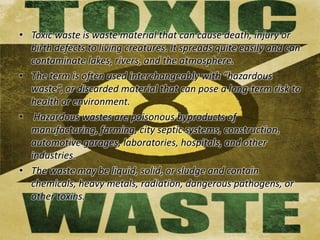
• Toxic waste is waste material that can cause death, injury or 
birth defects to living creatures. It spreads quite easily and can 
contaminate lakes, rivers, and the atmosphere. 
• The term is often used interchangeably with “hazardous 
waste”, or discarded material that can pose a long-term risk to 
health or environment. 
• Hazardous wastes are poisonous byproducts of 
manufacturing, farming, city septic systems, construction, 
automotive garages, laboratories, hospitals, and other 
industries. 
• The waste may be liquid, solid, or sludge and contain 
chemicals, heavy metals, radiation, dangerous pathogens, or 
other toxins.
• The protection of the Environment becomes a global 
issues and it is not an isolated problem of any nation 
or a particular area. 
• Man has the fundamental rights to freedom, equality 
and adequate conditions of life in an environment of 
equality that permits a life of dignity and well being 
and bears a solemn responsibility to protect and 
improve the environment for present and future 
generation.
• Some of the waste we generate, either in our homes or during 
industrial processes, is too poisonous or hazardous to just 
throw away with our ordinary waste or to recycle for further 
use. Some are listed below: 
• Nuclear Waste: The main type of hazardous waste that 
causes the different types of harmful diseases in the 
environment is nuclear waste. It is the type of hazardous 
waste that is generated during the manufacturing of the 
different type of nuclear technologies and we can also say 
that these wastes are produced by nuclear plants. 
• Chemical Waste: Chemical waste is toxic waste that contains 
poisonous, flammable, or reactive chemicals in the products.
• Radioactive waste: Radioactive waste is waste that has been 
affected by radiation or emits radiation. Radioactive waste 
usually comes from nuclear power plants; they may have been 
the old fuel rods that were replaced recently. Radioactive 
waste is usually stored deep underground covered in concrete, 
since they emit a lot of radiation that harms people 
• Medical waste: Medical waste is any kind of waste that has 
been infected by viruses, diseases, blood, human fluids etc. It 
is very dangerous; since people can be exposed to severe 
diseases that are on the waste. Medical waste usually comes 
from hospitals, health care facilities and research labs.
• Industrial Waste: The waste that is generated as a result of 
the different types of processes of the industries such as 
manufacturing new products for the benefits of the mankind 
is called as industrial waste. Chemicals include varnishes; 
wood preservation chemicals etc. different types of medicine 
manufacturing industries also take part in generating such 
type of wastes. So, EPA recommends different types of 
chemicals to save the environment from industrial waste. 
• There are different ways that are used to dispose these kinds 
of dangerous materials. Some important ways that are used 
widely to discard the hazardous waste are recycling of the 
products, some types of burning of old materials and many 
more chemical processes.
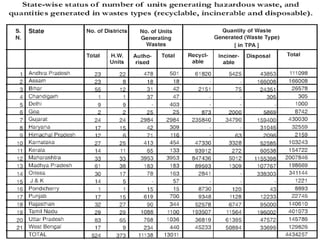
Levels of Toxic 
Waste In 
India
Impact of Toxic Waste 
• The effects of toxic waste can impact individual health and the 
environment. The consequences of poorly disposed toxic waste 
can impact the environment long after its effect on individuals. 
• Pollution: 
1.Water Pollution: Water pollution is the contamination of water 
bodies. Water pollution occurs when pollutants are discharged 
directly or indirectly into water bodies without adequate 
treatment to remove harmful components. 
• Effects of Water Pollution: 
a) Death of aquatic (water) animals 
b) Disruption of food-chains 
c) Diseases 
d) Destruction of ecosystems
2. Air Pollution :Air pollution is the introduction into 
the atmosphere of chemicals, particulates, or biological 
materials that cause discomfort, disease, or death to humans, 
damage other living organisms such as food crops, or damage 
the natural environment or built environment. 
• Effects Of Air Pollution: 
a) Acidification 
b) Eutrophication 
c) Ground-level ozone 
• Health: Hazardous waste carries environmental risks and also 
health risks for humans and wildlife. Some pollutants such as 
mercury can accumulate in human and animal tissue, thus 
compounding their effects. Hazardous waste is primarily 
generated by industry and businesses. Although regulations 
exist, contamination still occurs.
• Health Hazards: 
a) Cancer 
b) Respiratory Conditions 
c) Heart Disease 
d) Exposure Effects 
• Aquatic Life: Toxic waste pollutes the sea, deforming and 
killing fish and wildlife. We still do not know the full extent of 
the damage toxic waste causes, but we do know that diesel 
oil and cyanide can wreak havoc, injuring, killing and 
mutating many species of fish and birds 
• Environment: Toxins buried below ground can reach 
underground water streams, which empty out into nearby 
water sources. These pollutants affect surrounding wildlife. 
• Society: Social reform and an active government taking 
responsibility are some of the positive effects of toxic waste 
disposal.
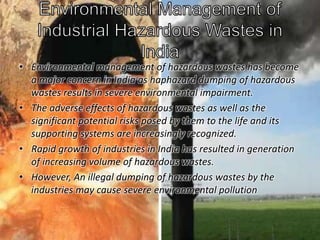
• Environmental management of hazardous wastes has become 
a major concern in India as haphazard dumping of hazardous 
wastes results in severe environmental impairment. 
• The adverse effects of hazardous wastes as well as the 
significant potential risks posed by them to the life and its 
supporting systems are increasingly recognized. 
• Rapid growth of industries in India has resulted in generation 
of increasing volume of hazardous wastes. 
• However, An illegal dumping of hazardous wastes by the 
industries may cause severe environmental pollution
• Hazardous Wastes (Management and Handling) 
Rules, 1989: Hazardous Wastes (Management and 
Handling)Rules, 1989, as amended to date, were notified in 
the country under the provisions of the Environment 
(Protection) Act, 1986,formanagement and handling, and 
import of hazardous wastes into the country. These rules were 
amended in 2000 and 2003, to bring the Rules in line with the 
requirements of the Basel Convention and also to improve the 
applicability.
ENVIRONMENTAL 
REGULATIONS AND LEGAL 
FRAMEWORK IN INDIA 
• Measures has been taken by the government to protect and 
preserve the environment. Several sector-specific policies have 
evolved, which are discussed below as: 
• ENVIRONMENTAL (PROTECTION) ACT, 1986: The Environment 
(Protection) Act, 1986 was introduced as an umbrella 
legislation that provides a holistic framework for the 
protection and improvement to the environment. 
• AIR (PREVENTION AND CONTROL OF POLLUTION) ACT 1981: 
The presence in air, beyond certain limits, of various pollutants 
discharged through industrial emission and from certain 
human activities connected with traffic, heating, etc; has a 
detrimental effect on the health of the people as also on 
animal life, vegetation and property.
• WATER (PREVENTION & CONTROL ) ACT 1974: The objectives 
of the Water (Prevention and Control of Pollution) Act are to 
provide for the Prevention and Control of Water Pollution and 
the maintenance or restoration of the wholesomeness of 
water for the establishment, with a view to carrying out the 
purposes aforesaid, of Boards for the prevention and control 
of water pollution, for conferring on and assigning to such 
Boards powers and functions relating thereto and for matters 
connected therewith. 
• HAZARDOUS WASTES (MANAGEMENT AND HANDLING) 
AMENDMENT RULES, 2003: These Rules classify used mineral 
oil as hazardous waste under the Hazardous Waste 
(Management & Handling) Rules, 2003 that requires proper 
handling and disposal.
• OZONE DEPLETING SUBSTANCES (REGULATION AND 
CONTROL) RULES, 2000: MoEF vide its notification date. 17th 
July, 2000 under the section of 6, 8 and 25 of the Environment 
(Protection) Act, 1986 has notified rules for regulation/ 
control of Ozone Depleting Substances ( ODS) under Montreal 
Protocol. As per the notification certain control and regulation 
has been imposed on manufacturing, import, export, and use 
of these compounds.
• “The National Environment Policy 2006” has brought out 
management aspects of hazardous wastes in the form of an 
action plan which includes: 
• Develop and implement viable models of public- private 
partnership for setting up and operating secure landfills, 
incinerators, and other appropriate techniques for the 
treatment and disposal of toxic and hazardous waste, both 
industrial and bio-medical, on payment by users, taking the 
concerns of local communities into account.
• Develop and implement strategies for cleanup of toxic and 
hazardous waste dump legacy, in particular in industrial areas 
and abandoned mines, and reclamation of such lands for 
future sustainable use. 
• Survey and develop a national inventory of toxic and 
hazardous waste dumps and online monitoring systems for 
movement of hazardous wastes. Strengthen capacities of 
institutions responsible for monitoring and enforcement in 
aspect of toxic and hazardous waste. 
• Strengthen the legal arrangements and response measures for 
addressing emergencies arising out of transportation, 
handling and disposal of hazardous wastes, as part of the 
chemical accidents regime.
• Give legal recognition to, and strengthen the informal sector 
systems of collection and recycling of various materials. In 
particular enhance their access to institutional finance and 
relevant technologies. 
• Develop and enforce regulations and guidelines for 
management of E-waste, as part of hazardous waste regime.
JUDICIAL CONTRIBUTION / 
CASE LAWS 
• The right of a person to pollution free environment is a part of 
basic jurisprudence of the land. Article 21 of the Constitution 
of India guarantees a fundamental right to life and personal 
liberty. Below are some mention case laws : 
• Taj Mahal Case: In Taj Mahal 's case, the Supreme Court 
issued directions that coal and coke based industries in Taj 
Trapezium (TTZ) which were damaging Taj should either 
change over to natural gas or to be relocated outside TTZ. 
Again the Supreme Court directed to protect the plants 
planted around Taj by the Forest Department as under: 
• The Divisional Forest Officer, Agra is directed to take 
immediate steps for seeing that water is supplied to the 
plants.
• The Union Government is directed to release the funds 
immediately without waiting for receipt of the proposal from 
the U.P. Government on the basis of the copy of the report. 
• Dehradun Valley Case: In that case, carrying haphazard and 
dangerous limestone quarrying in the Mussorie Hill range of 
the Himalaya, mines blasting out the hills with dynamite, 
extracting limestone from thousand of acres had upset the 
hydrological system of the valley. 
• The Supreme Court ordered the closing of limestone quarrying 
in the hills and observed: This would undoubtedly cause 
hardship to them, but it is a price that has to be paid for 
protecting and safeguarding the right of the people to live in 
healthy environment with minimal disturbance of ecological 
balance.
• Pollution of River Ganga : In M.C Mehta v Union of India 1987 
AIR 1086, 1987 SCR(1) 819; the Supreme Court dealt with 
pollution of Ganga water due to the negligence of the 
tanneries on its in establishing primary treatment plants 
(PTPs). 
• Countless tanneries, chemical plants, textile mills, distilleries, 
slaughterhouses, and hospitals contribute to the pollution of 
the Ganges by dumping untreated waste into it. Industrial 
effluents are about 12% of the total volume of effluent 
reaching the Ganges. Although a relatively low proportion, 
they are a cause for major concern because they are often 
toxic and non-biodegradable.
• The aforesaid study leads us to the following conclusion: 
 We have more than 200 Central and State legislations which 
deal with environmental issues. More legislation means more 
difficulties in enforcement. 
 It is not enough to enact the legislations. A positive attitude 
on the part of everyone in society is essential for effective 
and efficient enforcement of these legislations. 
 The powers vested to the Pollution Control Boards are not 
enough to prevent pollution. The Boards do not have power 
to punish the violators but can launch prosecution against 
them in the Courts which ultimately defeat the purpose and 
object of the Environmental Laws due to long delays in 
deciding the cases.
 The Environment Protection Laws have failed to bring about 
the desired results which were believed will be achieved. 
 There is a multiplicity of environment pollution control 
standards for the same type of industries. However, under 
the Environment (Protection) Act, 1986 now the power has 
been conferred upon the Central Government for laying 
down the standards for the quality of air, water and soil. It is 
hoped that this will ensure uniformity of standards through 
out the country. 
 In order to enforce the environmental laws stringently, mere 
mis-description and technical flaws should be disregarded by 
the Courts. The creative role of judiciary has been significant 
and laudable. The jurisdiction of the Courts has been 
expanded by way of Public Interest Litigation.
 The traditional concept that development and ecology are 
opposed to each other, is no longer acceptable, since 
'sustainable development' is the answer. The Supreme Court 
has accepted sustainable development as part of the laws of 
the land and has affirmed the 'precautionary principle' and 
the 'polluter pays principle' are essential features of 
sustainable development. 
 Finally, protection of the environment and keeping ecological 
balance unaffected is a task which not only the government 
but also every individual, association and corporation must 
undertake. It is a social obligation and fundamental duty 
enshrined in Article 51 A (g) of the Constitution of India.
Recommendations 
 There is a need to have a comprehensive and an integrated 
law on environmental protection for meaningful enforcement. 
 As there are limited powers (according to our study) it is 
imperatively necessary to give more powers to the Boards. 
 For the purpose of efficient and effective enforcement of these 
laws, it is necessary to set up the Environment Courts; with 
one Judge and two technical experts from the field of 
Environmental Science and Ecology. 
 To begin with we may have such Courts at the State and 
National levels that may later be extended to district level on 
need-based principle. In order to discourage prolonged 
litigation, the provisions should be confined to single appeal.
 The tapping of natural resources must be done with requisite 
attention and care so that ecology and environment may not 
be affected in any serious way. A long-term planning must be 
undertaken by the Central Government in consultation with 
the State Governments to protect and improve the 
environment and to keep up the national wealth. 
 It is necessary to emphasis that problem of environmental 
degradation can be tackled only by concerted efforts by every 
person, organization and institution and by extremely 
stringent enforcement of the laws. We have to educate, 
spread awareness, involve and motivate every child, woman 
and man in the country to conserve the local flora and fauna, 
soil and water resources and all other gifts of God which are 
national properties and belong to all and to none individually.
Thank 
You

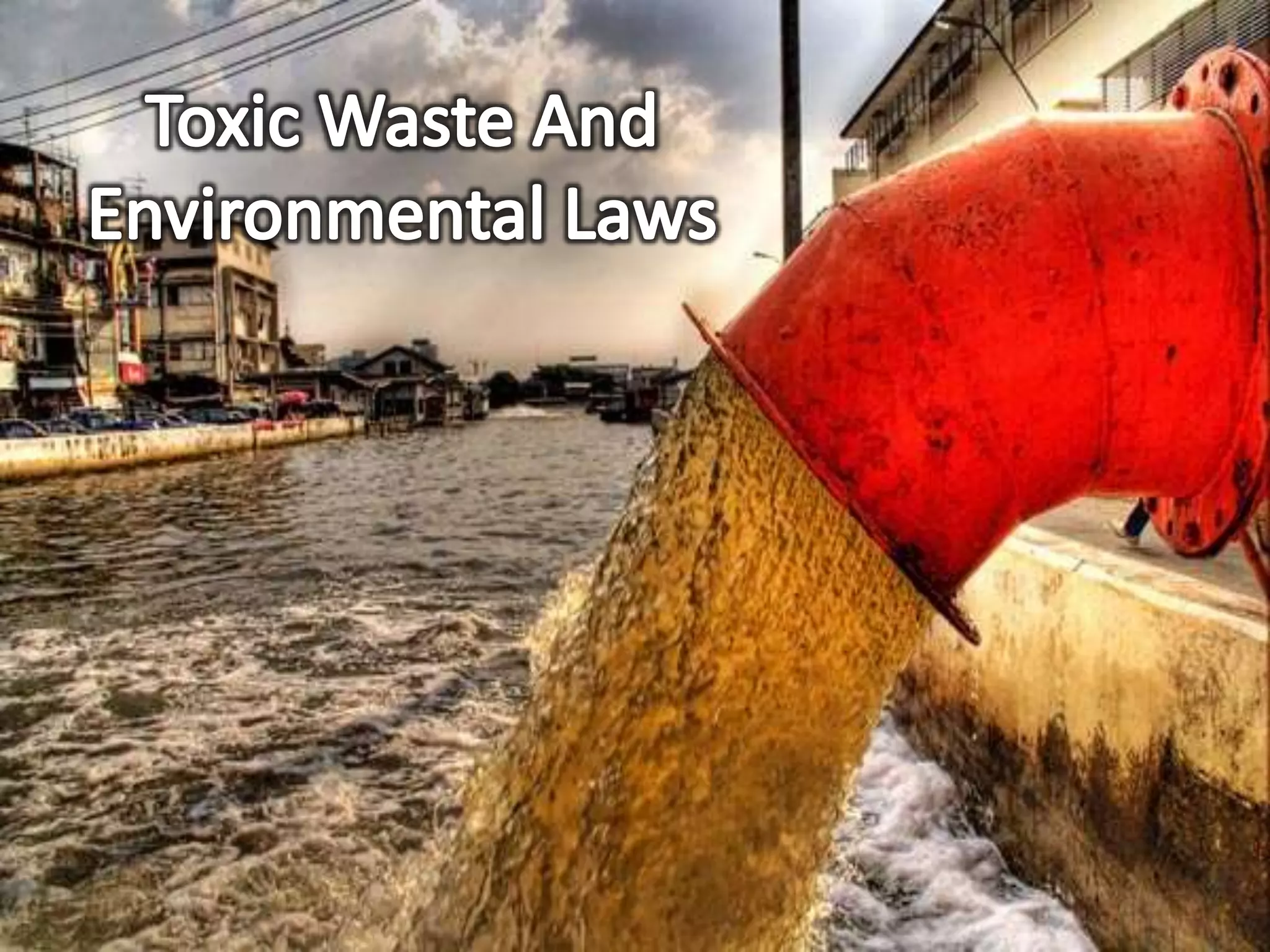
Toxic waste and environmental laws

  • 2.
    Acknowledgement • Weowe a great thanks to all the people who helped and supported us during the writing of this research report. • Our deepest thanks to professor, Mrs. Shanthi Narayanan the supervisor of the research report for guiding and correcting various documents of ours with attention and care. She has taken pain to go through the project and make necessary correction as and when needed. • We express our thanks to the Dean of Sharda University, School of Law for extending his support. • We would also thank my institution and my faculty members, without whom this report would have been a distant reality.
  • 3.
    “The sun, themoon and the stars would have disappeared long ago... had they happened to be within the reach of predatory human hands. Havelock Ellis, The Dance of Life, 1923.”
  • 4.
    Introduction • Innature, the totality of surrounding conditions. The world around us is our environment: Air, Sun, Ground, Sky, House, Woods -- whatever we live within is your environment. • But for the progress of the society industry is necessary, likewise pollution is inevitable. Since progress and pollution go together, there can be no end of progress, and consequently, no escape from pollution. • However, the main pollutant of the environment is toxic waste and it goes hand in hand with the problems of the environment.
  • 5.
    • Toxic wasteis waste material that can cause death, injury or birth defects to living creatures. It spreads quite easily and can contaminate lakes, rivers, and the atmosphere. • The term is often used interchangeably with “hazardous waste”, or discarded material that can pose a long-term risk to health or environment. • Hazardous wastes are poisonous byproducts of manufacturing, farming, city septic systems, construction, automotive garages, laboratories, hospitals, and other industries. • The waste may be liquid, solid, or sludge and contain chemicals, heavy metals, radiation, dangerous pathogens, or other toxins.
  • 6.
    • The protectionof the Environment becomes a global issues and it is not an isolated problem of any nation or a particular area. • Man has the fundamental rights to freedom, equality and adequate conditions of life in an environment of equality that permits a life of dignity and well being and bears a solemn responsibility to protect and improve the environment for present and future generation.
  • 7.
    • Some ofthe waste we generate, either in our homes or during industrial processes, is too poisonous or hazardous to just throw away with our ordinary waste or to recycle for further use. Some are listed below: • Nuclear Waste: The main type of hazardous waste that causes the different types of harmful diseases in the environment is nuclear waste. It is the type of hazardous waste that is generated during the manufacturing of the different type of nuclear technologies and we can also say that these wastes are produced by nuclear plants. • Chemical Waste: Chemical waste is toxic waste that contains poisonous, flammable, or reactive chemicals in the products.
  • 8.
    • Radioactive waste:Radioactive waste is waste that has been affected by radiation or emits radiation. Radioactive waste usually comes from nuclear power plants; they may have been the old fuel rods that were replaced recently. Radioactive waste is usually stored deep underground covered in concrete, since they emit a lot of radiation that harms people • Medical waste: Medical waste is any kind of waste that has been infected by viruses, diseases, blood, human fluids etc. It is very dangerous; since people can be exposed to severe diseases that are on the waste. Medical waste usually comes from hospitals, health care facilities and research labs.
  • 9.
    • Industrial Waste:The waste that is generated as a result of the different types of processes of the industries such as manufacturing new products for the benefits of the mankind is called as industrial waste. Chemicals include varnishes; wood preservation chemicals etc. different types of medicine manufacturing industries also take part in generating such type of wastes. So, EPA recommends different types of chemicals to save the environment from industrial waste. • There are different ways that are used to dispose these kinds of dangerous materials. Some important ways that are used widely to discard the hazardous waste are recycling of the products, some types of burning of old materials and many more chemical processes.
  • 10.
    Levels of Toxic Waste In India
  • 12.
    Impact of ToxicWaste • The effects of toxic waste can impact individual health and the environment. The consequences of poorly disposed toxic waste can impact the environment long after its effect on individuals. • Pollution: 1.Water Pollution: Water pollution is the contamination of water bodies. Water pollution occurs when pollutants are discharged directly or indirectly into water bodies without adequate treatment to remove harmful components. • Effects of Water Pollution: a) Death of aquatic (water) animals b) Disruption of food-chains c) Diseases d) Destruction of ecosystems
  • 13.
    2. Air Pollution:Air pollution is the introduction into the atmosphere of chemicals, particulates, or biological materials that cause discomfort, disease, or death to humans, damage other living organisms such as food crops, or damage the natural environment or built environment. • Effects Of Air Pollution: a) Acidification b) Eutrophication c) Ground-level ozone • Health: Hazardous waste carries environmental risks and also health risks for humans and wildlife. Some pollutants such as mercury can accumulate in human and animal tissue, thus compounding their effects. Hazardous waste is primarily generated by industry and businesses. Although regulations exist, contamination still occurs.
  • 14.
    • Health Hazards: a) Cancer b) Respiratory Conditions c) Heart Disease d) Exposure Effects • Aquatic Life: Toxic waste pollutes the sea, deforming and killing fish and wildlife. We still do not know the full extent of the damage toxic waste causes, but we do know that diesel oil and cyanide can wreak havoc, injuring, killing and mutating many species of fish and birds • Environment: Toxins buried below ground can reach underground water streams, which empty out into nearby water sources. These pollutants affect surrounding wildlife. • Society: Social reform and an active government taking responsibility are some of the positive effects of toxic waste disposal.
  • 15.
    • Environmental managementof hazardous wastes has become a major concern in India as haphazard dumping of hazardous wastes results in severe environmental impairment. • The adverse effects of hazardous wastes as well as the significant potential risks posed by them to the life and its supporting systems are increasingly recognized. • Rapid growth of industries in India has resulted in generation of increasing volume of hazardous wastes. • However, An illegal dumping of hazardous wastes by the industries may cause severe environmental pollution
  • 17.
    • Hazardous Wastes(Management and Handling) Rules, 1989: Hazardous Wastes (Management and Handling)Rules, 1989, as amended to date, were notified in the country under the provisions of the Environment (Protection) Act, 1986,formanagement and handling, and import of hazardous wastes into the country. These rules were amended in 2000 and 2003, to bring the Rules in line with the requirements of the Basel Convention and also to improve the applicability.
  • 18.
    ENVIRONMENTAL REGULATIONS ANDLEGAL FRAMEWORK IN INDIA • Measures has been taken by the government to protect and preserve the environment. Several sector-specific policies have evolved, which are discussed below as: • ENVIRONMENTAL (PROTECTION) ACT, 1986: The Environment (Protection) Act, 1986 was introduced as an umbrella legislation that provides a holistic framework for the protection and improvement to the environment. • AIR (PREVENTION AND CONTROL OF POLLUTION) ACT 1981: The presence in air, beyond certain limits, of various pollutants discharged through industrial emission and from certain human activities connected with traffic, heating, etc; has a detrimental effect on the health of the people as also on animal life, vegetation and property.
  • 19.
    • WATER (PREVENTION& CONTROL ) ACT 1974: The objectives of the Water (Prevention and Control of Pollution) Act are to provide for the Prevention and Control of Water Pollution and the maintenance or restoration of the wholesomeness of water for the establishment, with a view to carrying out the purposes aforesaid, of Boards for the prevention and control of water pollution, for conferring on and assigning to such Boards powers and functions relating thereto and for matters connected therewith. • HAZARDOUS WASTES (MANAGEMENT AND HANDLING) AMENDMENT RULES, 2003: These Rules classify used mineral oil as hazardous waste under the Hazardous Waste (Management & Handling) Rules, 2003 that requires proper handling and disposal.
  • 20.
    • OZONE DEPLETINGSUBSTANCES (REGULATION AND CONTROL) RULES, 2000: MoEF vide its notification date. 17th July, 2000 under the section of 6, 8 and 25 of the Environment (Protection) Act, 1986 has notified rules for regulation/ control of Ozone Depleting Substances ( ODS) under Montreal Protocol. As per the notification certain control and regulation has been imposed on manufacturing, import, export, and use of these compounds.
  • 21.
    • “The NationalEnvironment Policy 2006” has brought out management aspects of hazardous wastes in the form of an action plan which includes: • Develop and implement viable models of public- private partnership for setting up and operating secure landfills, incinerators, and other appropriate techniques for the treatment and disposal of toxic and hazardous waste, both industrial and bio-medical, on payment by users, taking the concerns of local communities into account.
  • 22.
    • Develop andimplement strategies for cleanup of toxic and hazardous waste dump legacy, in particular in industrial areas and abandoned mines, and reclamation of such lands for future sustainable use. • Survey and develop a national inventory of toxic and hazardous waste dumps and online monitoring systems for movement of hazardous wastes. Strengthen capacities of institutions responsible for monitoring and enforcement in aspect of toxic and hazardous waste. • Strengthen the legal arrangements and response measures for addressing emergencies arising out of transportation, handling and disposal of hazardous wastes, as part of the chemical accidents regime.
  • 23.
    • Give legalrecognition to, and strengthen the informal sector systems of collection and recycling of various materials. In particular enhance their access to institutional finance and relevant technologies. • Develop and enforce regulations and guidelines for management of E-waste, as part of hazardous waste regime.
  • 24.
    JUDICIAL CONTRIBUTION / CASE LAWS • The right of a person to pollution free environment is a part of basic jurisprudence of the land. Article 21 of the Constitution of India guarantees a fundamental right to life and personal liberty. Below are some mention case laws : • Taj Mahal Case: In Taj Mahal 's case, the Supreme Court issued directions that coal and coke based industries in Taj Trapezium (TTZ) which were damaging Taj should either change over to natural gas or to be relocated outside TTZ. Again the Supreme Court directed to protect the plants planted around Taj by the Forest Department as under: • The Divisional Forest Officer, Agra is directed to take immediate steps for seeing that water is supplied to the plants.
  • 25.
    • The UnionGovernment is directed to release the funds immediately without waiting for receipt of the proposal from the U.P. Government on the basis of the copy of the report. • Dehradun Valley Case: In that case, carrying haphazard and dangerous limestone quarrying in the Mussorie Hill range of the Himalaya, mines blasting out the hills with dynamite, extracting limestone from thousand of acres had upset the hydrological system of the valley. • The Supreme Court ordered the closing of limestone quarrying in the hills and observed: This would undoubtedly cause hardship to them, but it is a price that has to be paid for protecting and safeguarding the right of the people to live in healthy environment with minimal disturbance of ecological balance.
  • 26.
    • Pollution ofRiver Ganga : In M.C Mehta v Union of India 1987 AIR 1086, 1987 SCR(1) 819; the Supreme Court dealt with pollution of Ganga water due to the negligence of the tanneries on its in establishing primary treatment plants (PTPs). • Countless tanneries, chemical plants, textile mills, distilleries, slaughterhouses, and hospitals contribute to the pollution of the Ganges by dumping untreated waste into it. Industrial effluents are about 12% of the total volume of effluent reaching the Ganges. Although a relatively low proportion, they are a cause for major concern because they are often toxic and non-biodegradable.
  • 27.
    • The aforesaidstudy leads us to the following conclusion:  We have more than 200 Central and State legislations which deal with environmental issues. More legislation means more difficulties in enforcement.  It is not enough to enact the legislations. A positive attitude on the part of everyone in society is essential for effective and efficient enforcement of these legislations.  The powers vested to the Pollution Control Boards are not enough to prevent pollution. The Boards do not have power to punish the violators but can launch prosecution against them in the Courts which ultimately defeat the purpose and object of the Environmental Laws due to long delays in deciding the cases.
  • 28.
     The EnvironmentProtection Laws have failed to bring about the desired results which were believed will be achieved.  There is a multiplicity of environment pollution control standards for the same type of industries. However, under the Environment (Protection) Act, 1986 now the power has been conferred upon the Central Government for laying down the standards for the quality of air, water and soil. It is hoped that this will ensure uniformity of standards through out the country.  In order to enforce the environmental laws stringently, mere mis-description and technical flaws should be disregarded by the Courts. The creative role of judiciary has been significant and laudable. The jurisdiction of the Courts has been expanded by way of Public Interest Litigation.
  • 29.
     The traditionalconcept that development and ecology are opposed to each other, is no longer acceptable, since 'sustainable development' is the answer. The Supreme Court has accepted sustainable development as part of the laws of the land and has affirmed the 'precautionary principle' and the 'polluter pays principle' are essential features of sustainable development.  Finally, protection of the environment and keeping ecological balance unaffected is a task which not only the government but also every individual, association and corporation must undertake. It is a social obligation and fundamental duty enshrined in Article 51 A (g) of the Constitution of India.
  • 30.
    Recommendations  Thereis a need to have a comprehensive and an integrated law on environmental protection for meaningful enforcement.  As there are limited powers (according to our study) it is imperatively necessary to give more powers to the Boards.  For the purpose of efficient and effective enforcement of these laws, it is necessary to set up the Environment Courts; with one Judge and two technical experts from the field of Environmental Science and Ecology.  To begin with we may have such Courts at the State and National levels that may later be extended to district level on need-based principle. In order to discourage prolonged litigation, the provisions should be confined to single appeal.
  • 31.
     The tappingof natural resources must be done with requisite attention and care so that ecology and environment may not be affected in any serious way. A long-term planning must be undertaken by the Central Government in consultation with the State Governments to protect and improve the environment and to keep up the national wealth.  It is necessary to emphasis that problem of environmental degradation can be tackled only by concerted efforts by every person, organization and institution and by extremely stringent enforcement of the laws. We have to educate, spread awareness, involve and motivate every child, woman and man in the country to conserve the local flora and fauna, soil and water resources and all other gifts of God which are national properties and belong to all and to none individually.
  • 32.