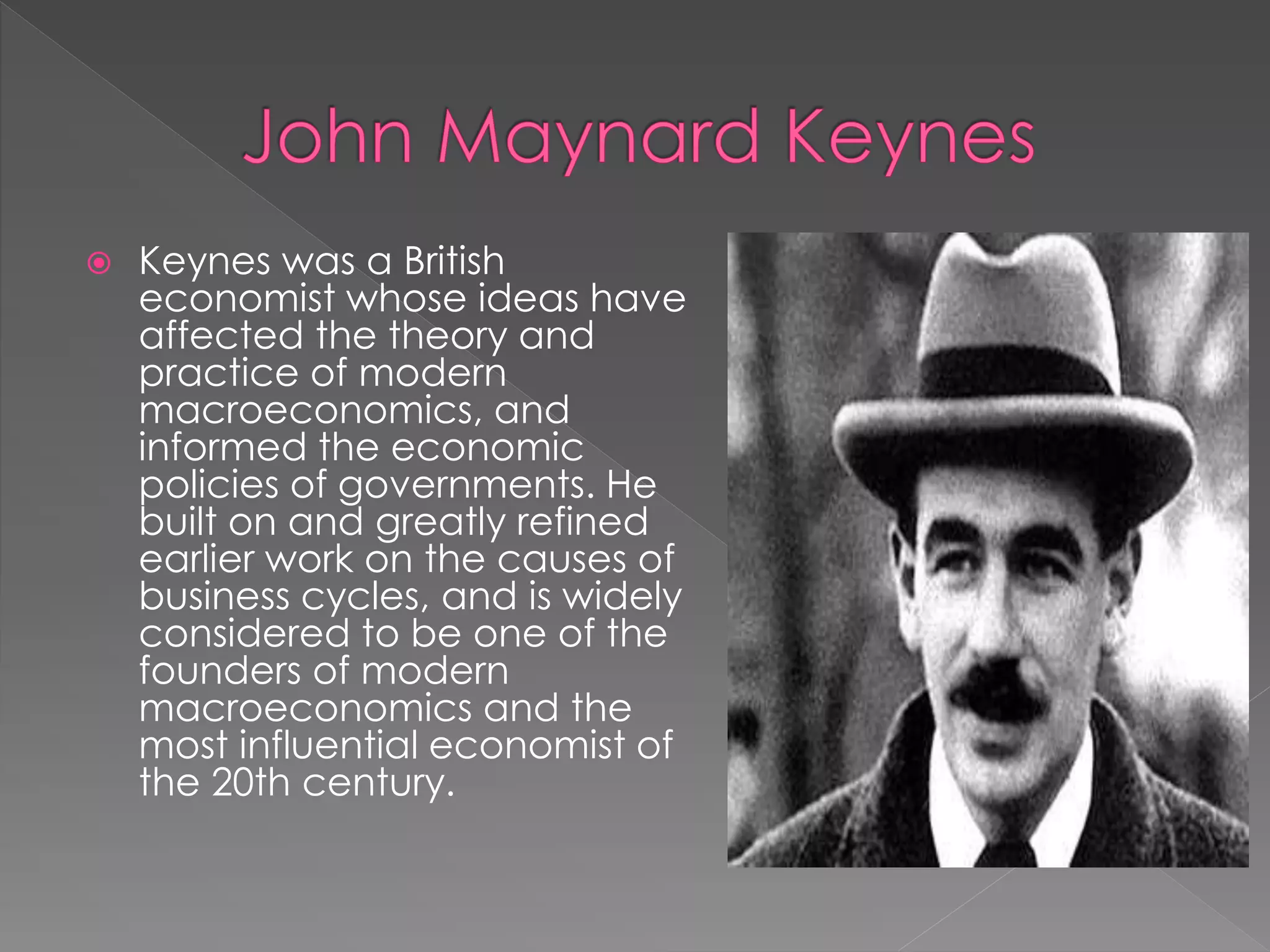
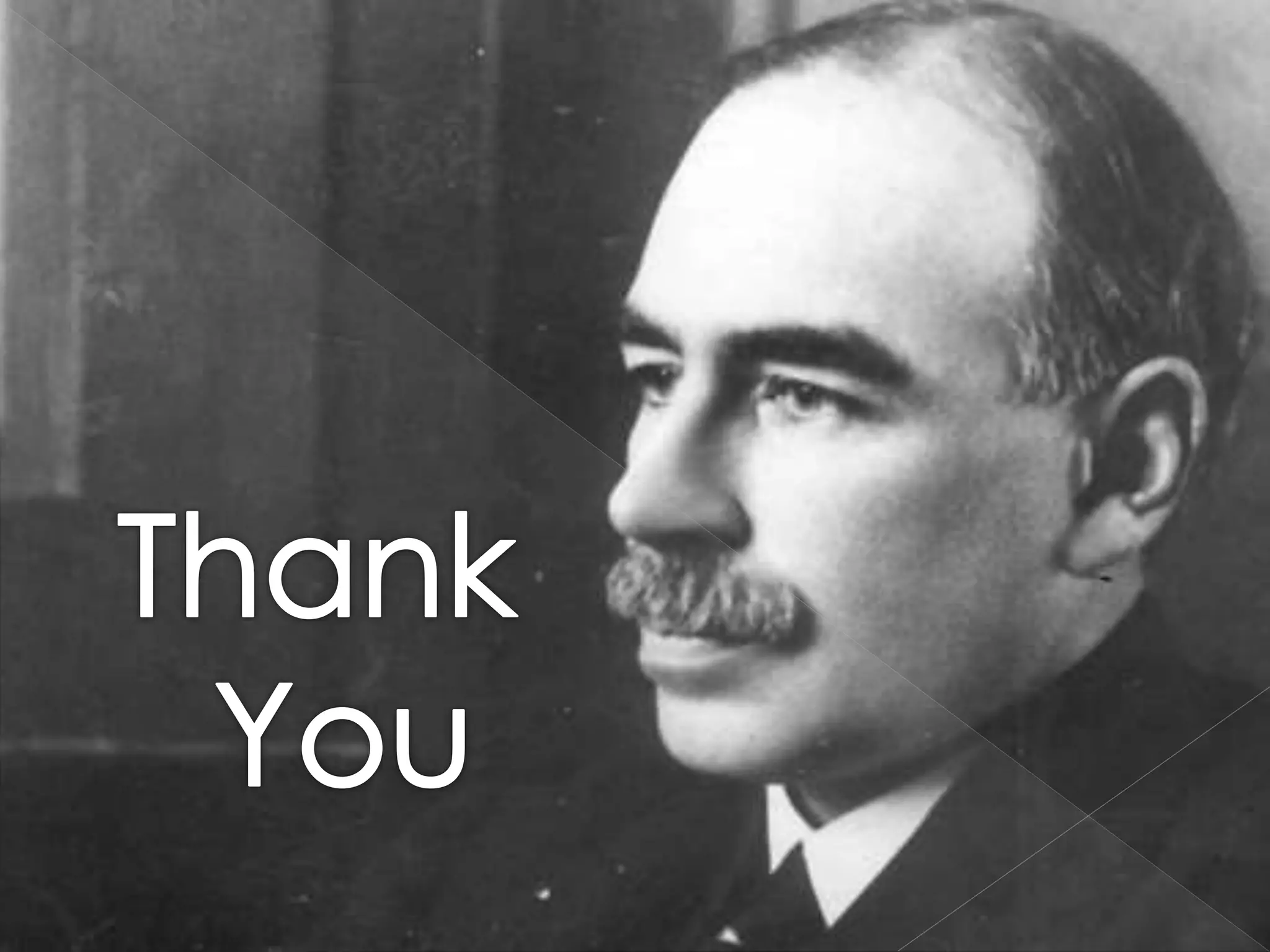
 Keynes was a British 
economist whose ideas have 
affected the theory and 
practice of modern 
macroeconomics, and 
informed the economic 
policies of governments. He 
built on and greatly refined 
earlier work on the causes of 
business cycles, and is widely 
considered to be one of the 
founders of modern 
macroeconomics and the 
most influential economist of 
the 20th century.
 In the 1930s, Keynes spearheaded a revolution in 
economic thinking, overturning the older ideas of 
neoclassical economics that held that free markets 
would, in the short to medium term, automatically 
provide full employment, as long as workers were 
flexible in their wage demands. Keynes instead 
argued that aggregate demand determined the 
overall level of economic activity, and that 
inadequate aggregate demand could lead to 
prolonged periods of high unemployment. He 
advocated the use of fiscal and monetary measures 
to mitigate the adverse effects of economic 
recessions and depressions. Following the outbreak of 
the Second World War, Keynes's ideas concerning 
economic policy were adopted by leading Western 
economies. In 1942, Keynes was awarded a 
hereditary peerage as Baron Keynes of Tilton in the 
County of Sussex. During the 1950s and 1960s, the 
success of Keynesian economics resulted in almost all 
capitalist governments adopting its policy 
recommendations.
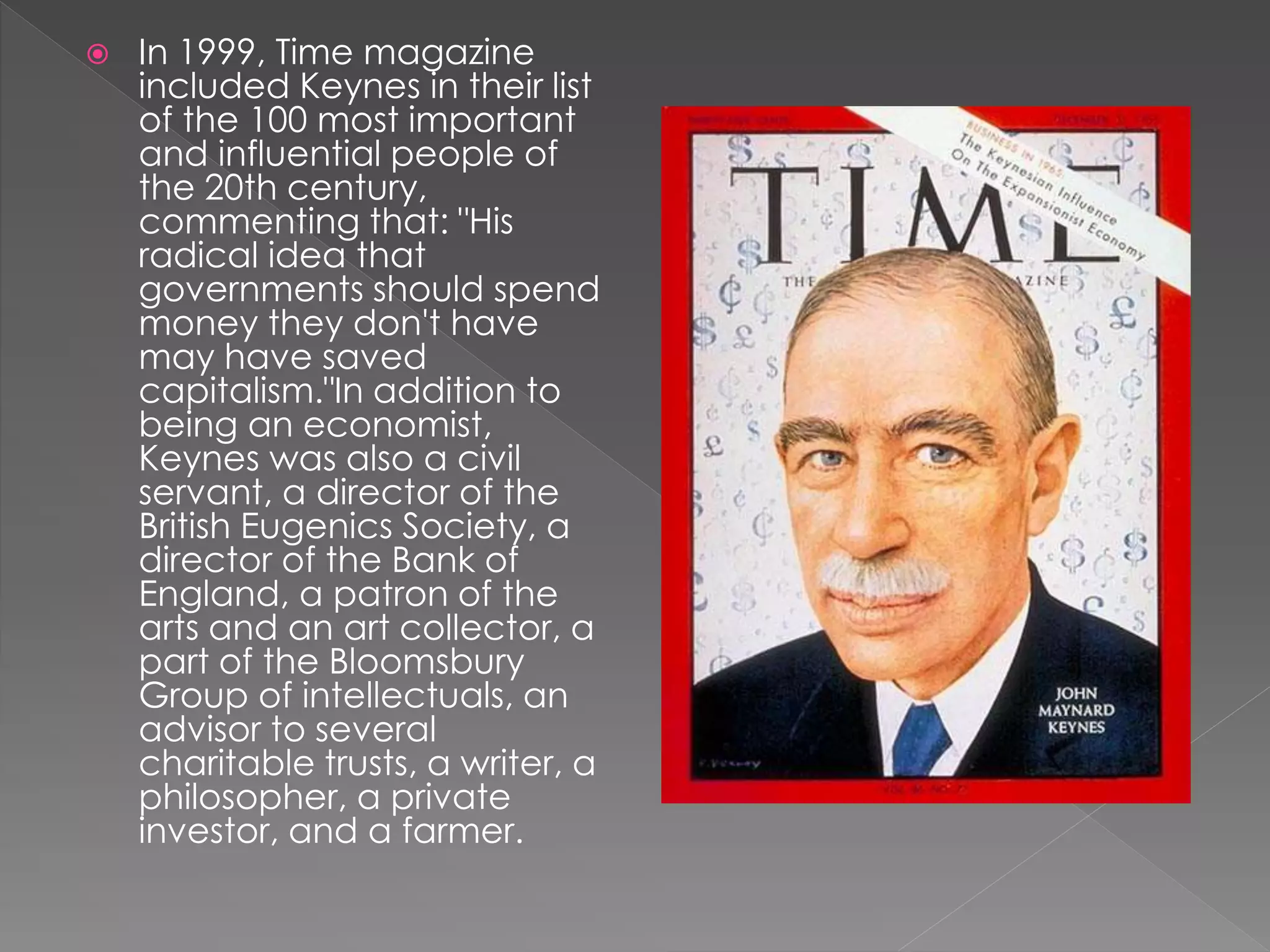
 In 1999, Time magazine 
included Keynes in their list 
of the 100 most important 
and influential people of 
the 20th century, 
commenting that: "His 
radical idea that 
governments should spend 
money they don't have 
may have saved 
capitalism."In addition to 
being an economist, 
Keynes was also a civil 
servant, a director of the 
British Eugenics Society, a 
director of the Bank of 
England, a patron of the 
arts and an art collector, a 
part of the Bloomsbury 
Group of intellectuals, an 
advisor to several 
charitable trusts, a writer, a 
philosopher, a private 
investor, and a farmer.
 The fundamental principle of the classical theory is that the 
economy is self-regulating. Classical economists maintain 
that the economy is always capable of achieving the natural 
level of real GDP or output, which is the level of real GDP that 
is obtained when the economy's resources are fully 
employed. 
 According to Say's Law, when an economy produces a 
certain level of real GDP, it also generates the income 
needed to purchase that level of real GDP. In other words, 
the economy is always capable of demanding all of the 
output that its workers and firms choose to produce. Hence, 
the economy is always capable of achieving the natural 
level of real GDP.
 Consider what happens when the funds from aggregate 
saving exceed the needs of all borrowers in the economy. In 
this situation, real GDP will fall below its natural level because 
investment expenditures will be less than the level of 
aggregate saving. 
 Aggregate saving, represented by the curve S, is an upward-sloping 
function of the interest rate; as the interest rate rises, 
the economy tends to save more. Aggregate investment, 
represented by the curve I, is a downward-sloping function of 
the interest rate; as the interest rate rises, the cost of 
borrowing increases and investment expenditures decline. 
Initially, aggregate saving and investment are equivalent at 
the interest rate, i. If aggregate saving were to increase, 
causing the S curve to shift to the right to S′, then at the same 
interest rate i, a gap emerges between investment and 
savings. Aggregate investment will be lower than aggregate 
saving, implying that equilibrium real GDP will be below its 
natural level.
 Unemployment 
 Says Law of Market 
 Equality between Saving and Investment 
 Money and Prices 
 Demand for Money 
 Role of State in Achieving High Level of Income 
and Employment 
 General versus Special Theory
Keynes & classical theory

Keynes & classical theory

  • 3.
     Keynes wasa British economist whose ideas have affected the theory and practice of modern macroeconomics, and informed the economic policies of governments. He built on and greatly refined earlier work on the causes of business cycles, and is widely considered to be one of the founders of modern macroeconomics and the most influential economist of the 20th century.
  • 4.
     In the1930s, Keynes spearheaded a revolution in economic thinking, overturning the older ideas of neoclassical economics that held that free markets would, in the short to medium term, automatically provide full employment, as long as workers were flexible in their wage demands. Keynes instead argued that aggregate demand determined the overall level of economic activity, and that inadequate aggregate demand could lead to prolonged periods of high unemployment. He advocated the use of fiscal and monetary measures to mitigate the adverse effects of economic recessions and depressions. Following the outbreak of the Second World War, Keynes's ideas concerning economic policy were adopted by leading Western economies. In 1942, Keynes was awarded a hereditary peerage as Baron Keynes of Tilton in the County of Sussex. During the 1950s and 1960s, the success of Keynesian economics resulted in almost all capitalist governments adopting its policy recommendations.
  • 5.
     In 1999,Time magazine included Keynes in their list of the 100 most important and influential people of the 20th century, commenting that: "His radical idea that governments should spend money they don't have may have saved capitalism."In addition to being an economist, Keynes was also a civil servant, a director of the British Eugenics Society, a director of the Bank of England, a patron of the arts and an art collector, a part of the Bloomsbury Group of intellectuals, an advisor to several charitable trusts, a writer, a philosopher, a private investor, and a farmer.
  • 6.
     The fundamentalprinciple of the classical theory is that the economy is self-regulating. Classical economists maintain that the economy is always capable of achieving the natural level of real GDP or output, which is the level of real GDP that is obtained when the economy's resources are fully employed.  According to Say's Law, when an economy produces a certain level of real GDP, it also generates the income needed to purchase that level of real GDP. In other words, the economy is always capable of demanding all of the output that its workers and firms choose to produce. Hence, the economy is always capable of achieving the natural level of real GDP.
  • 7.
     Consider whathappens when the funds from aggregate saving exceed the needs of all borrowers in the economy. In this situation, real GDP will fall below its natural level because investment expenditures will be less than the level of aggregate saving.  Aggregate saving, represented by the curve S, is an upward-sloping function of the interest rate; as the interest rate rises, the economy tends to save more. Aggregate investment, represented by the curve I, is a downward-sloping function of the interest rate; as the interest rate rises, the cost of borrowing increases and investment expenditures decline. Initially, aggregate saving and investment are equivalent at the interest rate, i. If aggregate saving were to increase, causing the S curve to shift to the right to S′, then at the same interest rate i, a gap emerges between investment and savings. Aggregate investment will be lower than aggregate saving, implying that equilibrium real GDP will be below its natural level.
  • 8.
     Unemployment Says Law of Market  Equality between Saving and Investment  Money and Prices  Demand for Money  Role of State in Achieving High Level of Income and Employment  General versus Special Theory