BlogTalk Asia 2009
Jeju, South Korea


                                 Jean-Henry Morin
                       University of Geneva – CUI
                      Dept. of Information Systems

                      Jean-Henry.Morin@unige.ch
                            http://jean-henry.com/
 BlogTalk Asia, Sept 2009
Outline

        •  Introduction and Context

        •  Motivation and Problem Statement

        •  Two Important Problems

        •  Proposition for Managed Personal Information

        •  Design Overview

        •  Conclusion and Discussion
                                                          2
J.-H. Morin
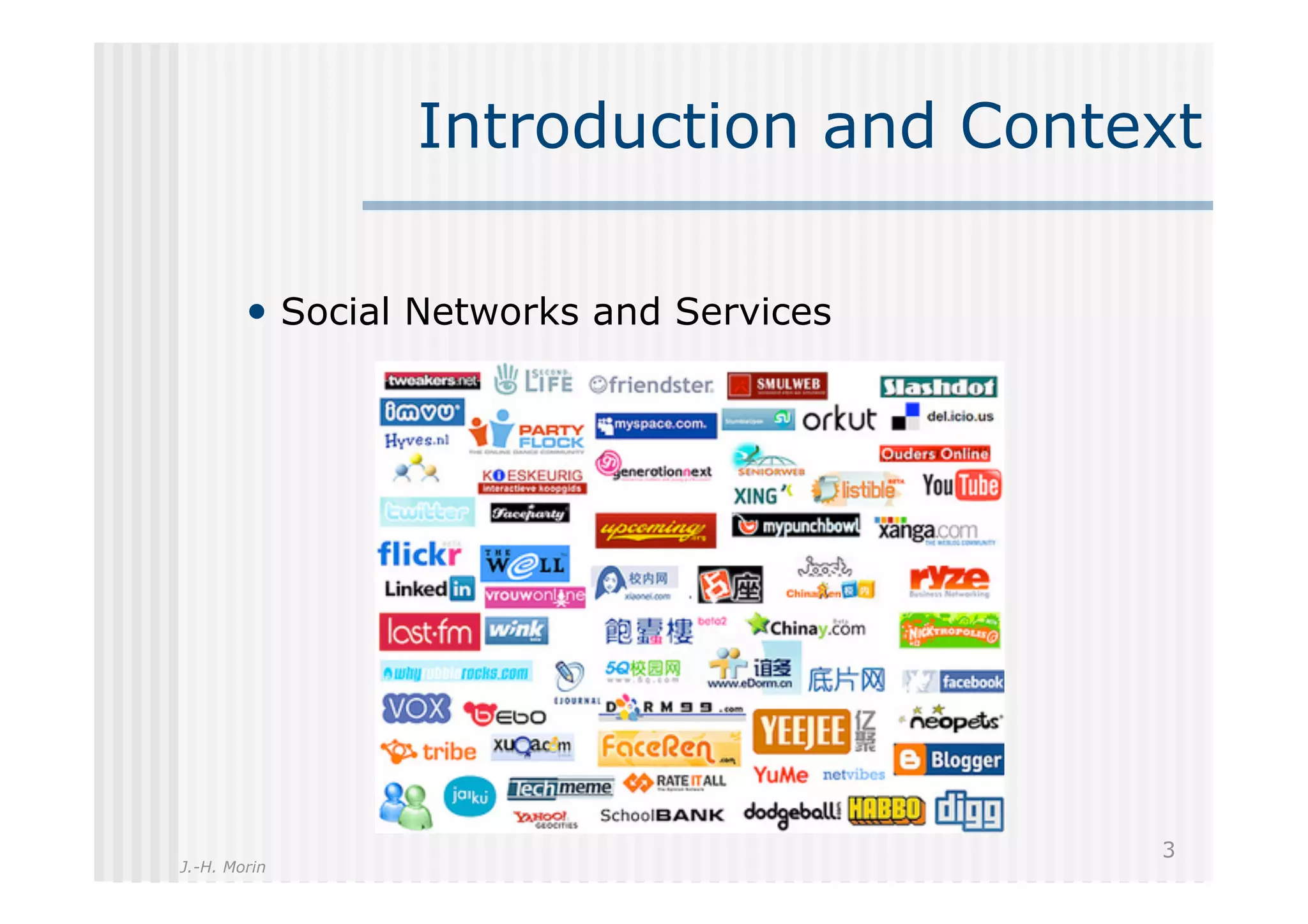
Introduction and Context

        •  Social Networks and Services


                                          3
J.-H. Morin
Introduction and Context

        •  Personal Information

              •  Different from Personally Identifying Information
               (PII)
                 •  Subject to legal frameworks in most countries

              •  Increasingly shared on social networks
                 •  Blurring boundaries between private and public life


      Legitimate concern (i.e., rights) over our
      information in terms of lifetime, usage
      purposes, access, etc.
                                                                          4
J.-H. Morin
Problems and Issues

        •  Publish / share once, publish / share
              forever
              • Indexing and searching

        •  Who “owns” and manages YOUR
              information (SLAs) ? Raging debates.
              • Who’s information is it ?
              • Do you retain control ?

        •  Semantic searching capabilities

                                                     5
J.-H. Morin
The Right to Forget

        •  Right to Forget : fundamental
              human right threatened by the digital
              nature of information (i.e., searchable)

        •  Traditional Media (i.e., non digital)
              “Memory” erodes over time
               • Labor and cost intensive

        •  Digital Media, requires explicit human
              intervention to “make forget” information
              (Rouvroy, 2007)

                                                          6
J.-H. Morin
Anonymity and Privacy

        •  Anonymity and Privacy are fundamental
              to social networking
              • It’s not a “bug”, it’s a feature !
              • It’s not schizophrenia !
                 •  Multiple legitimate personas (e.g., work, family,
                   communities, etc.)
              • How do we deal with it in a socially-
                responsible and ethically sustainable way ?
                 •  Cyber bullying (e.g., Akple in Korea)


        Requires traceability and accountability of
         information (i.e., managed information)
                                                                        7
J.-H. Morin
Key Question

        •  Is Privacy and personal information
              threatened by current social
              networking services ?

        •  We contend there is a need for
              Managed Personal Information
              • Socially-responsible and sustainable

 How can we retain an acceptable (by all) level of
   control over our personal information ?


                                                       8
J.-H. Morin
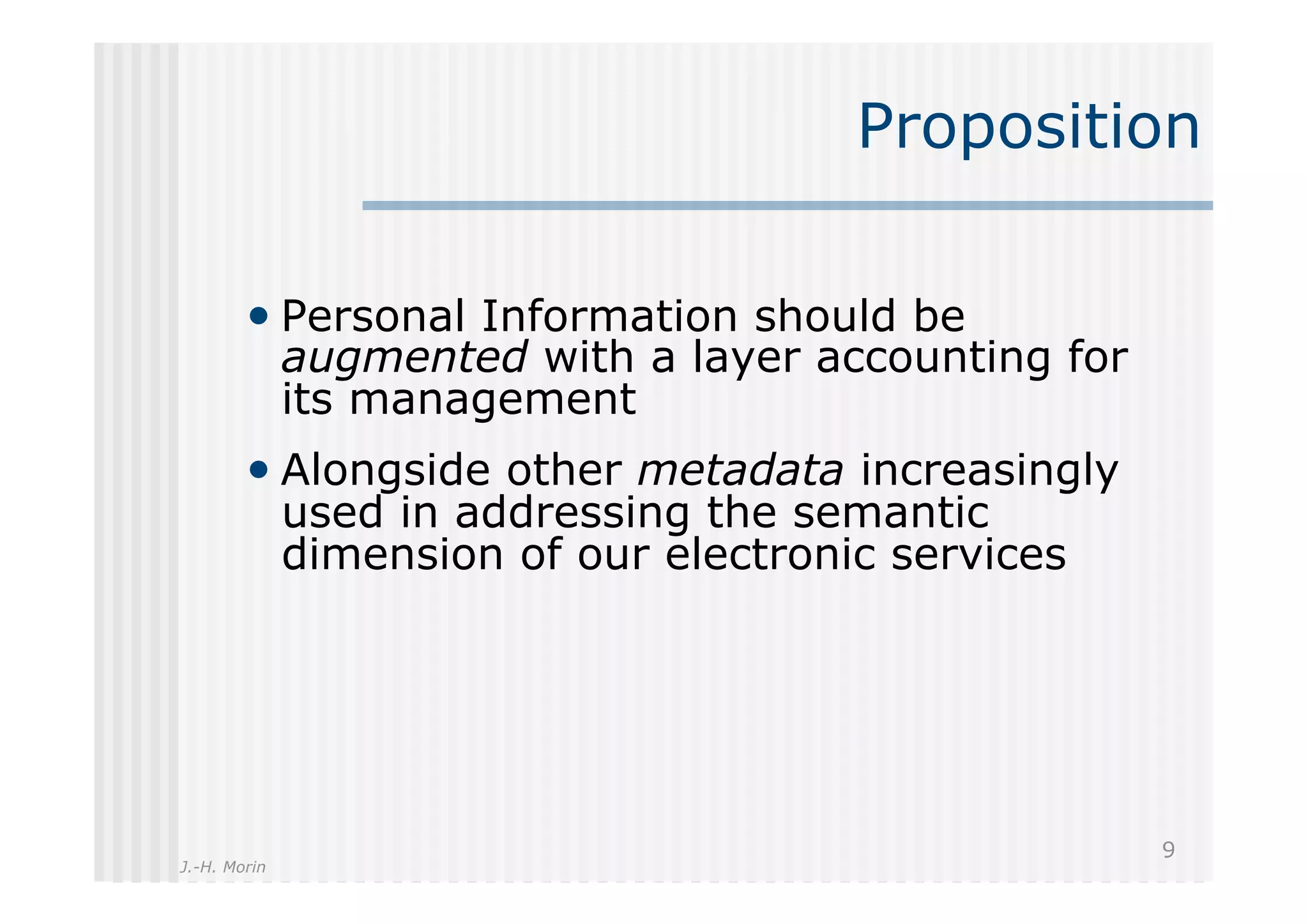
Proposition

        •  Personal Information should be
              augmented with a layer accounting for
              its management
        •  Alongside other metadata increasingly
              used in addressing the semantic
              dimension of our electronic services


                                                      9
J.-H. Morin
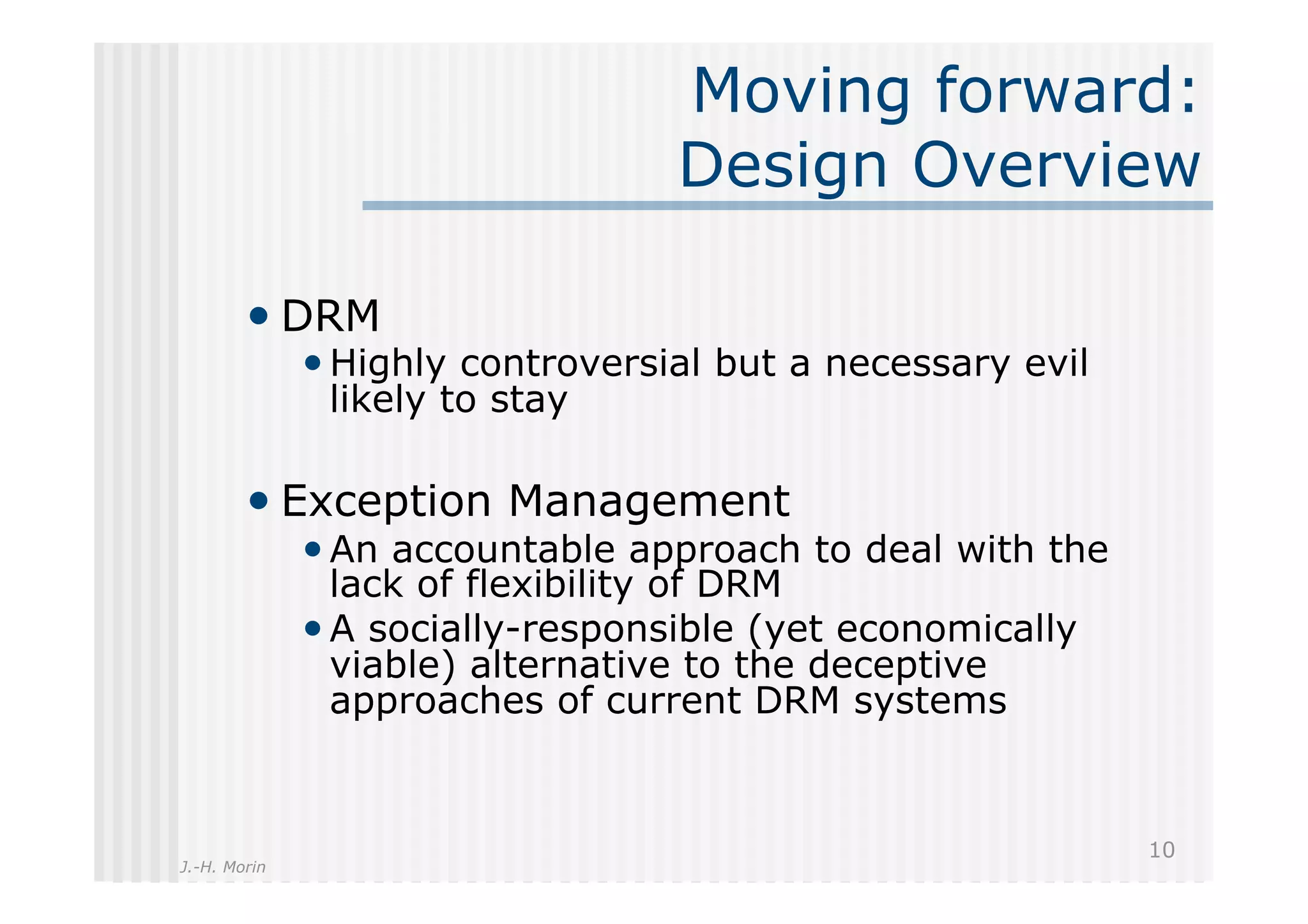
Moving forward:
                                  Design Overview

        •  DRM
              • Highly controversial but a necessary evil
               likely to stay

        •  Exception Management
              • An accountable approach to deal with the
                lack of flexibility of DRM
              • A socially-responsible (yet economically
                viable) alternative to the deceptive
                approaches of current DRM systems


                                                            10
J.-H. Morin
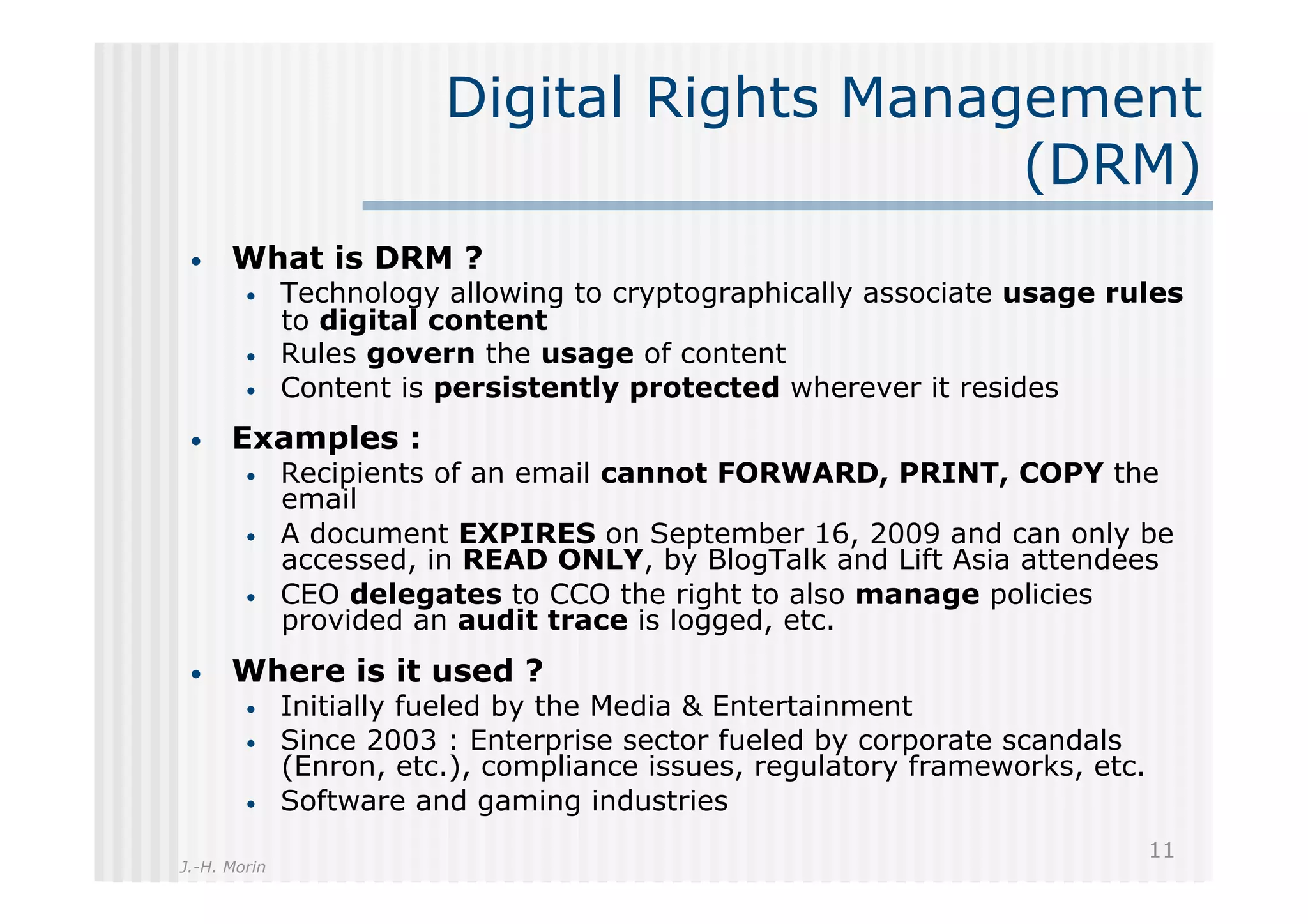
Digital Rights Management
                                             (DRM)
 •    What is DRM ?
        •     Technology allowing to cryptographically associate usage rules
              to digital content
        •     Rules govern the usage of content
        •     Content is persistently protected wherever it resides
 •    Examples :
        •     Recipients of an email cannot FORWARD, PRINT, COPY the
              email
        •     A document EXPIRES on September 16, 2009 and can only be
              accessed, in READ ONLY, by BlogTalk and Lift Asia attendees
        •     CEO delegates to CCO the right to also manage policies
              provided an audit trace is logged, etc.
 •    Where is it used ?
        •     Initially fueled by the Media & Entertainment
        •     Since 2003 : Enterprise sector fueled by corporate scandals
              (Enron, etc.), compliance issues, regulatory frameworks, etc.
        •     Software and gaming industries
                                                                              11
J.-H. Morin
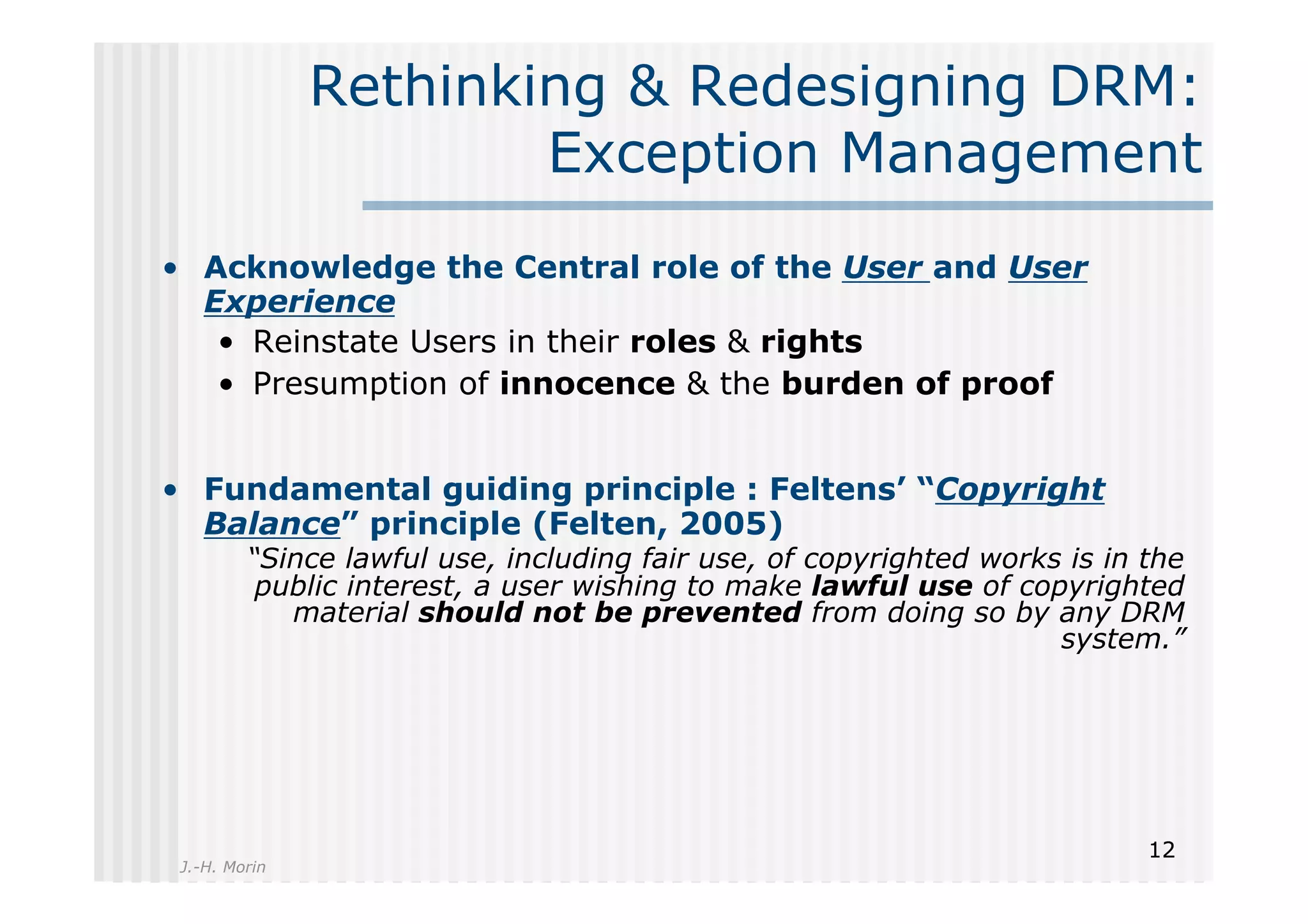
Rethinking & Redesigning DRM:
                       Exception Management
•  Acknowledge the Central role of the User and User
   Experience
    •  Reinstate Users in their roles & rights
    •  Presumption of innocence & the burden of proof


•  Fundamental guiding principle : Feltens’ “Copyright
   Balance” principle (Felten, 2005)
         “Since lawful use, including fair use, of copyrighted works is in the
          public interest, a user wishing to make lawful use of copyrighted
            material should not be prevented from doing so by any DRM
                                                                    system.”


                                                                           12
 J.-H. Morin
Rethinking & Redesigning DRM
                                     (cont.)
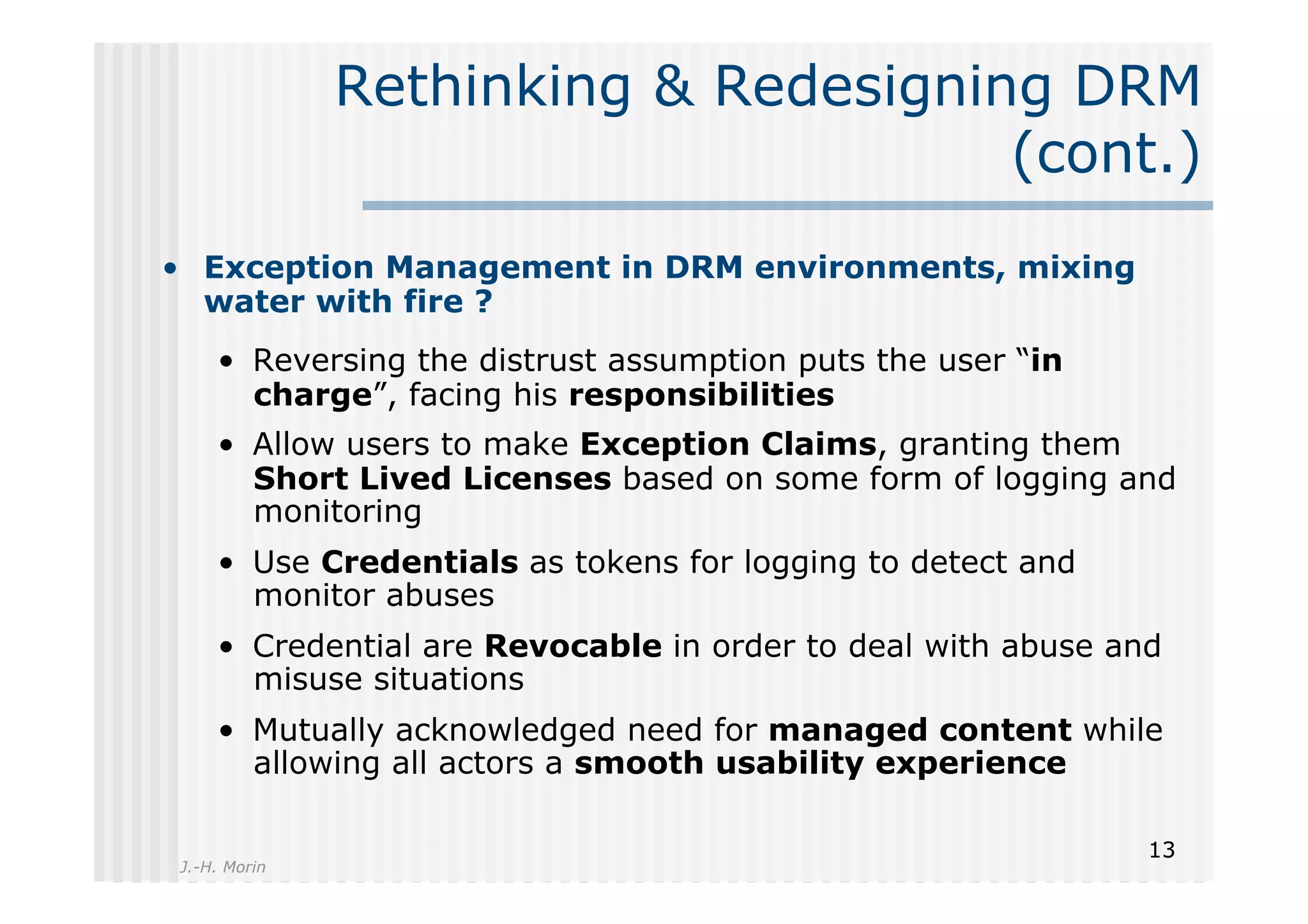
•  Exception Management in DRM environments, mixing
   water with fire ?
    •  Reversing the distrust assumption puts the user “in
       charge”, facing his responsibilities
    •  Allow users to make Exception Claims, granting them
       Short Lived Licenses based on some form of logging and
       monitoring
    •  Use Credentials as tokens for logging to detect and
       monitor abuses
    •  Credential are Revocable in order to deal with abuse and
       misuse situations
    •  Mutually acknowledged need for managed content while
       allowing all actors a smooth usability experience

                                                              13
J.-H. Morin
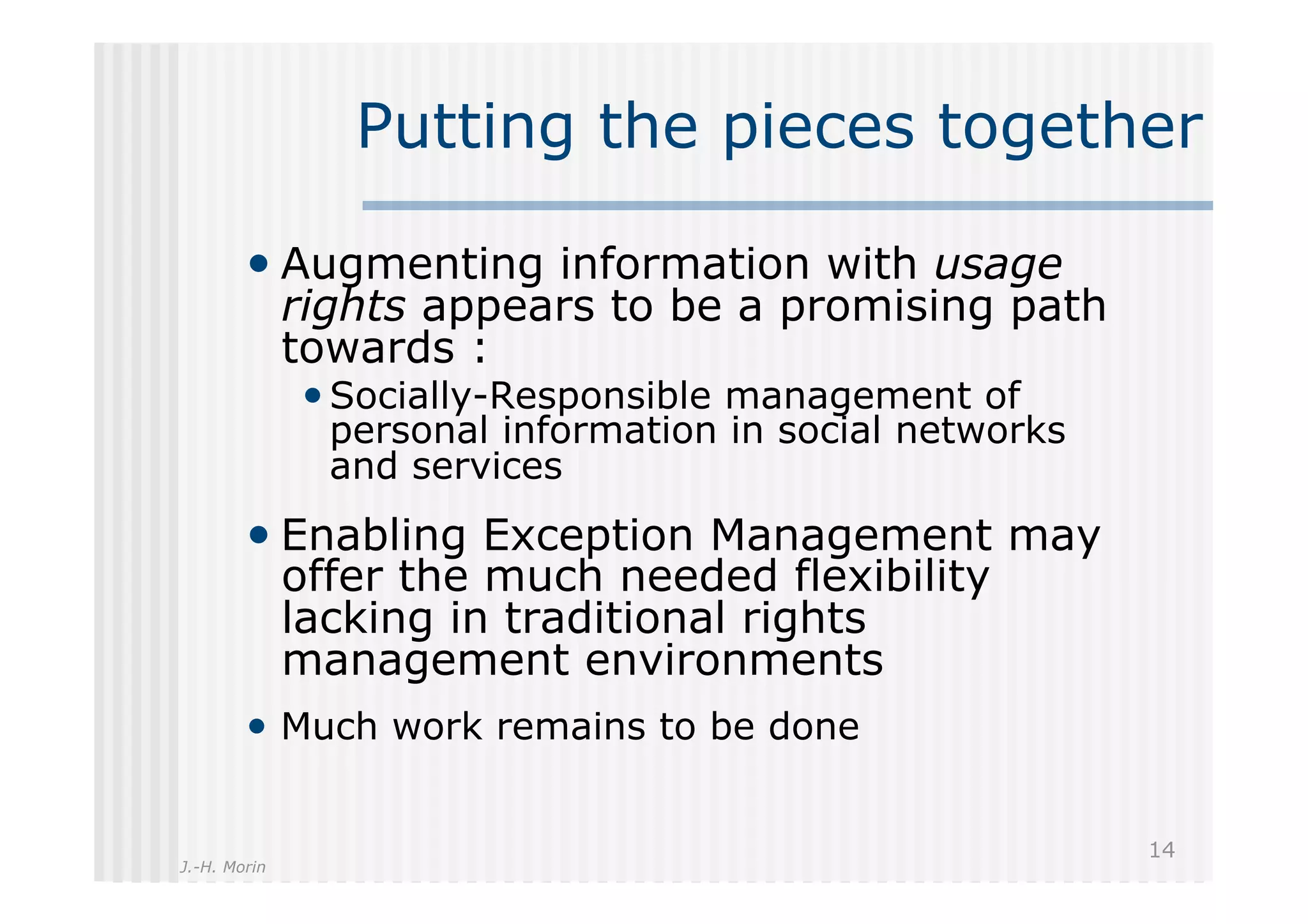
Putting the pieces together

        •  Augmenting information with usage
              rights appears to be a promising path
              towards :
              • Socially-Responsible management of
                personal information in social networks
                and services
        •  Enabling Exception Management may
              offer the much needed flexibility
              lacking in traditional rights
              management environments
        •  Much work remains to be done

                                                          14
J.-H. Morin
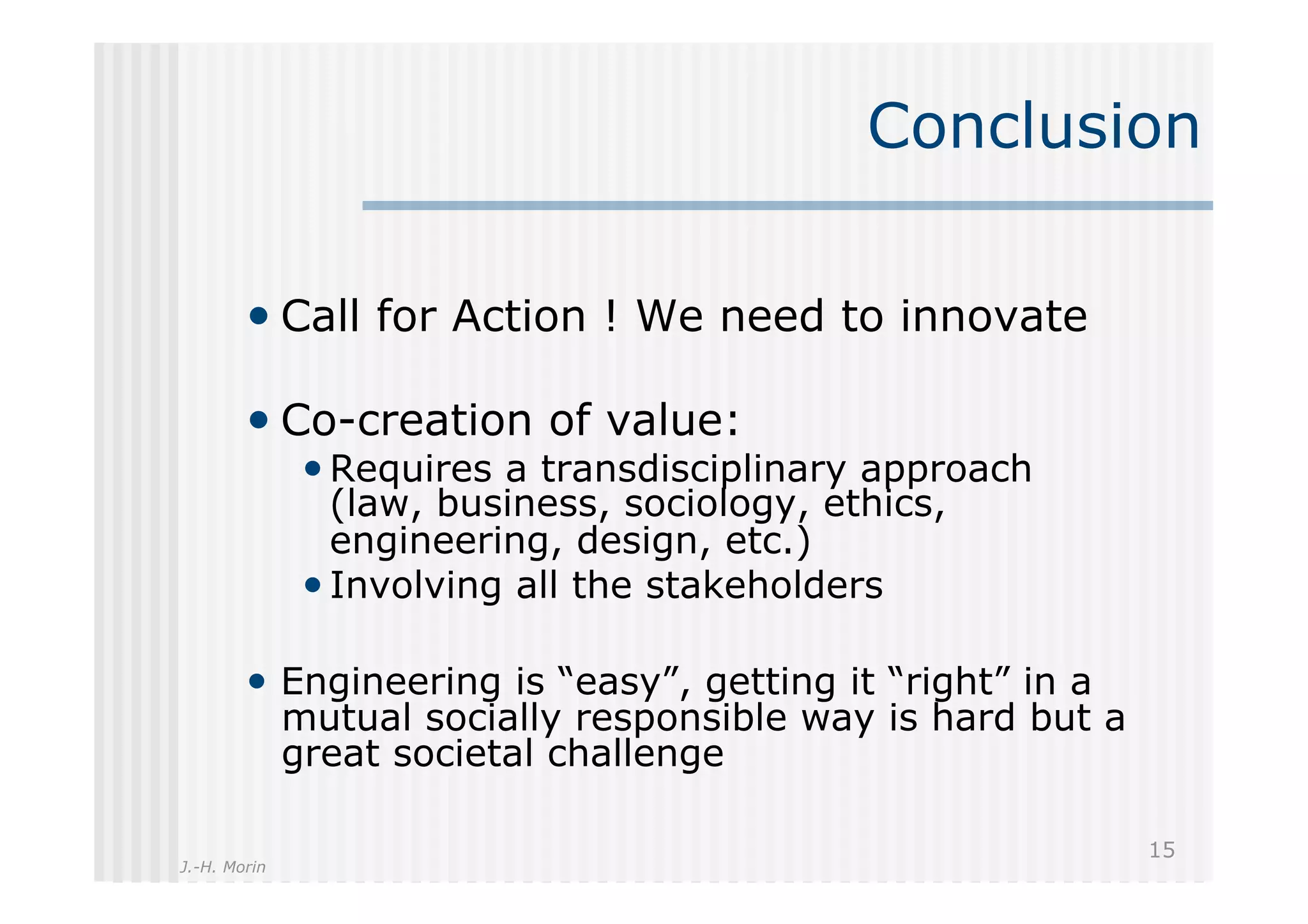
Conclusion

        •  Call for Action ! We need to innovate

        •  Co-creation of value:
               • Requires a transdisciplinary approach
                 (law, business, sociology, ethics,
                 engineering, design, etc.)
               • Involving all the stakeholders

        •  Engineering is “easy”, getting it “right” in a
              mutual socially responsible way is hard but a
              great societal challenge

                                                              15
J.-H. Morin
Questions - Discussion


                Thank you


                                       Jean-Henry Morin
                             University of Geneva – CUI
                            Dept. of Information Systems

                            Jean-Henry.Morin@unige.ch
                                  http://jean-henry.com/
                                                           16
J.-H. Morin

Towards Socially-Responsible Management of Personal Information in Social Networks

  • 1.
    BlogTalk Asia 2009 Jeju,South Korea Jean-Henry Morin University of Geneva – CUI Dept. of Information Systems Jean-Henry.Morin@unige.ch http://jean-henry.com/ BlogTalk Asia, Sept 2009
  • 2.
    Outline •  Introduction and Context •  Motivation and Problem Statement •  Two Important Problems •  Proposition for Managed Personal Information •  Design Overview •  Conclusion and Discussion 2 J.-H. Morin
  • 3.
    Introduction and Context •  Social Networks and Services 3 J.-H. Morin
  • 4.
    Introduction and Context •  Personal Information •  Different from Personally Identifying Information (PII) •  Subject to legal frameworks in most countries •  Increasingly shared on social networks •  Blurring boundaries between private and public life Legitimate concern (i.e., rights) over our information in terms of lifetime, usage purposes, access, etc. 4 J.-H. Morin
  • 5.
    Problems and Issues •  Publish / share once, publish / share forever • Indexing and searching •  Who “owns” and manages YOUR information (SLAs) ? Raging debates. • Who’s information is it ? • Do you retain control ? •  Semantic searching capabilities 5 J.-H. Morin
  • 6.
    The Right toForget •  Right to Forget : fundamental human right threatened by the digital nature of information (i.e., searchable) •  Traditional Media (i.e., non digital) “Memory” erodes over time • Labor and cost intensive •  Digital Media, requires explicit human intervention to “make forget” information (Rouvroy, 2007) 6 J.-H. Morin
  • 7.
    Anonymity and Privacy •  Anonymity and Privacy are fundamental to social networking • It’s not a “bug”, it’s a feature ! • It’s not schizophrenia ! •  Multiple legitimate personas (e.g., work, family, communities, etc.) • How do we deal with it in a socially- responsible and ethically sustainable way ? •  Cyber bullying (e.g., Akple in Korea) Requires traceability and accountability of information (i.e., managed information) 7 J.-H. Morin
  • 8.
    Key Question •  Is Privacy and personal information threatened by current social networking services ? •  We contend there is a need for Managed Personal Information • Socially-responsible and sustainable How can we retain an acceptable (by all) level of control over our personal information ? 8 J.-H. Morin
  • 9.
    Proposition •  Personal Information should be augmented with a layer accounting for its management •  Alongside other metadata increasingly used in addressing the semantic dimension of our electronic services 9 J.-H. Morin
  • 10.
    Moving forward: Design Overview •  DRM • Highly controversial but a necessary evil likely to stay •  Exception Management • An accountable approach to deal with the lack of flexibility of DRM • A socially-responsible (yet economically viable) alternative to the deceptive approaches of current DRM systems 10 J.-H. Morin
  • 11.
    Digital Rights Management (DRM) •  What is DRM ? •  Technology allowing to cryptographically associate usage rules to digital content •  Rules govern the usage of content •  Content is persistently protected wherever it resides •  Examples : •  Recipients of an email cannot FORWARD, PRINT, COPY the email •  A document EXPIRES on September 16, 2009 and can only be accessed, in READ ONLY, by BlogTalk and Lift Asia attendees •  CEO delegates to CCO the right to also manage policies provided an audit trace is logged, etc. •  Where is it used ? •  Initially fueled by the Media & Entertainment •  Since 2003 : Enterprise sector fueled by corporate scandals (Enron, etc.), compliance issues, regulatory frameworks, etc. •  Software and gaming industries 11 J.-H. Morin
  • 12.
    Rethinking & RedesigningDRM: Exception Management •  Acknowledge the Central role of the User and User Experience •  Reinstate Users in their roles & rights •  Presumption of innocence & the burden of proof •  Fundamental guiding principle : Feltens’ “Copyright Balance” principle (Felten, 2005) “Since lawful use, including fair use, of copyrighted works is in the public interest, a user wishing to make lawful use of copyrighted material should not be prevented from doing so by any DRM system.” 12 J.-H. Morin
  • 13.
    Rethinking & RedesigningDRM (cont.) •  Exception Management in DRM environments, mixing water with fire ? •  Reversing the distrust assumption puts the user “in charge”, facing his responsibilities •  Allow users to make Exception Claims, granting them Short Lived Licenses based on some form of logging and monitoring •  Use Credentials as tokens for logging to detect and monitor abuses •  Credential are Revocable in order to deal with abuse and misuse situations •  Mutually acknowledged need for managed content while allowing all actors a smooth usability experience 13 J.-H. Morin
  • 14.
    Putting the piecestogether •  Augmenting information with usage rights appears to be a promising path towards : • Socially-Responsible management of personal information in social networks and services •  Enabling Exception Management may offer the much needed flexibility lacking in traditional rights management environments •  Much work remains to be done 14 J.-H. Morin
  • 15.
    Conclusion •  Call for Action ! We need to innovate •  Co-creation of value: • Requires a transdisciplinary approach (law, business, sociology, ethics, engineering, design, etc.) • Involving all the stakeholders •  Engineering is “easy”, getting it “right” in a mutual socially responsible way is hard but a great societal challenge 15 J.-H. Morin
  • 16.
    Questions - Discussion Thank you Jean-Henry Morin University of Geneva – CUI Dept. of Information Systems Jean-Henry.Morin@unige.ch http://jean-henry.com/ 16 J.-H. Morin

Editor's Notes