Prof.	
  Jean-­‐Henry	
  Morin	
  
University	
  of	
  Geneva	
  –	
  CUI	
  
Ins8tute	
  of	
  Informa8on	
  Service	
  Science	
  
Faculté	
  des	
  Sciences	
  de	
  la	
  Société	


Jean-­‐Henry.Morin@unige.ch	
  
@jhmorin	
  
Reinsta(ng	
  Trust	
  in	
  the	
  Digital	
  Age	
  
PwC 5th Digital Trust Conference
Geneva
March 17, 2015
Who has NEVER « worked around » security
policies to legitimately complete work that systems
Prevented from doing ?
3	


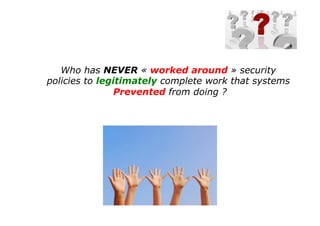
Security	
  is	
  bypassed,	
  
not	
  a2acked	
  
Inspired by Adi Shamir, Turing Award lecture, 2002


Foreword	
  
Human	
  Factor	
  
Outline
•  A bit of context and technology
•  3 eras of Trust
•  Revisiting technology
•  Co-Compliance Principle and Digital Responsibility
•  Conclusions & Take Away
•  Q & A
Context	
  (I)	
  
Organiza8ons	
  &	
  Corporate	
  sector	
  
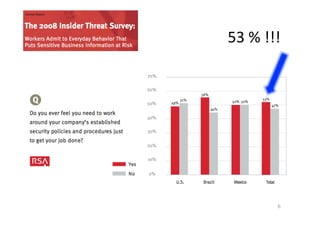
53	
  %	
  !!!	
  
6
Organizations & Corporate Sector :
Corporate Security Policies
53% admit circumventing corporate security policies to
get the work done (EMC RSA Security, 2008)
Among the most cited reasons justifying circumventing
corporate security policies (Cisco, 2008)
a)  Doesn’t correspond to the operational reality nor to what is
required to get the work done
b)  Need to access applications not belonging to or authorized by
corporate IT policies to work
Consequences : increase in risks and costs
•  Requires « creativity » to get the job done !
•  Increased stress due to unauthorized actions
•  Inefficiencies
•  Untraceable transgressions / violations
Informa8on	
  Protec8on	
  &	
  Control	
  
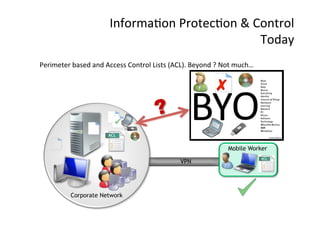
Today	
  
Perimeter	
  based	
  and	
  Access	
  Control	
  Lists	
  (ACL).	
  Beyond	
  ?	
  Not	
  much…	
  
?
Mobile Worker
Corporate Network
VPN
Context	
  (II)	
  
Entertainment	
  &	
  Media	
  sector	
  
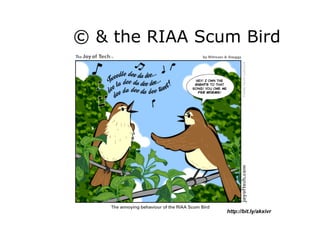
© & the RIAA Scum Bird
http://bit.ly/akxivr
1	
  Technology	
  
DRM	
  
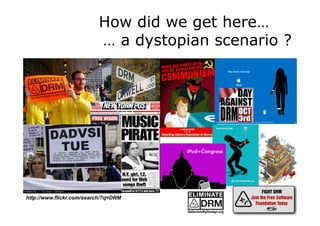
How did we get here…
… a dystopian scenario ?
http://www.flickr.com/search/?q=DRM
3	
  eras	
  of	
  trust	
  
•  Before	
  –	
  Suspicion	
  
•  Today	
  –	
  Breach	
  of	
  Trust	
  
•  Tomorrow	
  –	
  The	
  rise	
  of	
  «	
  informed	
  Trust	
  »	
  
h_p://eloquentscience.com/wp-­‐content/uploads/2012/05/past-­‐
present-­‐future-­‐sign1.jpg	
  
<	
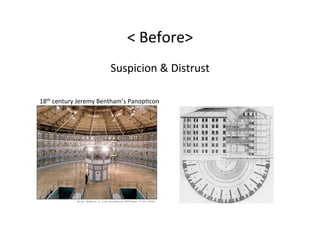
  Before>	
  
Suspicion	
  &	
  Distrust	


18th	
  century	
  Jeremy	
  Bentham’s	
  Panop8con	
  
A Paradox
We talked about Trust and Trusted Computing
in the digital age…
…but everything relied on a distrust
assumption
http://zatoichi.homeip.net/~brain/TrustedComputing.jpg
<	
  Today	
  >	
  
Massive	
  Breach	
  of	
  Trust	


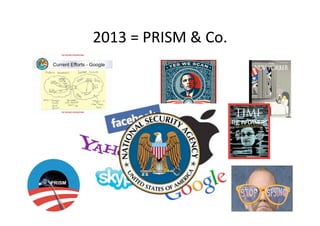
2013	
  =	
  PRISM	
  &	
  Co.	
  
<	
  Tomorrow	
  >	


The	
  rise	
  of	
  «	
  Informed	
  Trust	
  »	
  
Can IT be fixed ?
•  Acknowledging that :
•  Security is necessary (managed content)
•  Total Security is neither realistic nor desirable
•  Given the right User Experience and Business Models
most users smoothly comply (e.g., iTunes)
•  Most users aren’t criminals
•  We need to take a step back to :
•  Critically re-think Security, DRM, Trust
•  Reconsider the debate outside the either/or extremes of
total vs. no security
•  Factor in, by design, these issues for the development of
systems and services WE all use.
Rethinking & Redesigning
•  Acknowledge the Central role of the User and User
Experience
•  Reinstate Users in their roles & rights and Responsibilities
•  Presumption of innocence & the burden of proof
•  Fundamental guiding principle to Rethink and Redesign
DRM : Feltens’ “Copyright Balance” principle (Felten,
2005)
“Since lawful use, including fair use, of copyrighted works is in the
public interest, a user wishing to make lawful use of copyrighted
material should not be prevented from doing so by any DRM
system.”
•  Claim and Proposition :
•  Put the trust back into the hands of the users
•  Reverse the distrust assumption
Requires a major paradigm shift
From	
  Utopia	
  to	
  Reality	
  …	
  
The	
  Excep8on	
  Management	
  Model	
  
Rethinking & Redesigning DRM
•  Exception Management in DRM environments, mixing
water with fire ? Not necessarily !
•  Reversing the distrust assumption puts the user “in
charge”, facing his responsibilities
•  Allow users to make Exception Claims, granting them
Short Lived Licenses based on some form of logging and
monitoring
•  Use Credentials as tokens for logging to detect and
monitor abuses
•  Credential are Revocable in order to deal with abuse and
misuse situations
•  Mutually acknowledged need for managed content while
allowing all actors a smooth usability experience
(Morin and Pawlak, 2007, 2008); (Morin 2008, 2009)
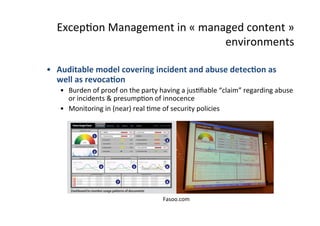
Excep8on	
  Management	
  in	
  «	
  managed	
  content	
  »	
  
environments	
  
•  Auditable	
  model	
  covering	
  incident	
  and	
  abuse	
  detec;on	
  as	
  
well	
  as	
  revoca;on	
  
•  Burden	
  of	
  proof	
  on	
  the	
  party	
  having	
  a	
  jus8fiable	
  “claim”	
  regarding	
  abuse	
  
or	
  incidents	
  &	
  presump8on	
  of	
  innocence	
  
•  Monitoring	
  in	
  (near)	
  real	
  8me	
  of	
  security	
  policies	
  
Fasoo.com	
  
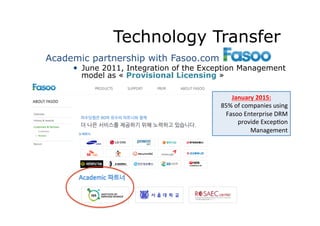
Technology Transfer
Academic partnership with Fasoo.com
•  June 2011, Integration of the Exception Management
model as « Provisional Licensing »
January	
  2015:	
  
85%	
  of	
  companies	
  using	
  
Fasoo	
  Enterprise	
  DRM	
  
provide	
  Excep8on	
  
Management	
  	
  
Ongoing	
  Work	
  …	
  	
  
•  DRM,	
  Security,	
  Trust	
  &	
  Block	
  Chain	
  
•  Security	
  Policy	
  Design	
  framework	
  
Perspec8ve…	
  
•  Take	
  into	
  account	
  the	
  Human	
  Factor	
  by	
  Design	
  
(People	
  Centric	
  Security,	
  PCS	
  [T.	
  Scholtz,	
  2012])	
  
•  Data	
  Protec8on	
  in	
  a	
  digital	
  economy	
  :	
  	
  
–  Awareness	
  raising	
  and	
  training	
  
–  The	
  EU	
  Data	
  Protec8on	
  reform:	
  re-­‐appropria;on	
  of	
  
data	
  and	
  personal	
  informa;on	
  by	
  the	
  people	


•  Public	
  Policies	
  and	
  Digital	
  Governance	
  :	
  Key	
  
success	
  factors,	
  Emergency!	
  
To Trust or not to be …
http://world.edu/wp-content/uploads/2013/02/climate-change-skeptics.jpg
Digital	
  Responsibility	
  :	
  Informed	
  Trust	
  &	
  Transparency	
  
Co-Compliance
•  Emerging principle relying on
« Informed Trust » and « Transparency »
•  Co-Compliance (short for collaborative compliance):
collaborative, shared responsibility enabled by digital
technologies allowing both joint elaboration of a decision or
action and the shared evaluation of its result.
Cost : Major paradigm shift !
(Morin,	
  2014)	
  
Digital Responsibility
Some Key characteristics (evolving) :
•  User Centered Design
•  Account for all stakeholders
•  Proportionality of the means to engage
•  Integrating the Human Factor
•  Openness and Transparency
•  Sharing and Collaboration
•  Limited and Humble use of the legal instrument
•  Leveraging sustainable public policies
(Morin,	
  2014)	
  
Conclusion
•  Trust assumes leaving to humans the capacity to
make free moral decision (Exception by Design)
•  Trust isn’t blind (managed, informed)
•  We are facing a MAJOR challenge of our
participative digital society
Is a socially responsible and sustainable
approach to trust in the digital era possible ?
References
J.-H. Morin, “Rethinking DRM Using Exception Management”, chapter III in
Handbook of Research on Secure Multimedia Distribution, S. Lian and Y. Zhang (Eds),
Information Science Reference (ISR), ISBN: 978-1-60566-262-6, IGI Global, March
2009, pp 39-54.
http://www.igi-global.com/reference/details.asp?id=33143
J.-H. Morin, “Exception Based Enterprise Rights Management : Towards a
Paradigm Shift in Information Security and Policy Management”, International
Journal On Advances in Systems and Measurements, issn 1942-261x, vol. 1, no. 1,
2008, pp. 40-49.
http://www.iariajournals.org/systems_and_measurements/
J.-H. Morin, “La responsabilité numérique : Restaurer la confiance à l'ère du
numérique“ FYP éditions, Avril 2014.
http://www.fypeditions.com/responsabilite-numerique/
Think(do)Tank on Service
Science and Innovation
http://thinkservices.info/
h_p://thinkdata.ch/	
  	
  
Swiss	
  Digital	
  Agenda	
  
Na8onal	
  debate	
  
h_p://NumeriCH.ch/	


L e t ’ s 	
   b e 	
   D i g i t a l l y 	
   R e s p o n s i b l e 	
   ! 	
  
Q 	
   & 	
   A 	


Contacts:
Prof.	
  Jean-­‐Henry	
  Morin	
  
University	
  of	
  Geneva	
  –	
  CUI	
  
Ins8tute	
  of	
  Informa8on	
  Service	
  Science	
  
Faculté	
  des	
  Sciences	
  de	
  la	
  Société	
  
h_p://iss.unige.ch/	
  	
  
Jean-­‐Henry.Morin@unige.ch	
  
@jhmorin	
  
h_p://ch.linkedin.com/in/jhmorin	
  
h_p://www.slideshare.net/jhmorin	
  
h_p://jean-­‐henry.com/	
  
&	
  

Reinstating Trust in the Digital Age

  • 1.
    Prof.  Jean-­‐Henry  Morin   University  of  Geneva  –  CUI   Ins8tute  of  Informa8on  Service  Science   Faculté  des  Sciences  de  la  Société     Jean-­‐Henry.Morin@unige.ch   @jhmorin   Reinsta(ng  Trust  in  the  Digital  Age   PwC 5th Digital Trust Conference Geneva March 17, 2015
  • 2.
    Who has NEVER« worked around » security policies to legitimately complete work that systems Prevented from doing ?
  • 3.
    3     Security  is  bypassed,   not  a2acked   Inspired by Adi Shamir, Turing Award lecture, 2002                 Foreword   Human  Factor  
  • 4.
    Outline •  A bitof context and technology •  3 eras of Trust •  Revisiting technology •  Co-Compliance Principle and Digital Responsibility •  Conclusions & Take Away •  Q & A
  • 5.
    Context  (I)   Organiza8ons  &  Corporate  sector  
  • 6.
  • 7.
    Organizations & CorporateSector : Corporate Security Policies 53% admit circumventing corporate security policies to get the work done (EMC RSA Security, 2008) Among the most cited reasons justifying circumventing corporate security policies (Cisco, 2008) a)  Doesn’t correspond to the operational reality nor to what is required to get the work done b)  Need to access applications not belonging to or authorized by corporate IT policies to work Consequences : increase in risks and costs •  Requires « creativity » to get the job done ! •  Increased stress due to unauthorized actions •  Inefficiencies •  Untraceable transgressions / violations
  • 8.
    Informa8on  Protec8on  &  Control   Today   Perimeter  based  and  Access  Control  Lists  (ACL).  Beyond  ?  Not  much…   ? Mobile Worker Corporate Network VPN
  • 9.
    Context  (II)   Entertainment  &  Media  sector  
  • 10.
    © & theRIAA Scum Bird http://bit.ly/akxivr
  • 11.
  • 12.
    How did weget here… … a dystopian scenario ? http://www.flickr.com/search/?q=DRM
  • 13.
    3  eras  of  trust   •  Before  –  Suspicion   •  Today  –  Breach  of  Trust   •  Tomorrow  –  The  rise  of  «  informed  Trust  »   h_p://eloquentscience.com/wp-­‐content/uploads/2012/05/past-­‐ present-­‐future-­‐sign1.jpg  
  • 14.
    <  Before>   Suspicion  &  Distrust     18th  century  Jeremy  Bentham’s  Panop8con  
  • 15.
    A Paradox We talkedabout Trust and Trusted Computing in the digital age… …but everything relied on a distrust assumption http://zatoichi.homeip.net/~brain/TrustedComputing.jpg
  • 16.
    <  Today  >   Massive  Breach  of  Trust    
  • 17.
    2013  =  PRISM  &  Co.  
  • 18.
    <  Tomorrow  >     The  rise  of  «  Informed  Trust  »  
  • 19.
    Can IT befixed ? •  Acknowledging that : •  Security is necessary (managed content) •  Total Security is neither realistic nor desirable •  Given the right User Experience and Business Models most users smoothly comply (e.g., iTunes) •  Most users aren’t criminals •  We need to take a step back to : •  Critically re-think Security, DRM, Trust •  Reconsider the debate outside the either/or extremes of total vs. no security •  Factor in, by design, these issues for the development of systems and services WE all use.
  • 20.
    Rethinking & Redesigning • Acknowledge the Central role of the User and User Experience •  Reinstate Users in their roles & rights and Responsibilities •  Presumption of innocence & the burden of proof •  Fundamental guiding principle to Rethink and Redesign DRM : Feltens’ “Copyright Balance” principle (Felten, 2005) “Since lawful use, including fair use, of copyrighted works is in the public interest, a user wishing to make lawful use of copyrighted material should not be prevented from doing so by any DRM system.” •  Claim and Proposition : •  Put the trust back into the hands of the users •  Reverse the distrust assumption Requires a major paradigm shift
  • 21.
    From  Utopia  to  Reality  …   The  Excep8on  Management  Model  
  • 22.
    Rethinking & RedesigningDRM •  Exception Management in DRM environments, mixing water with fire ? Not necessarily ! •  Reversing the distrust assumption puts the user “in charge”, facing his responsibilities •  Allow users to make Exception Claims, granting them Short Lived Licenses based on some form of logging and monitoring •  Use Credentials as tokens for logging to detect and monitor abuses •  Credential are Revocable in order to deal with abuse and misuse situations •  Mutually acknowledged need for managed content while allowing all actors a smooth usability experience (Morin and Pawlak, 2007, 2008); (Morin 2008, 2009)
  • 23.
    Excep8on  Management  in  «  managed  content  »   environments   •  Auditable  model  covering  incident  and  abuse  detec;on  as   well  as  revoca;on   •  Burden  of  proof  on  the  party  having  a  jus8fiable  “claim”  regarding  abuse   or  incidents  &  presump8on  of  innocence   •  Monitoring  in  (near)  real  8me  of  security  policies   Fasoo.com  
  • 24.
    Technology Transfer Academic partnershipwith Fasoo.com •  June 2011, Integration of the Exception Management model as « Provisional Licensing » January  2015:   85%  of  companies  using   Fasoo  Enterprise  DRM   provide  Excep8on   Management    
  • 25.
    Ongoing  Work  …     •  DRM,  Security,  Trust  &  Block  Chain   •  Security  Policy  Design  framework  
  • 26.
    Perspec8ve…   •  Take  into  account  the  Human  Factor  by  Design   (People  Centric  Security,  PCS  [T.  Scholtz,  2012])   •  Data  Protec8on  in  a  digital  economy  :     –  Awareness  raising  and  training   –  The  EU  Data  Protec8on  reform:  re-­‐appropria;on  of   data  and  personal  informa;on  by  the  people     •  Public  Policies  and  Digital  Governance  :  Key   success  factors,  Emergency!  
  • 27.
    To Trust ornot to be … http://world.edu/wp-content/uploads/2013/02/climate-change-skeptics.jpg Digital  Responsibility  :  Informed  Trust  &  Transparency  
  • 28.
    Co-Compliance •  Emerging principlerelying on « Informed Trust » and « Transparency » •  Co-Compliance (short for collaborative compliance): collaborative, shared responsibility enabled by digital technologies allowing both joint elaboration of a decision or action and the shared evaluation of its result. Cost : Major paradigm shift ! (Morin,  2014)  
  • 29.
    Digital Responsibility Some Keycharacteristics (evolving) : •  User Centered Design •  Account for all stakeholders •  Proportionality of the means to engage •  Integrating the Human Factor •  Openness and Transparency •  Sharing and Collaboration •  Limited and Humble use of the legal instrument •  Leveraging sustainable public policies (Morin,  2014)  
  • 30.
    Conclusion •  Trust assumesleaving to humans the capacity to make free moral decision (Exception by Design) •  Trust isn’t blind (managed, informed) •  We are facing a MAJOR challenge of our participative digital society Is a socially responsible and sustainable approach to trust in the digital era possible ?
  • 31.
    References J.-H. Morin, “RethinkingDRM Using Exception Management”, chapter III in Handbook of Research on Secure Multimedia Distribution, S. Lian and Y. Zhang (Eds), Information Science Reference (ISR), ISBN: 978-1-60566-262-6, IGI Global, March 2009, pp 39-54. http://www.igi-global.com/reference/details.asp?id=33143 J.-H. Morin, “Exception Based Enterprise Rights Management : Towards a Paradigm Shift in Information Security and Policy Management”, International Journal On Advances in Systems and Measurements, issn 1942-261x, vol. 1, no. 1, 2008, pp. 40-49. http://www.iariajournals.org/systems_and_measurements/ J.-H. Morin, “La responsabilité numérique : Restaurer la confiance à l'ère du numérique“ FYP éditions, Avril 2014. http://www.fypeditions.com/responsabilite-numerique/ Think(do)Tank on Service Science and Innovation http://thinkservices.info/ h_p://thinkdata.ch/     Swiss  Digital  Agenda   Na8onal  debate   h_p://NumeriCH.ch/    
  • 32.
          Le t ’ s   b e   D i g i t a l l y   R e s p o n s i b l e   !   Q   &   A       Contacts: Prof.  Jean-­‐Henry  Morin   University  of  Geneva  –  CUI   Ins8tute  of  Informa8on  Service  Science   Faculté  des  Sciences  de  la  Société   h_p://iss.unige.ch/     Jean-­‐Henry.Morin@unige.ch   @jhmorin   h_p://ch.linkedin.com/in/jhmorin   h_p://www.slideshare.net/jhmorin   h_p://jean-­‐henry.com/   &