Anesthetic concerns of tourniquet application
Dr. Muhammed Alif
Introduction
● Device which is used to control the flow of blood to and/or from an extremity.
● The word ‘’tourniquet’’ from the French verb ‘’tourner’’ (to turn).
● Louis Petit used screw-like device strapped to the thighs of patients undergoing leg
amputations.
● Arterial tourniquet – usually a pneumatic device consisting of an inflatable cuff connected to a
compressed gas supply.
● Allow controlled arterial compression and distal circulatory stasis.
● Most common – in surgical procedures on the extremities, creates bloodless surgical field.
● Examples include joint replacements and the repair of tendons, nerves, and blood vessels.
● Also used in Bier’s block
Components of pneumatic tourniquets
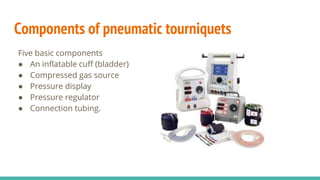
Five basic components
● An inflatable cuff (bladder)
● Compressed gas source
● Pressure display
● Pressure regulator
● Connection tubing.
Inflatable cuff
● Pressure – exerted on the circumference of extremity
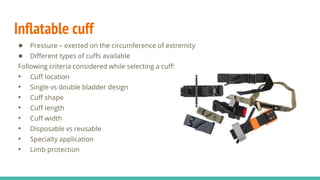
● Different types of cuffs available
Following criteria considered while selecting a cuff:
• Cuff location
• Single vs double bladder design
• Cuff shape
• Cuff length
• Cuff width
• Disposable vs reusable
• Specialty application
• Limb protection
● Length and width of the cuff – individualized considering the size and circumference of the pt’s
limb
● Cuff should overlap 3 inches but not more than 6 inches
● Too much overlap - ↑ pressure and rolling or wrinkling of underlying soft tissue
● Too small – compromise effective inflation, unexpected release or inadequate constriction
● Width of the cuff – wider than half the limb’s diameter.
● Wider cuff minimize the risk of injury to underlying tissue by dispersing pressure over a great
area.
● Wider cuff – consistently occlude the blood flow at lower pressure in adults and children
● Placed at point of the maximum circumference
● Soft padding kept around the limb – reduce wrinkling pinching, shearing of the tissues.
● Cuff tubing – positioned on or near the lateral aspect of the extremity to avoid pressure on
nerves and kinking of the tubing.
Tourniquet cuff pressure
● Depends on number of variables: age, skin, blood pressure, shape and size of
the extremity, dimensions of the cuff
● Optimal inflation pressure not established.
● Recommends cuff pressure of 200 – 300 mmHg
Various methods implemented to lower effective cuff pressure:
 Double tourniquet technique to change the point of compression
 Controlled hypotension to bring down the SBP
 Doppler technique and pulse oximetry to confirm the absence of arteria pulse
 Tourniquet inflation based on limb occlusion pressure
 Cuff pressure synchronization with systolic BP.
Limb occlusion pressure
● Minimum pressure required to stop the flow of arterial blood into the limb distal to the cuff.
● Determined by gradually increasing tourniquet pressure until distal blood flow interrupted
● Association of Perioperative Registered Nurses guideline:
● Cuff pressure should be adjusted by adding safety margin to LOP
1. Add 40 mmHg for LOP < 130mmHg
2. Add 60 mmHg for LOP 131 -190 mmHg
3. Add 80 mmHg for LOP >190 mmHg
4. For paediatric, adding 50 mmHg recommended
● LOP – should be measured during preop check up or when BP stabilized after induction
● Best practice – cuff pressure according to pt’s SBP or LOP.
● Exsanguination before inflation – improves quality of bloodless surgical field
minimizes pain due to tourniquet
● Normally done by limb elevation or by elastic wrap around the limb.
● Elastic wrap should not be used in:
infection, malignant tumour, thrombi in extremity
● Exsanguination is done by limb elevation alone
● Exsanguination and tourniquet use – controversial in sickle cell disease
Inflation or occlusion time
● Kept minimum to minimize risk to the patient
● Safe inflation time – not been accurately determined
● Varies with patient’s age, physical status, vascular supply to extremity
● Safe time limit of 1-3 hours – described
● Recommended to assess the operative situation at 2 hours
● If anticipated >2.5 hours, deflation for 10 mins, and at subsequent 1 hr interval
● Pediatric patients inflation time <75 mins – recommended for lower extremities
Cuff deflation:
● Causes release of anaerobic metabolites into the systemic circulation
● Cause hypotension, metabolic acidosis, hyperkalemia, myoglobulinemia,
myoglobinuria and possible renal failure.
● Known as myonephropathic metabolic syndrome
● Depends on size of the extremity, duration of tourniquet time, overall
physiological status of the patient.
Physiological effects of tourniquet application
Local effects
● Result of tissue ischemia distal to the inflated tourniquet and a combination of ischemia and
compression of the tissues beneath it.
Muscle
● Progressive decrease in Po2 and an increase in Pco2 within muscle cells.
● Energy stores steadily decline with time and intracellular stores of ATP and creatine phosphate are
exhausted after 2 and 3 h, respectively.
● Lactate concentration increases with the switch to anaerobic metabolism
● Changes to the histological appearances of muscle fibres - Marked changes in mitochondrial
morphology are visible after 1 h.
● Muscle underlying the tourniquet  subjected to both ischemia and compression
● Prone to develop changes such as local fibre necrosis after inflation times as short as 2 h.
● Microvascular injury occurs in muscle after ischaemia of greater than 2 h duration.
● After tourniquet release  increased vascular permeability results in:
Interstitial and intracellular oedema  frequently leads to the ‘post
tourniquet syndrome’,
Patient has a swollen, pale, stiff limb with weakness but no paralysis.
Typically lasts 1–6 weeks.
Nerve
● Physiological conduction block develops between 15 and 45 min
● Conduction block affects both motor and sensory modalities
● Reversible after deflation of the cuff
● Rate of development of this conduction block is the same with cuff pressures of 150 and 300
mm Hg.
● suggests – ischaemia rather than direct compression is the cause
● Direct mechanical compression of nerves  responsible for a second, longer lasting nerve
conduction block called ‘tourniquet paralysis’.
● Higher cuff pressures (e.g. 1000 mm Hg maintained for >1 h) can cause morphological changes
within the larger myelinated nerves
● Most marked at the sites where the pressure gradient between compressed and
uncompressed nerve is greatest
● At the proximal and distal edges of the tourniquet.
● The pressure gradient  results in displacement of the nodes of Ranvier, stretching and
degeneration of paranodal myelin and impaired nerve conduction
● Lasts up to 6 months.
Systemic effects
Cardiovascular effects
● ↑ in systemic vascular resistance and an effective ↑ in circulating blood volume – after exsanguination
and tourniquet inflation
● Transient ↑ in CVP and SBP
● b/l thigh tourniquet – can ↑ effective circulating blood volume by 15% (~750mL in adult)
● ↑ in CVP and circulatory overload
● Cardiac failure and cardiac arrest have been reported after the application of bilateral thigh
tourniquets.
● ↑ BP after transient rise  tourniquet pain –
● The rise in arterial pressure can be attenuated by the addition of ketamine (0.25 mg/kg)
● This may also help with tourniquet pain.
Tourniquet deflation,
● Post-ischaemic reactive hyperaemia is seen.
● Causes a transient increase in the volume of blood in the limb compared
with baseline levels.
● Metabolites from the ischaemic limb are released into the systemic
circulation.
● In combination with the redistribution of blood flow  causes a decrease
in both central venous and systolic pressures
● Temporary but can be dramatic.
Respiratory effects
● Deflation of the tourniquet  increase in end-tidal carbon dioxide concentration which usually peaks
within 1 min.
● The increase in Etco2 occurs for two reasons:
○ mixed venous PCO2 increases (after release of hypercapnic blood from the ischaemic area distal to the tourniquet into the
systemic circulation)
○ cardiac output increases after tourniquet deflation (in response to the decrease in arterial pressure).
● The peak increase in Etco2 concentration is greater with deflation of lower limb tourniquets (0.7–2.4
kPa) than with upper limb tourniquets (0.1–1.6 kPa).
● The duration of the increase in Etco2 depends on the ventilatory characteristics of the patient.
● In spontaneously breathing patients, minute ventilation increases rapidly  Etco2 returns to baseline
values within 3–5 min.
● In patients undergoing controlled ventilation, the Etco2 will typically remain raised for >6 min unless
minute ventilation is deliberately increased.
Central nervous system effects
● The increase in PaCO2 after deflation of the tourniquet causes an
increase in cerebral blood flow.
● Measurements of middle cerebral artery blood flow velocity show an
increase of up to 50%.
● In patients with head injuries  can cause an increase in intracranial
pressure.
● Hyperventilation after tourniquet deflation can prevent increases in
intracranial pressure by maintaining normocapnia.
Temperature effects
● Inflation of arterial tourniquets  associated with a gradual increase in
core body temperature.
● Caused by reduced heat transfer to and heat loss from the ischaemic
limb.
● The magnitude of this increase is small, ~0.5oC after 2 h of inflation.
● Tourniquet deflation causes a transient decrease in core temperature,
● Caused by redistribution of body heat.
● Associated with the return, of a small amount of hypothermic blood from
the ischaemic limb
Haematological effects
● Effects  complicated.
● Associated with a global hypercoagulable state.
● increased platelet aggregation caused by catecholamines released in response to pain - from surgery and the
tourniquet itself.
● After deflation of the tourniquet, there is a brief period of increased fibrinolytic activity.
● Maximal at 15 min and returns to preoperative levels within 30 min.
● But may nevertheless cause increased bleeding.
● The increase in fibrinolysis is caused by release of tissue plasminogen activator.
● Produced by the vasa vasorum in the affected limb in response to the acidosis and hypoxemia associated with
tourniquet application.
Metabolic effects
● Deflation of the tourniquet after 1–2 h  associated with small increases in plasma concentrations of
potassium and lactate.
● Peak increases of 0.3 and 2 mmol/litre, respectively, occur 3 min after deflation.
● Lactate and carbon dioxide returning to the systemic circulation from the ischaemic limb cause a
reduction in arterial pH.
● Reperfusion of the ischaemic limb and the other haemodynamic changes associated with tourniquet
deflation can cause brief increases in oxygen consumption and carbon dioxide production.
● The magnitude of these changes correlates with the duration of ischaemia.
● All of these changes are fully reversed within 30 min of tourniquet deflation.
Pharmacological effects:
● Isolates the limb from rest of the body.
● Can alter the Vd of some medications alteration in the pharmacokinetics
of anaesthetic drugs
● time interval between antibiotic administration and tourniquet inflation –
important for antibiotic prophylaxis.
● Clinical evidence – 5-10 mins before inflation – good tissue penitration
Complications associated with the use of arterial tourniquets
Nerve injury
● The most common complication and
can be the most devastating.
● Lower limb tourniquets
● Lower limb – sciatic nerve, upper limb –
radial nerve
● Esmarch bandage associated with
higher incidence of nerve inury
● Large diameter nerve fibres are more
susceptible to pressure
Muscle injury
● The post-tourniquet syndrome results in
a swollen, stiff, weak limb.
● Very rarely the post-ischaemic swelling
and oedema, in combination with
reperfusion hyperaemia, may lead to
the development of a compartment
syndrome.
● Rhabdomyolysis has been reported, but
is extremely rare.
○ associated with unusually long
ischaemic times or high cuff inflation
pressures.
Skin injury
● Chemical burns – most common form of
skin injury
● occur when alcohol-based solutions used
for skin preparation.
● Friction burns resulting from movement of
poorly applied tourniquets.
Intraoperative bleeding
● Incomplete exsanguination of the limb
● A poorly fitting or underpressurized cuff.
● May also be caused by blood entering
through the intramedullary vessels of long
bones.
Vascular injury
● uncommon, but can be catastrophic.
● 7 in >5000 sx
● Acute vascular insufficiency – may occur
mechanical pressure from the tourniquet
damages atheromatous vessels, causing
plaque rupture.
● Recommend avoiding the use in patients with
peripheral vascular disease.
Tourniquet pain
● Poorly localized, dull tight aching pain
● During GA, manifests as ↑ HR , MAP
● More common ↓ GA (53 -67%), more common lower limb Sx’s
● Etiology – unclear, thought to be by unmyelinated, slow conducting c fibres
that are usually inhibited by Aδ fibres.
● Aδ fibres – blocked by mechanical compression in 30 mins while C fibre
continue functioning
● Release PG’s  ↑ pain perception by sensitizing and exciting the pain
receptors.
● Limb ischemia – central sensitization via NMDA receptors due to repeated
nociceptive stimulus
• Has important impacts in anesthesia.
• Application of EMLA cream
• Infiltration with local anaesthetics.
• Use of wider cuff with low cuff pressure
• Addition of opioids, clonidine, epinephrine along with LA’s in spinal block
• None has attained complete success in pain relief.
• IV drugs, Ketamine, dexmedetomidine, MgSO4, also been studied
• Only thing reliably works – tourniquet deflation.
Tourniquet-induced hypertension
● Gradual increase in arterial pressure is frequently observed after a
variable time after tourniquet inflation.
● The exact mechanism - not known.
● Suggested - represents activation of the sympathetic nervous system in
response to the development of tourniquet pain.
● Plasma norepinephrine concentrations increase in parallel with arterial
pressure during tourniquet inflation.
● Clonidine attenuates sympathetic activity and, if given preoperatively,
blunts the hypertensive response.
Contraindications
● No absolute C/I
● Adequate care should be taken in
○ Severe peripheral vascular diseases.
○ Sickle cell disease
○ Sever crush injury’
○ Diabetic neuropathy
○ Patients with h/o DVT and PE.
Thank you…

Arterial tourniquet

  • 1.
    Anesthetic concerns oftourniquet application Dr. Muhammed Alif
  • 2.
    Introduction ● Device whichis used to control the flow of blood to and/or from an extremity. ● The word ‘’tourniquet’’ from the French verb ‘’tourner’’ (to turn). ● Louis Petit used screw-like device strapped to the thighs of patients undergoing leg amputations. ● Arterial tourniquet – usually a pneumatic device consisting of an inflatable cuff connected to a compressed gas supply. ● Allow controlled arterial compression and distal circulatory stasis. ● Most common – in surgical procedures on the extremities, creates bloodless surgical field. ● Examples include joint replacements and the repair of tendons, nerves, and blood vessels. ● Also used in Bier’s block
  • 3.
    Components of pneumatictourniquets Five basic components ● An inflatable cuff (bladder) ● Compressed gas source ● Pressure display ● Pressure regulator ● Connection tubing.
  • 4.
    Inflatable cuff ● Pressure– exerted on the circumference of extremity ● Different types of cuffs available Following criteria considered while selecting a cuff: • Cuff location • Single vs double bladder design • Cuff shape • Cuff length • Cuff width • Disposable vs reusable • Specialty application • Limb protection
  • 5.
    ● Length andwidth of the cuff – individualized considering the size and circumference of the pt’s limb ● Cuff should overlap 3 inches but not more than 6 inches ● Too much overlap - ↑ pressure and rolling or wrinkling of underlying soft tissue ● Too small – compromise effective inflation, unexpected release or inadequate constriction ● Width of the cuff – wider than half the limb’s diameter. ● Wider cuff minimize the risk of injury to underlying tissue by dispersing pressure over a great area. ● Wider cuff – consistently occlude the blood flow at lower pressure in adults and children ● Placed at point of the maximum circumference ● Soft padding kept around the limb – reduce wrinkling pinching, shearing of the tissues. ● Cuff tubing – positioned on or near the lateral aspect of the extremity to avoid pressure on nerves and kinking of the tubing.
  • 6.
    Tourniquet cuff pressure ●Depends on number of variables: age, skin, blood pressure, shape and size of the extremity, dimensions of the cuff ● Optimal inflation pressure not established. ● Recommends cuff pressure of 200 – 300 mmHg Various methods implemented to lower effective cuff pressure:  Double tourniquet technique to change the point of compression  Controlled hypotension to bring down the SBP  Doppler technique and pulse oximetry to confirm the absence of arteria pulse  Tourniquet inflation based on limb occlusion pressure  Cuff pressure synchronization with systolic BP.
  • 7.
    Limb occlusion pressure ●Minimum pressure required to stop the flow of arterial blood into the limb distal to the cuff. ● Determined by gradually increasing tourniquet pressure until distal blood flow interrupted ● Association of Perioperative Registered Nurses guideline: ● Cuff pressure should be adjusted by adding safety margin to LOP 1. Add 40 mmHg for LOP < 130mmHg 2. Add 60 mmHg for LOP 131 -190 mmHg 3. Add 80 mmHg for LOP >190 mmHg 4. For paediatric, adding 50 mmHg recommended ● LOP – should be measured during preop check up or when BP stabilized after induction ● Best practice – cuff pressure according to pt’s SBP or LOP.
  • 8.
    ● Exsanguination beforeinflation – improves quality of bloodless surgical field minimizes pain due to tourniquet ● Normally done by limb elevation or by elastic wrap around the limb. ● Elastic wrap should not be used in: infection, malignant tumour, thrombi in extremity ● Exsanguination is done by limb elevation alone ● Exsanguination and tourniquet use – controversial in sickle cell disease
  • 9.
    Inflation or occlusiontime ● Kept minimum to minimize risk to the patient ● Safe inflation time – not been accurately determined ● Varies with patient’s age, physical status, vascular supply to extremity ● Safe time limit of 1-3 hours – described ● Recommended to assess the operative situation at 2 hours ● If anticipated >2.5 hours, deflation for 10 mins, and at subsequent 1 hr interval ● Pediatric patients inflation time <75 mins – recommended for lower extremities
  • 10.
    Cuff deflation: ● Causesrelease of anaerobic metabolites into the systemic circulation ● Cause hypotension, metabolic acidosis, hyperkalemia, myoglobulinemia, myoglobinuria and possible renal failure. ● Known as myonephropathic metabolic syndrome ● Depends on size of the extremity, duration of tourniquet time, overall physiological status of the patient.
  • 11.
    Physiological effects oftourniquet application Local effects ● Result of tissue ischemia distal to the inflated tourniquet and a combination of ischemia and compression of the tissues beneath it. Muscle ● Progressive decrease in Po2 and an increase in Pco2 within muscle cells. ● Energy stores steadily decline with time and intracellular stores of ATP and creatine phosphate are exhausted after 2 and 3 h, respectively. ● Lactate concentration increases with the switch to anaerobic metabolism ● Changes to the histological appearances of muscle fibres - Marked changes in mitochondrial morphology are visible after 1 h. ● Muscle underlying the tourniquet  subjected to both ischemia and compression ● Prone to develop changes such as local fibre necrosis after inflation times as short as 2 h. ● Microvascular injury occurs in muscle after ischaemia of greater than 2 h duration.
  • 12.
    ● After tourniquetrelease  increased vascular permeability results in: Interstitial and intracellular oedema  frequently leads to the ‘post tourniquet syndrome’, Patient has a swollen, pale, stiff limb with weakness but no paralysis. Typically lasts 1–6 weeks. Nerve ● Physiological conduction block develops between 15 and 45 min ● Conduction block affects both motor and sensory modalities ● Reversible after deflation of the cuff ● Rate of development of this conduction block is the same with cuff pressures of 150 and 300 mm Hg. ● suggests – ischaemia rather than direct compression is the cause
  • 13.
    ● Direct mechanicalcompression of nerves  responsible for a second, longer lasting nerve conduction block called ‘tourniquet paralysis’. ● Higher cuff pressures (e.g. 1000 mm Hg maintained for >1 h) can cause morphological changes within the larger myelinated nerves ● Most marked at the sites where the pressure gradient between compressed and uncompressed nerve is greatest ● At the proximal and distal edges of the tourniquet. ● The pressure gradient  results in displacement of the nodes of Ranvier, stretching and degeneration of paranodal myelin and impaired nerve conduction ● Lasts up to 6 months.
  • 14.
    Systemic effects Cardiovascular effects ●↑ in systemic vascular resistance and an effective ↑ in circulating blood volume – after exsanguination and tourniquet inflation ● Transient ↑ in CVP and SBP ● b/l thigh tourniquet – can ↑ effective circulating blood volume by 15% (~750mL in adult) ● ↑ in CVP and circulatory overload ● Cardiac failure and cardiac arrest have been reported after the application of bilateral thigh tourniquets. ● ↑ BP after transient rise  tourniquet pain – ● The rise in arterial pressure can be attenuated by the addition of ketamine (0.25 mg/kg) ● This may also help with tourniquet pain.
  • 15.
    Tourniquet deflation, ● Post-ischaemicreactive hyperaemia is seen. ● Causes a transient increase in the volume of blood in the limb compared with baseline levels. ● Metabolites from the ischaemic limb are released into the systemic circulation. ● In combination with the redistribution of blood flow  causes a decrease in both central venous and systolic pressures ● Temporary but can be dramatic.
  • 16.
    Respiratory effects ● Deflationof the tourniquet  increase in end-tidal carbon dioxide concentration which usually peaks within 1 min. ● The increase in Etco2 occurs for two reasons: ○ mixed venous PCO2 increases (after release of hypercapnic blood from the ischaemic area distal to the tourniquet into the systemic circulation) ○ cardiac output increases after tourniquet deflation (in response to the decrease in arterial pressure). ● The peak increase in Etco2 concentration is greater with deflation of lower limb tourniquets (0.7–2.4 kPa) than with upper limb tourniquets (0.1–1.6 kPa). ● The duration of the increase in Etco2 depends on the ventilatory characteristics of the patient. ● In spontaneously breathing patients, minute ventilation increases rapidly  Etco2 returns to baseline values within 3–5 min. ● In patients undergoing controlled ventilation, the Etco2 will typically remain raised for >6 min unless minute ventilation is deliberately increased.
  • 17.
    Central nervous systemeffects ● The increase in PaCO2 after deflation of the tourniquet causes an increase in cerebral blood flow. ● Measurements of middle cerebral artery blood flow velocity show an increase of up to 50%. ● In patients with head injuries  can cause an increase in intracranial pressure. ● Hyperventilation after tourniquet deflation can prevent increases in intracranial pressure by maintaining normocapnia.
  • 18.
    Temperature effects ● Inflationof arterial tourniquets  associated with a gradual increase in core body temperature. ● Caused by reduced heat transfer to and heat loss from the ischaemic limb. ● The magnitude of this increase is small, ~0.5oC after 2 h of inflation. ● Tourniquet deflation causes a transient decrease in core temperature, ● Caused by redistribution of body heat. ● Associated with the return, of a small amount of hypothermic blood from the ischaemic limb
  • 19.
    Haematological effects ● Effects complicated. ● Associated with a global hypercoagulable state. ● increased platelet aggregation caused by catecholamines released in response to pain - from surgery and the tourniquet itself. ● After deflation of the tourniquet, there is a brief period of increased fibrinolytic activity. ● Maximal at 15 min and returns to preoperative levels within 30 min. ● But may nevertheless cause increased bleeding. ● The increase in fibrinolysis is caused by release of tissue plasminogen activator. ● Produced by the vasa vasorum in the affected limb in response to the acidosis and hypoxemia associated with tourniquet application.
  • 20.
    Metabolic effects ● Deflationof the tourniquet after 1–2 h  associated with small increases in plasma concentrations of potassium and lactate. ● Peak increases of 0.3 and 2 mmol/litre, respectively, occur 3 min after deflation. ● Lactate and carbon dioxide returning to the systemic circulation from the ischaemic limb cause a reduction in arterial pH. ● Reperfusion of the ischaemic limb and the other haemodynamic changes associated with tourniquet deflation can cause brief increases in oxygen consumption and carbon dioxide production. ● The magnitude of these changes correlates with the duration of ischaemia. ● All of these changes are fully reversed within 30 min of tourniquet deflation.
  • 21.
    Pharmacological effects: ● Isolatesthe limb from rest of the body. ● Can alter the Vd of some medications alteration in the pharmacokinetics of anaesthetic drugs ● time interval between antibiotic administration and tourniquet inflation – important for antibiotic prophylaxis. ● Clinical evidence – 5-10 mins before inflation – good tissue penitration
  • 22.
    Complications associated withthe use of arterial tourniquets Nerve injury ● The most common complication and can be the most devastating. ● Lower limb tourniquets ● Lower limb – sciatic nerve, upper limb – radial nerve ● Esmarch bandage associated with higher incidence of nerve inury ● Large diameter nerve fibres are more susceptible to pressure Muscle injury ● The post-tourniquet syndrome results in a swollen, stiff, weak limb. ● Very rarely the post-ischaemic swelling and oedema, in combination with reperfusion hyperaemia, may lead to the development of a compartment syndrome. ● Rhabdomyolysis has been reported, but is extremely rare. ○ associated with unusually long ischaemic times or high cuff inflation pressures.
  • 23.
    Skin injury ● Chemicalburns – most common form of skin injury ● occur when alcohol-based solutions used for skin preparation. ● Friction burns resulting from movement of poorly applied tourniquets. Intraoperative bleeding ● Incomplete exsanguination of the limb ● A poorly fitting or underpressurized cuff. ● May also be caused by blood entering through the intramedullary vessels of long bones. Vascular injury ● uncommon, but can be catastrophic. ● 7 in >5000 sx ● Acute vascular insufficiency – may occur mechanical pressure from the tourniquet damages atheromatous vessels, causing plaque rupture. ● Recommend avoiding the use in patients with peripheral vascular disease.
  • 24.
    Tourniquet pain ● Poorlylocalized, dull tight aching pain ● During GA, manifests as ↑ HR , MAP ● More common ↓ GA (53 -67%), more common lower limb Sx’s ● Etiology – unclear, thought to be by unmyelinated, slow conducting c fibres that are usually inhibited by Aδ fibres. ● Aδ fibres – blocked by mechanical compression in 30 mins while C fibre continue functioning ● Release PG’s  ↑ pain perception by sensitizing and exciting the pain receptors. ● Limb ischemia – central sensitization via NMDA receptors due to repeated nociceptive stimulus
  • 25.
    • Has importantimpacts in anesthesia. • Application of EMLA cream • Infiltration with local anaesthetics. • Use of wider cuff with low cuff pressure • Addition of opioids, clonidine, epinephrine along with LA’s in spinal block • None has attained complete success in pain relief. • IV drugs, Ketamine, dexmedetomidine, MgSO4, also been studied • Only thing reliably works – tourniquet deflation.
  • 26.
    Tourniquet-induced hypertension ● Gradualincrease in arterial pressure is frequently observed after a variable time after tourniquet inflation. ● The exact mechanism - not known. ● Suggested - represents activation of the sympathetic nervous system in response to the development of tourniquet pain. ● Plasma norepinephrine concentrations increase in parallel with arterial pressure during tourniquet inflation. ● Clonidine attenuates sympathetic activity and, if given preoperatively, blunts the hypertensive response.
  • 27.
    Contraindications ● No absoluteC/I ● Adequate care should be taken in ○ Severe peripheral vascular diseases. ○ Sickle cell disease ○ Sever crush injury’ ○ Diabetic neuropathy ○ Patients with h/o DVT and PE.
  • 28.

Editor's Notes

  • #27 In awake volunteers, the increasing arterial pressure runs parallel to development of pain, supporting this theory