T O U R I S T B E H A V I O R – Assignment P a g e |1
E D U C A T I O N
Q. What is the Procedure of the Write a Report?
1. Introduction: In academia there is some overlap between reports and essays, but
reports are more likely to be needed for business, scientific and technical subjects, and in the
workplace. Essentially, a report is a short, sharp, concise document which is written for a
particular purpose and audience. It generally sets outs and analyses a situation or problem,
often making recommendations for future action. It is a factual paper, and needs to be clear
and well-structured.
2. Report: A report is a systematic, well organized document which defines and analyses
a subject or problem, and give the Solutions
with Conclusion.
Another Definition, A report is a detailed and
well-organized document that defines and
analyses a subject or a problem.
A report should always be accurate, concise,
clearly written, and well structured.
A report might also record a sequence of events, evaluate a product or a process, discuss a
series of proposals, or make a number of recommendations. A report should include all the
information necessary for the reader to understand the topic under discussion and make
informed decisions about it.
According to Wikipedia, A report or account is any informational work (usually of writing,
speech, television, or film) made with the specific intention of relaying information or
recounting certain events in a widely presentable form.1
1
https://en.wikipedia.org/wiki/Report
T O U R I S T B E H A V I O R – Assignment P a g e |2
E D U C A T I O N
3. The Procedure of the Write a Report: The Major steps in the Research Process
Include Six Steps those are as follows in the details –
I. Defining the Objectives of the Research
II. Collecting Primary Data
III.Collecting & Evaluating Secondary Data
IV.Designing A Primary Research Study
V. Analyzing the Data
VI.Preparing A Report on the Findings
4.1 Defining the Objectives of the Research: Aims and Objectives should:
 Be concise and brief.
 Be interrelated; the aim is what you want to
achieve, and the objective describes how you are
going to achieve that aim.
 Be realistic about what you can accomplish in the
duration of the project and the other commitments
you have
 Approach the literature and theoretical issues related to your project.
 Develop a sampling frame and strategy or a rationale for their selection.
 Develop a strategy and design for data collection and analysis.
 Deal with ethical and practical problems in your research.
4.2 Collecting Primary Data:
The most common methods of collecting primary data are conducting questionnaires,
surveys, interviews, observations, case studies and focus groups, and examining documents
and records. Primary data is information obtained directly from first-hand sources.
Primary Data is research that has been conducted by organization, first hand. It is also known
as Field Research. There are three typical ways that Primary Data is collected in marketing:
observation, surveys, and experiments.
T O U R I S T B E H A V I O R – Assignment P a g e |3
E D U C A T I O N
Primary data is specific and relevant to your
products and services. However, Primary Data is
often very time consuming to collect, and usually
costs more to create than purchasing secondary data
reports. must take special care when collecting
primary data. It needs to be relevant, current, and
as unbiased as possible.
Primary Data is relevant when it directly applies to
company's products and services. It is relevant when it relates to the problems you are trying
to solve, and the marketing goals of organization. Primary Data is current. Primary Data is
unbiased when subjects have been honest and open during data collection. When constructing
Primary Data collection plan, must consider research methods, contact methods, the sampling
plan & research instruments.
Research Methods consist of observation, surveys, and experimentation. Contact Methods
typically consist of mail, phone, personal interaction, and various online methods.
4.3 Collecting & Evaluating Secondary Data:
Secondary data is information that has already been
collected by another person for other studies. While
primary data takes more time because the
information has to be gathered from scratch.
Secondary data is obtained from books, diaries,
newspapers, statistics, Internet articles, databases
and interview transcripts. Secondary data are
market research data collected for a purpose other
than the one on hand. The data have the advantage of being much less expensive and more
quickly available than primary data. However, because secondary data are collected for a
different purpose, one must carefully evaluate their appropriateness for a given market
research situation. Secondary data should be evaluated with respect to several important
criteria. The data should be accurate, without errors. The data should be relevant to the
particular research need on hand. In addition, secondary data should not be out of date.
T O U R I S T B E H A V I O R – Assignment P a g e |4
E D U C A T I O N
4.4 Designing A Primary Research Study:
The term primary research is widely used in academic research, market
research and competitive intelligence. Primary research involves the collection of original
primary data by researchers. It is often undertaken after researchers have gained some insight
into an issue by reviewing secondary research or by analyzing previously collect primary
data. It can be accomplished through various methods. The distinction between primary
research and secondary research is crucial among market-research professionals.
There are advantages and disadvantages to primary research:
Advantages
 The researcher can focus on both qualitative and
quantitative issues.
 Specific research issues are addressed as the
researcher customizes the search design.
 Primary research enables the marketer to focus on
specific subjects and the researcher to have a higher
control over how the information is collected. Taking that into account, the researcher
can decide on such requirements as size of project, time frame and goal.
 Primary research is more acute and up to date
Disadvantages
Compared to secondary research, primary data may be very expensive in preparing and
carrying out the research. Costs can be incurred in producing the paper for questionnaires
or the equipment for an experiment of some sort.
 Some research projects, while potentially offering information that could prove quite
valuable, may not be within the reach of a researcher.
 By the time that the research is complete, it may be out of date.
 A low response rate has to be expected.
An example of primary research in opinion research is if the government wants to know if
people are pleased with how the government is being run, so it hands out questionnaires to
the public asking if it is happy & if not, how the government is to improve.
T O U R I S T B E H A V I O R – Assignment P a g e |5
E D U C A T I O N
4.5 Analyzing the Data
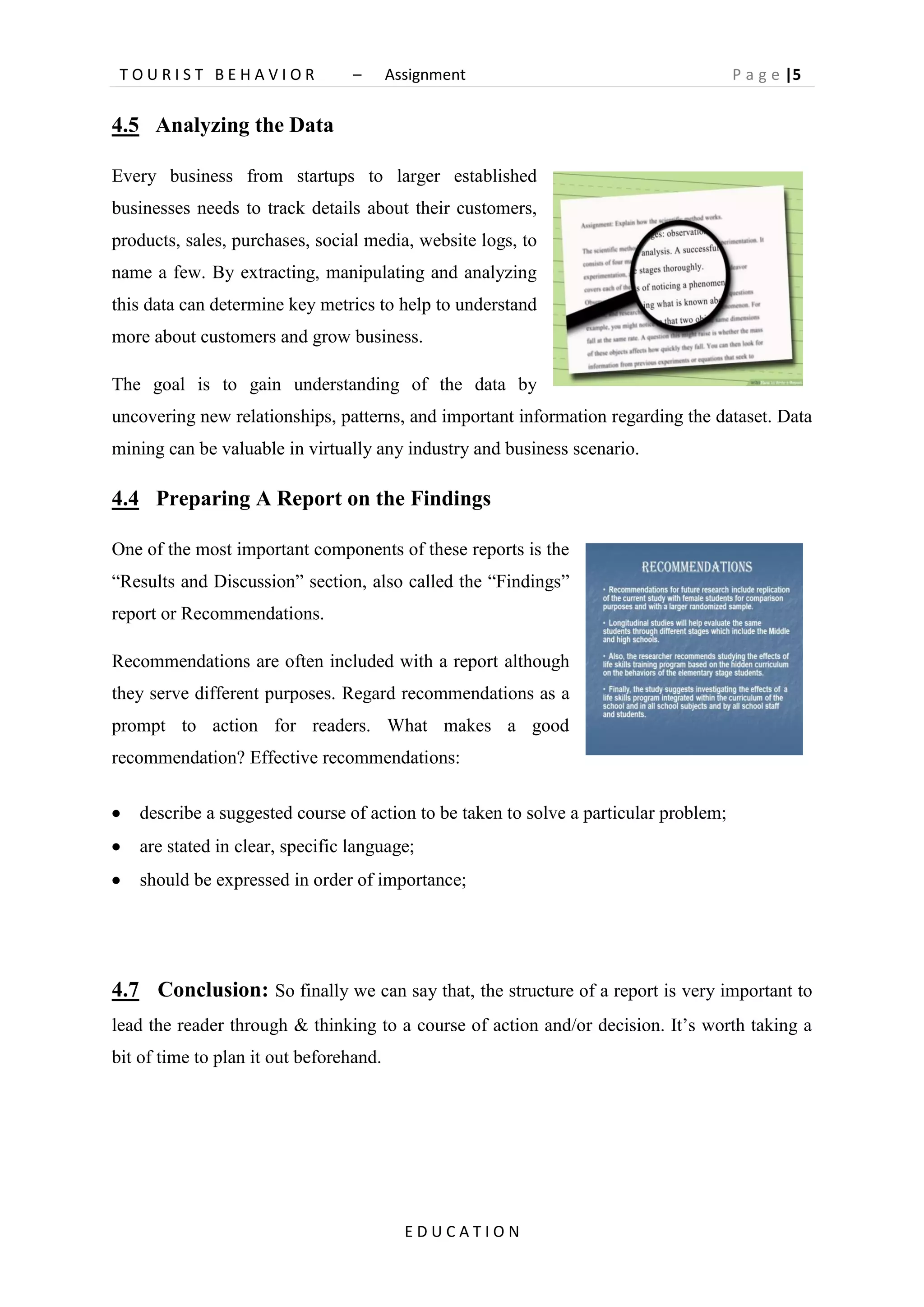
Every business from startups to larger established
businesses needs to track details about their customers,
products, sales, purchases, social media, website logs, to
name a few. By extracting, manipulating and analyzing
this data can determine key metrics to help to understand
more about customers and grow business.
The goal is to gain understanding of the data by
uncovering new relationships, patterns, and important information regarding the dataset. Data
mining can be valuable in virtually any industry and business scenario.
4.4 Preparing A Report on the Findings
One of the most important components of these reports is the
“Results and Discussion” section, also called the “Findings”
report or Recommendations.
Recommendations are often included with a report although
they serve different purposes. Regard recommendations as a
prompt to action for readers. What makes a good
recommendation? Effective recommendations:
 describe a suggested course of action to be taken to solve a particular problem;
 are stated in clear, specific language;
 should be expressed in order of importance;
4.7 Conclusion: So finally we can say that, the structure of a report is very important to
lead the reader through & thinking to a course of action and/or decision. It’s worth taking a
bit of time to plan it out beforehand.

Tourist behavior Learning Concept

  • 1.
    T O UR I S T B E H A V I O R – Assignment P a g e |1 E D U C A T I O N Q. What is the Procedure of the Write a Report? 1. Introduction: In academia there is some overlap between reports and essays, but reports are more likely to be needed for business, scientific and technical subjects, and in the workplace. Essentially, a report is a short, sharp, concise document which is written for a particular purpose and audience. It generally sets outs and analyses a situation or problem, often making recommendations for future action. It is a factual paper, and needs to be clear and well-structured. 2. Report: A report is a systematic, well organized document which defines and analyses a subject or problem, and give the Solutions with Conclusion. Another Definition, A report is a detailed and well-organized document that defines and analyses a subject or a problem. A report should always be accurate, concise, clearly written, and well structured. A report might also record a sequence of events, evaluate a product or a process, discuss a series of proposals, or make a number of recommendations. A report should include all the information necessary for the reader to understand the topic under discussion and make informed decisions about it. According to Wikipedia, A report or account is any informational work (usually of writing, speech, television, or film) made with the specific intention of relaying information or recounting certain events in a widely presentable form.1 1 https://en.wikipedia.org/wiki/Report
  • 2.
    T O UR I S T B E H A V I O R – Assignment P a g e |2 E D U C A T I O N 3. The Procedure of the Write a Report: The Major steps in the Research Process Include Six Steps those are as follows in the details – I. Defining the Objectives of the Research II. Collecting Primary Data III.Collecting & Evaluating Secondary Data IV.Designing A Primary Research Study V. Analyzing the Data VI.Preparing A Report on the Findings 4.1 Defining the Objectives of the Research: Aims and Objectives should:  Be concise and brief.  Be interrelated; the aim is what you want to achieve, and the objective describes how you are going to achieve that aim.  Be realistic about what you can accomplish in the duration of the project and the other commitments you have  Approach the literature and theoretical issues related to your project.  Develop a sampling frame and strategy or a rationale for their selection.  Develop a strategy and design for data collection and analysis.  Deal with ethical and practical problems in your research. 4.2 Collecting Primary Data: The most common methods of collecting primary data are conducting questionnaires, surveys, interviews, observations, case studies and focus groups, and examining documents and records. Primary data is information obtained directly from first-hand sources. Primary Data is research that has been conducted by organization, first hand. It is also known as Field Research. There are three typical ways that Primary Data is collected in marketing: observation, surveys, and experiments.
  • 3.
    T O UR I S T B E H A V I O R – Assignment P a g e |3 E D U C A T I O N Primary data is specific and relevant to your products and services. However, Primary Data is often very time consuming to collect, and usually costs more to create than purchasing secondary data reports. must take special care when collecting primary data. It needs to be relevant, current, and as unbiased as possible. Primary Data is relevant when it directly applies to company's products and services. It is relevant when it relates to the problems you are trying to solve, and the marketing goals of organization. Primary Data is current. Primary Data is unbiased when subjects have been honest and open during data collection. When constructing Primary Data collection plan, must consider research methods, contact methods, the sampling plan & research instruments. Research Methods consist of observation, surveys, and experimentation. Contact Methods typically consist of mail, phone, personal interaction, and various online methods. 4.3 Collecting & Evaluating Secondary Data: Secondary data is information that has already been collected by another person for other studies. While primary data takes more time because the information has to be gathered from scratch. Secondary data is obtained from books, diaries, newspapers, statistics, Internet articles, databases and interview transcripts. Secondary data are market research data collected for a purpose other than the one on hand. The data have the advantage of being much less expensive and more quickly available than primary data. However, because secondary data are collected for a different purpose, one must carefully evaluate their appropriateness for a given market research situation. Secondary data should be evaluated with respect to several important criteria. The data should be accurate, without errors. The data should be relevant to the particular research need on hand. In addition, secondary data should not be out of date.
  • 4.
    T O UR I S T B E H A V I O R – Assignment P a g e |4 E D U C A T I O N 4.4 Designing A Primary Research Study: The term primary research is widely used in academic research, market research and competitive intelligence. Primary research involves the collection of original primary data by researchers. It is often undertaken after researchers have gained some insight into an issue by reviewing secondary research or by analyzing previously collect primary data. It can be accomplished through various methods. The distinction between primary research and secondary research is crucial among market-research professionals. There are advantages and disadvantages to primary research: Advantages  The researcher can focus on both qualitative and quantitative issues.  Specific research issues are addressed as the researcher customizes the search design.  Primary research enables the marketer to focus on specific subjects and the researcher to have a higher control over how the information is collected. Taking that into account, the researcher can decide on such requirements as size of project, time frame and goal.  Primary research is more acute and up to date Disadvantages Compared to secondary research, primary data may be very expensive in preparing and carrying out the research. Costs can be incurred in producing the paper for questionnaires or the equipment for an experiment of some sort.  Some research projects, while potentially offering information that could prove quite valuable, may not be within the reach of a researcher.  By the time that the research is complete, it may be out of date.  A low response rate has to be expected. An example of primary research in opinion research is if the government wants to know if people are pleased with how the government is being run, so it hands out questionnaires to the public asking if it is happy & if not, how the government is to improve.
  • 5.
    T O UR I S T B E H A V I O R – Assignment P a g e |5 E D U C A T I O N 4.5 Analyzing the Data Every business from startups to larger established businesses needs to track details about their customers, products, sales, purchases, social media, website logs, to name a few. By extracting, manipulating and analyzing this data can determine key metrics to help to understand more about customers and grow business. The goal is to gain understanding of the data by uncovering new relationships, patterns, and important information regarding the dataset. Data mining can be valuable in virtually any industry and business scenario. 4.4 Preparing A Report on the Findings One of the most important components of these reports is the “Results and Discussion” section, also called the “Findings” report or Recommendations. Recommendations are often included with a report although they serve different purposes. Regard recommendations as a prompt to action for readers. What makes a good recommendation? Effective recommendations:  describe a suggested course of action to be taken to solve a particular problem;  are stated in clear, specific language;  should be expressed in order of importance; 4.7 Conclusion: So finally we can say that, the structure of a report is very important to lead the reader through & thinking to a course of action and/or decision. It’s worth taking a bit of time to plan it out beforehand.