TOTAL QUALITY MANAGEMENTTOTAL QUALITY MANAGEMENT
““MUST KNOW” CONCEPTS FOR ENGINEERSMUST KNOW” CONCEPTS FOR ENGINEERS
Sequence of presentationSequence of presentation
 IntroductionIntroduction
 Three Quality GurusThree Quality Gurus
 Commonality of Themes of Quality GurusCommonality of Themes of Quality Gurus
 DIFINITION OF QUALITY
 Five Approaches of Defining QualityFive Approaches of Defining Quality
 System Approach for TQMSystem Approach for TQM
 Triangle of wisdomTriangle of wisdom
 TQO HRMTQO HRM
 Customer SatisfactionCustomer Satisfaction
 Indicators for Customer SatisfactionIndicators for Customer Satisfaction
 Cost of QualityCost of Quality
 Benefits of TQMBenefits of TQM

INTRODUCTION TO TQM
What is TQM?
TQM is the integration of all functions and
processes within an organization in order to
achieve continuous improvement of the
quality of goods and services. The goal is
customer satisfaction.
THE THREE QUALITY GURUS
• DEMING: THE BEST KNOWN OF THE “EARLY”
PIONEERS, IS CREDITED WITH POPULARIZING
QUALITY CONTROL IN JAPAN IN EARLY
1950S.TODAY, HE IS REGARDED AS A NATIONAL
HERO IN THAT COUNTRY AND IS THE FATHER OF
THE WORLD FAMOUS DEMING PRIZE FOR
QUALITY.
JURANJURAN
 Juran, like Deming was invited to Japan in 1954 by theJuran, like Deming was invited to Japan in 1954 by the
union of Japanese Scientists and engineers.union of Japanese Scientists and engineers.
 Juran defines quality as fitness for use in terms of design,Juran defines quality as fitness for use in terms of design,
conformance, availability, safety and field use. He focusesconformance, availability, safety and field use. He focuses
on top-down management and technical methods rather thanon top-down management and technical methods rather than
worker pride and satisfaction.worker pride and satisfaction.
Philip Crosby: author of popular book Quality is
Free. His absolutes of quality are:
• Quality is defined as conformance to requirements, not
“goodness”
• The system for achieving quality is prevention, not
appraisal.
• The performance standard is zero defects, not “that’s close
enough”
• The measurement of quality is the price of non-
conformance, not indexes.
Commonality of Themes of Quality GurusCommonality of Themes of Quality Gurus
 Inspection is never the answer to quality improvement, norInspection is never the answer to quality improvement, nor
is “policing”.is “policing”.
 Involvement of leadership and top management is essentialInvolvement of leadership and top management is essential
to the necessary culture of commitment to quality.to the necessary culture of commitment to quality.
 A program for quality requires organization-wide effortsA program for quality requires organization-wide efforts
and long term commitment, accompanied by the necessaryand long term commitment, accompanied by the necessary
investment in training.investment in training.
 Quality is first and schedules are second.Quality is first and schedules are second.
DIFINITION OF QUALITYDIFINITION OF QUALITY
 The concept and vocabulary of quality are elusive. DifferentThe concept and vocabulary of quality are elusive. Different
people interpret quality differently. Few can define qualitypeople interpret quality differently. Few can define quality
in measurable terms that can be proved operationalized.in measurable terms that can be proved operationalized.
When asked what differentiates their product or service;When asked what differentiates their product or service;
The banker will answer” service”The banker will answer” service”
The healthcare worker will answer “quality health care”The healthcare worker will answer “quality health care”
The hotel employee will answer “customer satisfaction”The hotel employee will answer “customer satisfaction”
The manufacturer will simply answer “quality product”The manufacturer will simply answer “quality product”
Five Approaches of Defining QualityFive Approaches of Defining Quality
 Harvard professor David Garvin, in his bookHarvard professor David Garvin, in his book
Managing QualityManaging Quality summarized five principalsummarized five principal
approaches to define quality.approaches to define quality.
 TranscendentTranscendent
 Product basedProduct based
 User basedUser based
 Manufacturing basedManufacturing based
 Value basedValue based
Transcendental viewTranscendental view
 Those who hold the transcendental view would say “I can’tThose who hold the transcendental view would say “I can’t
define it, but I know it when I see it”define it, but I know it when I see it”
 Advertisers are fond of promoting products in these terms.Advertisers are fond of promoting products in these terms.
““ Where shopping is a pleasure” (supermarket). “We love toWhere shopping is a pleasure” (supermarket). “We love to
fly and it shows" (airline).fly and it shows" (airline).
Television and print media are awash with such indefinableTelevision and print media are awash with such indefinable
claims and therein lies the problem:claims and therein lies the problem:
 Quality is difficult to define or to operationalize. It thusQuality is difficult to define or to operationalize. It thus
becomes elusive when using the approach as basis forbecomes elusive when using the approach as basis for
competitive advantage. Moreover, the functions of design,competitive advantage. Moreover, the functions of design,
production and service may find it difficult to use theproduction and service may find it difficult to use the
definition as a basis for quality management.definition as a basis for quality management.
PRODUCT BASEDPRODUCT BASED
 Quality is viewed as a quantifiable or measurableQuality is viewed as a quantifiable or measurable
characteristic or attribute. For example durability orcharacteristic or attribute. For example durability or
reliability can be measured and the engineer can design toreliability can be measured and the engineer can design to
that benchmark.that benchmark.
 Quality is determined objectively.Quality is determined objectively.
 Although this approach has many benefits, it has limitationAlthough this approach has many benefits, it has limitation
as well. Where quality is based on individual taste oras well. Where quality is based on individual taste or
preference, the benchmark for measurement may bepreference, the benchmark for measurement may be
misleading.misleading.
USER BASEDUSER BASED
ItIt is based on idea that quality is an individual matter andis based on idea that quality is an individual matter and
products that best satisfy their preferences are those with theproducts that best satisfy their preferences are those with the
highest quality. This is rational approach but leads to twohighest quality. This is rational approach but leads to two
problems;problems;
 Consumer preference vary widely and it is difficult toConsumer preference vary widely and it is difficult to
aggregate these preferences into products with wide appeal.aggregate these preferences into products with wide appeal.
This leads to the choice between a niche strategy or aThis leads to the choice between a niche strategy or a
market aggregation approach which tries to identify thosemarket aggregation approach which tries to identify those
product attributes that meet the needs of the largest numberproduct attributes that meet the needs of the largest number
of consumers.of consumers.
 Another problem concerns the answer to the question “AreAnother problem concerns the answer to the question “Are
quality and customer satisfaction the same?” the answer isquality and customer satisfaction the same?” the answer is
probably not. One may admit that a Lincoln continental hasprobably not. One may admit that a Lincoln continental has
many quality attribute, but satisfaction may be bettermany quality attribute, but satisfaction may be better
achieved with an Escort.achieved with an Escort.
MANUFACTURING BASEDMANUFACTURING BASED
 Manufacturing-based definitions are concerned primarilyManufacturing-based definitions are concerned primarily
with engineering and manufacturing practices and use thewith engineering and manufacturing practices and use the
universal definition of “conformance to requirements”.universal definition of “conformance to requirements”.
Requirements or specifications are established by designRequirements or specifications are established by design
and any deviation implies a reduction in quality. Theand any deviation implies a reduction in quality. The
concept applies to services as well as product. Excellence inconcept applies to services as well as product. Excellence in
quality is not necessarily in the eye of the beholder butquality is not necessarily in the eye of the beholder but
rather in the standards set by the organization.rather in the standards set by the organization.
 This approach has the serious weakness. The consumer’sThis approach has the serious weakness. The consumer’s
perception of quality is equated with conformance andperception of quality is equated with conformance and
hence is internally focused.hence is internally focused.
Value BasedValue Based
 It is defined in term of costs and prices as well asIt is defined in term of costs and prices as well as
number of other attributes. Thus, the consumer’snumber of other attributes. Thus, the consumer’s
purchased decision is based on quality at anpurchased decision is based on quality at an
acceptable price. This approach is reflected in theacceptable price. This approach is reflected in the
popularpopular Consumer ReportsConsumer Reports magazine which ranksmagazine which ranks
products and services based on two criteria: Qualityproducts and services based on two criteria: Quality
and Value.and Value.
 The highest quality is not usually the best value.The highest quality is not usually the best value.
That designation is assigned to the “best- buy”That designation is assigned to the “best- buy”
product or serviceproduct or service..
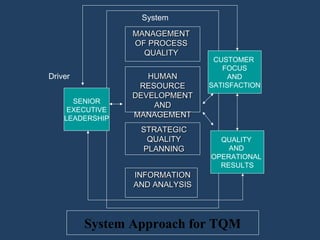
MANAGEMENTMANAGEMENT
OF PROCESSOF PROCESS
QUALITYQUALITY
HUMANHUMAN
RESOURCERESOURCE
DEVELOPMENTDEVELOPMENT
ANDAND
MANAGEMENTMANAGEMENT
STRATEGICSTRATEGIC
QUALITYQUALITY
PLANNINGPLANNING
INFORMATIONINFORMATION
AND ANALYSISAND ANALYSIS
CUSTOMER
FOCUS
AND
SATISFACTION
QUALITY
AND
OPERATIONAL
RESULTS
SENIOR
EXECUTIVE
LEADERSHIP
System Approach for TQM
Driver
System
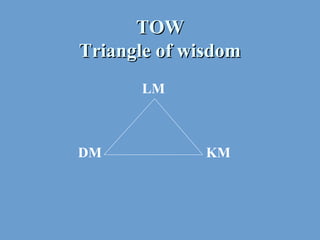
TOWTOW
Triangle of wisdomTriangle of wisdom
LM
DM KM
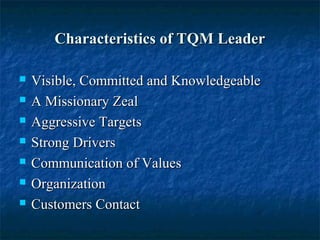
Characteristics of TQM LeaderCharacteristics of TQM Leader
 Visible, Committed and KnowledgeableVisible, Committed and Knowledgeable
 A Missionary ZealA Missionary Zeal
 Aggressive TargetsAggressive Targets
 Strong DriversStrong Drivers
 Communication of ValuesCommunication of Values
 OrganizationOrganization
 Customers ContactCustomers Contact
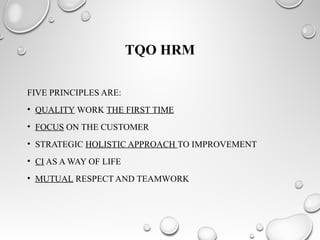
TQO HRM
FIVE PRINCIPLES ARE:
• QUALITY WORK THE FIRST TIME
• FOCUS ON THE CUSTOMER
• STRATEGIC HOLISTIC APPROACH TO IMPROVEMENT
• CI AS A WAY OF LIFE
• MUTUAL RESPECT AND TEAMWORK
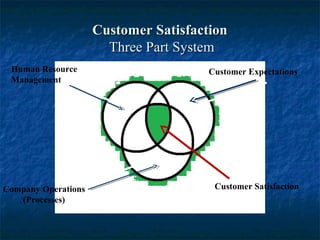
Customer SatisfactionCustomer Satisfaction
Three Part SystemThree Part System
Human Resource
Management
Customer Expectations
Company Operations
(Processes)
Customer Satisfaction
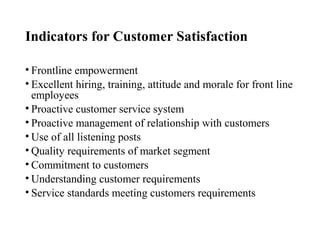
Indicators for Customer Satisfaction
• Frontline empowerment
• Excellent hiring, training, attitude and morale for front line
employees
• Proactive customer service system
• Proactive management of relationship with customers
• Use of all listening posts
• Quality requirements of market segment
• Commitment to customers
• Understanding customer requirements
• Service standards meeting customers requirements
Cost of QualityCost of Quality
Three Views of quality CostsThree Views of quality Costs
Higher quality means higher cost.Higher quality means higher cost.
 Quality attributes such as performance and features cost more inQuality attributes such as performance and features cost more in
terms of labor, material, design and other costly resources.terms of labor, material, design and other costly resources.
 The additional benefits from improved quality do not compensateThe additional benefits from improved quality do not compensate
for additional expense.for additional expense.
The cost of improving quality is less than the resulting savings.The cost of improving quality is less than the resulting savings.
 The saving result from less rework, scrap and other direct expensesThe saving result from less rework, scrap and other direct expenses
related defects.related defects.
 This is said to account for the focus on continuous improvement ofThis is said to account for the focus on continuous improvement of
processes in Japanese firms.processes in Japanese firms.
Three Views of quality CostsThree Views of quality Costs
Quality costs are those incurred in excess of thoseQuality costs are those incurred in excess of those
that would have been incurred if the product werethat would have been incurred if the product were
built or the service performed exactly right the firstbuilt or the service performed exactly right the first
time.time.
 This view is held by adherents of TQM philosophy.This view is held by adherents of TQM philosophy.
Costs include not only those that are direct, but alsoCosts include not only those that are direct, but also
those resulting from lost customers, lost market sharethose resulting from lost customers, lost market share
and the many hidden costs and foregone opportunitiesand the many hidden costs and foregone opportunities
not identified by modern cost accounting systems.not identified by modern cost accounting systems.
QUALITY COSTS
COST OF QUALITY IS THE COST OF NON QUALITY
1: 10:100 RULE
“A STITCH IN TIME SAVES
NINE”
Types of Quality CostsTypes of Quality Costs
The cost of quality is generally classifiedThe cost of quality is generally classified
into four categoriesinto four categories
1.1. Cost of PreventionCost of Prevention
2.2. Cost of AppraisalCost of Appraisal
3.3. Cost of Internal FailureCost of Internal Failure
4.4. Cost of External FailureCost of External Failure
Quality Costs
Cost of Prevention
 Prevention costs include those activities which
remove and prevent defects from occurring in the
production process.
 Included are such activities as quality planning,
production reviews, training, and engineering
analysis, which are incurred to ensure that poor
quality is not produced.
Appraisal
 Those costs incurred to identify poor quality
products after they occur but before shipment to
customers. e.g. Inspection activity.
Quality CostsQuality Costs
Internal FailureInternal Failure
 Those incurred during the production process.Those incurred during the production process.
 Include such items as machine downtime, poor qualityInclude such items as machine downtime, poor quality
materials, scrap, and rework.materials, scrap, and rework.
External FailureExternal Failure
 Those incurred after the product is shipped.Those incurred after the product is shipped.
 External failure costs include returns and allowances,External failure costs include returns and allowances,
warranty costs, and hidden costs of customer dissatisfactionwarranty costs, and hidden costs of customer dissatisfaction
and lost market shareand lost market share..
Benefits of TQM
• Greater customer loyalty
• Market share improvement
• Higher stock prices
• Reduced service calls
• Higher prices
• Greater productivity
ConclusionConclusion
Remember the earth revolves around theRemember the earth revolves around the
CUSTOMER.CUSTOMER. Quality begets customers andQuality begets customers and
customers beget quality. Let us all have actioncustomers beget quality. Let us all have action
plans to support quality, this will make theplans to support quality, this will make the
world happy and earn us the blessing of Godworld happy and earn us the blessing of God
Almighty.Almighty.
““Actions are direct reflection of one’sActions are direct reflection of one’s
intentions” (Al-Quran)intentions” (Al-Quran)

Total quality management

  • 3.
    TOTAL QUALITY MANAGEMENTTOTALQUALITY MANAGEMENT ““MUST KNOW” CONCEPTS FOR ENGINEERSMUST KNOW” CONCEPTS FOR ENGINEERS
  • 4.
    Sequence of presentationSequenceof presentation  IntroductionIntroduction  Three Quality GurusThree Quality Gurus  Commonality of Themes of Quality GurusCommonality of Themes of Quality Gurus  DIFINITION OF QUALITY  Five Approaches of Defining QualityFive Approaches of Defining Quality  System Approach for TQMSystem Approach for TQM  Triangle of wisdomTriangle of wisdom  TQO HRMTQO HRM  Customer SatisfactionCustomer Satisfaction  Indicators for Customer SatisfactionIndicators for Customer Satisfaction  Cost of QualityCost of Quality  Benefits of TQMBenefits of TQM 
  • 5.
    INTRODUCTION TO TQM Whatis TQM? TQM is the integration of all functions and processes within an organization in order to achieve continuous improvement of the quality of goods and services. The goal is customer satisfaction.
  • 6.
    THE THREE QUALITYGURUS • DEMING: THE BEST KNOWN OF THE “EARLY” PIONEERS, IS CREDITED WITH POPULARIZING QUALITY CONTROL IN JAPAN IN EARLY 1950S.TODAY, HE IS REGARDED AS A NATIONAL HERO IN THAT COUNTRY AND IS THE FATHER OF THE WORLD FAMOUS DEMING PRIZE FOR QUALITY.
  • 7.
    JURANJURAN  Juran, likeDeming was invited to Japan in 1954 by theJuran, like Deming was invited to Japan in 1954 by the union of Japanese Scientists and engineers.union of Japanese Scientists and engineers.  Juran defines quality as fitness for use in terms of design,Juran defines quality as fitness for use in terms of design, conformance, availability, safety and field use. He focusesconformance, availability, safety and field use. He focuses on top-down management and technical methods rather thanon top-down management and technical methods rather than worker pride and satisfaction.worker pride and satisfaction.
  • 8.
    Philip Crosby: authorof popular book Quality is Free. His absolutes of quality are: • Quality is defined as conformance to requirements, not “goodness” • The system for achieving quality is prevention, not appraisal. • The performance standard is zero defects, not “that’s close enough” • The measurement of quality is the price of non- conformance, not indexes.
  • 9.
    Commonality of Themesof Quality GurusCommonality of Themes of Quality Gurus  Inspection is never the answer to quality improvement, norInspection is never the answer to quality improvement, nor is “policing”.is “policing”.  Involvement of leadership and top management is essentialInvolvement of leadership and top management is essential to the necessary culture of commitment to quality.to the necessary culture of commitment to quality.  A program for quality requires organization-wide effortsA program for quality requires organization-wide efforts and long term commitment, accompanied by the necessaryand long term commitment, accompanied by the necessary investment in training.investment in training.  Quality is first and schedules are second.Quality is first and schedules are second.
  • 10.
    DIFINITION OF QUALITYDIFINITIONOF QUALITY  The concept and vocabulary of quality are elusive. DifferentThe concept and vocabulary of quality are elusive. Different people interpret quality differently. Few can define qualitypeople interpret quality differently. Few can define quality in measurable terms that can be proved operationalized.in measurable terms that can be proved operationalized. When asked what differentiates their product or service;When asked what differentiates their product or service; The banker will answer” service”The banker will answer” service” The healthcare worker will answer “quality health care”The healthcare worker will answer “quality health care” The hotel employee will answer “customer satisfaction”The hotel employee will answer “customer satisfaction” The manufacturer will simply answer “quality product”The manufacturer will simply answer “quality product”
  • 11.
    Five Approaches ofDefining QualityFive Approaches of Defining Quality  Harvard professor David Garvin, in his bookHarvard professor David Garvin, in his book Managing QualityManaging Quality summarized five principalsummarized five principal approaches to define quality.approaches to define quality.  TranscendentTranscendent  Product basedProduct based  User basedUser based  Manufacturing basedManufacturing based  Value basedValue based
  • 12.
    Transcendental viewTranscendental view Those who hold the transcendental view would say “I can’tThose who hold the transcendental view would say “I can’t define it, but I know it when I see it”define it, but I know it when I see it”  Advertisers are fond of promoting products in these terms.Advertisers are fond of promoting products in these terms. ““ Where shopping is a pleasure” (supermarket). “We love toWhere shopping is a pleasure” (supermarket). “We love to fly and it shows" (airline).fly and it shows" (airline). Television and print media are awash with such indefinableTelevision and print media are awash with such indefinable claims and therein lies the problem:claims and therein lies the problem:  Quality is difficult to define or to operationalize. It thusQuality is difficult to define or to operationalize. It thus becomes elusive when using the approach as basis forbecomes elusive when using the approach as basis for competitive advantage. Moreover, the functions of design,competitive advantage. Moreover, the functions of design, production and service may find it difficult to use theproduction and service may find it difficult to use the definition as a basis for quality management.definition as a basis for quality management.
  • 13.
    PRODUCT BASEDPRODUCT BASED Quality is viewed as a quantifiable or measurableQuality is viewed as a quantifiable or measurable characteristic or attribute. For example durability orcharacteristic or attribute. For example durability or reliability can be measured and the engineer can design toreliability can be measured and the engineer can design to that benchmark.that benchmark.  Quality is determined objectively.Quality is determined objectively.  Although this approach has many benefits, it has limitationAlthough this approach has many benefits, it has limitation as well. Where quality is based on individual taste oras well. Where quality is based on individual taste or preference, the benchmark for measurement may bepreference, the benchmark for measurement may be misleading.misleading.
  • 14.
    USER BASEDUSER BASED ItItis based on idea that quality is an individual matter andis based on idea that quality is an individual matter and products that best satisfy their preferences are those with theproducts that best satisfy their preferences are those with the highest quality. This is rational approach but leads to twohighest quality. This is rational approach but leads to two problems;problems;  Consumer preference vary widely and it is difficult toConsumer preference vary widely and it is difficult to aggregate these preferences into products with wide appeal.aggregate these preferences into products with wide appeal. This leads to the choice between a niche strategy or aThis leads to the choice between a niche strategy or a market aggregation approach which tries to identify thosemarket aggregation approach which tries to identify those product attributes that meet the needs of the largest numberproduct attributes that meet the needs of the largest number of consumers.of consumers.  Another problem concerns the answer to the question “AreAnother problem concerns the answer to the question “Are quality and customer satisfaction the same?” the answer isquality and customer satisfaction the same?” the answer is probably not. One may admit that a Lincoln continental hasprobably not. One may admit that a Lincoln continental has many quality attribute, but satisfaction may be bettermany quality attribute, but satisfaction may be better achieved with an Escort.achieved with an Escort.
  • 15.
    MANUFACTURING BASEDMANUFACTURING BASED Manufacturing-based definitions are concerned primarilyManufacturing-based definitions are concerned primarily with engineering and manufacturing practices and use thewith engineering and manufacturing practices and use the universal definition of “conformance to requirements”.universal definition of “conformance to requirements”. Requirements or specifications are established by designRequirements or specifications are established by design and any deviation implies a reduction in quality. Theand any deviation implies a reduction in quality. The concept applies to services as well as product. Excellence inconcept applies to services as well as product. Excellence in quality is not necessarily in the eye of the beholder butquality is not necessarily in the eye of the beholder but rather in the standards set by the organization.rather in the standards set by the organization.  This approach has the serious weakness. The consumer’sThis approach has the serious weakness. The consumer’s perception of quality is equated with conformance andperception of quality is equated with conformance and hence is internally focused.hence is internally focused.
  • 16.
    Value BasedValue Based It is defined in term of costs and prices as well asIt is defined in term of costs and prices as well as number of other attributes. Thus, the consumer’snumber of other attributes. Thus, the consumer’s purchased decision is based on quality at anpurchased decision is based on quality at an acceptable price. This approach is reflected in theacceptable price. This approach is reflected in the popularpopular Consumer ReportsConsumer Reports magazine which ranksmagazine which ranks products and services based on two criteria: Qualityproducts and services based on two criteria: Quality and Value.and Value.  The highest quality is not usually the best value.The highest quality is not usually the best value. That designation is assigned to the “best- buy”That designation is assigned to the “best- buy” product or serviceproduct or service..
  • 17.
    MANAGEMENTMANAGEMENT OF PROCESSOF PROCESS QUALITYQUALITY HUMANHUMAN RESOURCERESOURCE DEVELOPMENTDEVELOPMENT ANDAND MANAGEMENTMANAGEMENT STRATEGICSTRATEGIC QUALITYQUALITY PLANNINGPLANNING INFORMATIONINFORMATION ANDANALYSISAND ANALYSIS CUSTOMER FOCUS AND SATISFACTION QUALITY AND OPERATIONAL RESULTS SENIOR EXECUTIVE LEADERSHIP System Approach for TQM Driver System
  • 18.
  • 19.
    Characteristics of TQMLeaderCharacteristics of TQM Leader  Visible, Committed and KnowledgeableVisible, Committed and Knowledgeable  A Missionary ZealA Missionary Zeal  Aggressive TargetsAggressive Targets  Strong DriversStrong Drivers  Communication of ValuesCommunication of Values  OrganizationOrganization  Customers ContactCustomers Contact
  • 20.
    TQO HRM FIVE PRINCIPLESARE: • QUALITY WORK THE FIRST TIME • FOCUS ON THE CUSTOMER • STRATEGIC HOLISTIC APPROACH TO IMPROVEMENT • CI AS A WAY OF LIFE • MUTUAL RESPECT AND TEAMWORK
  • 21.
    Customer SatisfactionCustomer Satisfaction ThreePart SystemThree Part System Human Resource Management Customer Expectations Company Operations (Processes) Customer Satisfaction
  • 22.
    Indicators for CustomerSatisfaction • Frontline empowerment • Excellent hiring, training, attitude and morale for front line employees • Proactive customer service system • Proactive management of relationship with customers • Use of all listening posts • Quality requirements of market segment • Commitment to customers • Understanding customer requirements • Service standards meeting customers requirements
  • 23.
    Cost of QualityCostof Quality Three Views of quality CostsThree Views of quality Costs Higher quality means higher cost.Higher quality means higher cost.  Quality attributes such as performance and features cost more inQuality attributes such as performance and features cost more in terms of labor, material, design and other costly resources.terms of labor, material, design and other costly resources.  The additional benefits from improved quality do not compensateThe additional benefits from improved quality do not compensate for additional expense.for additional expense. The cost of improving quality is less than the resulting savings.The cost of improving quality is less than the resulting savings.  The saving result from less rework, scrap and other direct expensesThe saving result from less rework, scrap and other direct expenses related defects.related defects.  This is said to account for the focus on continuous improvement ofThis is said to account for the focus on continuous improvement of processes in Japanese firms.processes in Japanese firms.
  • 24.
    Three Views ofquality CostsThree Views of quality Costs Quality costs are those incurred in excess of thoseQuality costs are those incurred in excess of those that would have been incurred if the product werethat would have been incurred if the product were built or the service performed exactly right the firstbuilt or the service performed exactly right the first time.time.  This view is held by adherents of TQM philosophy.This view is held by adherents of TQM philosophy. Costs include not only those that are direct, but alsoCosts include not only those that are direct, but also those resulting from lost customers, lost market sharethose resulting from lost customers, lost market share and the many hidden costs and foregone opportunitiesand the many hidden costs and foregone opportunities not identified by modern cost accounting systems.not identified by modern cost accounting systems.
  • 25.
    QUALITY COSTS COST OFQUALITY IS THE COST OF NON QUALITY 1: 10:100 RULE “A STITCH IN TIME SAVES NINE”
  • 26.
    Types of QualityCostsTypes of Quality Costs The cost of quality is generally classifiedThe cost of quality is generally classified into four categoriesinto four categories 1.1. Cost of PreventionCost of Prevention 2.2. Cost of AppraisalCost of Appraisal 3.3. Cost of Internal FailureCost of Internal Failure 4.4. Cost of External FailureCost of External Failure
  • 27.
    Quality Costs Cost ofPrevention  Prevention costs include those activities which remove and prevent defects from occurring in the production process.  Included are such activities as quality planning, production reviews, training, and engineering analysis, which are incurred to ensure that poor quality is not produced. Appraisal  Those costs incurred to identify poor quality products after they occur but before shipment to customers. e.g. Inspection activity.
  • 28.
    Quality CostsQuality Costs InternalFailureInternal Failure  Those incurred during the production process.Those incurred during the production process.  Include such items as machine downtime, poor qualityInclude such items as machine downtime, poor quality materials, scrap, and rework.materials, scrap, and rework. External FailureExternal Failure  Those incurred after the product is shipped.Those incurred after the product is shipped.  External failure costs include returns and allowances,External failure costs include returns and allowances, warranty costs, and hidden costs of customer dissatisfactionwarranty costs, and hidden costs of customer dissatisfaction and lost market shareand lost market share..
  • 29.
    Benefits of TQM •Greater customer loyalty • Market share improvement • Higher stock prices • Reduced service calls • Higher prices • Greater productivity
  • 30.
    ConclusionConclusion Remember the earthrevolves around theRemember the earth revolves around the CUSTOMER.CUSTOMER. Quality begets customers andQuality begets customers and customers beget quality. Let us all have actioncustomers beget quality. Let us all have action plans to support quality, this will make theplans to support quality, this will make the world happy and earn us the blessing of Godworld happy and earn us the blessing of God Almighty.Almighty. ““Actions are direct reflection of one’sActions are direct reflection of one’s intentions” (Al-Quran)intentions” (Al-Quran)